D5660 is the CDT code for putting a new clasp on a partial denture the patient already wears, on a tooth it did not clasp before, billed per tooth.
- When to use: The partial needs retention on a tooth it never engaged, most often because the old clasped tooth was extracted.
- When not to use: Repairing or replacing a clasp the partial already had is D5630, and adding the lost tooth itself is D5650.
- Billing note: Put the newly clasped tooth number on the line, and expect the plan to read D5660 together with the extraction and any D5650 on the claim.
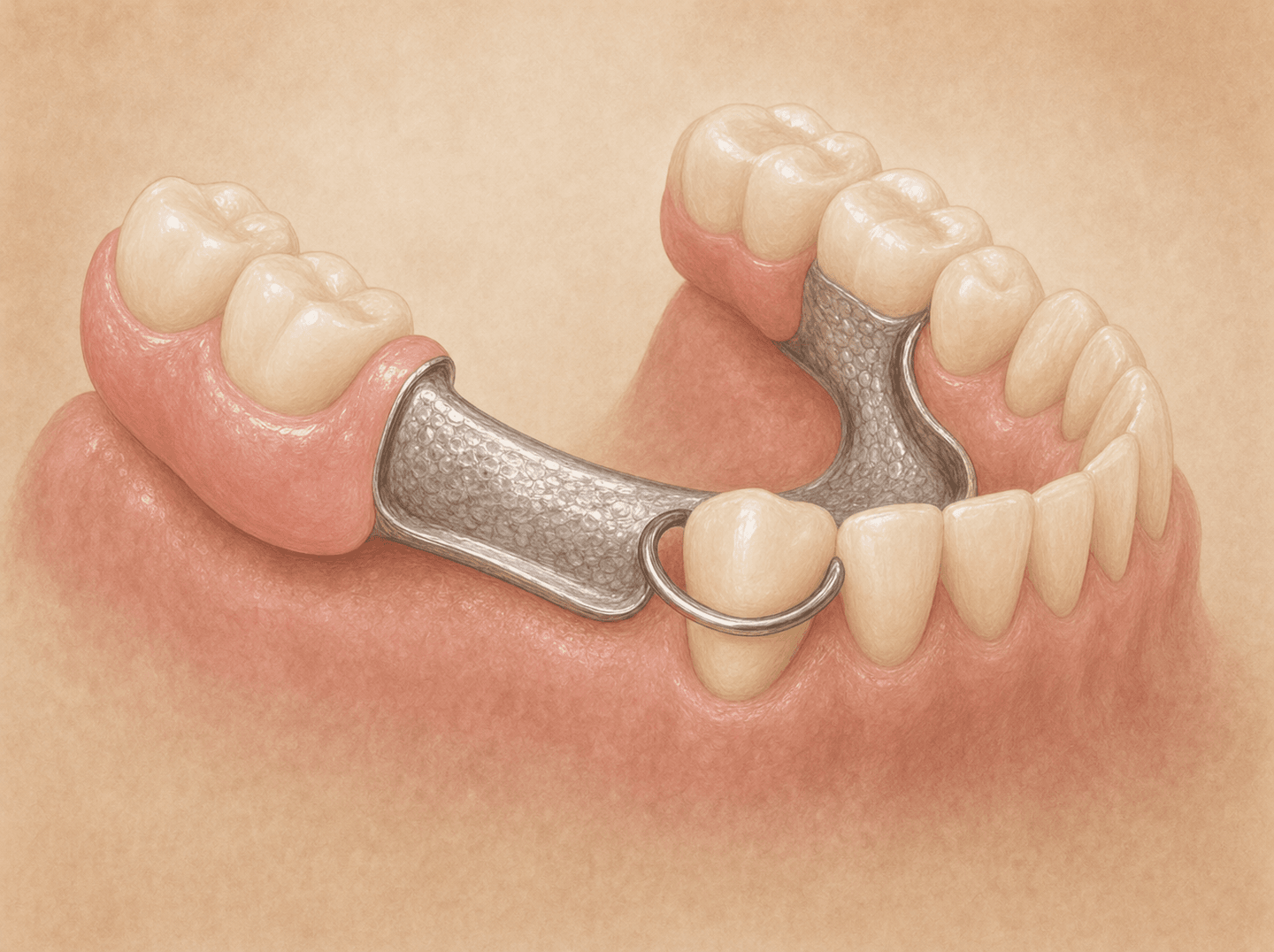
Why a partial gains a clasp
A partial denture holds on through the teeth it clasps. When one of those teeth is lost, the partial loses retention on that side and starts to lift or rock. The fix is usually two changes at once: a prosthetic tooth goes into the new space, and a clasp is added to the next natural tooth so the partial has something to grip again.
Less often, D5660 shows up on its own. The partial was always loose on one side and the dentist decides to add retention, or a tooth was crowned and is now contoured well enough to hold a clasp it couldn’t before.
The common thread is that the clasp is new to that tooth. If the partial already clasped the tooth and the clasp failed, the work is a repair, coded D5630.
The paired claim: lost abutment, new clasp
This is the scenario D5660 is billed in most. The claim usually carries three procedures, and they need to agree with each other.
A patient wears a five-year-old lower cast partial, D5214 at delivery, replacing teeth 19 and 30 and clasping teeth 20, 21, 28, and 29. Tooth 21 has advanced bone loss and is extracted. The dentist sends the partial to the lab with a pick-up impression. The lab adds a premolar in the tooth 21 space and a new wrought wire clasp on tooth 22, the canine, which the partial had only rested against before.
The claim:
- The extraction of tooth 21, under its own code.
- D5650, one unit, tooth 21, for the added tooth.
- D5660, one unit, tooth 22, for the new clasp.
The chart note explains why the clasp moved: the abutment was extracted and retention was transferred to the adjacent canine. Without that sentence, a reviewer sees a clasp code on a tooth the partial never touched and a lost tooth on the history, and may not connect them.
The lab removes the old clasp on tooth 21 when it adds the replacement tooth in that space. That clasp is not billed as a D5630 repair, because nothing was repaired.
Where plans push back
Repair and addition codes are often grouped under one benefit with one frequency limit, which is plan-dependent. A paired D5650 and D5660 claim can run into a dollar or count limit that a single repair would not.
The missing-tooth clause matters when the timing differs from this example. If the tooth was lost before coverage began rather than extracted under the plan, some plans deny the added tooth, and the clasp claim may be reviewed along with it.
When a tooth getting a new clasp is also getting a new crown, the crown is billed on its own code. If the crown is contoured to fit an existing clasp rather than a new one, that extra crown work is D2971, and D5660 does not apply.
FAQs
- What's the difference between D5660 and D5630?
- History on that tooth. D5630 repairs or replaces a clasp the partial already had, so the tooth was clasped before and is clasped again. D5660 puts a clasp on a tooth the partial never engaged. Swapping a broken cast clasp for a wire one on the same tooth is D5630, not an addition.
- Is D5660 billed per clasp or per tooth?
- Per tooth, by the descriptor. Two newly clasped teeth are two units, each with its tooth number. The number of arms on one tooth doesn't change the count.
- Can a clasp be added to a flexible partial?
- Usually not in the way an acrylic or cast partial can be modified. Many flexible partials, D5225 or D5226 when made, retain with clasps formed from the base material and can't take a new one easily, so a lost abutment often means a new partial. Ask the lab before promising the patient an addition.
Related codes
Need help billing this code?
We handle D5660 claims daily.
If your team is spending time on denials, narratives, or carrier follow-up for this code, our outsourced dental insurance billing service can take it off your plate. We submit the claims, post what comes back, and follow up on anything unpaid. Already sitting on older claims that never paid? Our AR cleanup project works the backlog.
“Claims, posting, denials, all of it gets handled, and it costs far less than hiring another employee. My front desk got hours of their week back, and honestly I just don't think about billing anymore.”
CDT codes are maintained by the American Dental Association. This page is an editorial billing guide, not the official ADA code descriptor. Verify current coverage policies with each carrier before submitting claims.