D5876 is the CDT code for adding a metal reinforcing substructure to an acrylic complete denture, reported once per arch.
- When to use: A metal mesh or framework is embedded in a removable complete denture to strengthen it, either when the denture is made or during a repair.
- When not to use: A partial's cast framework is part of D5213 or D5214, and the framework inside a fixed implant hybrid belongs to D6114 or D6115.
- Billing note: Many plans treat D5876 as an optional upgrade the patient pays for, so get a signed financial estimate before the lab adds the metal.
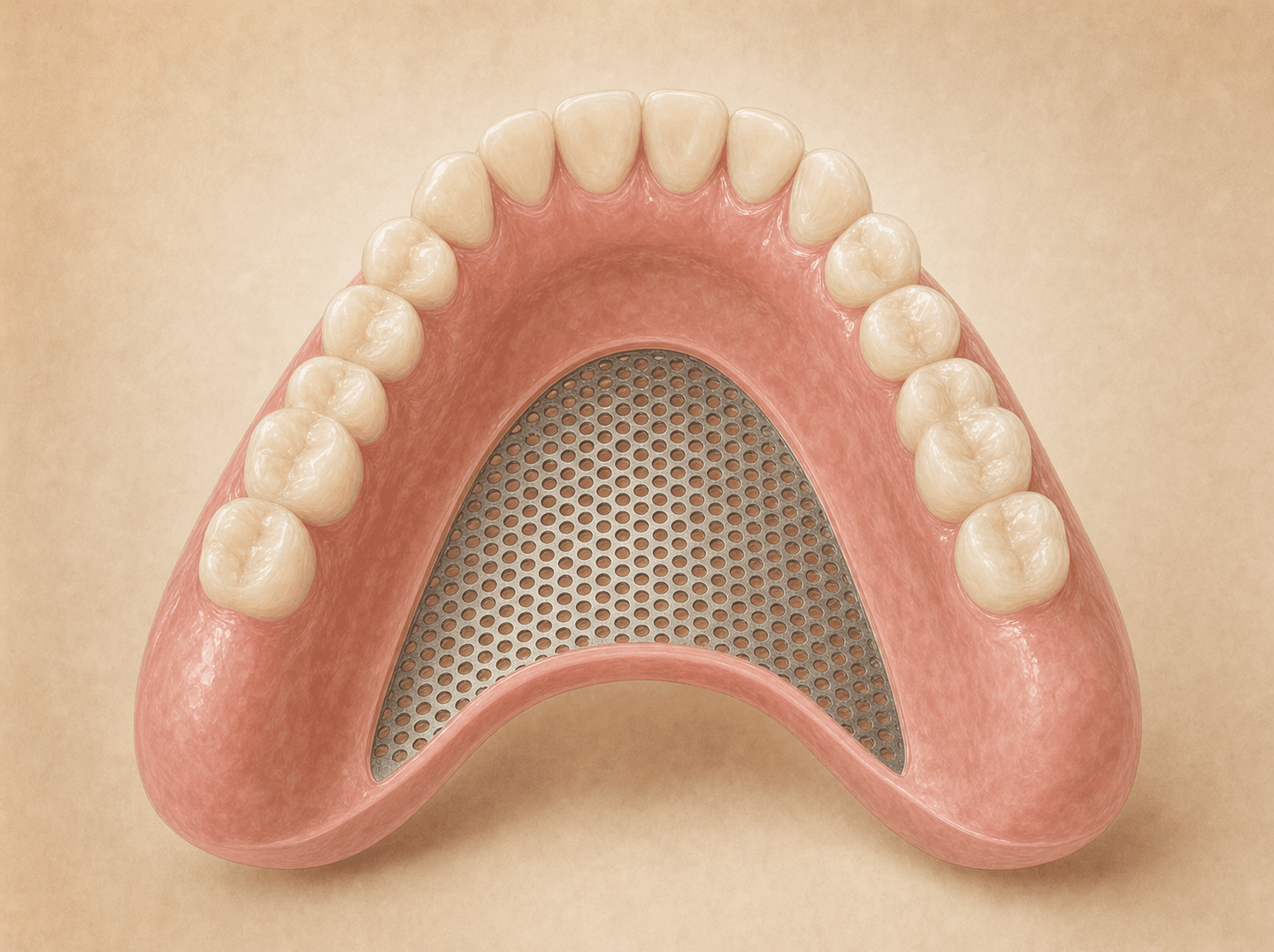
What D5876 adds to a denture
D5876 is an add-on. It reports a metal substructure, usually a cast or prefabricated mesh or framework, embedded in the acrylic of a removable complete denture to make it harder to break. It does not stand alone. The denture itself still bills under its own code, such as D5110 for a conventional upper or D5120 for a conventional lower.
The unit is the arch. Reinforcing both dentures in a set is two lines of D5876.
Dentists reach for it when a denture has a history of fracturing, when it opposes natural teeth that load it hard, or when the acrylic over a retention feature would otherwise be thin. The clinical reason belongs in the note, because it is the first thing a reviewer looks for.
The CDT 2026 revision
D5876 was one of the codes the ADA revised for CDT 2026, to clarify what the procedure is and where it applies. The name now refers to an acrylic complete denture, and the descriptor makes clear the reinforcement can be added when the denture is first made or later when it is repaired. Delta Dental of Kansas lists D5876 among its 2026 revisions and notes that its existing processing policies stay in place.
Two practical points follow:
- Repairs count. Reinforcement added while fixing a broken denture is reportable, alongside the repair code. A broken upper base is D5512 and a broken lower base is D5511. The arch digits run opposite to most denture pairs, so check them.
- Old wording lingers. UnitedHealthcare’s removable prosthodontics policy (DCP020.17, effective January 1, 2026) still prints the code as full denture. The meaning and unit are unchanged, so no remapping is needed.
Where D5876 does not belong
Cast metal partial dentures. The metal framework of a partial is built into the partial code. D5213 and D5214 already describe a cast metal framework with resin bases, upper and lower. Adding D5876 to either reports the same metal twice.
Fixed implant hybrids. A screw-retained full-arch prosthesis has a framework inside it, but it is a fixed implant denture, D6114 on the upper and D6115 on the lower. The framework is part of that prosthesis.
Removable overdentures. The descriptor speaks to a removable complete denture without naming which denture code it pairs with. A natural-tooth overdenture such as D5863 or an implant overdenture such as D6110 or D6111 is a removable complete denture, and reinforcing one is a common clinical choice. Whether a plan pays D5876 next to an overdenture code is plan-dependent, so ask at predetermination.
Coverage is the real hurdle
Many plans do not pay for D5876 at all. Delta Dental of Tennessee’s CDT 2026 update says the service is not a benefit of most of its plans and that the fee is the patient’s responsibility. Other plans may exclude it or treat it as an optional upgrade over a standard acrylic denture.
That makes the financial conversation the main billing task. Quote D5876 as a separate patient-paid line unless the plan’s benefits say otherwise, and get the estimate signed before the lab case goes out. Submitting it anyway is still worthwhile on plans that may pay, because the EOB documents the denial for the patient’s records and any secondary coverage.
Denial scenario: repair with reinforcement
A patient’s three-year-old upper denture cracks down the midline for the second time. The dentist repairs the base and has the lab embed a metal mesh across the palate to stop a third fracture. The office bills D5512 and D5876 on the repair date.
The primary plan pays the repair and denies D5876 as not a covered benefit. Because the office quoted the reinforcement as patient-paid before sending the case to the lab, the balance goes to the patient without a dispute. Had the office treated D5876 as part of the repair and not quoted it, the fee would have been hard to collect.
FAQs
- Is D5876 billed per denture or per arch?
- Per arch. One reinforced upper denture is one unit of D5876, and reinforcing both an upper and a lower is two lines, each with its arch designated. It is an add-on, so it always travels with a complete denture on the same arch.
- Can D5876 be billed during a denture repair?
- Yes, under the CDT 2026 descriptor. The 2026 revision clarified that the code covers metal reinforcement added when a complete denture is made or when one is repaired. A fractured upper base fixed with embedded mesh would show the repair code, D5512, plus D5876 on the same date. Some plans still treat the reinforcement as inclusive to the repair, so verify before quoting.
- Does D5876 apply to a fixed implant hybrid?
- No. D5876 belongs to removable acrylic complete dentures. A fixed full-arch implant prosthesis is D6114 on the upper or D6115 on the lower, and its metal or milled framework is part of that prosthesis fee. Adding D5876 to a hybrid claim double-counts the framework.
- Why does our fee schedule still say full denture for D5876?
- Because many payers have not updated their tables. CDT 2026 revised D5876 to say complete denture and clarified its scope, but UnitedHealthcare's removable prosthodontics policy effective January 1, 2026 still lists the older full denture wording. The code number and per-arch unit did not change, so claims process the same way.
Related codes
Need help billing this code?
We handle D5876 claims daily.
If your team is spending time on denials, narratives, or carrier follow-up for this code, our outsourced dental insurance billing service can take it off your plate. We submit the claims, post what comes back, and follow up on anything unpaid. Already sitting on older claims that never paid? Our AR cleanup project works the backlog.
“Claims, posting, denials, all of it gets handled, and it costs far less than hiring another employee. My front desk got hours of their week back, and honestly I just don't think about billing anymore.”
CDT codes are maintained by the American Dental Association. This page is an editorial billing guide, not the official ADA code descriptor. Verify current coverage policies with each carrier before submitting claims.