D6065 is the CDT code for an all-porcelain or ceramic single-tooth crown that attaches directly to the implant body as one piece, with no separately billable abutment — unlike D6058, which seats on a separate abutment.
Where it goes wrong is the implant-supported versus abutment-supported code question (D6065 vs D6058), and the alternate-benefit downgrade to a conventional crown allowable.
On this page
- What D6065 covers
- When to bill D6065
- What separates D6065 from D6058
- The alternate-benefit downgrade and the broader implant-coverage question
- Top reasons D6065 gets denied or downgraded
- The full implant-restoration billing sequence
- Documentation that supports the claim
- Example case
- Implant restoration billing checks
- FAQs
What D6065 covers
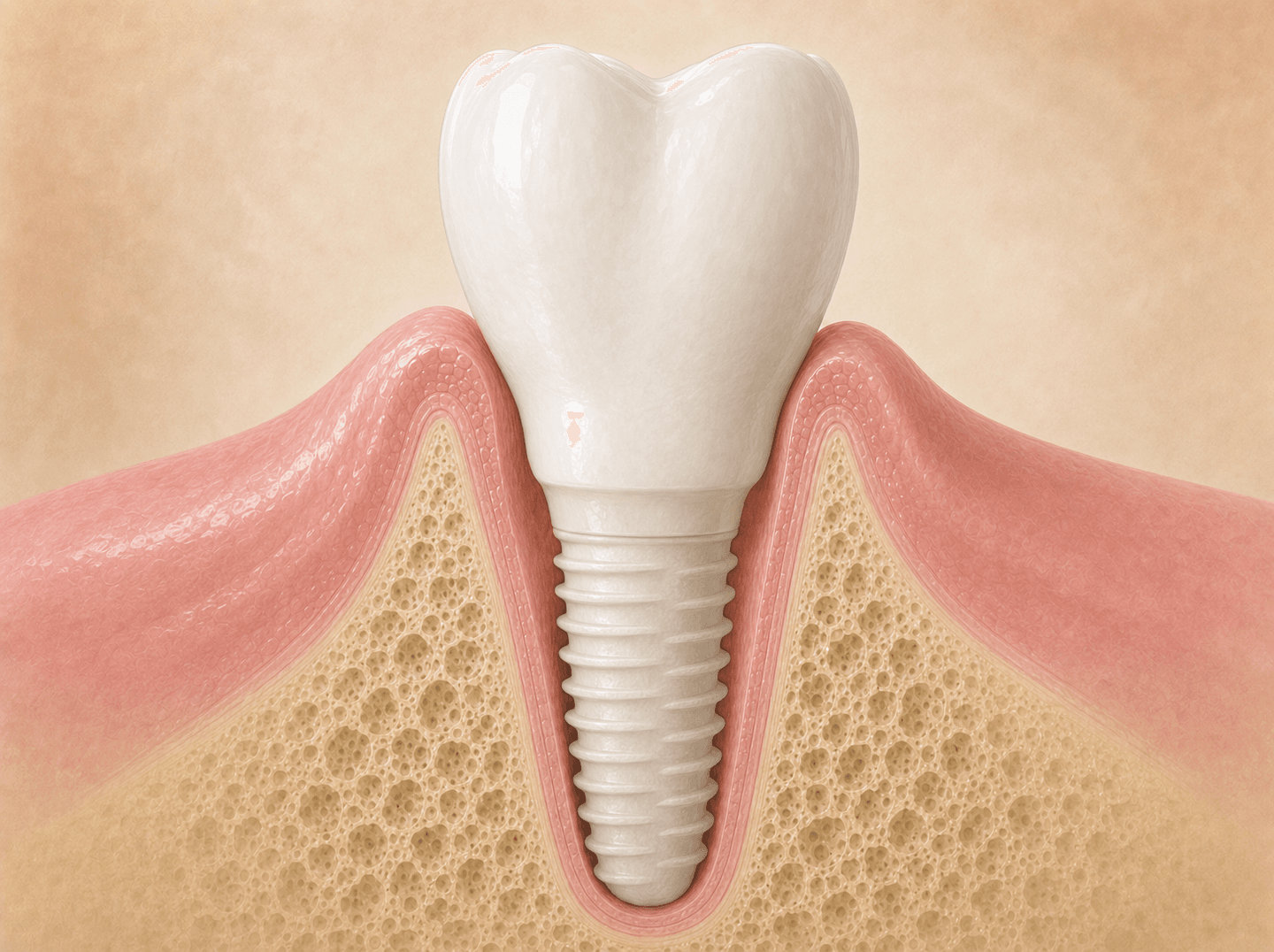
D6065 reports an implant-supported porcelain or ceramic crown, an all-ceramic restoration that attaches directly to the implant body as a one-piece unit (the “UCLA-type” restoration). The abutment function is integral to the crown, so there is no separately billable abutment in the case. The code includes the impression or scan of the implant, the laboratory fabrication, the try-in, the occlusal adjustment, the seating, and the post-seating occlusion check.
It does not cover:
- Abutment-supported ceramic crowns, which seat on a separate, separately billable abutment (D6056 prefab or D6057 custom). Use D6058.
- Implant-supported PFM crowns. Use D6066 (porcelain fused to metal).
- Implant-supported full-metal crowns. Use D6067 (high noble metal).
- The separate implant abutment. On a true D6065 case there isn’t one, but if a separate abutment was placed, the abutment is D6056 or D6057 and the crown is D6058.
- The implant fixture. Use D6010 for placement.
- Conventional all-ceramic crowns on natural teeth. Use D2740.
- Implant-supported bridges. Use the implant-supported retainer codes for the retainer crowns and the standard pontic codes (D6240, D6245) for the pontics. D6065 through D6067 are single-tooth implant crowns, not bridge components.
Three things define the code: ceramic material, implant-supported (attached directly to the implant body with no separate abutment), and single-tooth implant context.
When to bill D6065
Bill D6065 when:
- A single-tooth implant restoration attaches directly to the implant body as one piece.
- No separate abutment (D6056 or D6057) was placed or billed.
- The crown is porcelain or ceramic.
- The crown has been seated, occlusion adjusted, and finalized.
Do not bill D6065 for:
- Abutment-supported crowns seated on a separate billable abutment. Use D6058.
- PFM or full-metal implant crowns. Use D6066 or D6067.
- Restorations on natural teeth. Use D2740 for a conventional all-ceramic crown.
- Provisional or temporary implant crowns. Use D6085 for an interim implant crown.
What separates D6065 from D6058
The implant-supported versus abutment-supported distinction is the main billing question in the single-tooth implant-crown family. It turns on whether a separate, separately billable abutment exists, not on whether the crown is cemented or screw-retained.
Implant-supported (D6065) indicators:
- A one-piece restoration that attaches directly to the implant body, with no separately billable abutment.
- No separate D6056 or D6057 line on the case, because the abutment function is integral to the crown.
- Can be cemented or screw-retained. Retention method is not what determines the code.
Abutment-supported (D6058) indicators:
- A separate abutment (D6056 prefab or D6057 custom) is placed on the implant and billed as its own line item.
- The ceramic crown is supported by that abutment. It can be cemented onto the abutment or screw-retained to it. Either way it’s D6058.
- Common when a custom abutment is needed to correct angulation, build an emergence profile, or position the margin.
Retention does not decide between D6065 and D6058. The determinant is whether a separate, separately billable abutment exists. The structural independence of the abutment drives the code: if the abutment could stand on its own as a distinct component, the case is D6058 with a separate abutment line, even on a screw-retained crown delivered as one piece. A case billed as D6065 when a separate abutment was actually placed and billed misrepresents the procedure. The chart and the claim should agree.
The alternate-benefit downgrade and the broader implant-coverage question
Many plans apply an alternate-benefit clause on implant crowns. The downgrade target varies:
- Some plans pay D6065 at the D2740 (conventional all-ceramic crown) allowable.
- Some plans pay D6065 at a bridge pontic allowable (D6245 or similar) on the reasoning that a bridge would have been the alternative restoration if the patient hadn’t chosen an implant.
- A handful of plans don’t cover implant restorations at all and apply the partial denture or no-coverage rules.
The patient-responsibility math:
- The office submits D6065 at the implant-crown office fee.
- The carrier processes and applies the alternate-benefit clause (or the no-coverage rule).
- The carrier pays D6065 at the downgrade allowable or denies entirely.
- The patient owes the difference plus coinsurance on the lower allowable.
For implant cases the dollar gap can be large. A pre-treatment estimate is the right workflow checkpoint, particularly on plans with explicit implant restrictions.
Top reasons D6065 gets denied or downgraded
Five issues account for most problems on this code:
- Alternate-benefit downgrade. Plan pays D6065 at D2740 or a bridge pontic allowable. Not a denial. Bill the patient the difference.
- Plan excludes implant restorations entirely. Newer marketplace plans and some employer-sponsored plans don’t cover implant restorations. The claim denies as non-covered. The patient owes the full fee.
- Wrong code for an abutment-supported crown. D6065 billed when a separate abutment was placed and billed. Recode the abutment as D6056 or D6057 and the crown as D6058, and resubmit. The chart should match.
- Material mismatch. D6065 billed for a PFM or full-metal implant crown. Recode as D6066 or D6067. The chart should name the crown material.
- Missing implant placement history. The carrier can’t find the D6010 in the patient’s records. Documentation of the placement date (chart entry, prior carrier records, surgical center records) resolves it.
The full implant-restoration billing sequence
A single-tooth implant restoration that ends in D6065 typically involves two or more codes across multiple dates of service. The absence of an abutment line is what distinguishes this sequence from the abutment-supported one.
Standard two-stage workflow ending in D6065:
- D6010 (surgical placement of the implant body) at the surgical visit.
- D6011 (second-stage surgery, uncovering) if the case was buried during healing.
- D6065 (this code) at the final crown delivery visit, typically three to six months after placement. No separate abutment line, because the restoration attaches directly to the implant.
If the case instead used a separate abutment, the sequence would include a D6056 or D6057 line at the abutment-seating visit and the crown would be D6058. The presence or absence of the abutment line is the billing fingerprint of which restoration was delivered.
Carrier behavior varies on these workflows. Most plans pay each code on its own merits per the plan’s allowables. A few apply bundling rules that combine codes into a single payment. The pre-treatment estimate should reflect the plan’s actual processing logic on the full sequence.
Documentation that supports the claim
The claim needs:
- Date of service (the crown delivery date).
- Tooth number or implant location.
- Implant brand and platform (some carriers require this on the claim).
- Crown material designation (porcelain or ceramic).
For the patient record, document:
- Implant placement date.
- That the restoration is implant-supported (one piece, direct to the implant, no separate abutment).
- Crown material (e.g., lithium disilicate, zirconia).
- Shade selection.
- Retention method (cement or screw) and, if cemented, the cement type.
- Occlusal adjustment and verification.
- Soft tissue check at delivery for subgingival cement removal, if cemented.
The note that the restoration attached directly to the implant with no separate abutment is what supports D6065 over D6058. If the chart instead describes seating a crown on a placed abutment, the carrier will read the case as abutment-supported and expect D6058 with an abutment line.
Example case
A 49-year-old patient had an implant placed on tooth #9 (upper left central incisor) by an oral surgeon five months ago. The implant is integrated and well-positioned, with good angulation and a healthy emergence profile that doesn’t require a custom abutment. The general dentist plans a one-piece screw-retained all-ceramic crown that attaches directly to the implant.
Treatment sequence:
- Visit 1 (five months ago): D6010 placement at the surgical center.
- Visit 2 (today): final lithium disilicate crown, one piece, screw-retained directly to the implant. No separate abutment placed or billed.
Billing steps:
- Verify benefits and confirm implant crown coverage. Pull the carrier’s expected payment on D6065 and check for downgrade or exclusion rules.
- Submit D6065 on the crown delivery date with tooth number 9 and the implant brand.
- Document that the crown is implant-supported (one piece, direct to the implant, no separate abutment) and the retention method.
- Do not add an abutment line. There is no separate abutment on this case.
- If the carrier downgrades or denies, the appeal path depends on the plan’s specific language.
If the plan covers implant crowns at full allowable, the claim pays at the D6065 allowable and the patient owes the standard coinsurance. If the plan downgrades to D2740, the gap is the patient’s responsibility, which the pre-treatment estimate should have flagged.
Implant restoration billing checks
The specifics vary across Open Dental, Dentrix, Eaglesoft, Curve, and Carestream. The steps that matter:
- Distinguish D6065 from D6058 at the time of charting. Implant-supported (one piece, direct to the implant, no separate abutment) is D6065. Abutment-supported (separate billable abutment) is D6058. Retention (cement or screw) does not decide the code. The chart should match the actual restoration.
- Don’t add an abutment line on a D6065 case. If a separate abutment was placed and billed, the crown is D6058, not D6065.
- Match the code to the crown material. D6065 ceramic, D6066 PFM, D6067 full metal. The chart should name the material.
- Run pre-treatment estimates on implant restoration cases. Implant restoration is the procedure category with the largest patient-responsibility surprises.
- Track the implant brand on the patient record. Some carriers require this on the claim. The PMS implant record carries the value forward across visits.
If your office sees recurring D6065 downgrades, the cause is usually plan-side: the patient’s plan applies an implant restoration restriction the practice didn’t catch at treatment planning. A pre-treatment estimate workflow that confirms the plan’s specific implant rules before the crown impression prevents most of these.
FAQs
- What's the difference between D6065 and D6058?
- D6065 is an implant-supported ceramic crown: a one-piece restoration that attaches directly to the implant body, with no separately billable abutment. D6058 is an abutment-supported ceramic crown: it seats on a separate implant abutment (D6056 prefab or D6057 custom) that is billed on its own line. The axis is whether a separate, separately billable abutment exists, not whether the crown is cemented or screw-retained. Both can be cemented or screw-retained, so retention method does not determine the code.
- Does retention (cement vs screw) decide between D6065 and D6058?
- No. The deciding factor is whether the abutment is a separate, separately billable component. An implant-supported crown (D6065) integrates the abutment function into the crown as one unit. An abutment-supported crown (D6058) sits on a distinct abutment. A screw-retained crown can be either code depending on whether the abutment could stand independently. The chart should reflect which restoration was actually delivered.
- Why was D6065 paid at the D2740 allowable?
- Some plans apply an alternate-benefit clause on implant crowns, paying D6065 at the D2740 (conventional all-ceramic crown) allowable. The plan considers the conventional crown allowable adequate. The patient owes the difference between the implant-crown office fee and the conventional crown allowable. This is plan language, not a denial. Some plans pay it at a bridge pontic allowable instead, and some exclude implant restorations entirely.
- Should there be a separate abutment code on a D6065 claim?
- No. D6065 is the case with no separately billable abutment, because the abutment function is integral to the crown. If a separate abutment (D6056 or D6057) was placed and billed, the crown should be D6058, not D6065. A D6065 claim with an abutment line on the same case is a code mismatch the carrier will question.
- What's the difference between D6065, D6066, and D6067?
- All three are single-tooth implant-supported crowns that attach directly to the implant with no separate abutment. They differ by material. D6065 is porcelain or ceramic, D6066 is porcelain fused to metal, and D6067 is full metal (high noble). Code to the material actually delivered. The chart should name the crown material so the claim matches.
Related codes
Need help billing this code?
We handle D6065 claims daily.
If your team is spending time on denials, narratives, or carrier follow-up for this code, our outsourced dental insurance billing service can take it off your plate. We work inside your PMS and post payments the same week.
CDT codes are maintained by the American Dental Association. This page is an editorial billing guide, not the official ADA code descriptor. Verify current coverage policies with each carrier before submitting claims.