D6010 is the CDT code for the surgery that seats an implant fixture into the jawbone, the screw that takes over from a tooth root, and it covers that visit only, not the abutment or crown that follow later.
Most billing problems on it are scope: whether the plan covers implants at all, whether the missing-tooth clause excludes the site, and how the body, abutment, and crown stack into three or four separate codes the practice has to track across visits.
What D6010 covers
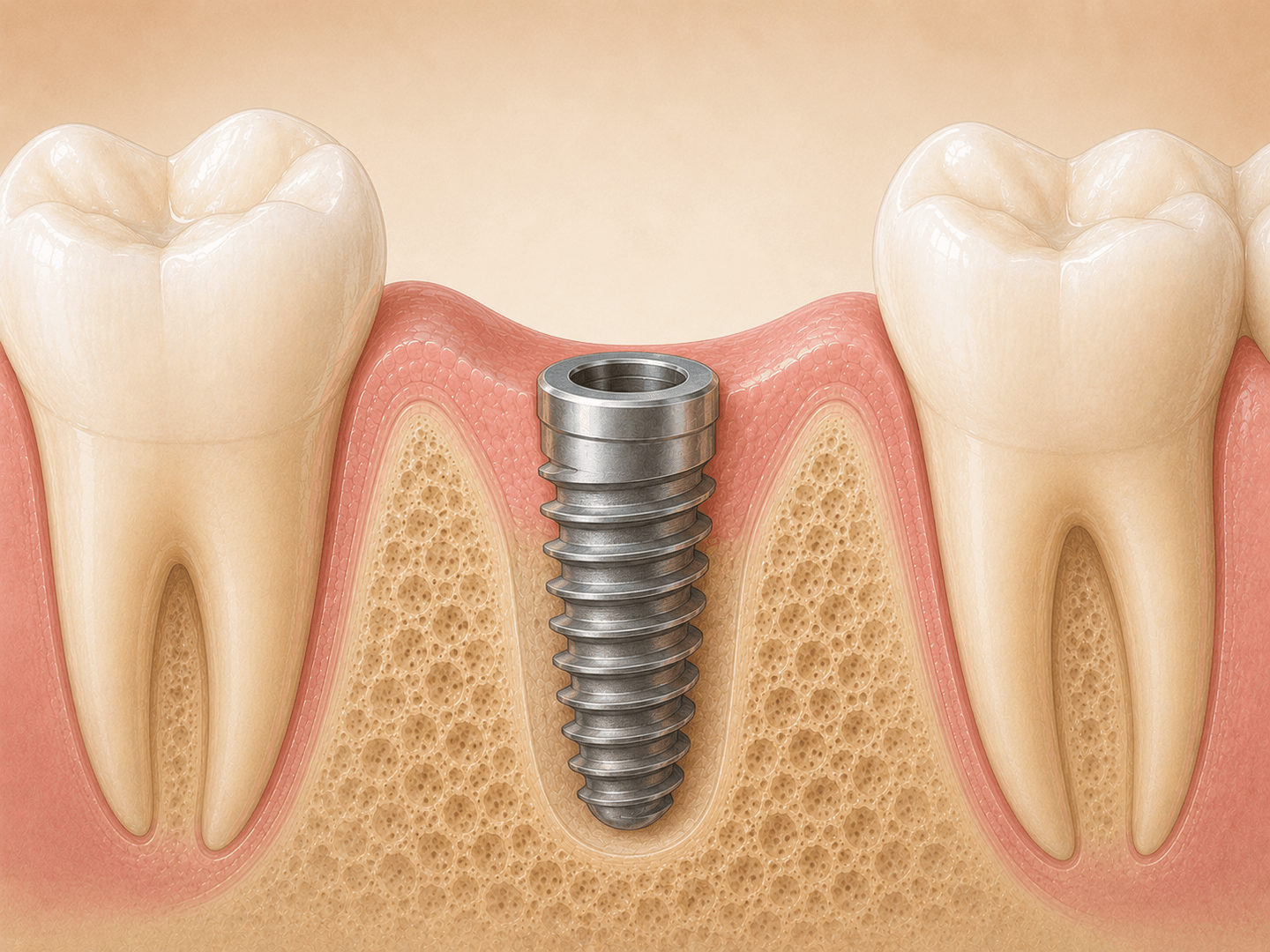
D6010 reports the surgery that seats an endosteal implant fixture, the titanium or zirconia screw placed into bone where a tooth root used to be. The fee covers the surgical visit: site preparation, the osteotomy, implant placement, and closure. It does not include the abutment, the crown, the bone graft if one is needed at a separate visit, or the imaging used to plan the case.
It does not cover:
- The abutment that connects the implant to the crown. Custom is D6057, prefabricated is D6056.
- The implant crown. Implant-supported crown codes start at D6058 and vary by material.
- A bone graft at a separate visit. That’s D7953.
- A bone graft placed at the same visit as the implant. That’s D6104 on the same claim, not bundled into D6010.
- Sinus lift or ridge augmentation procedures (D7951, D7952, D7950).
- The CBCT or panoramic used for planning. Code those separately.
The implant body code only reports the surgical placement. Everything else stacks.
When to bill D6010
Bill D6010 when:
- A surgical visit places one endosteal implant body in the bone.
- The placement is staged (implant first, abutment and crown later).
- Same-day extraction and immediate implant placement: bill D6010 for the implant and the appropriate extraction code on the same claim.
Do not bill D6010 for:
- The abutment seating visit. That’s D6057 or D6056.
- The crown delivery visit. That’s the D6058 series.
- A mini-implant under 3mm diameter. That’s D6013.
- An eposteal or transosteal implant. Those are D6040 or D6050. Both are rare.
- A bone graft procedure done at a separate visit from the implant placement.
Top reasons D6010 gets denied
- No implant benefit on the plan. The most common denial. Many dental plans exclude implants categorically. The denial reads “implants not a covered benefit.” The patient owes the full fee. There is no appeal that wins this.
- Missing-tooth clause. The plan covers implants but excludes any tooth that was missing before the policy started. The carrier needs evidence the tooth was extracted while the patient was covered.
- Alternate-benefit downgrade. The plan covers a bridge as the standard treatment and pays the bridge fee toward the implant, leaving the patient to make up the difference. This is not a denial. It’s a plan-design payment.
- Predetermination required but not submitted. Some plans require preauthorization for any implant claim. The denial reads “submitted without prior approval.”
- Bundling errors. The bone graft, abutment, or crown was billed on the same line as D6010. Carriers reject the line and each procedure has to be refiled separately.
Missing-tooth clause, in practice
The clause is straightforward in writing and contested in adjudication. The plan says it won’t pay benefits for a tooth that was missing before the patient was covered under the policy. Carriers ask for the extraction date and proof that the patient was covered under the current plan when the extraction happened.
The documentation that resolves this fastest:
- The extraction date in the implant claim narrative.
- The carrier the patient was covered under at the time (often the same plan, sometimes a prior plan that the current carrier will accept history from).
- A note in the chart if the tooth was lost to trauma, congenital absence, or another circumstance that some plans treat as an exception.
If the carrier has no record of the extraction and the patient transferred from another office, the new practice often has to request records from the prior provider to support the claim. Plan ahead at the consultation appointment.
Medical crossover
Implant placement can be billed to medical insurance under three common circumstances:
- The implant replaces a tooth lost to traumatic injury (motor vehicle accident, sports, assault).
- The implant is part of head-and-neck cancer reconstruction.
- The implant supports a prosthesis after a tumor resection.
For routine missing-tooth replacement from caries or periodontal disease, medical insurance generally does not cover D6010. The medical crossover involves CPT 21248 (partial reconstruction, three or fewer teeth or less than half the arch) or 21249 (complete reconstruction, four or more teeth or more than half the arch), reported once per arch with the number of implants entered in the units column, an ICD-10 diagnosis that supports medical necessity, and usually a letter of medical necessity. CPT codes are per-arch and CDT D6010 is per-tooth, so they do not crosswalk one-to-one. Most general dental offices submit dental-only unless the trauma or cancer connection is clear from the chart.
D6010 versus the implant code stack
A complete implant case generates three to five claim lines across multiple visits:
- D6010 for seating the implant fixture.
- D6057 (custom) or D6056 (prefab) for the abutment.
- D6058 through D6065 for the implant crown, varying by material.
- D6104 for a bone graft at the time of implant placement (same visit).
- D7953 for a bone graft as a separate prior visit.
- D6190 for a surgical guide fabricated in advance.
Each line is its own benefit decision. A plan might cover the implant body and deny the crown, cover the crown and deny the abutment, or downgrade everything to a bridge fee. Track each line through the EOB.
Documentation that supports the claim
The claim needs:
- Implant brand, model, and lot number in the chart.
- Pre-op radiograph showing the edentulous site.
- Post-op radiograph confirming placement.
- A narrative that includes the date the natural tooth was extracted and the diagnosis that led to the extraction.
For the patient record, document:
- Date and reason of the original extraction.
- Whether the patient was insured under the current plan at the time of extraction.
- Implant manufacturer, model, length, and diameter.
- Surgical technique (one-stage, two-stage, immediate placement).
- Bone quality classification and any grafting performed.
Example case
A 56-year-old established patient lost tooth #19 to a fractured root two years ago, while covered under the same plan they have today. The dentist places an endosteal implant in the #19 site. The plan covers implants at 50% with a $1,500 annual maximum.
Billing steps:
- Verify the implant benefit and confirm the missing-tooth clause status at the consultation, not the surgical visit.
- Submit D6010 with a narrative naming the extraction date (so the missing-tooth clause clears) and the manufacturer details.
- Attach the pre-op and post-op radiographs.
- Expect the EOB to show payment at 50% up to the annual maximum, with the balance billed to the patient.
- Do not bill the abutment or crown until those visits happen. Submitting them in advance generally gets rejected.
What to get right in your PMS
- Track the original extraction date for every implant patient. The missing-tooth clause adjudication depends on it. A field in the implant record beats hunting through old charts.
- Submit D6010 alone, not bundled with the abutment or crown. The codes pay on separate visits with separate adjudications.
- Document the implant manufacturer and model in the chart and the narrative. Carriers occasionally audit for FDA-cleared products.
- Confirm implant coverage at the verification stage, not at the placement appointment. Discovering an implant exclusion in the chair is the worst time.
- If the plan downgrades to a bridge, post the carrier’s payment and bill the patient the difference. Do not appeal a downgrade as a denial. The plan is paying what its contract says.
FAQs
- What is the dental code for a dental implant?
- D6010 for seating the implant fixture itself. The full case usually stacks three or four codes across separate visits: D6010 for the implant, D6057 (custom) or D6056 (prefab) for the abutment, and a D6058-series code for the implant crown. Bone grafting at the same visit is D6104, or D7953 if grafted separately.
- Will my patient's plan cover D6010?
- Many plans exclude implants categorically. Among plans that do cover implants, the most common denial is the missing-tooth clause: the plan won't pay for an implant on a tooth that was missing before the policy started. Verify implant coverage and confirm the carrier's missing-tooth clause status before scheduling the surgical visit, not after.
- What's the difference between D6010 and the implant crown code?
- D6010 is the surgical visit that places the implant body in bone. The crown that sits on the abutment months later is a separate code in the D6058 to D6065 range, depending on material. The abutment between them is also separate (D6057 custom or D6056 prefab). Each code is its own benefit decision.
- Can I bill D6010 to medical insurance?
- Sometimes. Implants placed after traumatic tooth loss, as part of head-and-neck cancer reconstruction, or to support a prosthesis after tumor resection can crossover to medical. The medical code is CPT 21248 for partial arch reconstruction (roughly three or fewer teeth replaced, less than half the arch) or 21249 for complete reconstruction (four or more teeth, more than half the arch). Each applies to either the mandible or the maxilla and is reported once per arch by report, with the number of implants placed entered in the units column. The distinction is the extent of arch reconstruction, not the number of implants. CPT codes are per-arch and CDT D6010 is per-tooth, so they do not crosswalk one-to-one. For routine missing-tooth replacement from caries or periodontal disease, medical generally does not cover.
- Does D6010 include the bone graft at the implant site?
- No. If a graft is placed at the same visit as the implant body, code D6104 (bone graft at the time of implant placement) on the same claim. If the graft was a separate prior visit to build the ridge first, that's D7953. Bundling the graft into the D6010 line gets the graft denied and is a common rejection.
Related codes
Need help billing this code?
We handle D6010 claims daily.
If your team is spending time on denials, narratives, or carrier follow-up for this code, our outsourced dental insurance billing service can take it off your plate. We work inside your PMS and post payments the same week.
CDT codes are maintained by the American Dental Association. This page is an editorial billing guide, not the official ADA code descriptor. Verify current coverage policies with each carrier before submitting claims.