D6057 is the CDT code for a custom-fabricated implant abutment that connects an implant fixture to a restoration — machined or printed to a patient-specific design from a scan or impression, with the seating visit folded into the one code.
The abutment is machined or printed to a patient-specific design from a digital scan or impression, then placed at the abutment-seating appointment. Nearly every billing problem on D6057 traces back to one thing: the distinction from D6056 (prefabricated abutment) and the documentation that justifies the higher allowable.
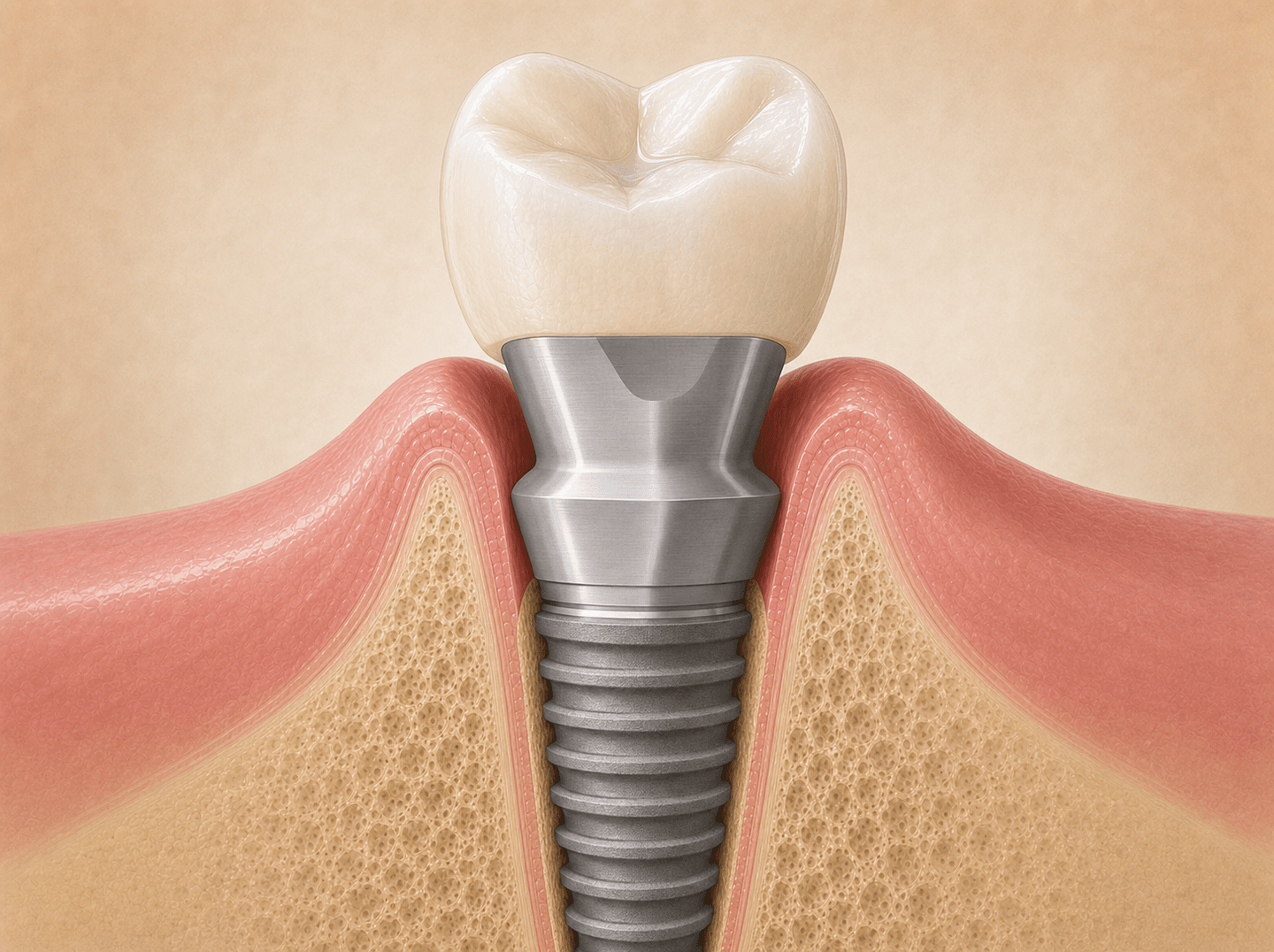
What D6057 covers
D6057 reports a custom-fabricated implant abutment that connects an implant fixture to a restoration. The abutment is designed specifically for the patient’s case (implant position, angulation, soft tissue profile, emergence contour, planned restoration) and fabricated by machining or printing from titanium, zirconia, or another biocompatible material. The code includes the abutment placement at the abutment-seating appointment, the torque verification, the soft tissue management, and the connection of the temporary or final restoration.
It does not cover:
- Prefabricated abutments selected from a stock catalog. Use D6056.
- The implant fixture itself. Use D6010 for the surgical placement of the implant body.
- The crown or restoration placed on top of the abutment. Use D6058 (porcelain/ceramic crown), D6059 (PFM with high noble metal), D6060 (PFM with predominantly base metal), D6061 (PFM with noble metal), etc.
- Implant-supported bridges or full-arch restorations. Use the appropriate D6065, D6068, or D6075 series.
- Repair or removal of a previously placed abutment. For repair, use D6095, which covers repairing an implant abutment and is itself a by-report code. There is no dedicated code for abutment removal as such; use D6199 (unspecified implant procedure, by report) with a narrative. Note D6080 is implant maintenance (a fixed prosthesis is removed, the prosthesis and abutments are cleansed, then reinserted) and D6196 (new for CDT 2026) is removal of an indirect restoration on an implant-retained abutment, not removal or repair of the abutment itself.
- Surgical abutment uncovering or second-stage surgery on a two-stage implant. Use D6011.
The defining feature is custom fabrication for this patient’s case. If the abutment came off a shelf, the code is D6056.
When to bill D6057
Bill D6057 when:
- A custom abutment has been designed specifically for the patient’s implant case.
- The abutment has been fabricated by a dental lab or in-office mill from a digital scan or analog impression of the implant position.
- The abutment has been seated on the implant fixture, torqued to specification, and connected to the planned restoration.
Do not bill D6057 for:
- Stock abutments selected from a catalog, even if modified chairside. Use D6056.
- The implant placement procedure.
- The crown or restoration placed on the abutment.
What separates D6057 from D6056
The clinical and billing distinction between custom and prefabricated abutments is the single most important factor on this code. Carriers reviewing higher-cost abutment claims expect to see evidence of the custom design.
Custom abutment (D6057) indicators:
- Digital impression or scan body workflow with a CAD design specific to the patient.
- Lab work order describing the patient-specific design parameters.
- Documentation of why the case required custom (angulation correction, emergence profile in esthetic zone, deep soft tissue requiring custom contour, screw access redirection).
- Machined or printed from a stock blank to the patient-specific design.
Prefabricated abutment (D6056) indicators:
- Stock abutment pulled from inventory, matching the implant manufacturer’s catalog.
- Selected by clinical judgment but not designed for this case.
- Modified chairside if needed (occlusal adjustment, height reduction). Chairside modification does not convert a D6056 case into D6057.
- Documented as “prefab” or with a catalog SKU in the lab order or chart note.
A case that uses a stock abutment and adds a screw-retained custom crown on top is still D6056 for the abutment and the appropriate D6058/D6059/etc. for the crown. The custom design is on the crown, not the abutment.
The downgrade pattern
Some plans pay D6057 at the D6056 allowable through an alternate-benefit clause. The math:
- The office submits D6057 at the custom abutment office fee.
- The carrier processes and applies the alternate-benefit clause.
- The carrier pays D6057 at the D6056 allowable.
- The patient owes the difference between the custom abutment office fee and the prefab allowable, plus the coinsurance on the lower allowable.
The dollar gap is typically substantial (custom abutments cost meaningfully more than prefab). A pre-treatment estimate is the right workflow checkpoint, particularly on cases where the patient’s plan applies the downgrade.
Top reasons D6057 gets denied or downgraded
Five issues account for most problems on this code:
- Alternate-benefit downgrade to D6056. The most common scenario. Plan pays at the prefab allowable. Not a denial. Bill the patient the difference and coinsurance.
- Documentation not supporting custom designation. Carrier reviews the chart and lab work, can’t identify what made the abutment custom, downgrades to D6056. Lab work order with CAD design or patient-specific design notes prevents this.
- Same-date billing with D6010. D6057 billed on the same date as the implant placement triggers a question about immediate-load protocols. Most cases legitimately occur weeks or months apart; same-date billing requires explicit immediate-load documentation.
- Implant fixture not visible in claims history. Carrier can’t find a D6010 in the patient’s history at this office or others. The abutment is being billed without a prior implant placement on record. Documentation of the implant placement date (chart entry, prior carrier records, surgical center records) resolves this.
- Coverage exclusion on implants. Some plans exclude implant restorations entirely or cover them at a bridge allowable. The exclusion applies to the abutment as part of the implant restoration. Verify before treatment planning.
The documentation that justifies custom
When the carrier asks for documentation supporting the D6057 designation, the items they want to see are:
- Lab work order with the patient name, implant brand and platform, and a description of the custom design.
- CAD design screenshot or output showing the patient-specific design (angulation, emergence profile, height).
- Chart note stating the clinical reason for custom (angulation correction, soft tissue depth, esthetic zone, screw access angle).
- Pre-op clinical photos showing the implant position and soft tissue architecture (helpful, not required).
A chart that says “custom abutment placed on #14 implant” without supporting design documentation invites the downgrade. A chart that includes the lab work order with a design rationale typically holds up to audit.
Documentation that supports the claim
The claim needs:
- Date of service (the abutment placement date).
- Tooth number or implant location.
- Implant brand and platform (some carriers require this on the claim form).
- Lab work order or CAD documentation if requested.
For the patient record, document:
- Implant placement date and the period of healing before abutment placement.
- Abutment material (titanium, zirconia, hybrid).
- Custom design rationale (angulation correction, emergence profile, esthetic zone).
- Torque value at seating.
- Soft tissue management at seating (uncovering, healing collar removal).
- Connection to provisional or final restoration.
If the case is in the esthetic zone, additional documentation (clinical photos, design notes) supports both the claim and the patient’s record of the case.
Example case
A 54-year-old patient had a maxillary right central incisor (#8) implant placed four months ago by an oral surgeon. The patient returns to the general dentist for restoration. The implant is healed and integrated. The case is in the esthetic zone with thin soft tissue requiring a custom emergence profile.
Treatment sequence:
- Visit 1: scan body placed, digital scan taken, lab work order issued for custom titanium abutment with esthetic-zone emergence profile design.
- Visit 2 (two weeks later): custom abutment seated, torqued to manufacturer specification, soft tissue checked, provisional crown placed.
- Visit 3: final all-ceramic crown delivered.
Billing steps:
- Verify benefits and confirm implant restoration coverage. Pull the carrier’s expected payment on D6057 and D6058 separately.
- Run a pre-treatment estimate. If the plan downgrades D6057 to D6056, quote the patient the actual gap.
- Submit D6057 on the abutment placement date with tooth number 8 and implant brand.
- Submit D6058 on the final crown delivery date with tooth number 8.
- Attach the lab work order and CAD documentation if the carrier requests it.
If the carrier downgrades, an appeal with the esthetic-zone narrative, the soft tissue depth measurement, and the CAD screenshot showing the custom emergence profile is reasonable on a case where custom is clinically defensible.
Implant restoration billing checks
The specifics vary across Open Dental, Dentrix, Eaglesoft, Curve, and Carestream. The steps that matter:
- Distinguish D6057 from D6056 at the time of charting. The PMS should require a designation. A “default to D6057” workflow that doesn’t ask whether the abutment was actually custom invites downgrades.
- Attach the lab work order to the patient record. The lab work order is the single most useful piece of documentation when the carrier asks for justification.
- Bill on the abutment placement date. The implant placement (D6010) was a separate procedure on a separate date.
- Track the implant brand and platform on the patient record. Some carriers require this on the claim form. Adding it to the PMS implant record once saves time on every related claim.
- Run pre-treatment estimates on implant cases. The combination of abutment downgrades, crown allowables, and plan-specific implant rules makes implant restoration the procedure category with the largest patient-responsibility surprises.
If your office sees recurring D6057 downgrades, the cause is usually documentation that doesn’t distinguish the case from D6056. A short chart-note template that prompts for the custom-design rationale prevents most of these.
FAQs
- What's the difference between D6056 and D6057?
- D6056 is a prefabricated abutment: stock component, off-the-shelf, selected from the manufacturer's catalog and placed. D6057 is a custom-fabricated abutment: designed and machined or printed specifically for the patient's implant position, soft tissue profile, and planned restoration. The clinical workflows and the lab work are different. Carriers expect the difference to be reflected in the chart and the documentation.
- Why was D6057 paid at the D6056 allowable?
- Some plans apply an alternate-benefit clause on custom abutments, paying D6057 at the D6056 (prefabricated) allowable. The plan considers the prefabricated abutment functionally adequate. The patient owes the difference between the custom abutment office fee and the prefab allowable. This is plan language, not a denial. Documentation justifying the custom abutment (angulation, soft tissue contour, esthetic zone) can support an appeal on some plans.
- Is the abutment-supported crown billed separately?
- Yes. D6057 covers the abutment only. The restoration on top of the abutment is a separate code: D6058 for porcelain/ceramic, D6059 for PFM with high noble metal, D6060 for PFM with predominantly base metal, etc. The two codes bill together on the same case but represent separate procedures.
- What does the lab document need to show?
- Carriers requesting documentation on custom abutments typically want to see the lab work order, the CAD design file or screenshot, and the patient-specific design rationale (angulation correction, emergence profile, esthetic zone considerations). A stock abutment selected from a catalog and modified chairside is not D6057; that's still D6056. The distinction is whether the abutment was designed for this patient or selected from inventory.
- Can D6057 be billed on the same date as the implant placement (D6010)?
- Usually no. The standard implant workflow is fixture placement (D6010), healing period of several months, abutment placement (D6057), crown delivery (D6058 or related). Some immediate-load protocols place the abutment at the same visit as the implant, but the case has to be documented as immediate-load with the appropriate clinical justification. Most carriers expect a healing period between D6010 and D6057.
Related codes
Need help billing this code?
We handle D6057 claims daily.
If your team is spending time on denials, narratives, or carrier follow-up for this code, our outsourced dental insurance billing service can take it off your plate. We work inside your PMS and post payments the same week.
CDT codes are maintained by the American Dental Association. This page is an editorial billing guide, not the official ADA code descriptor. Verify current coverage policies with each carrier before submitting claims.