D6068 is the CDT code for an all-ceramic anchor crown on a fixed implant bridge that seats on a separate abutment.
- When to use: An implant anchors a ceramic bridge with at least one pontic, and a D6056 or D6057 abutment sits under the anchor crown.
- When not to use: A single implant crown is D6058, a ceramic anchor attached straight to the implant is D6075, and a ceramic pontic is D6245.
- Billing note: Many plans apply an alternate benefit to implant bridges, so run a pre-treatment estimate on every retainer, abutment, and pontic before treatment.
On this page
- What D6068 covers
- Bridge retainer, not a single crown
- D6068 vs D6075: abutment-supported or implant-supported
- The material set within the abutment-supported retainers
- How a complete implant bridge bills
- Coverage reality: implant prosthetics are their own benefit question
- Documentation that supports the claim
- FAQs
What D6068 covers
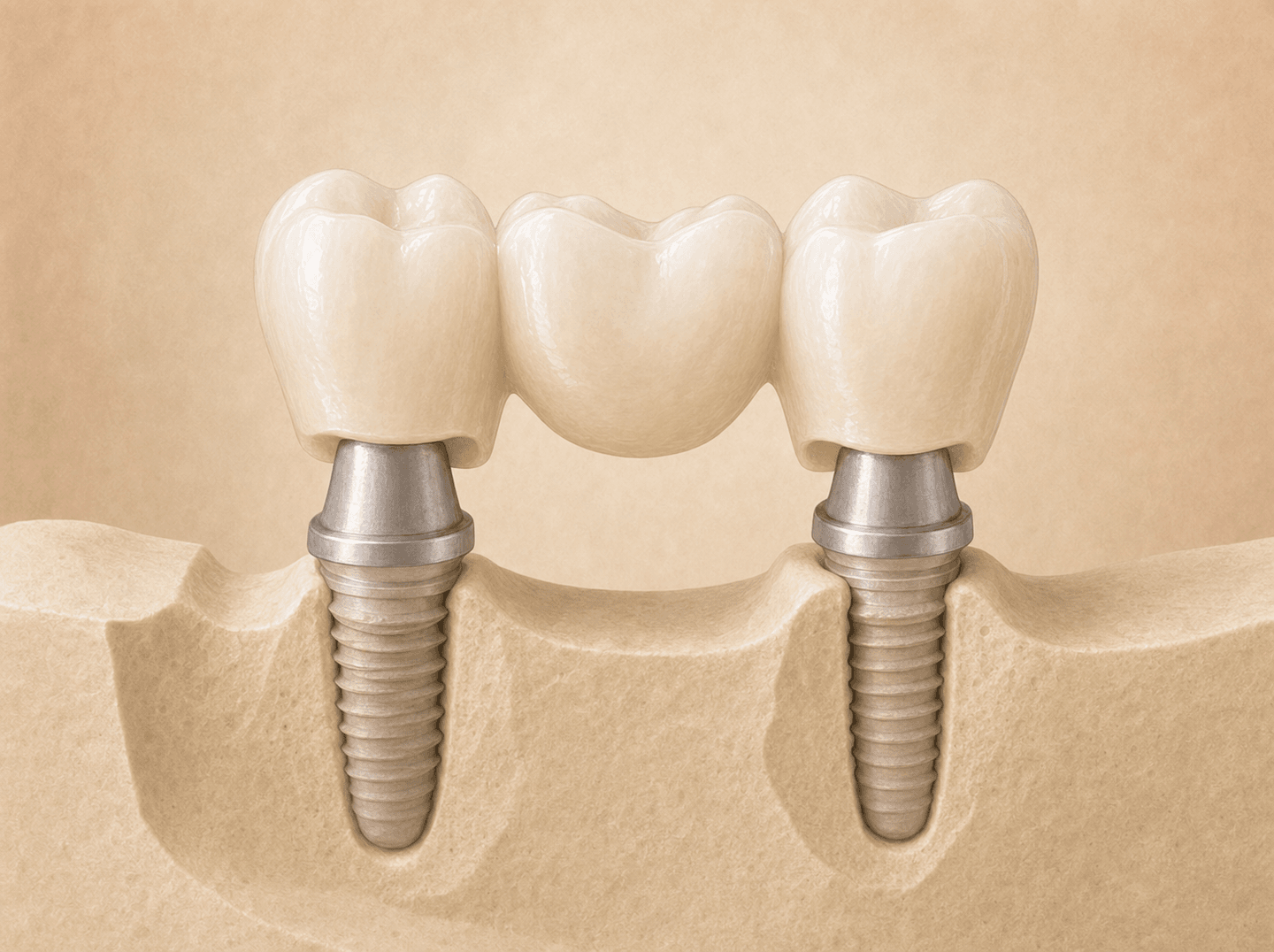
D6068 reports one abutment-supported retainer for an all-ceramic fixed implant bridge. A retainer is the anchor crown of a fixed partial denture, the unit that caps an implant and carries the span of replaced teeth. On a D6068 case the retainer is all porcelain or ceramic and seats on a separate implant abutment (D6056 prefab or D6057 custom). It can be cemented onto the abutment or screw-retained to it.
Bill D6068 when the case is a fixed implant bridge with at least two anchors and at least one pontic between them, a separate abutment under the retainer is billed on its own line, and the ceramic retainer has been seated, adjusted, and finalized.
It does not cover:
- Single-tooth implant crowns that restore one implant on its own. Use D6058 (abutment-supported ceramic crown) or D6065 (implant-supported ceramic crown).
- Implant-supported ceramic retainers that attach directly to the implant with no separate abutment. Use D6075.
- Abutment-supported retainers in other materials. Use D6069 to D6071 (PFM) or D6072 to D6074 (cast metal).
- The pontic, the replaced tooth suspended in the span. Use a standard pontic code such as D6245 (porcelain/ceramic) or D6240 (PFM, high noble).
- The implant abutment itself. Use D6056 (prefabricated) or D6057 (custom).
- The implant fixture. Use D6010 for placement.
Bridge retainer, not a single crown
The first mistake on D6068 is treating it like a single implant crown. A single-tooth implant restoration replaces one tooth on one implant and bills as a crown: D6058 for the abutment-supported ceramic version, D6065 for the implant-supported version. Nothing else rides on that claim.
A fixed implant bridge replaces additional missing teeth across a span. The implants at the ends carry retainer crowns, and the teeth in between are pontics. The ceramic anchor crown on an implant in that bridge is D6068, and it appears on the claim alongside the pontic codes and the second retainer.
D6068 vs D6075: abutment-supported or implant-supported
Once the case is a bridge, the next question is the same one that separates the single-crown codes D6058 and D6065: does the retainer sit on a separate, separately billable abutment, or directly on the implant body? Retention method does not decide it.
Abutment-supported (D6068) indicators:
- A separate abutment (D6056 prefab or D6057 custom) is placed on the implant and billed as its own line item.
- The ceramic retainer is cemented onto that abutment or screw-retained to it. Either way it is D6068.
- Common when a custom abutment is needed to correct angulation across the bridge or to build a consistent margin and emergence profile under the retainers.
Implant-supported (D6075) indicators:
- The ceramic retainer attaches directly to the implant body.
- No separate D6056 or D6057 line under that retainer, because the abutment function is integral to it.
- Can also be cemented or screw-retained.
The material set within the abutment-supported retainers
D6068 is the ceramic member of the abutment-supported retainer family:
- D6068 is all porcelain or ceramic.
- D6069 / D6070 / D6071 are porcelain fused to metal (high noble / predominantly base metal / noble).
- D6072 / D6073 / D6074 are cast metal (high noble / predominantly base metal / noble).
Code to the material actually delivered. A ceramic retainer (D6068) commonly pairs with a ceramic pontic (D6245), but the retainer and pontic codes are each chosen by their own material, so confirm each rather than assuming the whole bridge is one material.
How a complete implant bridge bills
A fixed implant bridge is billed as its parts, each its own line on the case. A typical abutment-supported ceramic bridge on two implants replacing one tooth in the middle bills as:
- D6010 for each implant fixture placed (at the surgical visit, often by a surgeon).
- D6057 or D6056 for the abutment under each retainer (at the abutment-seating visit).
- D6068 for each ceramic retainer (at the bridge delivery visit).
- D6245 for the porcelain/ceramic pontic in the span.
That is two D6068 retainers, two abutments, and one D6245 pontic. A longer span adds more pontics. If the retainers attached directly to the implants, they would be D6075 with no abutment lines. Entering the bridge as a single procedure produces wrong estimates and a claim the carrier can’t process under its bridge rules.
The retainer and pontic codes for both support types are listed together in the dental implant codes guide.
Coverage reality: implant prosthetics are their own benefit question
Implant bridge coverage does not behave like routine restorative coverage. Many plans apply an alternate-benefit clause to implant prosthetics, and the downgrade target varies by plan:
- Some pay the implant retainer at a conventional tooth-supported bridge retainer allowable (a retainer crown code such as D6740), on the reasoning that a conventional bridge would have been the alternative.
- Some pay a lower implant allowable than the office fee.
- A handful exclude implant restorations entirely and deny as non-covered.
Most plans price each bridge component on its own allowable, but some bundle components or apply missing-tooth and frequency rules across the span. The patient’s share compounds across the retainers and pontics, so the gap on an implant bridge is larger than on a single crown. The general benefit summary won’t tell you how the plan treats an implant retainer versus a conventional one.
Documentation that supports the claim
The claim needs:
- Date of service (the bridge delivery date).
- Tooth numbers or implant locations for the anchors and the pontic span.
- Implant brand and platform for each implant (some carriers require this on the claim).
- Retainer material designation (porcelain or ceramic).
For the patient record, document:
- That the case is a fixed partial denture, with the anchor implants and the pontic span identified, so the retainer code is defensible as a bridge component.
- Implant placement dates for each fixture.
- Abutment type (custom or prefab) under each retainer. A chart that describes retainers going straight to the implants will be read as D6075.
- Retainer material (e.g., lithium disilicate, zirconia) for each anchor.
- Retention method (cement or screw) and, if cemented, the cement type.
- The soft tissue check at delivery for subgingival cement, on cemented retainers.
FAQs
- What is the difference between D6068 and D6075?
- The difference is whether a separate, separately billable abutment exists. Both are ceramic retainers that anchor a fixed implant bridge. D6068 is abutment-supported: the retainer seats on a separate implant abutment (D6056 prefab or D6057 custom) that bills on its own line. D6075 is implant-supported: the retainer attaches directly to the implant body. Either can be cemented or screw-retained, so the chart should show which was actually delivered.
- What is the difference between D6068 and D6058?
- The difference is scope. D6058 is a single abutment-supported ceramic crown that restores one implant on its own. D6068 is one anchor of a fixed bridge, so it sits next to a pontic and usually a second retainer on the same claim. The chart should describe a fixed partial denture, not a single crown, for D6068 to hold up.
- How do you bill a full implant bridge with D6068?
- Bill it as separate components. Each implant anchor gets a retainer code (D6068) plus its abutment (D6056 or D6057), and each replaced tooth gets a pontic code (D6245 for porcelain/ceramic). A two-implant, one-pontic ceramic bridge is two D6068 retainers, two abutments, and one D6245 pontic. Carriers bundle and price the components differently, so run a pre-treatment estimate on the full set.
- Why was D6068 downgraded to a conventional bridge allowable?
- The plan applied an alternate-benefit clause to implant prosthetics, paying the retainer at a conventional tooth-supported bridge retainer allowable (such as D6740) or a lower implant allowable. The patient owes the difference. This is plan language, not a denial, and some plans exclude implant restorations entirely. Confirm how the plan treats implant bridges before treatment.
- Does retention method (cement vs screw) decide D6068?
- No. An abutment-supported ceramic retainer is D6068 whether it is cemented onto its abutment or screw-retained to it. The code turns on two things: it is a bridge retainer rather than a single crown, and it seats on a separate billable abutment rather than directly on the implant. Document both.
- Is D6068 a current CDT code for 2026?
- Yes. D6068 is active in CDT 2026. The abutment-supported retainer family by material (D6068 ceramic, D6069 to D6071 porcelain-fused-to-metal, D6072 to D6074 cast metal) remains in place alongside the implant-supported set (D6075 ceramic, D6076 PFM, D6077 cast metal).
Related codes
Need help billing this code?
We handle D6068 claims daily.
If your team is spending time on denials, narratives, or carrier follow-up for this code, our outsourced dental insurance billing service can take it off your plate. We submit the claims, post what comes back, and follow up on anything unpaid. Already sitting on older claims that never paid? Our AR cleanup project works the backlog.
“Claims, posting, denials, all of it gets handled, and it costs far less than hiring another employee. My front desk got hours of their week back, and honestly I just don't think about billing anymore.”
CDT codes are maintained by the American Dental Association. This page is an editorial billing guide, not the official ADA code descriptor. Verify current coverage policies with each carrier before submitting claims.