D6111 is the CDT code for a removable denture that snaps onto implants or attachment abutments on a fully edentulous lower arch.
- When to use: The overdenture is delivered on a lower arch with no natural teeth left, and the patient takes it out at home.
- When not to use: A fixed lower hybrid is D6115, a lower arch that still has natural teeth is D6113, and the upper removable version is D6110.
- Billing note: Many plans exclude implants or pay only toward a conventional lower denture, so verify the implant benefit and missing-tooth clause before treatment.
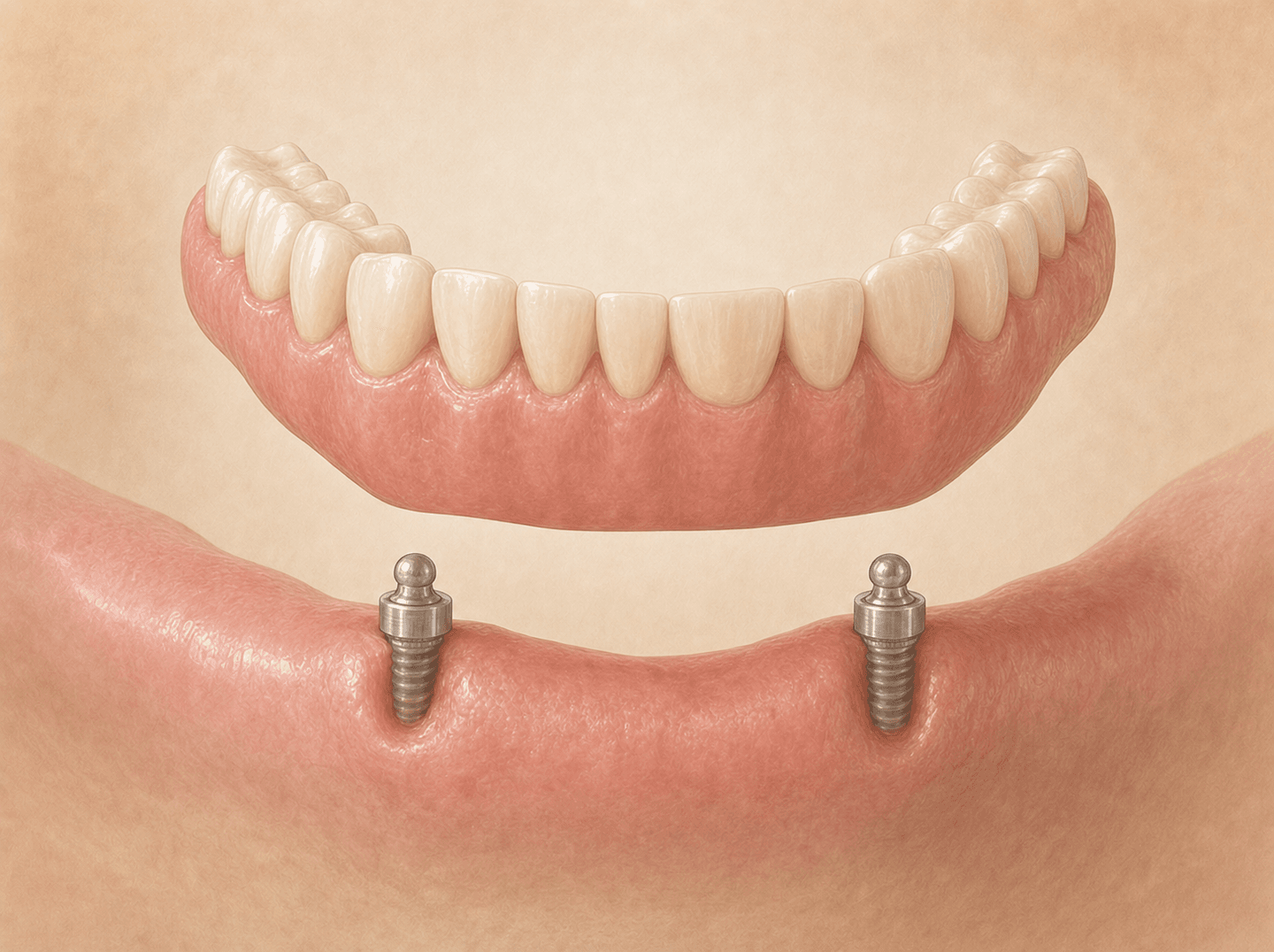
What D6111 covers
D6111 reports delivery of a removable denture retained by implants or attachment abutments on a fully edentulous lower arch. The patient takes the overdenture in and out, and it snaps onto attachments or a bar carried by the implants. Bill it on the delivery date.
It does not cover:
- A fixed denture on a fully edentulous lower arch that only the clinician removes. That is D6115.
- A removable implant denture on a partially edentulous lower arch. That is D6113.
- The removable implant overdenture on the upper arch. That is D6110.
- A conventional complete lower denture with no implant support, which is a standard removable prosthetic code, not an implant code.
- The surgical placement of the implant bodies. That is D6010 per implant, billed on earlier dates.
- The abutment and attachment placement that retain the denture. Those are D6191 (abutment) and D6192 (attachment).
- Replacement of a worn retention insert inside an attachment. That is D6091.
- The routine maintenance visit on the finished overdenture. That is D6280, billed on later dates.
The distinguishing axis: removable, edentulous, mandibular
D6111 sits in a grid of eight implant-denture codes, D6110 through D6117, and three questions place any case in one of them:
- Removable or fixed? Removable means the patient takes it out. Fixed means only the clinician removes it. The fixed counterpart on the same arch is D6115.
- Edentulous or partially edentulous? Fully edentulous means no natural teeth remain on that arch. The partially edentulous removable version is D6113.
- Maxillary or mandibular? The upper-arch removable twin is D6110.
The most common miscode is a fixed hybrid billed as a removable overdenture, or the reverse, because both are full-arch implant restorations. The record has to state that the patient removes the denture. If the prosthesis is screwed in and stays, the code is D6115. The full grid is in the dental implant codes guide.
Top reasons D6111 gets denied or downgraded
- No implant benefit on the plan. Many plans exclude implant services, and the overdenture denies with the rest of the case. The patient owes the fee, and no appeal overturns a categorical exclusion.
- Missing-tooth clause. Plans that cover implants often exclude an arch that was edentulous before the policy started. The carrier looks for evidence the teeth were lost while the patient was covered.
- Alternate benefit to a conventional denture. Some plans pay only toward a standard complete lower denture and treat the implant overdenture as an upgrade, leaving the patient the difference. This is a plan-design payment, not a denial.
- Predetermination required but not submitted. Full-arch implant prosthetics often require preauthorization. Submitting without it draws a denial for no prior approval.
- Removable-versus-fixed mismatch. The claim says D6111 but the record describes a fixed hybrid, or the reverse. The carrier reprocesses to the code the chart supports.
Documentation that supports the claim
The record should name:
- The arch and its edentulous status, stated as a fully edentulous mandible, so the code matches D6111 rather than D6113.
- That the prosthesis is removable, which separates D6111 from D6115.
- The retention design: attachments or a bar, and how many implants carry the overdenture.
- When the arch became edentulous, which is what a missing-tooth-clause review turns on.
A note that reads only “implant denture, lower” establishes neither of the two facts the code depends on.
Example case
A patient with a fully edentulous lower arch has two implants placed and, several months later, receives a removable overdenture that snaps onto attachment abutments. The plan covers implants at a reduced benefit and applies a missing-tooth clause.
- At the treatment-planning visit, verify the implant benefit, the missing-tooth clause, and any predetermination requirement.
- Bill the surgical and abutment codes on their own dates as the case progresses.
- At delivery, submit D6111 with a narrative naming the fully edentulous lower arch, the removable design, and the retention (for example, two implants with attachment abutments).
- If the arch was edentulous before coverage, attach the extraction history.
- If the plan applies an alternate benefit toward a conventional denture, post the carrier’s payment and bill the patient the difference the estimate already showed.
FAQs
- What is the dental code for a lower implant-supported denture?
- D6111, when the denture is removable and the lower arch is fully edentulous. If the lower prosthesis is fixed and only the clinician removes it, that is D6115. The removable version for the upper arch is D6110.
- What is the difference between D6111 and D6115?
- Removable versus fixed. D6111 is an overdenture the patient takes in and out. D6115 is a fixed denture on the same fully edentulous lower arch, screwed or cemented so only the clinician removes it. The chart has to state whether the patient can remove the denture, because that is the axis the carrier reads.
- What is the difference between D6111 and D6113?
- Whether natural teeth remain. D6111 is for a fully edentulous lower arch. D6113 is the removable implant denture for a partially edentulous lower arch. Coding a partially edentulous case as D6111 mismatches the record.
- Does D6111 include the implants and abutments?
- No. D6111 is the removable overdenture only. Implant bodies are D6010 per implant, abutments have their own codes, and the attachment components are D6191 for the abutment placement and D6192 for the attachment placement. Each code is its own line and its own benefit decision.
- Why did the plan deny D6111?
- Usually for plan-dependent reasons: an implant exclusion, a missing-tooth clause on an arch that was edentulous before coverage started, or an alternate benefit that pays only toward a conventional complete lower denture and leaves the patient the difference. Verify all three before treatment planning.
- Is D6111 the same as the overdenture maintenance code?
- No. D6111 reports delivery of the removable overdenture. D6280, added for CDT 2026, reports the later maintenance visit where the denture is removed, the implant components and tissue are cleaned, and the attachments are checked. They are separate codes on separate dates.
Related codes
Need help billing this code?
We handle D6111 claims daily.
If your team is spending time on denials, narratives, or carrier follow-up for this code, our outsourced dental insurance billing service can take it off your plate. We submit the claims, post what comes back, and follow up on anything unpaid. Already sitting on older claims that never paid? Our AR cleanup project works the backlog.
“Claims, posting, denials, all of it gets handled, and it costs far less than hiring another employee. My front desk got hours of their week back, and honestly I just don't think about billing anymore.”
CDT codes are maintained by the American Dental Association. This page is an editorial billing guide, not the official ADA code descriptor. Verify current coverage policies with each carrier before submitting claims.