On this page
- Four questions that pick an implant code
- Placing the implant body
- Abutments
- Implant crowns by support and material
- Bridges on implants
- Implant dentures and full-arch prostheses
- Maintenance, repair, and removal
- Coverage, downgrades, and the missing tooth clause
- Staged dates of service
- Billing implants to medical
- Setting up implant codes in your PMS
- Common questions
A single implant case is usually billed as three or four procedures over several months. The surgery that places the implant, a bone graft if one is needed, the abutment, and the crown each have their own code, date of service, and benefit decision. This guide covers how to pick the code at each stage and the billing issues that affect the whole case. Each code page covers what only applies to that code.
Four questions that pick an implant code
- Which stage is this? Surgery, uncovering the implant, the abutment, the restoration, or later maintenance, repair, and removal. Each stage has its own section of the codebook.
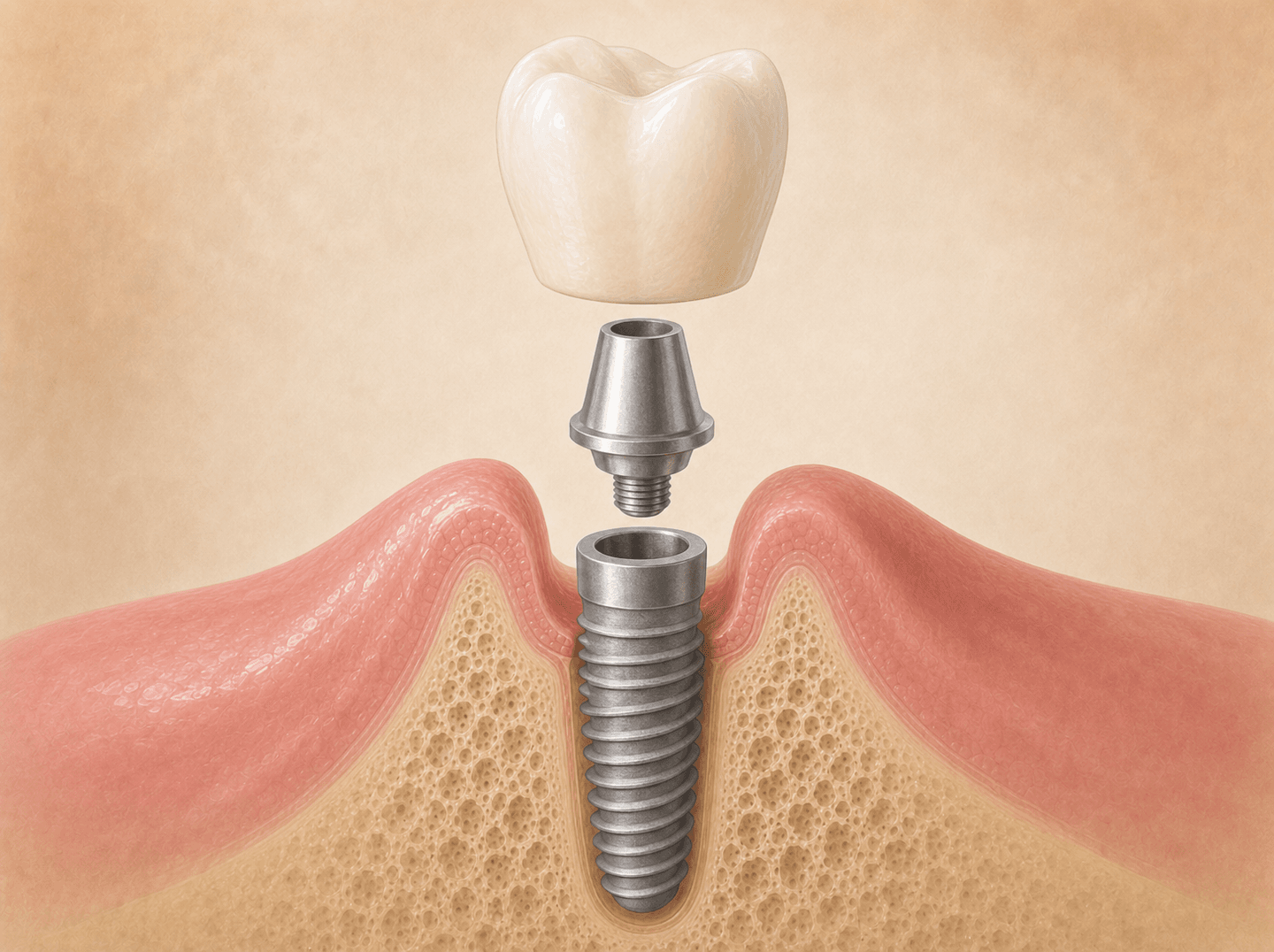
- What does the restoration attach to? A crown or bridge that sits on a separate abutment is abutment-supported, and the abutment is billed on its own line. A crown that attaches directly to the implant body is implant-supported, and there is no separate abutment to bill. Whether the crown is cemented or screwed in does not affect the code.
- What is it made of? All-ceramic, porcelain fused to metal, cast metal, and titanium each have their own codes. For the metal crowns, the alloy class (high noble, noble, or predominantly base) changes the code too.
- Is it one tooth, a bridge, or a whole arch? Single crowns, bridge retainers, and implant dentures are three separate code groups. Implant dentures are split again by upper or lower arch, removable or fixed, and whether the arch has any natural teeth left.
The second question is where implant claims most often go wrong. The two support types have parallel code sets for the same materials, and a claim with the wrong support type also gets the abutment line wrong, either missing or billed when it should not be.
Placing the implant body
| Code | What it reports |
|---|---|
| D6010 | Surgical placement of a standard endosteal implant body in the bone |
| D6013 | Surgical placement of a mini implant |
| D6012 | A temporary implant body that holds a transitional prosthesis |
| D6040 | An eposteal implant, which sits on the bone under the gum tissue |
| D6050 | A transosteal implant, which passes through the jawbone |
| D7994 | A zygomatic implant, anchored in the cheekbone |
| D6190 | A radiographic or surgical implant index, such as a surgical guide |
| D6011 | Second-stage surgery to uncover a buried implant |
D6010 is the code for almost every case. The other placement codes each describe a different kind of implant, so the implant system and the operative note decide which one applies.
The bone graft at the time of placement is its own line. A graft placed during the same visit as the implant is D6104, and a membrane around the implant is D6106 or D6107. A graft placed in a socket or on a ridge in an earlier surgery has a different code. The bone graft dental codes guide covers how to tell them apart, along with sinus lifts.
Second-stage surgery is often bundled. D6011 reports going back in to uncover an implant that was buried under the tissue to heal, so a healing cap or abutment can go on. Cigna’s 2026 DPPO guidelines allow it only after a D6010 on an earlier date of service, and disallow it when it is incidental to another surgery. Delta Dental Insurance Company treats the D6011 fee as included in D6010 when the plan covers implants, and treats D6190 as included in the definitive treatment for one implant. When the implant gets a healing cap at placement and is never buried, there is no second stage to bill.
If the osteotomy is guided by dynamic navigation or a robotic system instead of a printed guide, the index is D7939. AAOMS notes that D7939 does not include placing the implant, which is still reported separately.
Abutments
The abutment connects the implant to the crown. Three codes cover the abutment itself and a fourth covers the bar used under overdentures. One rule decides whether an abutment code belongs on the claim at all.
- D6056 is a prefabricated stock abutment. The code includes modifying the abutment and placing it.
- D6057 is a custom abutment that a lab makes for that patient. The code includes placing it.
- D6051 is an interim abutment, used for a temporary period during treatment.
- D6055 is a connecting bar that splints implants or abutments together, usually under an overdenture.
The rule is the support type. An abutment code goes with an abutment-supported crown or bridge and never with an implant-supported one. Delta Dental Insurance Company’s implant coding guidance says implant-supported crowns do not need abutment codes, and Cigna’s 2026 DPPO guidelines disallow D6056 and D6057 with any implant-supported crown, bridge, or prosthesis. The D6057 page covers the prefabricated versus custom question in detail.
Implant crowns by support and material
Every material has two codes, one for each support type. The table pairs them.
| Material | Abutment-supported | Implant-supported |
|---|---|---|
| Porcelain or ceramic | D6058 | D6065 |
| Porcelain fused to high noble metal | D6059 | D6066 |
| Porcelain fused to predominantly base metal | D6060 | D6082 |
| Porcelain fused to noble metal | D6061 | D6083 |
| Porcelain fused to titanium or titanium alloys | D6097 | D6084 |
| Cast high noble metal | D6062 | D6067 |
| Cast predominantly base metal | D6063 | D6086 |
| Cast noble metal | D6064 | D6087 |
| Titanium or titanium alloys | D6094 | D6088 |
The numbers do not follow a pattern you can guess. Most of the older pairs sit between D6058 and D6067, and the other materials are spread across D6082 to D6097. Read the code from the table or the fee schedule every time. The lab invoice settles the alloy. For titanium, the invoice will not list a noble percentage, and that blank does not mean the crown is base metal.
A temporary crown worn on an implant while tissue heals or the final crown is made is D6085, the interim implant crown.
Bridges on implants
An implant bridge uses two families of codes. The crowns on the implants are retainers from the implant section, split by support type and material the same way single crowns are. The replacement teeth between them are pontics, and they use the same pontic codes as a bridge on natural teeth.
- Abutment-supported retainers run from D6068 for all-ceramic through D6074, plus D6194 for titanium and D6195 for porcelain fused to titanium.
- Implant-supported retainers are D6075 for ceramic, D6076 for porcelain fused to high noble alloys, and D6077 for cast high noble alloys, with the other materials covered by D6098, D6099, and D6120 through D6123.
- Pontics come from the fixed partial denture pontic codes, such as D6245 for porcelain or ceramic and D6240 for porcelain fused to high noble metal.
Delta Dental Insurance Company’s guidance calls out one error in particular. A crown on an implant that anchors a bridge uses the implant retainer codes, never a natural-tooth retainer code such as D6740. The same abutment rule applies here. Abutment-supported retainers carry abutment lines, and implant-supported retainers do not.
Implant dentures and full-arch prostheses
The implant denture codes form a grid of three questions: removable or fixed, upper or lower, and whether the arch has no natural teeth left or still has some.
| Prosthesis | Upper (maxillary) | Lower (mandibular) |
|---|---|---|
| Removable, no natural teeth left | D6110 | D6111 |
| Removable, natural teeth remain | D6112 | D6113 |
| Fixed, no natural teeth left | D6114 | D6115 |
| Fixed, natural teeth remain | D6116 | D6117 |
| Interim fixed, no natural teeth left | D6119 | D6118 |
Watch the last row. The interim fixed denture codes reverse the usual order: D6118 is the lower arch and D6119 is the upper. The implants under any of these are billed separately with D6010 or D6013. A connecting bar is D6055, and semi-precision abutments and attachments are placed with D6191 and D6192. Replacing the worn part of an attachment later is D6091, per attachment.
Cigna’s 2026 DPPO guidelines consider implants in a fully edentulous arch with clinical rationale, and limit them to three per quadrant and six per arch when allowed. Other plans set their own limits, so predetermine a full-arch case.
Maintenance, repair, and removal
This end of the implant section changes often. Several of its codes are new in the last two code sets.
Cleaning and maintenance.
- D6080 is full-arch fixed hybrid maintenance when the prosthesis is removed and put back, and D6180 is the same visit when it is not removed. Both are per arch.
- D6280, new in CDT 2026, is the parallel code for a full-arch removable implant denture that is removed and reinserted, per arch.
- A single implant crown has no maintenance code of its own. Routine cleaning goes on the prophylaxis codes, whose descriptors include implants.
Treating disease around an implant. D6081 is scaling and debridement of one implant with mucositis, without a flap. D6049, new in CDT 2026, is the same without-flap treatment when the diagnosis is peri-implantitis. D6101 and D6102 are surgical debridement with a flap, the second adding osseous contouring. D6103 is a bone graft to repair a defect around an existing implant.
Screws and loose crowns. D6089 is accessing and retorquing a loose implant screw, per screw. D6193 is replacing the screw, and D6096 is removing a broken retaining screw. D6092 re-cements or re-bonds a crown, and D6093 a bridge. D6197 replaces the material that seals the screw access opening on a screw-retained prosthesis, per implant.
Repairs and removal. D6090 repairs an implant or abutment-supported prosthesis. D6196, new in CDT 2026, removes an indirect restoration from an implant abutment. Delta Dental of Kansas lists it as a code with no separate fee billable to the patient. D6100 is surgical removal of an implant body. D6105 is removing an implant body without removing bone or raising a flap. D6198 removes an interim implant component, such as an interim abutment or a temporary crown, placed for a set period. D6199 is the by-report code for an implant procedure with no specific code.
Coverage, downgrades, and the missing tooth clause
These rules apply to every code in the case.
The implant benefit and the missing tooth clause come first. Many plans exclude implants outright, and many that cover them exclude a tooth that was missing before the patient’s coverage started. The clause can deny the whole case, including the graft, abutment, and crown. Record the extraction date and the plan in force on that date at the consultation. The missing tooth clause guide covers how carriers apply it and what to ask at verification.
Alternate benefits pay the implant case at the price of something cheaper. A plan with limited or no implant coverage may pay toward the implant restoration as if it were a conventional bridge or partial. Delta Dental Insurance Company says it pays an allowance toward implant-supported prosthetics based on the fee for a standard pontic, subject to the same limits as standard prosthetics. Cigna’s 2026 DPPO guidelines say implants may not be covered when conventional prosthetics can reasonably replace the teeth, typically when four or more teeth are missing in the arch, and that prior prosthetic history in the arch can affect coverage. The EOB shows a downgrade as an alternate benefit adjustment. A downgrade is the plan paying what its contract says, so an appeal that treats it as a denial usually goes nowhere. Whether the difference can be billed to the patient depends on the plan and your participating agreement, so set that expectation in the financial agreement before surgery.
Each line gets its own benefit decision. A plan can cover the implant body and deny the crown, or the reverse, and frequency limits apply per code. PEHP’s 2026 guide, for example, limits the implant crown codes to one per tooth in five years. Predetermine elective cases and read each line of the estimate.
Staged dates of service
Each stage goes on the claim on the date it happened. The implant body is billed on the surgery date. A second-stage uncovering is billed on its own later date. The abutment and crown are billed when they are delivered.
The ADA’s claim form instructions ask for the date the procedure was performed. For a crown or other prosthetic that takes more than one visit, many carriers and participating agreements treat the seat date as that date, so check the carrier’s rule before reporting a crown on its prep or impression date. The same instructions say to use the CDT version in effect on the procedure date, so a case that crosses January 1 bills its later stages from the new code set. If the patient’s coverage changes mid-case, check with both plans which stages each one will consider, because the answer turns on the dates of service.
Keep the documentation the carrier will ask for with each stage. Delta Dental Insurance Company asks for a pre-op radiograph showing each implant site and a post-op radiograph showing the whole implant. Attach both to the surgical claim. For the restorative claims, note the tooth number, the support type, and the material from the lab invoice.
Billing implants to medical
Implants go to medical in a narrow set of cases, mainly teeth lost to trauma and reconstruction after tumor or cancer surgery. Replacing a tooth lost to decay or periodontal disease usually stays dental.
AAOMS’s implant coding paper lays out the medical side. CPT 21248 reports partial reconstruction of the mandible or maxilla with endosteal implants, meaning three or fewer teeth replaced or less than half the arch, and 21249 reports complete reconstruction, meaning four or more teeth or more than half the arch. Those codes cover placing the implants, uncovering them, and providing abutment posts. AAOMS says to append modifier 52 when abutment posts were not provided. CPT codes describe the arch while CDT codes describe each implant, so the two sets cannot be mapped one to one. When a medical payer accepts HCPCS dental codes, AAOMS recommends reporting D6010 per implant instead. Implant removal on the medical side is CPT 20670 or 20680, superficial or deep.
The diagnosis carries the medical claim. AAOMS lists ICD-10 categories that commonly apply to implant cases, including disorders of teeth and supporting structures (K08), disorders of tooth development (K00), and other diseases of the jaws (M27). The chart has to support the diagnosis that goes on the claim. For which plan pays first when a patient has both, see when medical is actually primary.
Setting up implant codes in your PMS
- Label the crown codes by support type and material. “Implant crown, ceramic, on abutment” and “implant crown, ceramic, direct to implant” as the D6058 and D6065 labels keep the poster choosing by the lab prescription.
- Link the abutment to the crown. Set an edit that flags an abutment-supported crown with no abutment line on file, and an implant-supported crown with one.
- Store the extraction date in the implant record. The missing tooth clause turns on it, and hunting for it at claim time is how the clause gets missed.
- Keep the implant retainer codes separate from the natural-tooth bridge codes. A bridge template built for teeth will pick D6740 on an implant by default.
- Add the 2026 codes. D6049, D6196, and D6280 are new this year and are missing from older fee schedules.
Verify any code against a current source before it goes on a claim. The CDT code reference covers the rest of the codebook, and our insurance billing service is where this work lives day to day.
Common questions
- What is the CDT code for a dental implant?
- D6010 reports the surgery that places a standard endosteal implant body in the bone. A mini implant is D6013, and a temporary implant that holds a transitional prosthesis is D6012. The rest of the case is billed separately: the abutment, the crown, any bone graft, and any second-stage surgery, usually on different dates of service.
- What is the code for an implant crown?
- It depends on two facts: what the crown attaches to and what it is made of. A crown seated on a separate abutment is abutment-supported, and an all-ceramic one is D6058. A crown that attaches directly to the implant body with no separate abutment is implant-supported, and an all-ceramic one is D6065. Each support type has its own code for every material: ceramic, porcelain fused to each metal class, cast metal, and titanium.
- What is the dental code for an implant abutment?
- D6056 for a prefabricated stock abutment, which includes any modification and placing it. D6057 for a custom abutment made by a lab for that patient, which includes placing it. D6051 is an interim abutment. An abutment code belongs on the claim only when the crown or bridge is abutment-supported. With an implant-supported restoration there is no separate abutment to bill.
- Can you bill an abutment with an implant-supported crown?
- No. An implant-supported crown attaches directly to the implant, so any abutment piece is part of the crown itself. Delta Dental Insurance Company's coding guidance says implant-supported crowns do not need abutment codes, and Cigna's 2026 DPPO guidelines disallow D6056 and D6057 when they are reported with an implant-supported crown, bridge, or prosthesis. Whether the crown is cemented or screwed in does not change this.
- What codes are used for an implant bridge?
- The crowns on the implants are billed as retainers for a fixed partial denture, from the implant retainer codes. D6068 is an all-ceramic retainer on an abutment and D6075 is an all-ceramic retainer attached directly to the implant. The replacement teeth between them use the same pontic codes as a tooth-borne bridge, such as D6245 for a porcelain or ceramic pontic. Natural-tooth retainer codes like D6740 do not belong on an implant bridge.
- What is the code for tightening a loose implant screw?
- D6089 reports accessing and retorquing a loose implant screw, per screw. If the screw has to be replaced, that is D6193. Removing a broken retaining screw is D6096. Re-cementing or re-bonding a crown that came off is D6092, and D6093 for an implant bridge.
Working with us
We can track the implant case from placement to crown.
We verify the implant benefit and missing tooth clause before surgery, code each stage to the visit it happened on, keep the abutment and crown codes matched to how the restoration attaches, and follow up on downgrades and denials through the final crown.