D6280 is the CDT code for the maintenance visit on a full-arch removable implant overdenture, where the denture is removed, cleaned, and reseated.
- When to use: The overdenture snaps onto implants on a fully edentulous arch, and the visit is routine recall maintenance rather than a repair, reline, or attachment replacement.
- When not to use: A fixed hybrid is D6080 when removed or D6180 when not, a removable partial is D9934 or D9935, and a prophylaxis on natural teeth is D1110.
- Billing note: Northeast Delta Dental and Delta Dental Insurance allow it once every 36 months, not every six months, so verify the plan's interval before scheduling the recall.
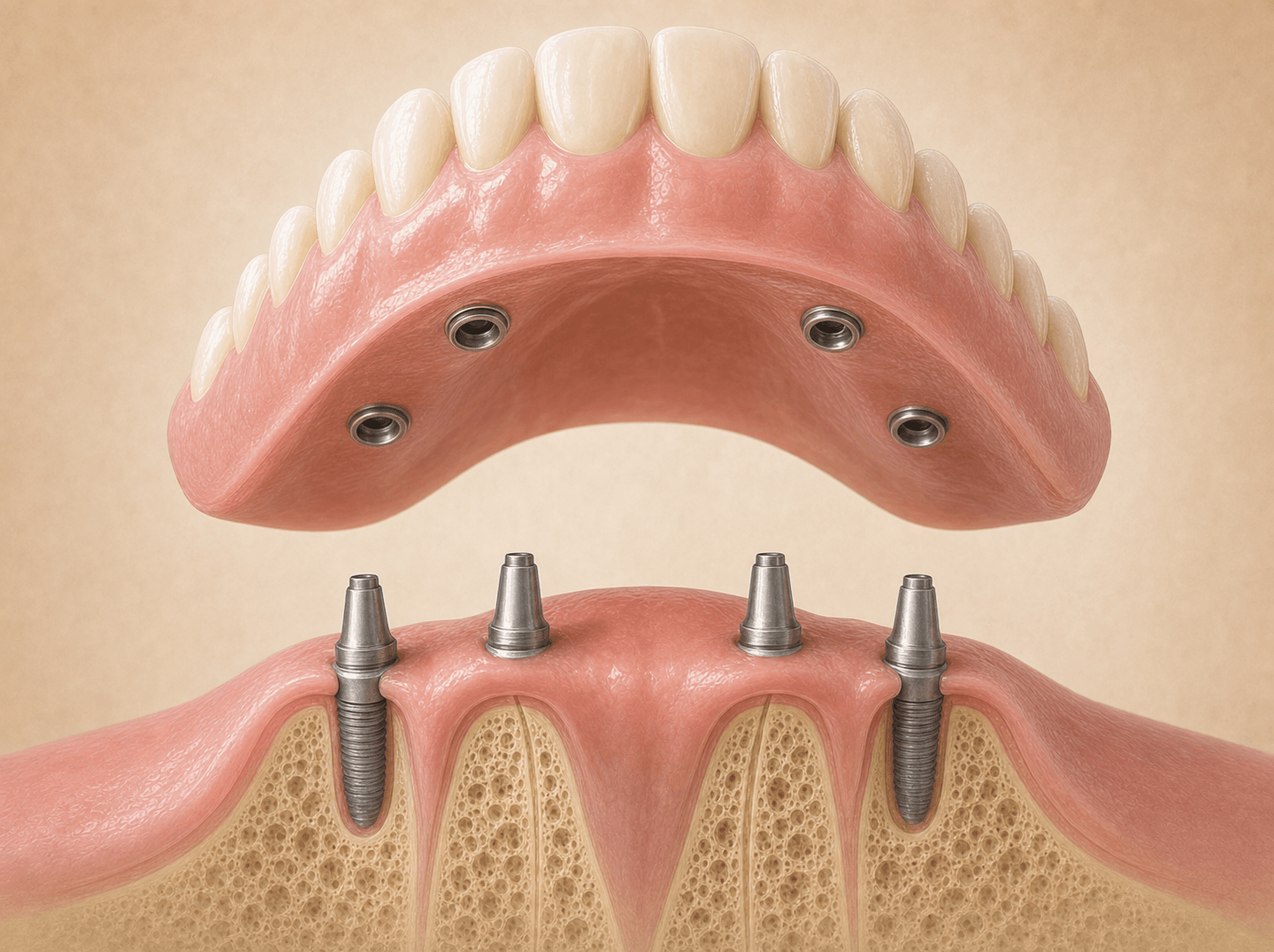
What D6280 covers
D6280 reports the cleaning and maintenance procedure for a full-arch removable implant/abutment-supported denture: a removable overdenture retained by multiple implants and their attachments (locator attachments, bar with clips, magnetic attachments, etc.). The procedure includes removal of the overdenture, cleaning and inspection of the implant components (abutments, attachment housings, healing collars), cleaning of the soft tissue under the denture, cleaning of the denture itself (internal surface, attachment recesses, tooth surfaces), inspection and minor adjustment of attachment components, and reseating of the overdenture.
It does not cover:
- Maintenance of a full-arch fixed hybrid prosthesis that is removed and reinserted. Use D6080 (or D6180 if it’s cleaned without removal). Routine cleaning around a single-implant crown or fixed bridge has no dedicated maintenance code. It’s reported under prophylaxis (D1110/D1120).
- Prophylaxis on natural teeth. Use D1110 (adult) or D4910 (periodontal maintenance).
- The initial delivery of the overdenture. Use D6110 (maxillary) or D6111 (mandibular). D6112 and D6113 are the partially edentulous removable codes and fall outside D6280’s full-arch scope; routine cleaning and inspection of a removable partial is reported with D9934 (maxillary) or D9935 (mandibular).
- Replacement of attachment components (locator inserts, clips, magnets). Use D6091 (replacement of semi-precision attachment) or the appropriate replacement code.
- Repair of the overdenture itself. Use D5511/D5512 (repair complete denture base, mandibular/maxillary) or D5520 (replace broken teeth).
- Reline or rebase of the overdenture. Use the appropriate denture reline or rebase code.
- Recall radiographs on the implants. Use the appropriate D0220/D0274 codes.
- Implant scaling/debridement for peri-implantitis. Use D6101 or D6049 (new for 2026 single-implant peri-implantitis).
The code is specifically for the routine maintenance recall visit on a full-arch removable overdenture, the most common ongoing visit type for this prosthesis category.
When to bill D6280
Bill D6280 when:
- The patient has a full-arch removable implant/abutment-supported overdenture (typically retained by 2 to 6 implants per arch with locator, bar-clip, or similar attachments).
- A maintenance recall visit has been performed including removal of the overdenture, cleaning and inspection of the implant components and soft tissue, and cleaning of the overdenture.
- The overdenture has been reseated and the patient released from the visit.
Do not bill D6280 for:
- Maintenance on a full-arch fixed hybrid prosthesis that’s removed and reinserted. Use D6080 (or D6180 if cleaned without removal). Routine maintenance around a single-implant crown is reported under prophylaxis (D1110/D1120), not D6080.
- The initial overdenture delivery visit. Use D6110 (maxillary) or D6111 (mandibular).
- Visits where the overdenture is being repaired, relined, or rebased. Use the appropriate prosthetic code.
Why D6280 was added in CDT 2026
The American Dental Association added D6280 in the 2026 CDT update specifically because full-arch removable implant overdentures have distinct maintenance requirements that weren’t well-served by existing codes. Before 2026, practices typically billed this work under D6080 (which covers the full-arch fixed hybrid prosthesis, not a removable overdenture), under a prophylaxis code (D1110), or split into multiple line items. None of these captured the removable-overdenture workflow accurately.
The full-arch removable case involves:
- Multiple implants requiring individual component inspection.
- Removable prosthesis with internal surfaces and attachment housings that accumulate plaque and food debris.
- Soft tissue under the denture that requires inspection for inflammation, hyperplasia, or pressure sores.
- Attachment wear that affects retention and patient function.
The 2026 code separates this workflow into its own billable category. For billing offices, the practical change is straightforward: full-arch removable cases should be coded as D6280 rather than aggregated under D6080.
What separates D6280 from D6080
The distinction is fixed versus removable full-arch. Both are per-arch maintenance codes.
D6080 (full-arch fixed hybrid maintenance) indicators:
- A full-arch fixed (screw-retained) hybrid prosthesis that is physically removed and reinserted, per arch.
- Cleaning covers the prosthesis and the abutments after it’s been taken off.
- It is not a per-implant code and does not apply to a single-implant crown or a short fixed bridge. (For a fixed hybrid cleaned without removing it, use D6180.)
D6280 (full-arch removable implant maintenance) indicators:
- Multiple implants supporting a removable overdenture (typically 2–6 implants per arch).
- Overdenture is removed for the cleaning.
- Cleaning includes the denture’s internal surface, attachment housings, and the implant components themselves.
- Inspection includes attachment wear, retention adequacy, and tissue under the denture.
A patient with a full-arch fixed hybrid prosthesis on one arch would bill D6080 for that arch’s maintenance (D6180 if it isn’t removed). A patient with a full-arch removable overdenture on one arch and a complete denture on the other would bill D6280 for the implant overdenture maintenance. Routine cleaning around a single-implant crown, by contrast, is captured under the prophylaxis code, not a separate implant-maintenance code.
Top reasons D6280 will get denied or pended in 2026
Five issues are likely to dominate in the first year of the code:
- Code not recognized. Carrier’s coverage table hasn’t been updated for CDT 2026. The denial reads “service not covered” or “code not on file.” Carrier-update timing varies; based on prior CDT release cycles, most catch up within the first one to two quarters. Resubmit when the carrier’s system shows the code.
- Bundling with general implant maintenance. Some plans will treat D6280 as a duplicate of D6080 and bundle. Appeal with documentation showing the prosthesis type and the workflow specific to the overdenture.
- Frequency interval shared with D6080 and D6180. Delta Dental Insurance runs one 36-month clock across D6280, D6080, and D6180, so a prior fixed-hybrid maintenance visit can knock out the overdenture visit. Northeast Delta Dental covers D6280 once every 36 months per arch for patients 16 and older. A six-month implant-maintenance cadence is not what these plans pay, so verify the interval before scheduling the recall.
- Documentation requirements unclear. New code, no established documentation expectations yet. Chart should document the procedure completely: prosthesis removed, components cleaned and inspected, soft tissue inspected, attachments checked, denture cleaned and reseated.
- Plan coverage update lag. Self-funded plans, smaller carriers, and some marketplace plans may not update their coverage tables until late 2026. Until then, expect to bill D6280, appeal non-recognition, and document thoroughly. D6080 is not a clean substitute. It’s the full-arch fixed hybrid code, not a removable-overdenture code.
The full-arch overdenture maintenance workflow
A standard D6280 visit typically includes:
- Patient history and exam. Check for symptoms (pain, sore spots, loose attachments, food trapping).
- Overdenture removal. Patient or clinician removes the overdenture.
- Soft tissue inspection. Check the tissue under the denture for hyperplasia, redness, sore spots, pressure indications. Document any findings.
- Implant component inspection. Check abutments, attachment housings, healing collars. Document component status (intact, worn, requires replacement).
- Implant cleaning. Mechanical cleaning of the implant components and surrounding tissue. Some practices use specific implant scalers; others use rubber polishing.
- Denture cleaning. Internal surface, attachment recesses, tooth surfaces. Ultrasonic cleaning or chairside scrubbing.
- Attachment check. Test retention. If attachments are worn, document and discuss replacement (separate code).
- Denture reseat. Place the cleaned overdenture, verify fit and retention.
- Patient instructions. Home care, attachment replacement schedule, next recall interval.
This entire workflow is the procedure D6280 bills. If attachment replacement or denture repair is needed, those are separate codes added at the same visit.
Documentation that supports the claim
The claim needs:
- Date of service.
- Arch designation (maxillary, mandibular, or both if a dual-arch case).
- Implant count and attachment type if the carrier requests it.
For the patient record, document:
- Type of overdenture (number of implants, attachment system).
- Soft tissue findings under the denture.
- Implant component status (each implant inspected and any findings).
- Attachment retention check (adequate, worn, requires replacement).
- Cleaning method used.
- Patient instructions and next recall.
A chart note that reads “implant maintenance” without specifying the workflow is insufficient. The new code carries an expectation that the chart shows the full removable-overdenture workflow.
Example case
A 71-year-old patient had a maxillary full-arch implant overdenture delivered 18 months ago, retained by four locator attachments on four implants. She returns for a scheduled maintenance recall visit. She reports no symptoms but notes the denture feels “less snug” than it did a year ago.
Treatment sequence:
- Patient history and exam, noting reduced retention complaint.
- Overdenture removed by the patient.
- Soft tissue under the denture inspected: mild redness on the palatal vault, no sore spots.
- Four implants inspected: all intact, no peri-implant inflammation. Locator abutments examined; one shows mild wear.
- Implants cleaned mechanically. Soft tissue cleaned.
- Denture ultrasonically cleaned. Attachment housings flushed and inspected. One housing shows insert wear consistent with reduced retention complaint.
- Insert replacement discussed with the patient and scheduled (separate code, separate visit).
- Denture reseated. Patient released.
Billing steps:
- Verify benefits and confirm coverage for D6280. If the carrier hasn’t loaded the 2026 codes, plan to appeal rather than substitute D6080 (the fixed-hybrid code, not a removable-overdenture code).
- Submit D6280 on the date of service with arch designation 01 (maxillary).
- Schedule the attachment insert replacement as a separate visit billed as D6091 (replacement of semi-precision attachment).
If the carrier denies D6280 as a non-recognized code, the cleanest path is to appeal with documentation of the overdenture workflow and re-attempt D6280 in 60–90 days once coverage tables are updated. D6080 is not an accurate substitute (it describes a full-arch fixed hybrid, not a removable overdenture), so avoid recoding to it just to force a payment.
Implant restoration billing checks
The specifics vary across Open Dental, Dentrix, Eaglesoft, Curve, and Carestream. The steps that matter:
- Update procedure code tables for CDT 2026. D6280 needs to be added to the PMS with a fee and a coverage default. Most PMS vendors push CDT 2026 updates in early 2026; verify the update is installed.
- Distinguish D6280 from D6080 at the time of charting. The PMS should prompt for the prosthesis type when an implant maintenance code is selected.
- Set arch designation correctly. Maxillary, mandibular, or both arches if applicable.
- Track which carriers have adopted the new code. A short flag on the carrier record helps the front desk and the billing team handle treatment planning and patient quotes accurately.
- Document the workflow. A chart note template for D6280 that covers the standard workflow (removal, soft tissue inspection, component inspection, cleaning, attachment check, reseat) prevents documentation gaps.
If your office sees recurring denials on D6280 in 2026, the most likely cause is the carrier-update lag pattern that typically follows a CDT release. A quarterly check of which carriers have updated their tables, combined with thorough documentation and appeals on non-recognition, keeps the maintenance work billable through the transition. Avoid defaulting to D6080 (the fixed-hybrid code) as a substitute for the removable overdenture.
FAQs
- What's new about D6280 versus the older D6080?
- D6080 is the maintenance code for a full-arch fixed hybrid prosthesis that is removed and reinserted (per arch). D6280 is its counterpart for the full-arch removable implant/abutment-supported overdenture. The split is fixed versus removable full-arch, not single-implant versus full-arch. Routine cleaning around a single-implant crown has no dedicated maintenance code; it's captured under prophylaxis (D1110/D1120). The removable overdenture has unique cleaning and inspection requirements (attachment wear, full-arch tissue under the denture, multiple implant components) that justify a distinct code.
- How often can D6280 be billed?
- Less often than most offices assume, at least at the carriers that have published a rule. Northeast Delta Dental covers D6280 once every 36 months per arch for patients 16 and older. Delta Dental Insurance (the Delta Dental of California group of member companies) also uses a 36-month interval and shares that one clock across D6280, D6080, and D6180, so any of the three performed within 36 months of another is denied. Delta member companies publish genuinely different rules, so check the specific one on the patient's plan. One wrinkle to watch: Delta Dental Insurance's 2026 provider summary states the benefit as once per tooth in 36 months even though the code's own nomenclature is per arch, so adjudication may not match the unit you billed. Plans outside Delta may still default to a general implant-maintenance allowable or not recognize the code at all in the first year.
- Does D6280 include the prophylaxis on the patient's natural teeth?
- No. D6280 covers the cleaning and maintenance of the implant overdenture and the associated implant components. If the patient still has natural teeth on the opposing arch, those are cleaned under the standard prophylaxis code (D1110 for adult, D4910 for periodontal maintenance). The two codes can bill on the same visit but represent separate procedures.
- Will all carriers cover D6280 in 2026?
- Probably not in the first year. New CDT codes typically take several months to a year before carrier coverage tables are fully updated. Practices billing D6280 in 2026 should expect some denials as 'code not yet recognized' or 'service not covered.' Some plans will pay it under the general implant maintenance allowable; some will deny pending a plan update; a few may not cover overdenture maintenance at all. Verify per carrier before treatment planning.
- Can D6280 be billed on the same date as the overdenture delivery?
- No. D6280 is for ongoing maintenance, not for initial delivery. The full-arch removable overdenture is delivered under D6110 (maxillary) or D6111 (mandibular). D6112 and D6113 are the partially edentulous versions and sit outside D6280's full-arch scope. Both Delta Dental Insurance and Northeast Delta Dental also restrict D6280 inside 12 months of the D6110/D6111 delivery: under Delta Dental Insurance's rule, if the delivering office performs it in that window the fee is treated as part of the denture fee and is not billable to the patient, and if a different office performs it the fee becomes the patient's responsibility. D6280 starts at the maintenance recall visits after that window.
Related codes
Need help billing this code?
We handle D6280 claims daily.
If your team is spending time on denials, narratives, or carrier follow-up for this code, our outsourced dental insurance billing service can take it off your plate. We submit the claims, post what comes back, and follow up on anything unpaid. Already sitting on older claims that never paid? Our AR cleanup project works the backlog.
“Claims, posting, denials, all of it gets handled, and it costs far less than hiring another employee. My front desk got hours of their week back, and honestly I just don't think about billing anymore.”
CDT codes are maintained by the American Dental Association. This page is an editorial billing guide, not the official ADA code descriptor. Verify current coverage policies with each carrier before submitting claims.