D6080 is the CDT code for maintenance on a full-arch fixed hybrid implant prosthesis that is removed, cleaned, and reinserted, billed per arch.
- When to use: The arch has a screw-retained full-arch fixed hybrid, and the chart shows the prosthesis was unscrewed and taken off at this visit.
- When not to use: Cleaning without removal is D6180, a removable overdenture is D6280, and cleaning around a single implant crown is D1110 or D4910.
- Billing note: Many plans exclude implant maintenance or share one frequency limit between D6080 and D6180, so verify the benefit per arch before the visit.
What D6080 covers
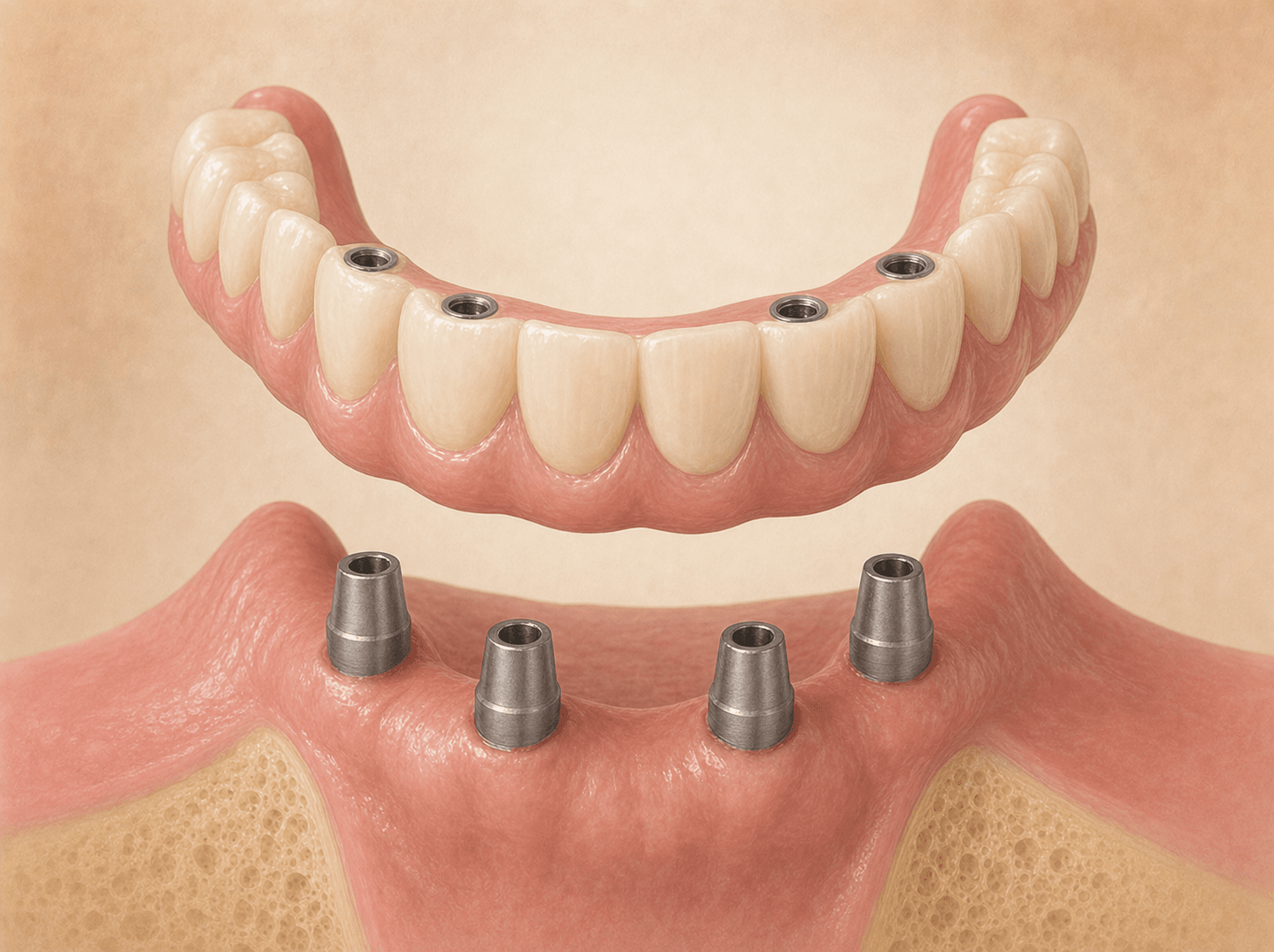
D6080 reports the maintenance visit on a full-arch fixed hybrid implant prosthesis, often described as an “All-on-X” or screw-retained full-arch bridge, when the prosthesis is removed and reinserted. The prosthesis is unscrewed and taken off the implants, the prosthesis and abutments are cleaned and inspected, the implants are debrided, occlusion and stability are checked, and the prosthesis is screwed back into place. The visit includes reviewing daily home care with the patient.
Both conditions have to be true: the prosthesis is a full-arch fixed hybrid (not a single crown, not a short bridge), and it is physically removed and reinserted. The code is reported per arch. A patient with full-arch fixed hybrids on both arches is two units of D6080, not one code for the whole mouth and not a code per implant.
It does not cover:
- A full-arch fixed hybrid cleaned without removing it. That is D6180.
- A full-arch removable overdenture. That is D6280.
- Routine cleaning around a single-implant crown or a short implant bridge. There is no dedicated implant-maintenance code for that; it falls under prophylaxis (D1110 / D1120) or periodontal maintenance (D4910).
- Repairs to the prosthesis or its components, or treatment of peri-implantitis. Those are separate codes (D6049 for non-surgical single-implant debridement, D6101 for surgical debridement, plus the relevant repair codes).
D6080 versus D6180: removed versus not removed
For a full-arch fixed hybrid, the only question between D6080 and D6180 is whether the prosthesis came off.
- The clinician unscrews and removes the prosthesis, cleans it and the abutments, inspects the implants, and reinserts: D6080.
- The clinician cleans and debrides the prosthesis and the accessible implant areas with the prosthesis left in place: D6180 (added effective CDT 2025).
On many plans that cover implant maintenance, D6080 and D6180 draw against the same frequency allowance, so a D6180 visit can use up the interval that would otherwise apply to a D6080 visit, and the reverse. That is plan language, not a universal rule, so confirm it on the specific plan. The other maintenance, screw, and repair codes on the implant side, including the ones new in CDT 2026, are in the dental implant codes guide.
D6080 versus D6280: fixed versus removable
Both are per-arch, full-arch, removal-and-reinsertion maintenance codes. The difference is the prosthesis.
D6080 (full-arch fixed hybrid) is for a screw-retained prosthesis that only the clinician removes, by undoing the prosthetic screws. The patient does not take it out at home.
D6280 (full-arch removable overdenture) is for an overdenture the patient removes and reinserts daily, retained by attachments such as locators, a bar with clips, or magnets. Its maintenance covers the attachment housings, attachment wear, and the tissue under the denture. D6280 was added effective CDT 2026.
A patient with a fixed hybrid on the upper arch and a removable overdenture on the lower bills D6080 for the upper arch and D6280 for the lower. Confirm D6180 and D6280 are loaded in your practice management system, since both are recent additions and are easy to confuse with D6080 at charting.
Coverage reality: often patient-pay, and plan-dependent
Many plans do not cover implant maintenance at all. Coverage often depends on whether the plan covered the underlying implant prosthesis, and many plans exclude implant services or pay them at a reduced benefit. When the prosthesis was not a covered benefit, the maintenance on it usually is not either.
When a plan does cover D6080, the rules vary by contract:
- Frequency is plan-specific. Some plans set a multi-year interval rather than a per-year one, and D6080 and D6180 often share it.
- Recent-insertion exclusions show up. Some plans will not pay maintenance for a period after the prosthesis was first delivered, treating early follow-up as part of the delivery.
- Per arch is the unit. A dual-arch case is two units, and the plan applies its frequency rule per arch.
Verify the implant-maintenance benefit and the per-arch frequency before the visit, and quote the patient accordingly. Many of these cases are the patient’s responsibility, and it is better to say so before the visit than on the statement.
The D6080 maintenance workflow
A standard D6080 visit generally includes:
- History and exam. Ask about symptoms (looseness, food trapping, soreness, hygiene difficulty) and look at the prosthesis and surrounding tissue.
- Prosthesis removal. Undo the prosthetic screws and remove the full-arch prosthesis.
- Implant and abutment inspection. Check each implant and abutment for mobility, peri-implant tissue health, screw integrity, and component wear. Document findings per implant.
- Debridement and cleaning. Clean the implants and abutments, and the prosthesis itself, including the intaglio (tissue-facing) surface where debris collects.
- Occlusion and stability check. Confirm the prosthesis and implants are stable and the bite is correct.
- Reinsertion. Reseat the prosthesis, torque the screws to specification, and seal the access channels.
- Home-care review. Go over daily cleaning under and around the fixed prosthesis.
A repair, component replacement, or peri-implantitis treatment done at the same visit is a separate procedure coded on its own.
Documentation that supports the claim
The record has to establish the two facts the code turns on, the prosthesis type and the removal. A note that just reads “implant maintenance” does neither.
- Arch designation (maxillary, mandibular, or both for a dual-arch case billed as two units).
- Prosthesis type, stated as a full-arch fixed hybrid.
- That the prosthesis was removed and reinserted. A note that says it was cleaned “in place” undercuts a D6080 claim.
- Per-implant findings from the inspection (mobility, tissue health, screw and component status).
- The cleaning performed on the implants, abutments, and prosthesis, and the torque values at reinsertion.
FAQs
- Is D6080 a current CDT code for 2026?
- Yes. D6080 is active in CDT 2026, with an editorial revision that replaced 'superstructure' in the descriptor with 'prosthesis'. The meaning is unchanged. The companion code D6180 (same prosthesis cleaned without removal) was added effective CDT 2025, and D6280 (removable overdenture maintenance) effective CDT 2026.
- What's the difference between D6080 and D6180?
- Whether the prosthesis comes off. D6080 is for a full-arch fixed hybrid prosthesis that is unscrewed, removed, cleaned along with the abutments, and reinserted. D6180 is for the same prosthesis cleaned in the mouth without removal. Both are per arch. Document which one happened, because the chart has to match the code.
- Can I bill D6080 for cleaning around a single-implant crown?
- No. D6080 is specific to a full-arch fixed hybrid prosthesis and is reported per arch, not per implant. There is no dedicated code for routine cleaning around a single-implant crown or a short implant bridge. That work falls under prophylaxis (D1110 for the permanent dentition, D1120 for the primary dentition) or periodontal maintenance (D4910), depending on the patient's perio status.
- Is D6080 the same as a regular cleaning?
- No. A prophylaxis (D1110 or D1120) cleans natural teeth. D6080 is removing a full-arch fixed hybrid prosthesis, debriding and inspecting the implants and abutments, cleaning the prosthesis, and reinserting it. If the patient also has natural teeth cleaned at the same visit, that prophylaxis is a separate code.
- How often will a plan pay D6080?
- It depends on the plan, and many plans do not cover implant maintenance at all. Where it is covered, frequency varies by contract, some plans set a multi-year interval, and D6080 and D6180 often share one frequency limit. Verify coverage and frequency before treatment planning, and expect many of these visits to be patient-pay.
- Does D6080 cover repairs to the prosthesis or treatment of peri-implantitis?
- No. D6080 is the routine removal-and-reinsertion maintenance visit only. Repairing or replacing prosthesis components, screws, or attachments is reported under the appropriate repair code by report. Non-surgical scaling and debridement of a single implant with peri-implantitis is D6049 (new for CDT 2026), and surgical debridement of a peri-implant defect with flap access is D6101. Each is coded separately from D6080.
Related codes
Need help billing this code?
We handle D6080 claims daily.
If your team is spending time on denials, narratives, or carrier follow-up for this code, our outsourced dental insurance billing service can take it off your plate. We submit the claims, post what comes back, and follow up on anything unpaid. Already sitting on older claims that never paid? Our AR cleanup project works the backlog.
“Claims, posting, denials, all of it gets handled, and it costs far less than hiring another employee. My front desk got hours of their week back, and honestly I just don't think about billing anymore.”
CDT codes are maintained by the American Dental Association. This page is an editorial billing guide, not the official ADA code descriptor. Verify current coverage policies with each carrier before submitting claims.