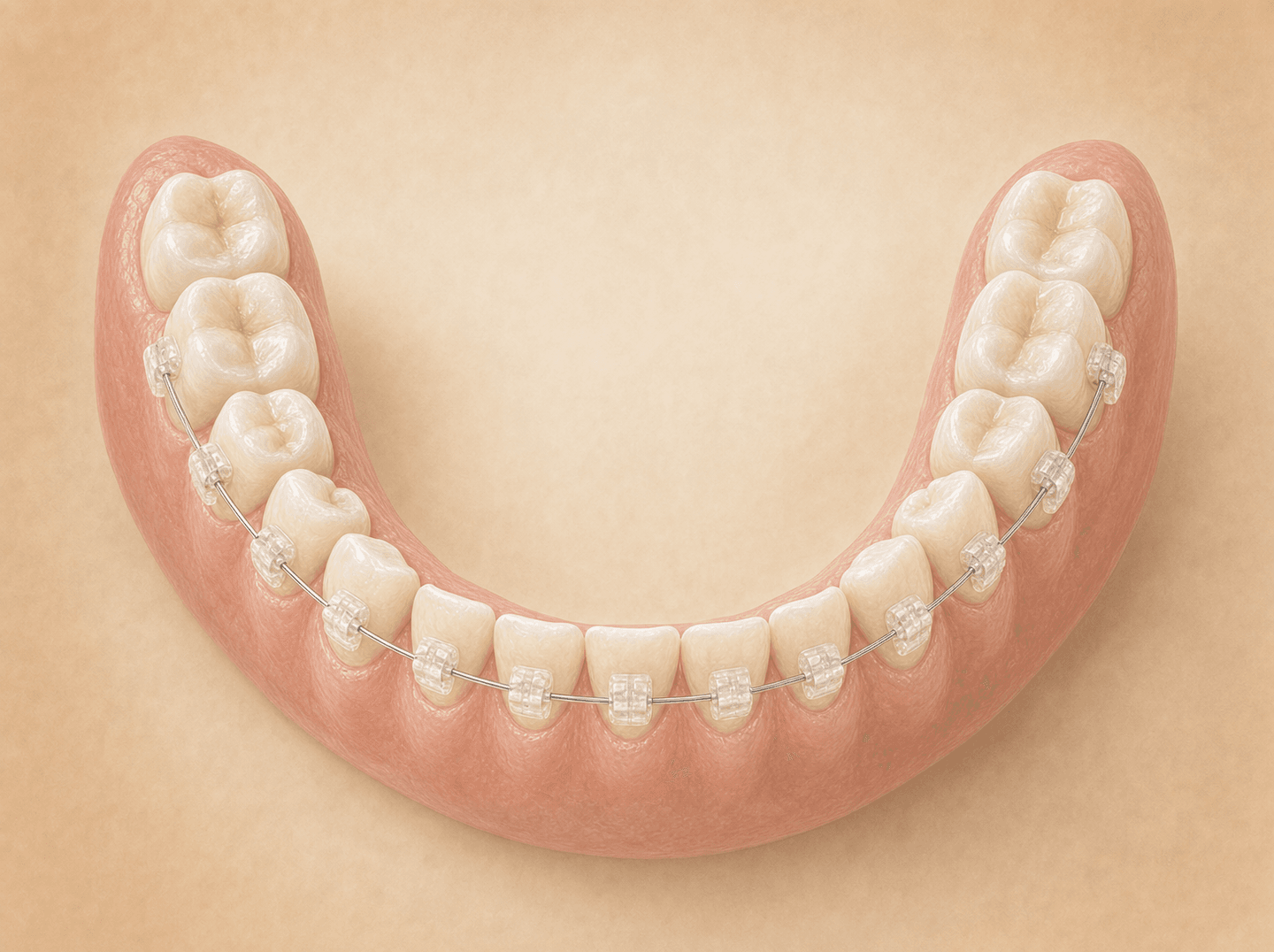
D8090 is the CDT code for comprehensive orthodontic treatment of the whole bite in an adult whose permanent teeth are in and growth is complete.
- When to use: The treatment plan corrects the whole bite with braces or aligners, and the records stage the dentition as adult, whatever the patient's age.
- When not to use: A one-problem adult case is D8040, an adolescent dentition is D8080, and comprehensive ortho combined with jaw surgery is D8091.
- Billing note: Many ortho benefits end at a dependent age limit, so verify adult coverage before banding and quote the case as self-pay when there is none.
On this page
What D8090 covers
D8090 reports comprehensive orthodontic treatment of the adult dentition. Both conditions have to be true:
- The scope is comprehensive. The dentist corrects the full malocclusion: the whole bite and the alignment of both arches, not one isolated problem.
- The stage is the adult dentition. All the permanent teeth are erupted and skeletal growth is complete.
Treatment runs over many months with fixed appliances or aligners, and the code reports that full course of care, not a single visit. Change the scope and the case moves to the limited codes. Change the stage and it moves to D8080 or D8070.
D8080 vs D8090: dentition stage, not age
The three comprehensive orthodontic codes are identical except for the stage of the patient’s dentition:
- D8070 is the transitional dentition, some primary teeth alongside erupting permanent teeth.
- D8080 is the adolescent dentition, permanent teeth essentially all in.
- D8090 is the adult dentition, permanent teeth all in and growth complete.
The split is not the patient’s age, and not the appliance (metal, ceramic, or clear aligner). “Adult” is a clinical staging term for a fully erupted, fully grown permanent dentition. Age does matter on D8090, but on the coverage side: stage the patient by what’s in the mouth, then check the plan’s age limit separately. Conflating the two is how an adult case gets quoted wrong.
Comprehensive versus limited: the other axis
Confusing the scope is the second common miscode, and on adult cases it is also where carriers push back.
Comprehensive treatment (D8070, D8080, D8090) addresses the full malocclusion across both arches as a complete course of care.
Limited treatment (D8010 through D8040) has a deliberately narrow objective: one defined problem, such as minor crowding, a single relapse, or pre-prosthetic alignment of a few teeth. Limited codes are also organized by dentition stage, and D8040 is the limited counterpart to D8090.
An adult-dentition patient could be either. The scope of the treatment plan decides it.
A note on the surgical comprehensive code
CDT 2025 added D8091 for comprehensive orthodontic treatment combined with orthognathic (jaw) surgery, and it remains active in 2026. When a case is reported under D8091, the limited and comprehensive codes (D8010 through D8090) are not billed separately on top of it; Northeast Delta Dental, for example, makes them not billable to the patient on the same date as D8091. Surgical cases also commonly carry a medical-billing component for the surgery, so confirm how the case splits between the dental and medical plans before submitting. Comprehensive ortho without surgery stays on D8090.
Coverage reality: adult ortho is the hard case
Many plans have no orthodontic benefit at all, and many that do limit it to dependent children. On an adult case, first verify whether the plan covers orthodontics and whether it covers adults. When there is an adult benefit, it has its own rules:
- A separate lifetime maximum. Ortho often has its own dollar cap, frequently a flat lifetime amount per patient, separate from the annual maximum. Verify the remaining amount: adults may have had braces years earlier under any plan, which can already have drawn it down.
- An age limit. This is the one that bites on D8090. Many ortho benefits apply only to dependents under a set age, often 19, which excludes most adults. Capture the age limit at verification, not at banding, and check it before the patient signs a contract.
- A waiting period. Adult ortho benefits carry waiting periods more often than other parts of the plan.
- Payment spread over treatment. Carriers commonly pay an initial amount at the start and then periodic payments over active treatment, up to the lifetime max.
The general benefit summary won’t show whether adults are covered, the lifetime ortho max, the waiting period, or the payment schedule, so verify the adult benefit on its own terms and track these fields apart from the annual maximum in the PMS. Expect the self-pay conversation on most adult cases.
How ortho pays out, and what to report when
When an adult case is covered, the usual pattern is an initial benefit when active treatment begins (appliance placement or banding), then continuing payments until the lifetime maximum is reached or treatment ends. The banding date is the treatment start date and the initial claim’s date of service, so bill the real start date, not the day the contract was posted. Some carriers want the case reported once on D8090 at the start and track the payments themselves. Others want periodic visits reported under D8670 over the course of care.
Related codes around a comprehensive adult case:
- D8660 is the pre-orthodontic visit to monitor growth and development before active treatment. It comes up less on adults, since growth is complete, but it is separate from the comprehensive treatment.
- D8670 is the periodic treatment visit billed under the contract, the code many carriers want for the ongoing installments.
- D8680 is orthodontic retention: removing the appliances and constructing and placing the retainer at the end of active treatment. Whether retention is bundled into the comprehensive fee or billed separately is a plan-and-contract question. Settle it before treatment so the patient’s total isn’t a surprise at debanding.
When to bill D8090
Bill D8090 for comprehensive treatment of an adult with a fully erupted permanent dentition and completed growth, such as full correction of crowding, spacing, and a malocclusion (overbite, underbite, crossbite) across the whole dentition, delivered as a complete course of active treatment.
Do not bill D8090 for:
- A patient in the adolescent dentition (D8080 if comprehensive).
- A patient in the transitional (mixed) dentition (D8070).
- A limited-objective case treating one defined problem (D8040 in the adult dentition).
- A comprehensive case that includes orthognathic surgery (D8091).
- The pre-treatment monitoring visit (D8660) or the retention phase (D8680), which are separate codes.
Documentation that supports the claim
Adult cases get scrutinized harder because coverage is narrower. The record that supports D8090 generally includes:
- Diagnostic casts or digital models of the dentition.
- Radiographs appropriate to ortho diagnosis, commonly panoramic and cephalometric.
- Intraoral and extraoral photographs documenting the malocclusion.
- A written treatment plan stating the objectives, the appliances, and the estimated duration.
- The dentition stage, documented clearly so the stage code is defensible if a reviewer questions it.
The same records support an appeal when a carrier pays a comprehensive claim at the limited level. For plans that cover adults but apply a severity threshold, the records also need to show the malocclusion meets the carrier’s criteria. Check what the carrier requires before submitting.
An ortho case is billed across its whole lifecycle. For how verification, the initial claim, continuation claims, and debond fit together, see the orthodontic insurance billing guide.
FAQs
- What is the dental code for adult braces?
- D8090, for comprehensive treatment of the adult dentition: all permanent teeth in and growth complete, with full correction of alignment and bite across both arches. The neighboring comprehensive codes are D8080 (adolescent dentition) and D8070 (transitional dentition, a mix of primary and permanent teeth); pick by dentition stage, not age. A narrow, single-problem adult case is the limited code D8040.
- What's the difference between D8080 and D8090?
- Dentition stage. Both are comprehensive treatment. D8080 is the adolescent dentition; D8090 is the adult dentition, where all the permanent teeth are in and growth has finished. The dentist's clinical staging decides it, not the patient's age or whether the appliance is metal, ceramic, or clear aligners. Document the stage in the chart so the code and the record agree.
- Does dental insurance cover adult orthodontics under D8090?
- Often not. Many plans with an orthodontic benefit limit it to dependents under a certain age, commonly 19, which excludes most adults. When an adult ortho benefit exists, it has a separate lifetime maximum, frequently a waiting period, and payment spread over treatment. Verify the adult benefit and the age limit before banding, because an adult case quoted as covered and then denied for age is a large-dollar surprise.
- What's the difference between D8090 and D8040?
- Scope, not stage. Both apply to the adult dentition. D8040 is limited treatment of one defined problem, such as minor crowding, a single relapse, or pre-prosthetic alignment. D8090 is comprehensive treatment of the full malocclusion across both arches. Some carriers downgrade a comprehensive adult claim to the limited benefit, so check the EOB against what was actually treated.
- How does insurance pay out an adult orthodontic case like D8090?
- Over time. The usual pattern is an initial payment at banding or appliance placement, then periodic payments over active treatment, up to the lifetime ortho maximum. Verify the remaining lifetime maximum, not the headline number, because prior ortho on any plan may have drawn it down. Some carriers want continuing visits under D8670; confirm the process before building the payment schedule into the patient's contract.
- Is D8090 a current CDT code for 2026?
- Yes. D8090 is active in CDT 2026, unchanged, along with D8070 and D8080. CDT 2025 added D8091 for comprehensive orthodontic treatment combined with orthognathic surgery, also active in 2026. The old interceptive codes (D8050 and D8060) were deleted effective CDT 2022. A narrow, single-problem adult case is the limited code D8040.
Related codes
Need help billing this code?
We handle D8090 claims daily.
If your team is spending time on denials, narratives, or carrier follow-up for this code, our outsourced dental insurance billing service can take it off your plate. We submit the claims, post what comes back, and follow up on anything unpaid. Already sitting on older claims that never paid? Our AR cleanup project works the backlog. Working the whole claim yourself? Start with our orthodontic insurance billing guide.
“Clear handles our verification, claims, and continuation billing, and they follow up on anything that doesn't pay. Nothing slips between visits anymore, and my team always knows who to reach.”
CDT codes are maintained by the American Dental Association. This page is an editorial billing guide, not the official ADA code descriptor. Verify current coverage policies with each carrier before submitting claims.