D8680 is the CDT code for orthodontic retention at the end of treatment: removing the appliances and making and placing the retainer.
- When to use: Active treatment is complete and the patient is debonded and given the first retainer, whatever the retainer type.
- When not to use: Adjusting an existing retainer is D8681, removing appliances on a case that stops early is D8695, and retainer replacement is D8703 or D8704.
- Billing note: On installment cases, carriers such as Cigna often hold the final payment until a D8680 claim is filed, so file it at debond.
On this page
- What D8680 covers
- The distinguishing axis: completion of treatment, not retainer work in general
- Maintenance and repair are their own codes
- Coverage reality: retention is often inside the case fee
- The debond claim and the final payment
- When to bill D8680
- Documentation that supports the claim
- What to get right in your PMS
- FAQs
What D8680 covers
D8680 reports orthodontic retention at the end of active treatment. In the chair, that’s the debond appointment and what follows: the dentist removes the appliances, then constructs and places the retainer that holds the corrected position. The code reports that whole retention event, the removal plus building and delivering the retainer, as the procedure that completes the case.
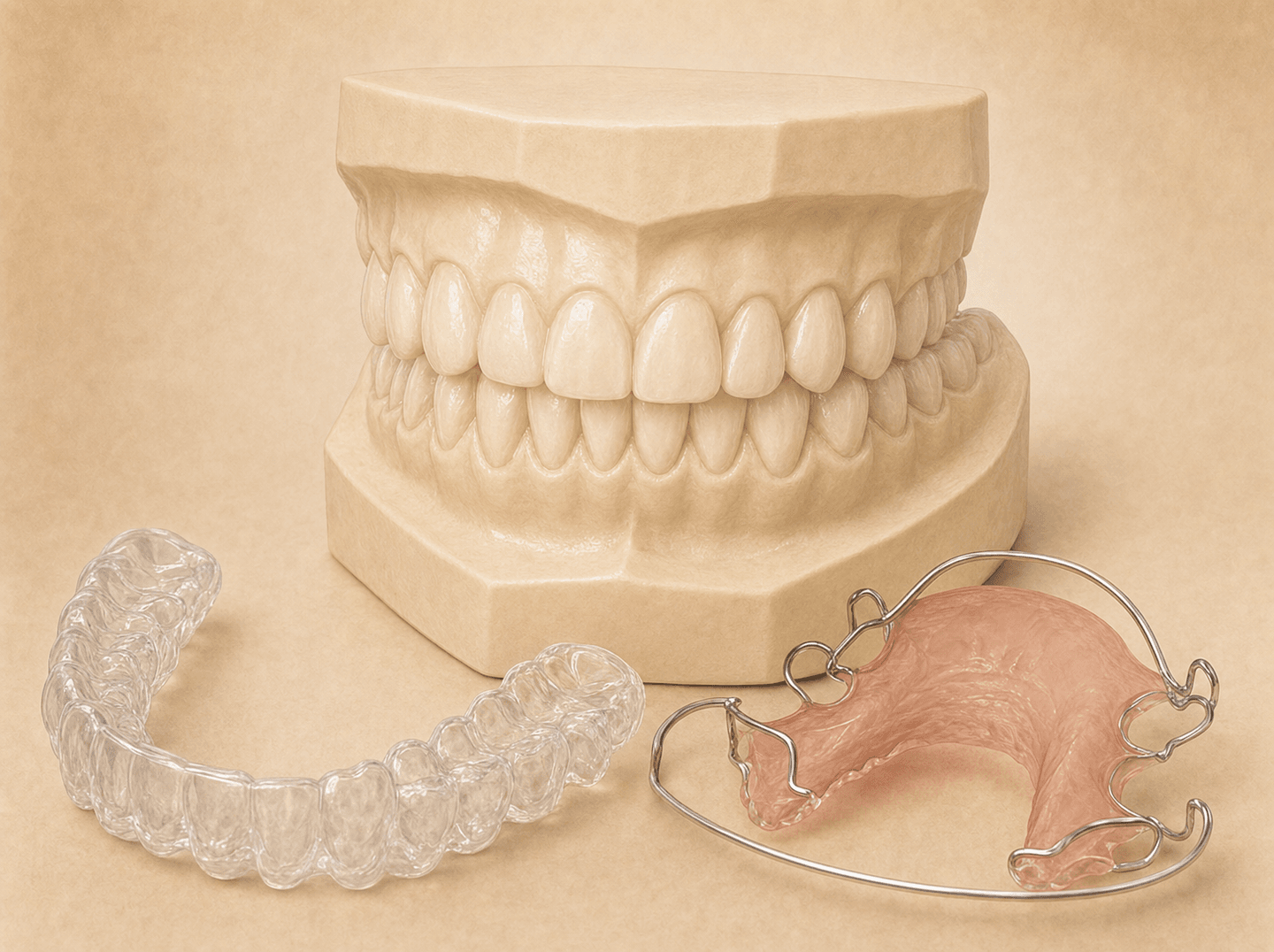
The retainer type doesn’t change the code. A removable Hawley, a clear Essix, or a bonded fixed wire all fall under D8680 for the initial retention phase. What defines the code is the event: treatment is finished, the appliances are coming off, and the patient is moving into retention.
The distinguishing axis: completion of treatment, not retainer work in general
This is the thing to get right. D8680 is the retention phase, the one that happens once, when active treatment ends. It is not a catch-all for anything involving a retainer. Several separate codes cover the rest of the retainer’s life, and reaching for D8680 on one of those is the common miscode.
- D8680 is initial retention: appliances off at completion, retainer built and placed.
- D8681 is a removable retainer adjustment, done later on a retainer the patient already has.
- D8695 is removal of fixed appliances for a reason other than completing treatment, the patient who transfers out or discontinues mid-case. That is not retention, because the case isn’t finished.
The split is the event, not the appliance and not who’s in the chair. Delivering the retainer the first time at the end of the case is D8680. Anything that happens to that retainer afterward, or any appliance removal that isn’t a completed case, is a different code.
Maintenance and repair are their own codes
Once a patient is in retention, the retainer can need work over the years. None of that is D8680, and the codes are now split per arch, which is the part older references get wrong.
- Re-cement or re-bond a fixed retainer: D8698 (maxillary), D8699 (mandibular).
- Repair a fixed retainer, including reattachment: D8701 (maxillary), D8702 (mandibular).
- Replace a lost or broken retainer: D8703 (maxillary), D8704 (mandibular).
If you’re working from an older code list, you may see a single re-cement or repair code where there are now arch-specific ones. Use the current per-arch codes, and report the arch you actually worked on. D8680 stays reserved for the original retention phase.
Coverage reality: retention is often inside the case fee
How D8680 pays comes down to how the plan handles the comprehensive case, and that is plan-dependent.
On many plans the comprehensive case fee under D8070, D8080, or D8090 is a global fee that already includes retention. On those plans D8680 pays nothing on its own, and the claim, if you file it at all, is informational. The retention was paid for inside the case.
On other plans, or other contracts, retention is a payable line and D8680 carries its own benefit. And on installment-paid cases, the D8680 claim can be the trigger for the final payment rather than a fee of its own. The carrier holds the last installment until it sees the case finished, and the retention claim is the completion signal.
The patient side matters just as much as the carrier side. If the practice quoted an all-in case fee that covers retainers, you can’t bill the patient a separate D8680 charge on top of it. The patient already paid for retention inside the case fee they agreed to. Whether retention is bundled or separate should be settled in the patient contract at the start of the case, not improvised at debond.
The debond claim and the final payment
Because some carriers pay comprehensive cases in installments, the end of the case is also a billing event, and D8680 is often the code that closes it out.
The pattern: the carrier pays an initial amount at banding, then periodic installments over treatment (often billed under D8670 against the contract), then holds the final installment until the case is confirmed complete. A D8680 retention claim is what confirms completion. File it with the final records and the last payment releases.
When to bill D8680
Bill D8680 when active orthodontic treatment is complete, the appliances are removed, and the retainer is constructed and placed. Typical situations:
- A comprehensive case under D8070, D8080, or D8090 reaches its end, the patient is debonded, and you deliver the retainer.
- A carrier paying the case in installments needs the completion event reported to release the final payment.
Do not bill D8680 for:
- Adjusting a retainer the patient already has. That’s D8681.
- Removing fixed appliances for a reason other than completing treatment, like a transfer or a discontinued case. That’s D8695.
- Re-cementing, repairing, or replacing a retainer down the line. Those are D8698 through D8704, by arch.
- A separate charge on a case whose comprehensive fee already covered retention, to either the patient or the carrier.
Documentation that supports the claim
Retention is the completion of the case, so the record should show the case actually finished. What supports a D8680 claim:
- The debond date, the date the appliances were removed and retention began, as the date of service.
- The original appliance-placement (banding) date and the comprehensive case it ties to, so the carrier can match retention to the right contract and installment schedule.
- The retainer type delivered (removable or fixed, which arch or arches), noted in the record.
- Final records where the carrier requires them, since some installment plans want completion documentation before releasing the last payment.
If you’re filing D8680 to release a final installment, treat it like the rest of the ortho claim: it has to point back to the original case, not float as a standalone procedure.
What to get right in your PMS
The exact menus differ across Open Dental, Dentrix, Eaglesoft, Curve, and Carestream, but the setup that prevents problems is the same:
- Decide at case start whether retention is bundled or separate. Set the patient contract so it’s clear whether the comprehensive fee includes the retainer or D8680 is a separate charge. Settling this at the start is what keeps debond from becoming a surprise bill.
- Flag carriers that hold the final installment for a debond claim. Mark the plans, Cigna among them, where the last payment won’t release until D8680 is filed, so the front office files it instead of waiting on a payment that isn’t coming.
- Carry the original banding date onto the D8680 claim. Like the periodic D8670 claims, the retention claim needs the case’s start date and link to the original approval so the carrier can match it to the contract.
- Keep retention separate from retainer maintenance in the code list. D8680 (initial retention), D8681 (adjustment), and the per-arch repair, re-cement, and replacement codes (D8698 to D8704) should be distinct line items so later retainer work doesn’t get coded as a second retention.
- Reconcile the final installment against the case balance. When the debond claim releases the last payment, post it against the original comprehensive case fee so the ledger closes the case out rather than showing retention as new revenue.
An ortho case is billed across its whole lifecycle. For how verification, the initial claim, continuation claims, and debond fit together, see the orthodontic insurance billing guide.
FAQs
- What is the dental code for placing a retainer after braces?
- When the patient finishes active orthodontic treatment, the appliances come off and the retainer goes in, that's D8680, orthodontic retention. It covers removing the appliances and constructing and placing the retainer or retainers at the end of the case. It applies whether the retainer is a removable Hawley, a clear Essix, or a bonded fixed wire. D8680 is the retention phase that completes treatment. It is not the adjustment of a retainer later (D8681), and it is not a repair or replacement code.
- Is D8680 billed separately or included in the orthodontic case fee?
- It depends on the plan, and this is where the money is. Many plans pay the comprehensive case as a global fee under D8070, D8080, or D8090 that already includes retention, so D8680 pays nothing on its own and the claim is informational. Other plans, or other contracts, treat retention as a payable event. The patient's contract matters too: if the practice quoted an all-in case fee that covers retainers, you can't turn around and bill the patient a separate D8680 charge. Confirm how the specific carrier and the patient contract handle retention before you promise either one a number.
- Why does Cigna want a D8680 claim before paying the final installment?
- Some carriers, Cigna most commonly, pay a comprehensive case in installments and hold the final installment until they have proof the case actually finished. A D8680 retention claim is that proof: it tells the carrier the appliances are off and the patient is in retention, which is the completion event. If a Cigna ortho ledger shows a lingering balance with active coverage and no payment in the window you expected, an unfiled D8680 is the usual reason. This is a plan-and-carrier behavior, not a universal rule, so verify the payout schedule, but on installment cases the debond claim is often what unlocks the last payment.
- What's the difference between D8680 and D8681?
- The event, not the appliance. D8680 is the retention phase at the end of treatment: taking the appliances off and building and placing the retainer the first time. D8681 is a removable orthodontic retainer adjustment, an appointment after the retainer is already delivered where you adjust it for fit, comfort, or function. D8680 happens once, at debond. D8681 happens later, on an existing retainer. If you're delivering the retainer for the first time it's D8680; if you're tuning a retainer the patient already has it's D8681.
- What code do I use if a fixed retainer breaks or the patient loses it?
- Not D8680. D8680 is the initial retention phase, not maintenance. For a fixed retainer that has come loose, re-cement or re-bond it under D8698 (maxillary) or D8699 (mandibular). To repair a fixed retainer including reattachment, use D8701 (maxillary) or D8702 (mandibular). To replace a lost or broken retainer, use D8703 (maxillary) or D8704 (mandibular). Repair and replacement of a retainer are separate from the original retention, and many plans treat them as patient responsibility, so verify coverage before quoting.
- Is D8680 a current CDT code for 2026?
- Yes. D8680 is active in CDT 2026 and reports orthodontic retention, removing the appliances and constructing and placing the retainer. The retainer maintenance codes around it were expanded in recent CDT cycles into per-arch repair, re-cement, and replacement codes (D8698 through D8704), so an older reference that lumps all retainer work together is out of date. D8680 itself remains the completion-of-treatment retention code. Removing fixed appliances for a reason other than completing treatment is a different code, D8695.
Related codes
Need help billing this code?
We handle D8680 claims daily.
If your team is spending time on denials, narratives, or carrier follow-up for this code, our outsourced dental insurance billing service can take it off your plate. We submit the claims, post what comes back, and follow up on anything unpaid. Already sitting on older claims that never paid? Our AR cleanup project works the backlog. Working the whole claim yourself? Start with our orthodontic insurance billing guide.
“Clear handles our verification, claims, and continuation billing, and they follow up on anything that doesn't pay. Nothing slips between visits anymore, and my team always knows who to reach.”
CDT codes are maintained by the American Dental Association. This page is an editorial billing guide, not the official ADA code descriptor. Verify current coverage policies with each carrier before submitting claims.