D8695 is the CDT code for removing fixed orthodontic appliances when treatment stops early, for a reason other than finishing the case.
- When to use: Braces come off mid-case because the patient transfers, discontinues, can no longer pay, or needs them removed for a medical reason.
- When not to use: Appliances removed at the end of a completed case are D8680, and repairing an appliance is D8696 or D8697.
- Billing note: Most plans pay only for the months treated, so file the claim, wait for the prorated payment, then settle any patient refund.
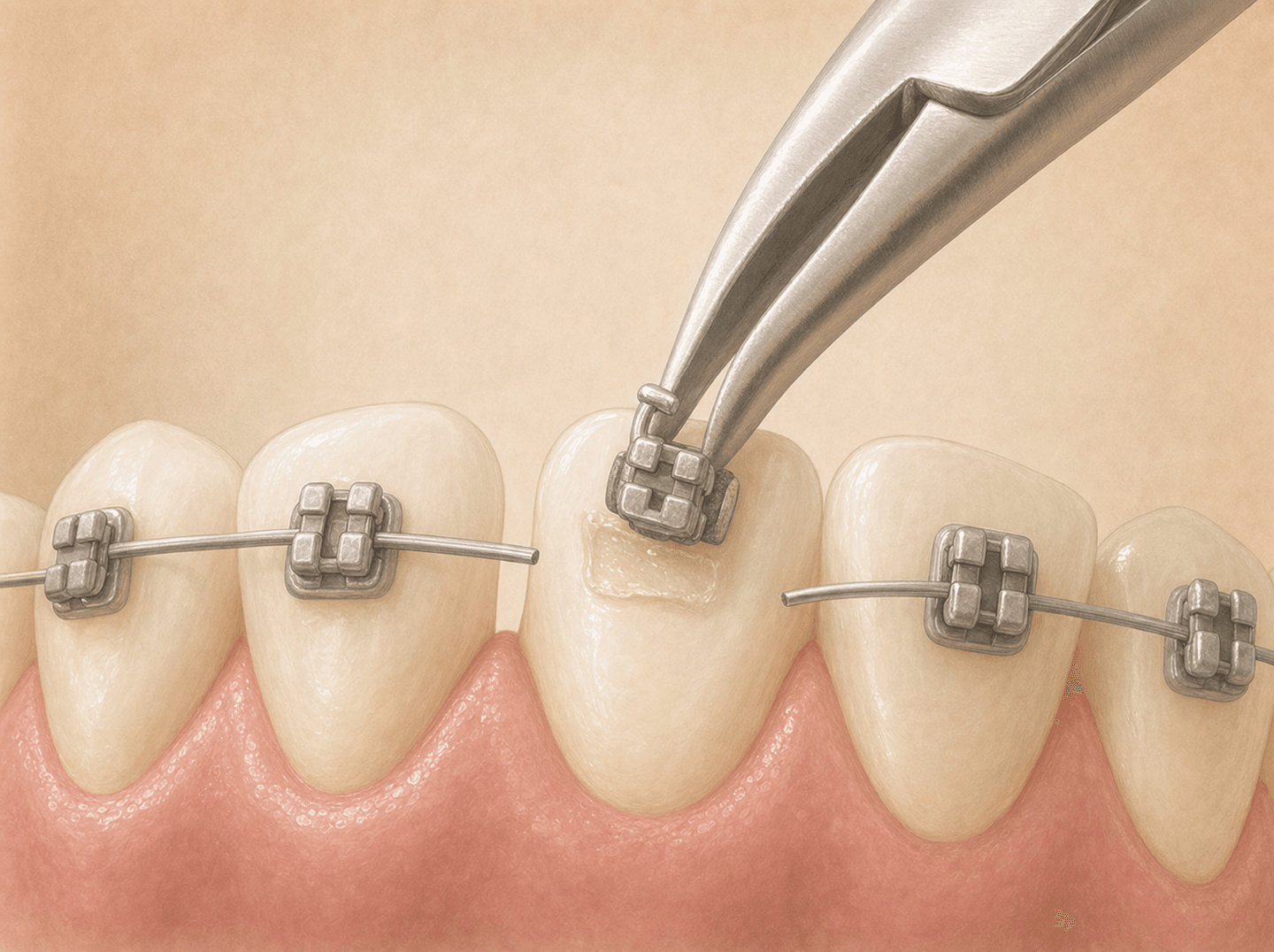
What D8695 covers
D8695 reports taking off fixed orthodontic appliances when the case is stopping early, for a reason other than completing treatment. The brackets and wires come off, but the patient is not finishing the case or moving into retention. Typical situations:
- A patient transfers to another provider and the appliances are removed before the move.
- A patient discontinues treatment, stops keeping appointments, or can no longer afford the case.
- A medical reason forces removal mid-treatment: an allergy to the appliance materials, an oral infection, or an MRI the brackets interfere with.
The circumstance defines the code, not the mechanics. Taking brackets off is the same physical act whether the case finished or not.
Do not bill D8695 for:
- Appliances removed because treatment is complete. That’s retention, D8680.
- Adjusting a removable retainer the patient already has. That’s D8681.
- Repairing an orthodontic appliance. That’s D8696 (maxillary) or D8697 (mandibular).
- Re-cementing or re-bonding a fixed retainer. That’s D8698 (maxillary) or D8699 (mandibular).
Stopping early versus completing: D8695 and D8680
The same step, appliances off, ends two different events:
- D8680 is orthodontic retention. The appliances come off because treatment is complete, and the retainer is built and placed.
- D8695 is removal because treatment is stopping early. There is no retainer phase, because the case isn’t finished.
The split is the reason the appliances come off, not the appliance type, the arch, or the provider. A patient who transfers gets D8695. A patient who finishes and gets a retainer gets D8680.
The two also do different billing work. On installment-paid comprehensive cases, D8680 is often the claim that confirms completion and releases the final payment, and some carriers hold that installment until a debond claim is on file; confirm this on the specific contract. D8695 closes nothing out on the carrier’s terms and triggers no final payout. It is far more likely to sit alongside a proration calculation.
Coverage reality: proration and capturing what’s owed
How an early-termination case pays is plan-dependent, but the usual pattern is proration. Ortho benefits typically pay over the treatment term: an initial amount at banding, then installments across the active months, often reported under D8670 against the contract. When the case ends early, the plan generally pays for the months treated up to the removal date and no further.
- File the claim even on a discontinued case. The months already treated still count. D8695, tied to the original case and banding date, is how you capture what the plan covers up to the cutoff.
- Reconcile the patient side against the prorated benefit, not the full contract. If the patient prepaid or financed the full case fee, an early stop usually means a refund or adjusted balance, and the amount depends on what the plan paid.
- Watch the lifetime maximum. Ortho draws on a lifetime maximum, not an annual one. A partially used benefit leaves less for treatment restarted elsewhere. Note the remaining amount on the patient’s record so the patient and the next provider know what’s left.
The transfer-out handoff
Many D8695 cases are transfers to another orthodontist. The receiving office has to bill the rest of the treatment as a work in progress, and it can only do that with your history:
- The original banding date, the treatment start date the next office will reference.
- The estimated months of treatment completed at removal, so the receiving provider can show the remaining term.
- What the plan paid, documented with the EOBs, so the next office and carrier can continue the sequence without double-counting the lifetime maximum.
That history goes in the Box 35 remarks on the claim. Some carriers want the original banding date in the remarks rather than the main date field and will deny if it’s placed wrong, which is plan-dependent. A patient who arrives at the new office with brackets off and no history is a billing problem handed downstream.
Documentation that supports the claim
Because D8695 hinges on why treatment stopped, the record has to establish the reason, not just the removal:
- The reason the case ended: transfer, discontinuation, financial, or medical.
- The date of service, the date the appliances were removed, which anchors the proration.
- The original comprehensive case and banding date the claim ties back to.
- The months of treatment completed at removal.
- The prior EOBs, documenting what the plan already paid against the case.
On a transfer, this record is what determines whether the patient’s remaining benefit survives the move.
An ortho case is billed across its whole lifecycle. For how verification, the initial claim, continuation claims, and debond fit together, see the orthodontic insurance billing guide.
FAQs
- What is the dental code for removing braces early?
- D8695, removal of fixed orthodontic appliances for a reason other than finishing the case. It applies when a patient transfers to another provider, discontinues treatment, can no longer afford the case, or needs the brackets removed for a medical reason like an MRI. If the appliances come off because the case is done and the patient is moving into a retainer, that's D8680 (orthodontic retention).
- What's the difference between D8695 and D8680?
- The reason the appliances come off. D8680 is retention at the end of a completed case: appliances removed and the retainer built and placed. On installment plans it can release the final payment. D8695 is removal when treatment stops early, for a transfer, discontinuation, or a financial or medical reason. It ends the case before its term, so the benefit usually pays only for the months actually treated.
- How does insurance pay D8695 on a case that stops mid-treatment?
- Usually by proration, though it is plan-dependent. Most ortho benefits pay a comprehensive case over its term, an initial amount at banding and then installments. When the case stops early, the plan typically pays only for the months delivered up to removal. File the claim to capture what the plan covers, and confirm the carrier's early-termination handling before you reconcile the ledger or refund the patient.
- What do I put on the claim and in the patient's record for an early removal?
- The reason treatment stopped and the date the appliances came off; those are what separate D8695 from a normal debond. Tie the claim to the original comprehensive case and banding date so the carrier can prorate. On a transfer, put the original banding date and estimated months of treatment completed in the Box 35 remarks, and keep the prior EOBs, because the next office needs that history to bill the remaining care as a work in progress.
- Is D8695 the same as a retainer or appliance repair code?
- No. D8695 is removal of fixed appliances when a case stops early. Adjusting a removable retainer is D8681, repairing an orthodontic appliance is D8696 (maxillary) or D8697 (mandibular), and re-cementing or re-bonding a fixed retainer is D8698 (maxillary) or D8699 (mandibular).
- Is D8695 a current CDT code for 2026?
- Yes. D8695 is active in CDT 2026 and was not added, deleted, or revised in the 2026 update, so its prior meaning holds. It sits next to D8680 (orthodontic retention) and the appliance and retainer repair codes (D8696 through D8699), which are separate procedures.
Related codes
Need help billing this code?
We handle D8695 claims daily.
If your team is spending time on denials, narratives, or carrier follow-up for this code, our outsourced dental insurance billing service can take it off your plate. We submit the claims, post what comes back, and follow up on anything unpaid. Already sitting on older claims that never paid? Our AR cleanup project works the backlog. Working the whole claim yourself? Start with our orthodontic insurance billing guide.
“Clear handles our verification, claims, and continuation billing, and they follow up on anything that doesn't pay. Nothing slips between visits anymore, and my team always knows who to reach.”
CDT codes are maintained by the American Dental Association. This page is an editorial billing guide, not the official ADA code descriptor. Verify current coverage policies with each carrier before submitting claims.