D9128 is the CDT code for the first 15 minutes of a photobiomodulation session, low-level light therapy used to ease pain and inflammation.
- When to use: PBM is a distinct therapeutic step for a documented indication, such as healing after an extraction, and not incidental laser use.
- When not to use: Each additional 15 minutes, even a partial block, is D9129, and surgical or cutting laser work is coded by the procedure performed.
- Billing note: Most plans deny D9128 as experimental in 2026, so collect from the patient at the visit and still file the claim.
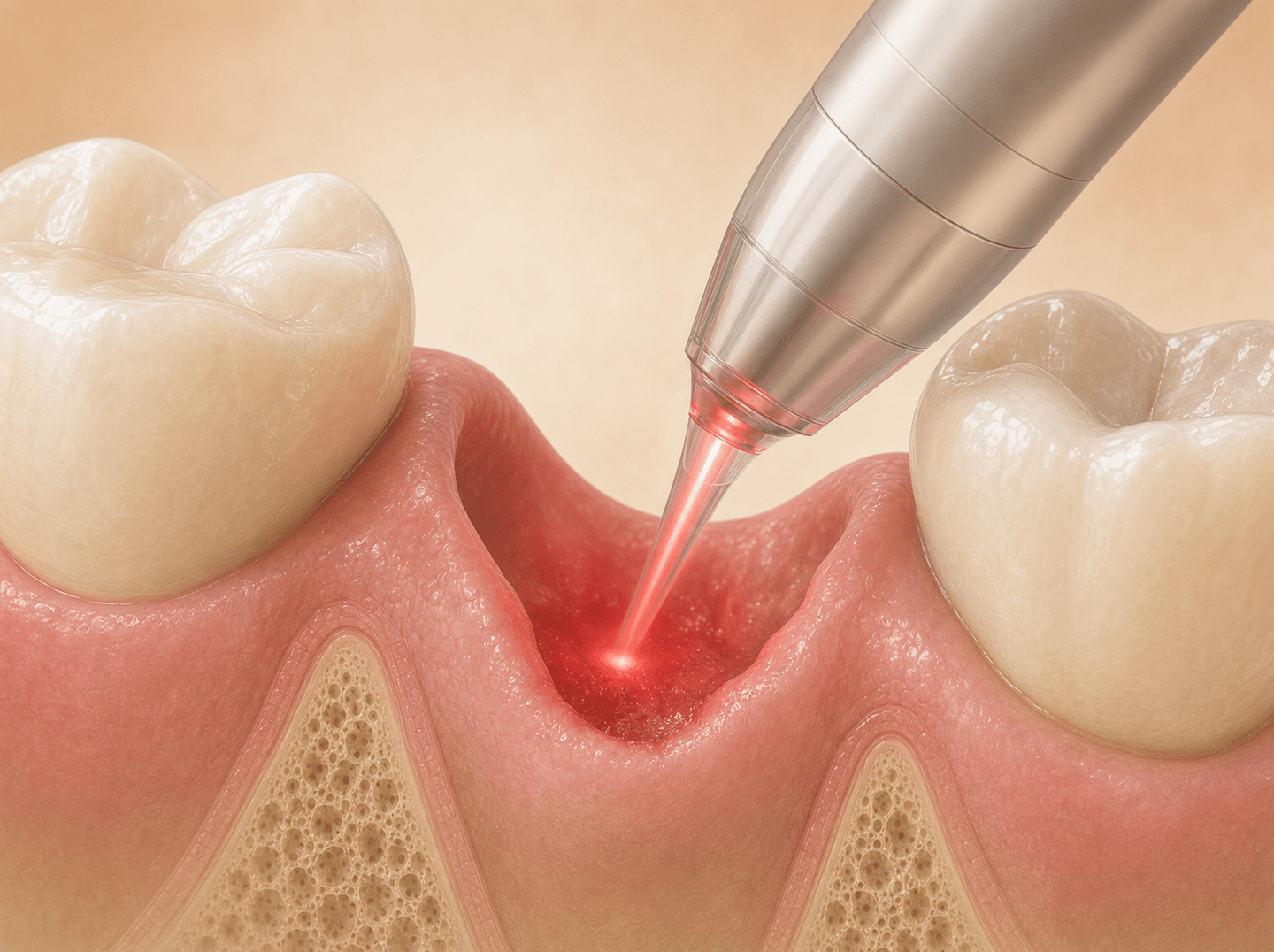
What D9128 covers and does not cover
D9128 reports the first 15-minute increment of photobiomodulation (PBM) therapy in a dental setting. PBM applies specific wavelengths of light, typically red or near-infrared at 600 to 1000 nm, to tissue at low power densities. It promotes cellular repair, reduces inflammation, and modulates pain signaling. The code isn’t limited to one indication: it applies to any intraoral or perioral PBM application the dentist provides for a therapeutic purpose.
Bill D9128 when:
- PBM is performed as a distinct therapeutic step for a documented clinical indication.
- Light is actually applied to tissue. A session shorter than 15 minutes is still one unit of D9128.
- The therapy is performed by or under the supervision of the treating dentist.
It does not cover:
- Time beyond the first 15 minutes. Use D9129 for each additional 15-minute increment.
- Setup, patient positioning, or equipment calibration. The increment starts when light reaches tissue.
- Diagnostic laser use (caries detection, fluorescence imaging). Those fall under the diagnostic code family.
- Soft-tissue laser surgery (gingivectomy, frenectomy, incision and drainage), coded under oral surgery or periodontics. A soft-tissue laser used during a gingivectomy already coded as D4210 is incidental, not D9128.
- Hard-tissue laser procedures (cavity preparation, crown lengthening with laser), coded by the procedure performed, not the tool.
- Cosmetic light treatments such as whitening with LED activation, which has its own codes.
- Incidental light exposure that isn’t part of a defined PBM protocol, whatever its length.
D9128 is therapeutic light at sub-thermal power. If the laser is cutting, ablating, or curing, the procedure is something else.
Clinical applications in dentistry
The most common scenarios for D9128:
- Post-extraction healing. Applied to the extraction site to reduce inflammation and speed socket healing. Often paired with D7140 (simple extraction) or D7210 (surgical extraction).
- Post-implant placement. Applied around the implant site to support osseointegration and reduce post-operative discomfort.
- Post-periodontal therapy. Applied after scaling and root planing (D4341/D4342) or periodontal flap surgery to promote soft-tissue healing.
- TMJ pain management. Applied to the temporomandibular joint area to reduce inflammation and pain. Also a candidate for medical cross-coding.
- Oral mucositis management. Applied to mucositis lesions, particularly in patients undergoing cancer therapy. One of the stronger evidence-based applications.
- Aphthous ulcer treatment. Applied to recurrent aphthous ulcers to reduce pain and healing time.
- Post-orthodontic pain. Applied after orthodontic adjustments. Less commonly billed but clinically documented.
- Nerve regeneration. Applied for paresthesia after third molar extraction or implant placement to support nerve recovery.
The clinical indication is the billing justification. Owning a PBM device is not. The chart must document the specific condition and why PBM was appropriate for that patient.
D9128 and D9129: first increment versus additional increments
D9128 covers the first 15 minutes. D9129 covers each 15-minute block after that, and both descriptors count a partial block as a whole one, so D9129 becomes reportable as soon as treatment passes 15 minutes. The structure resembles the time-based codes for anesthesia and sedation.
Billing by elapsed treatment time:
- 1 to 15 minutes: D9128 x 1.
- 15:01 to 30:00: D9128 x 1, D9129 x 1.
- 30:01 to 45:00: D9128 x 1, D9129 x 2.
- 45:01 to 60:00: D9128 x 1, D9129 x 3.
Count light-on-tissue time, not chair time. A 30-minute appointment with 10 minutes of setup, 15 minutes of treatment, and 5 minutes of cleanup is one unit of D9128. Carriers may still apply their own time or unit edits, so verify per plan.
New code, carrier lag: the 2026 reality
D9128 is new in CDT 2026. Based on prior new-code cycles, most commercial carriers have not yet added it to their fee schedules or coverage tables. Claims will come back as “code not recognized,” “not a covered benefit,” “experimental/investigational,” or processed at $0 allowed. A few carriers may start mapping the code to an adjunctive-services benefit, but wide adoption is unlikely before 2027.
For the front desk: quote PBM as patient-pay unless you have confirmed coverage with the specific carrier. Having a code and having coverage are different things.
For billing: submit D9128 anyway, even when you expect denial. The claim creates a utilization record, and carrier coverage decisions are influenced by claim volume. If no one bills the code, carriers have no data to build a policy around.
For the PMS: confirm D9128 and D9129 are active after the CDT 2026 update, or add them manually with the code, description, and office fee. Set a fee for both that reflects the practice’s costs (device amortization, consumables, provider time) and the local market.
The “experimental/investigational” exclusion
The most common D9128 denial will be “experimental or investigational procedure,” not “code not recognized.” It is harder to appeal because it comes from the plan’s contract language, not the claims system.
- Code not recognized: the carrier’s system hasn’t been updated for CDT 2026. This resolves as carriers update their code tables. You can call the carrier, reference the ADA’s CDT 2026 code list, and request a manual review.
- Experimental/investigational: the benefit contract excludes procedures the carrier classifies as experimental. The ADA publishing a code doesn’t mean the carrier’s medical/dental policy committee has reviewed the evidence and moved PBM out of that category.
Appealing an experimental exclusion requires peer-reviewed studies supporting PBM for the specific indication (post-surgical healing, mucositis, TMJ). The ADA’s recognition of the code is a supporting data point but not decisive; carriers make independent coverage determinations.
For most practices in 2026, the practical approach is to bill PBM as patient-pay, submit the claim for the utilization record, and revisit coverage annually. Note each carrier’s response on the carrier record (“D9128 denied as experimental, 3/2026” or “D9128 paid at $X, 6/2026”) so the front desk can quote accurately as carriers begin recognizing the code over 2026 and 2027.
Documentation that supports the claim
Document PBM fully even when it is patient-pay, in case of an audit, retroactive coverage, a patient dispute, or a state board question about the therapy.
The claim needs:
- Date of service.
- D9128, and D9129 with units if applicable.
- The code for any associated procedure on the same date, on the same claim.
The patient record should show:
- Clinical indication. For example, post-extraction inflammation, TMJ pain, or an aphthous ulcer.
- Wavelength in nanometers (for example, 810 nm or 660 nm).
- Power density in milliwatts per square centimeter (mW/cm2).
- Total energy delivered in joules per square centimeter (J/cm2), if the device tracks it.
- Duration. Light-on-tissue time in minutes, with start and end times.
- Area treated. For example, “buccal and lingual mucosa surrounding extraction site #30.”
- Treatment protocol. Continuous or pulsed, distance from tissue, number of points treated.
A PBM note template with these fields keeps anything from being missed.
Example case
A 52-year-old patient has a surgical extraction of an impacted lower left third molar (tooth #17, D7210). Right after the site is irrigated and sutured, the surgeon applies PBM to the site with an 810 nm diode laser at 200 mW/cm2 in continuous mode. Light application runs from 10:42 AM to 11:00 AM, 18 minutes, over the buccal mucosa, lingual mucosa, and the socket in a slow-scanning pattern. The patient then gets post-op instructions and is discharged.
Billing steps:
- The plan does not cover PBM. Quote the D9128 fee as patient-pay before the procedure and collect at time of service.
- Submit on the date of service:
- D7210 on tooth #17.
- D9128 x 1, expecting denial or $0 payment.
- D9129 x 1. The session was one full 15-minute block plus 3 minutes into a second, and D9129 counts a partial block as a whole one. A carrier may still deny it on a time or unit edit, which in 2026 is the likely outcome regardless.
- If the carrier denies D9128 as experimental, note it on the carrier record. An appeal isn’t cost-effective here unless the practice is building a systematic case for coverage with that carrier.
- If the carrier unexpectedly pays, post the payment and refund the patient the covered portion.
FAQs
- Is photobiomodulation therapy covered by dental insurance?
- Rarely, in 2026. Most dental carriers classify PBM/LLLT as experimental or investigational, and plan language excluding experimental procedures blocks coverage even with the new CDT code. A few plans may cover it when documented as medically necessary for post-surgical healing or pain management. Verify the specific plan before quoting coverage.
- What is the difference between D9128 and D9129?
- D9128 covers the first 15 minutes of photobiomodulation therapy. D9129 covers each 15-minute block after that, and a partial block counts. A 30-minute session is D9128 once and D9129 once; a 45-minute session is D9128 once and D9129 twice; an 18-minute session is D9128 once and D9129 once. Count actual treatment time, not setup or teardown. Individual carriers may still apply their own time or unit edits.
- Can D9128 be billed alongside the procedure it supports?
- Yes. D9128 is a separate line on the same date of service as the procedure it supports, such as an extraction, implant placement, or periodontal surgery, and is not bundled into the surgical code. Some carriers may deny it as inclusive of the primary procedure. If so, appeal with documentation showing PBM as a distinct therapeutic step.
- Should I bill D9128 to medical insurance instead?
- Possibly, for some indications. PBM for TMJ pain or post-surgical inflammation may be billable to medical insurance under CPT codes rather than CDT. Medical cross-coding is beyond the scope of this guide, but it is worth exploring with a medical billing specialist if your practice performs PBM regularly for pain or TMJ.
- What documentation does D9128 require?
- At minimum: the clinical indication, wavelength (nanometers), power density (milliwatts per square centimeter), treatment duration, anatomic area treated, and the protocol or rationale. Without this detail, a carrier that does consider coverage will pend or deny for insufficient documentation.
Related codes
Need help billing this code?
We handle D9128 claims daily.
If your team is spending time on denials, narratives, or carrier follow-up for this code, our outsourced dental insurance billing service can take it off your plate. We submit the claims, post what comes back, and follow up on anything unpaid.
“Claims, posting, denials, all of it gets handled, and it costs far less than hiring another employee. My front desk got hours of their week back, and honestly I just don't think about billing anymore.”
CDT codes are maintained by the American Dental Association. This page is an editorial billing guide, not the official ADA code descriptor. Verify current coverage policies with each carrier before submitting claims.