D0250 is the CDT code for a flat extraoral X-ray of the skull or jaws, taken with the tube and detector held still.
- When to use: The dentist orders a stationary extraoral view of the skull, sinuses, or jaw, such as after facial trauma or to check the maxillary sinus.
- When not to use: A rotating panoramic is D0330, a cephalometric image with analysis is D0340, and an extraoral image of the posterior teeth in both arches is D0251.
- Billing note: Each image is its own D0250 line, and trauma imaging often belongs on the medical claim, so check medical coverage first.
What D0250 covers
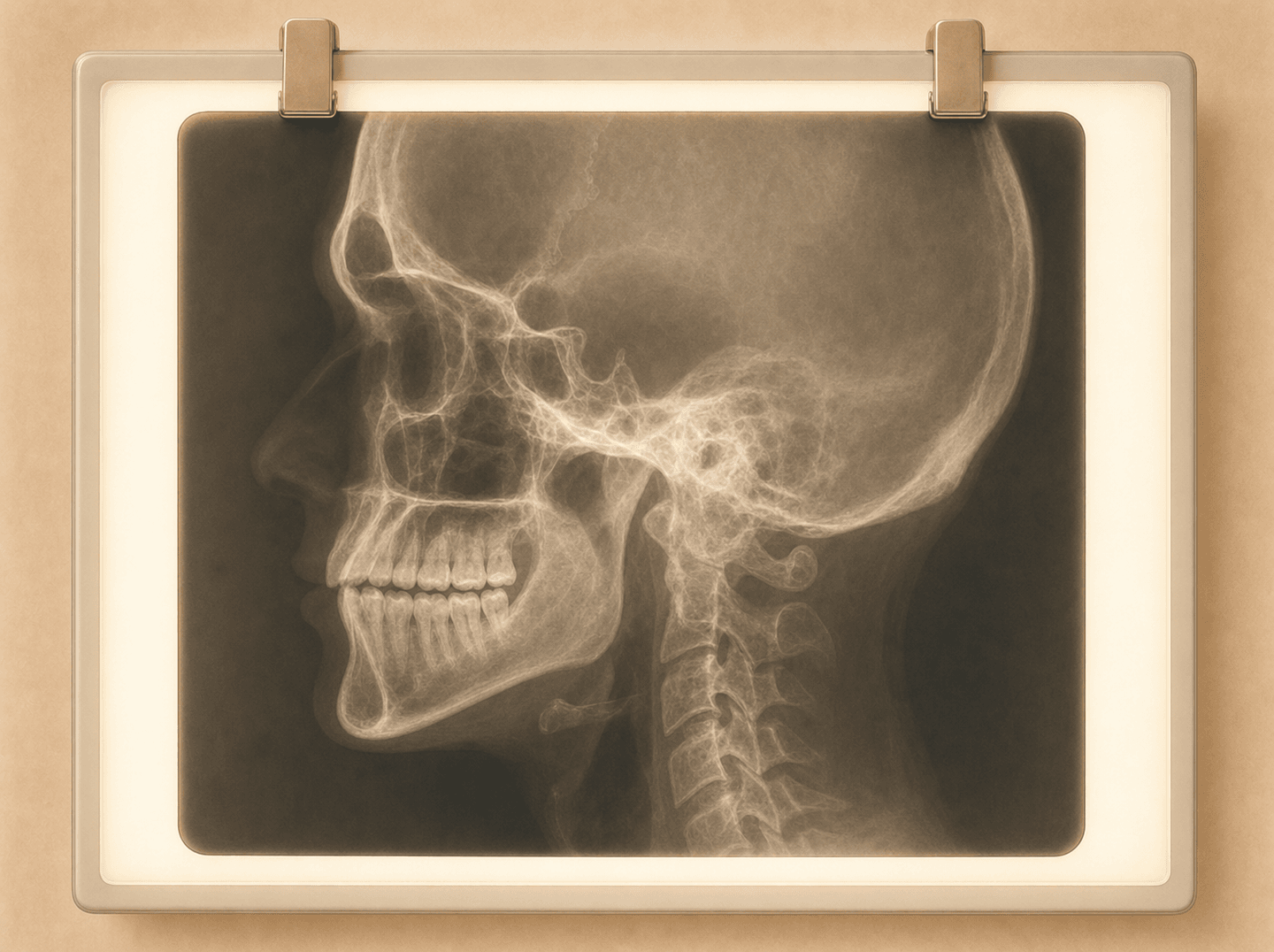
D0250 is the catch-all for traditional extraoral projection films. The patient’s head is positioned, the tube and detector stay fixed, and one flat image is exposed. Common views include the lateral skull, the posterior-anterior skull, the submentovertex, the Waters view for the maxillary sinuses, the lateral oblique of the mandibular body, and the lateral ramus.
In a general office these images are rare. They show up in oral surgery, trauma workups, sinus questions, and offices that still use a cephalostat for non-orthodontic views. Most practices bill D0250 a few times a year, which is exactly why it gets miscoded when it does come up.
How it differs from the other extraoral codes
The extraoral codes are separated by how the image is made and what the code bundles in.
- D0330, panoramic. The tube and detector rotate around the head to produce one curved, tomographic view of both arches. Rotation is the line: D0250 is stationary.
- D0340, 2D cephalometric. A cephalometric image, usually a lateral skull, taken for cephalometric analysis. Its descriptor includes acquisition, measurement, and analysis. If the lateral skull was taken to trace and measure for orthodontic planning, it is D0340. If the same projection was taken to look at a fracture or a foreign body, it is D0250.
- D0251, extraoral posterior. Limited to the complete posterior teeth of both arches, as a unique image. In practice it is usually the extraoral bitewing-style capture on a pan unit, not a skull projection.
- Cone beam CT. A 3D volume, coded by field of view, from D0364 for a limited field to D0367 for both jaws, with D0368 for a TMJ series. A 2D slice or projection pulled from a billed CBCT is not a separate D0250.
One line per image
D0250 is a per-image code. The 2016 CDT revision removed “first” from its descriptor and deleted D0260, the old “each additional image” code. The practical rule is simple: count the exposures and report that many units of D0250.
A trauma series is the usual example. A patient who took an elbow to the jaw in a pickup basketball game arrives at an oral surgery office. The surgeon orders a posterior-anterior view and a lateral oblique of each side of the mandible to look for a fracture line. That is three images, so the claim carries D0250 three times. A panoramic taken at the same visit adds a D0330 line; the pan does not absorb the skull views, and the skull views do not absorb the pan.
Coverage and the medical claim
Dental plans treat D0250 unevenly. Many cover it when it is tied to a recognizable diagnostic need such as trauma, pathology, or a sinus question, and some exclude extraoral films outside a pan entirely. It is not on every Medicaid schedule. Kentucky Medicaid’s 2026 dental fee schedule lists D0330 and D0340 but not D0250.
Facial trauma and sinus imaging also cross into medical coverage, billed with medical codes rather than CDT. When the injury came from an accident or the question is sinus disease, check the patient’s medical plan before sending the dental claim, and document the clinical reason for each view so either payer can see why it was taken.
The capture-only gap
CDT 2021 added image-capture-only codes for offices that take an image another provider interprets: D0701 for a panoramic, D0702 for a 2D cephalometric, D0705 for an extraoral posterior image, and intraoral and photographic equivalents. There is no capture-only twin of D0250. If your office only takes the skull views and a radiologist reads them, D0250 is still the only extraoral 2D projection code, and the interpretation question has to be worked out with the payer.
FAQs
- What is the D0250 dental code?
- D0250 reports a two-dimensional extraoral radiograph made with the x-ray source and detector held stationary. Typical examples are the classic skull and jaw projections: a lateral skull, a posterior-anterior skull, a submentovertex view, a Waters sinus view, an oblique view of the mandibular body, and a lateral ramus view. The list is not exhaustive.
- How do I bill more than one D0250 image?
- Report D0250 once per image. Before 2016, CDT split extraoral films into a first image (D0250) and each additional image (D0260). D0260 was deleted for CDT 2016 and D0250 was rewritten without the word 'first', so a three-view trauma series is three units of D0250. Some payers want separate lines and some want a quantity; follow the payer's claim format.
- Is a panoramic X-ray billed as D0250?
- No. A panoramic image is D0330. The panoramic unit rotates the tube and detector around the head during the exposure, which is the opposite of the stationary setup D0250 describes. Billing a pan as D0250 misstates the service.
- Is there a capture-only version of D0250?
- No. The capture-only codes added in CDT 2021 cover the panoramic (D0701), the 2D cephalometric (D0702), the extraoral posterior image (D0705), and several intraoral and photographic images. None corresponds to D0250, so an office that captures these views for a separate reader has no capture-only code to report.
Related codes
Need help billing this code?
We handle D0250 claims daily.
If your team is spending time on denials, narratives, or carrier follow-up for this code, our dental insurance verification service can take it off your plate. We submit the claims, post what comes back, and follow up on anything unpaid.
“Claims, posting, denials, all of it gets handled, and it costs far less than hiring another employee. My front desk got hours of their week back, and honestly I just don't think about billing anymore.”
CDT codes are maintained by the American Dental Association. This page is an editorial billing guide, not the official ADA code descriptor. Verify current coverage policies with each carrier before submitting claims.