D0273 is the CDT code for a set of three bitewing X-rays taken at the same visit and billed as one line.
- When to use: Exactly three bitewing images are taken, often two on a side with full molars and premolars and one on a side with missing back teeth.
- When not to use: Two images are D0272, four are D0274, a vertical set of seven to eight is D0277, and an extraoral bitewing-mode image is D0251.
- Billing note: Most plans pool frequency across the horizontal bitewing codes, so a D0273 inside the window of a prior one-, two-, three-, or four-image set usually denies.
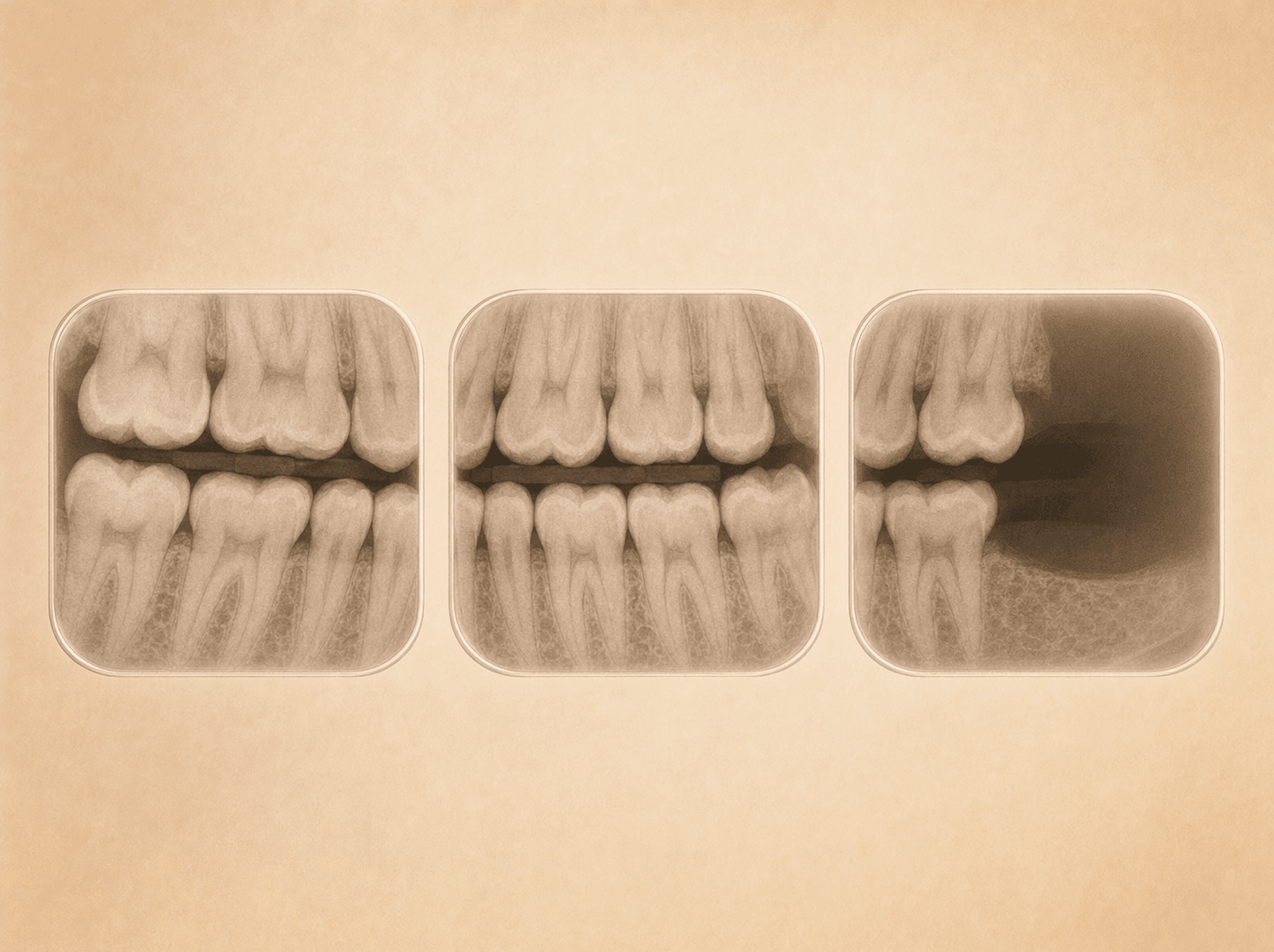
What D0273 reports
D0273 is the three-image member of the bitewing family. A bitewing shows the crowns of the upper and lower back teeth together, with the contacts opened, so the dentist can read interproximal decay and the crest of the bone. The family is coded strictly by image count, not by which teeth appear or why the images were taken:
- D0270, one image.
- D0272, two images.
- D0273, three images.
- D0274, four images.
- D0277, a vertical series of seven to eight images.
Three is the uneven count, and that is the clue to when it applies.
Why the set is three
Horizontal bitewings normally come in matched pairs, one or two per side. A three-image set means the two sides were not imaged the same way. Typical reasons:
- An asymmetric adult arch. The right side still has premolars and two molars and needs separate premolar and molar images to see every contact. The left side lost its molars years ago, and one image captures what remains.
- Mixed dentition. A child whose permanent first molars are in on one side but whose second primary molar on the other side is still the last tooth may need an extra image on just one side.
- A targeted add-on. The dentist planned two bitewings, then asked for one more view of a specific contact before the patient left the chair. All three images were taken at the same visit, so they report together as D0273.
The chart note should say which areas were imaged. When a reviewer sees an odd count, the note explains it without a phone call.
A claim that went sideways
An office takes two bitewings on the right side of a 58-year-old patient and one on the left, where she has lost her upper and lower molars. The assistant posts D0272 for “the right side” and D0270 for “the left side.” The carrier processes D0272, then denies D0270 as a frequency duplicate because both lines carry the same date and the plan allows one bitewing series per year.
The fix is to correct the claim to one line of D0273. The patient’s annual bitewing benefit is spent either way; the difference is that D0273 reports the service as it happened and pays the three-image allowance, rather than a two-image fee plus a denial.
Frequency and the full-series overlap
Most plans allow bitewings once or twice per benefit year and pool the limit across D0270 through D0274. Vertical bitewings (D0277) are often limited separately or counted against the full-series limit instead, depending on the plan. A three-image set taken inside the horizontal bitewing window usually denies on frequency whatever count the earlier set was. Some plans also deny bitewings taken within a set period of a full-mouth series (D0210), because the series already includes interproximal coverage.
Watch the same-day total, too. When bitewings and periapicals (D0220) on one date add up to or exceed the plan’s full-series fee, many carriers pay them as if a D0210 had been billed, which can also use up the full-series frequency. Confirm the patient’s last bitewing date and last full series during verification.
Not every bitewing-shaped image is D0273
A panoramic unit running a bitewing program captures the posterior teeth from outside the mouth. That is D0251, reported per extraoral image actually captured, not D0273, however many views the software displays. D0273 describes three intraoral images on film or a sensor inside the mouth.
FAQs
- When would a dentist take three bitewings instead of two or four?
- When the two sides of the mouth need different coverage. A side with a full row of premolars and molars usually needs two images to open the contacts, while a side with missing molars or a shorter arch can be read in one. Three images is also common in mixed dentition, when erupting molars on one side need an extra view.
- Can I bill D0272 and D0270 instead of D0273?
- No. Three bitewings taken at one visit are one line of D0273. Splitting the set into a two-image code plus a single-image code misreports the service, and carriers that see both on one date typically rebundle or deny one line.
- Does a retaken bitewing count toward the three?
- Generally not. Code the set by the diagnostic images the dentist used. If a fourth exposure was a retake of a blurred or cone-cut film, the set is still three images and still D0273. Most carriers do not pay for retakes, and billing a retake as an extra image inflates the code.
- Do plans pay D0273 more than D0272?
- Usually, but not on a fixed ratio. Fee schedules set each count separately and they do not always scale with the number of images. Kentucky Medicaid's 2026 schedule, for example, pays more for D0273 ($39.00 for patients under 21) than for D0274 ($37.38). Read the allowable for each code rather than assuming three images pay three-quarters of four.
Related codes
Need help billing this code?
We handle D0273 claims daily.
If your team is spending time on denials, narratives, or carrier follow-up for this code, our dental insurance verification service can take it off your plate. We submit the claims, post what comes back, and follow up on anything unpaid.
“Claims, posting, denials, all of it gets handled, and it costs far less than hiring another employee. My front desk got hours of their week back, and honestly I just don't think about billing anymore.”
CDT codes are maintained by the American Dental Association. This page is an editorial billing guide, not the official ADA code descriptor. Verify current coverage policies with each carrier before submitting claims.