D1355 is the CDT code for applying a caries-preventive medicament to a sound, at-risk tooth surface to stop decay before it starts, reported one tooth at a time and not counting topical fluoride.
The single biggest miscode is treating it as the twin of D1354, the caries-arresting code. They look identical at the chair because both can use silver diamine fluoride, but D1355 is for a tooth with no cavity yet and D1354 is for a tooth with an active lesion. The other trouble spots are billing it once for a multi-tooth visit when it is per tooth, slipping a topical fluoride application under it, and assuming coverage on a benefit that plans treat inconsistently.
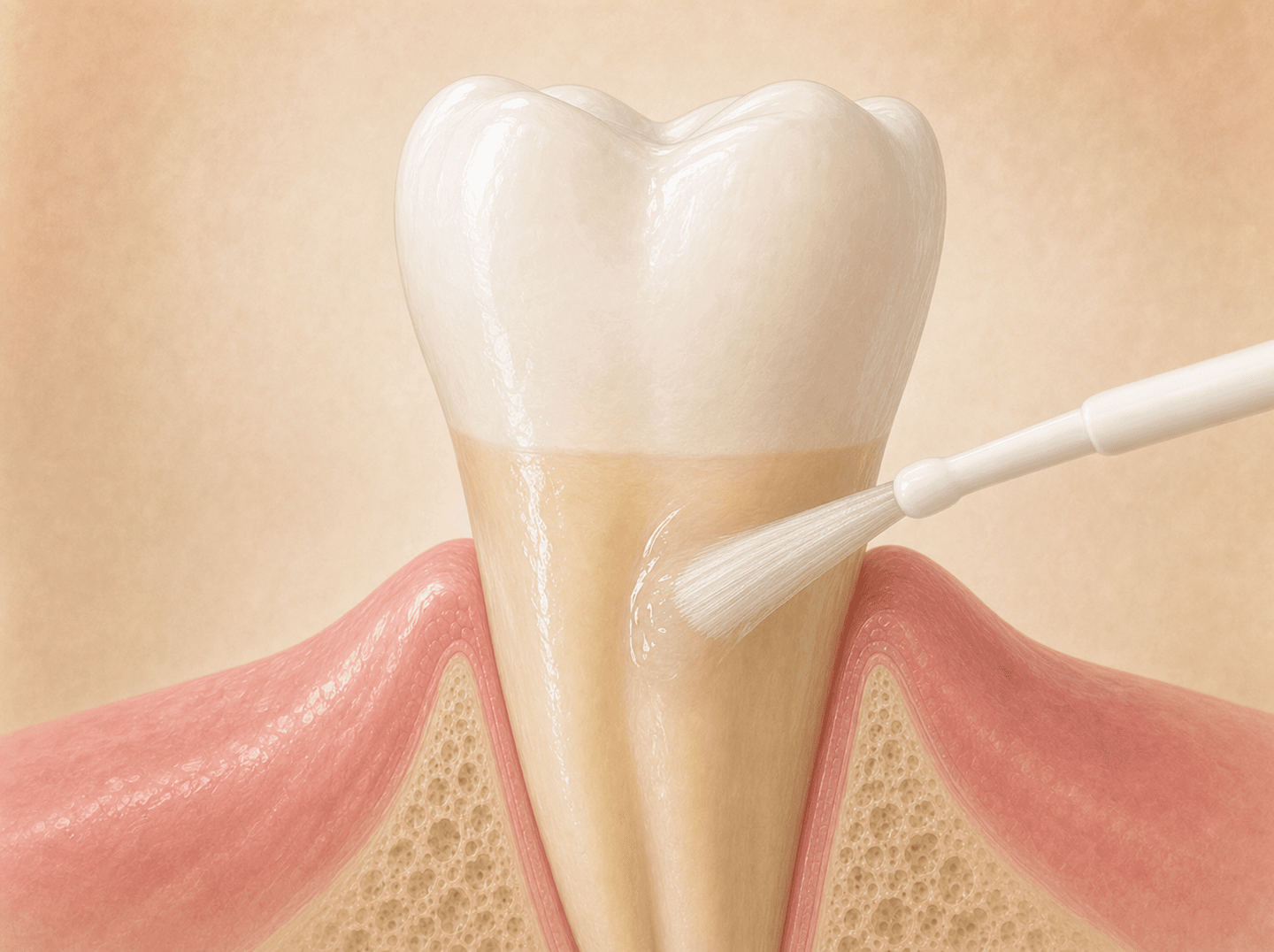
What D1355 covers
D1355 reports the application of a caries-preventive medicament to a single tooth that does not have an active cavity. The medicament is applied to a sound or at-risk surface to keep decay from starting or to support remineralization in a patient assessed at elevated caries risk. It is reported per tooth, so the unit of billing is the tooth, not the visit.
Two facts about the code drive everything downstream. The first is intent: D1355 is prevention. There is no carious lesion on the surface being treated. The second is what it leaves out: topical fluorides are excluded. The medicaments that belong under D1355 are the non-fluoride preventive agents, with silver diamine fluoride, silver nitrate, and chlorhexidine or thymol varnishes the ones used most.
The code is for the medicament application itself. The exam that established the caries risk, any radiographs, and any cleaning or fluoride done at the same visit are separate procedures with their own codes.
D1355 vs. D1354: the distinction that drives the code
This is where the code gets miscoded, so be precise. D1355 and D1354 are both per-tooth medicament codes, both can use silver diamine fluoride, and the product in the bottle can be physically identical. They do not overlap in clinical intent, and the code follows the intent.
D1355 is for prevention. The surface is sound or at risk, there is no cavity, and the medicament is applied to stop decay before it starts. D1354 is for arrest. There is an active carious lesion on the tooth, and the medicament is applied to halt it. One protects a tooth before a cavity forms. The other treats a cavity that already exists.
What D1355 is not
- A caries-arresting medicament (D1354). This is the most common miscode. D1354 treats an active carious lesion. D1355 protects a sound or at-risk surface. Same product can be involved. The condition of the tooth is what separates them.
- A topical fluoride treatment. D1206 (fluoride varnish) and D1208 (other topical fluoride, excluding varnish) are whole-mouth preventive applications reported once per visit. D1355 is per tooth and is written to exclude topical fluorides. A whole-mouth fluoride application is a fluoride code, not D1355, even when the goal is prevention.
- A sealant (D1351). D1351 bonds a resin coating into the pits and grooves of a chewing surface to physically seal it. D1355 applies a medicament. Both are preventive and both are per tooth, but one is a sealant and the other is a chemical preventive agent. They are different procedures.
- Enamel regeneration (D2991). D2991 reports a scaffold-based medicament that guides hydroxyapatite regeneration on an early, incipient lesion, rebuilding enamel rather than only protecting a sound surface. It is classified as restorative and reports a different clinical action than preventing decay on a tooth that has none.
Per tooth, not per visit
D1355 is reported per tooth. Each tooth treated is its own unit, tied to its own tooth number and its own chart entry.
This trips up offices that are used to the topical fluoride codes, which work the opposite way. D1206 and D1208 are reported once per visit no matter how many teeth get coated, because they are whole-mouth applications. D1355 is a tooth-specific treatment, so the unit is the tooth.
The practical consequences:
- A visit where a preventive medicament is applied to four at-risk surfaces on four teeth supports four units of D1355, each documented separately, not one line for the visit.
- Posting a single D1355 for a multi-tooth visit underbills the work that was actually done.
- Each unit needs its own tooth number on the claim and a chart note that names the at-risk surface on that tooth. A claim with one tooth number and a quantity of four, or four lines with no per-tooth findings, is harder to defend on review.
Coverage reality: a benefit plans treat inconsistently
D1355 is a newer preventive code, and carrier policy has not settled into a single pattern. Treat coverage as plan-dependent in every part of the conversation.
- When it is covered. Some plans pay D1355 as a preventive benefit, often conditioned on a documented elevated caries risk and sometimes limited by age or by a per-tooth frequency cap. The caries risk assessment in the chart is frequently what gets the claim paid on these plans.
- When it is not. Other plans do not cover D1355 at all, or fold it into other preventive services rather than paying it on its own line. There is no commercial-market default to assume.
- Patient-pay. When a plan excludes D1355, it is usually a low-cost procedure relative to the restorative work it is meant to head off. Low fee does not mean charge-by-default: on participating plans, confirm the patient-billable rules before charging when the plan does not pay.
When to bill D1355
Bill D1355 when a non-fluoride caries-preventive medicament is applied to a sound or at-risk tooth surface to prevent decay or support remineralization in a patient at elevated caries risk. Common situations:
- A high-caries-risk patient with exposed root surfaces, where a preventive medicament is applied to protect the sound root.
- Sound surfaces around orthodontic bands or brackets, where decalcification risk is high and the medicament is applied for prevention.
- A patient with a documented high caries history where the clinical plan is to protect specific sound surfaces before lesions form.
Do not bill D1355 for:
- A tooth with an active carious lesion being arrested. That is D1354.
- A whole-mouth fluoride treatment for prevention. That is D1206 or D1208.
- A sealant placed in the pits and grooves of a chewing surface. That is D1351.
- A scaffold medicament that regenerates enamel on an incipient lesion. That is D2991, a restorative procedure.
Documentation that supports the claim
The per-tooth, prevention-specific nature of D1355 makes documentation the difference between a clean claim and a denied one. For each tooth treated, the note should capture:
- The tooth and the sound surface. Tooth number and the surface treated, with a note that it was sound or at risk and free of an active carious lesion. This is the line that distinguishes D1355 (no active decay) from D1354 (active lesion).
- The caries risk. The caries risk assessment that supports a preventive medicament. Plans that cover D1355 frequently key the benefit to documented elevated risk, so the risk indication belongs in the record.
- The medicament. That a caries-preventive medicament was applied, and which one, so the chart confirms a non-fluoride preventive agent rather than a topical fluoride.
- The preventive intent. That the purpose was prevention or remineralization on a sound surface, not arrest of an existing lesion and not restoration.
A one-line narrative on the claim, naming the tooth and the at-risk surface treated for prevention, helps a carrier process it against the right benefit and keeps a reviewer from reading it as a miscoded arresting application.
What to get right in your PMS
The exact menus differ across Open Dental, Dentrix, Eaglesoft, Curve, and Carestream, but the setup that prevents problems is the same:
- Keep D1354 and D1355 as distinct, clearly labeled codes. The fastest way to miscode is a single fuzzy “SDF” entry. Label one as arresting (D1354) and one as preventive (D1355) so whoever posts the visit picks the one that matches the tooth’s condition, not the product.
- Post D1355 per tooth, with the tooth number on every unit. Configure it so the system prompts for a tooth number and so a multi-tooth visit posts multiple units, not one. This is the opposite of how D1206 and D1208 are posted.
- Prompt for the caries-risk note. Plans that cover D1355 often require a documented elevated-risk indication. Build the prompt into the workflow so the risk assessment is in the chart at the point of care.
- Track per-tooth frequency. Where a plan caps D1355 per tooth, the record needs to show how many times each tooth has been treated, not just a patient-level count, so the front desk knows when a tooth has hit its limit.
- Verify coverage before treatment. D1355 coverage is uneven across plans. Verify whether the specific plan covers it, what it requires, and whether the fee is patient-billable on participating contracts before applying.
FAQs
- Is D1355 a current CDT code for 2026?
- Yes. D1355, the per-tooth code for a preventive medicament on a sound surface, was added in the CDT 2021 code set and is still active in CDT 2026. It was not deleted or revised in the 2026 update. If a code table is missing it, that is an out-of-date table, not a sign the code is gone. The code closed a real gap: before it existed, there was no clean way to report a non-fluoride preventive medicament applied to a sound surface, because the fluoride codes D1206 and D1208 do not cover it.
- What is the difference between D1354 and D1355?
- The tooth's condition, not the product. D1354 is the caries-arresting code: there is an active carious lesion on the tooth and the medicament is applied to stop it. D1355 is the caries-preventive code: the surface is sound or at risk with no cavity present, and the medicament is applied to keep decay from starting. Both are per tooth and both can use silver diamine fluoride, which is exactly why they get swapped. Code what the tooth shows. An active lesion supports D1354. A sound at-risk surface supports D1355. The chart note has to state the lesion status tooth by tooth so the code and the documentation agree.
- Does D1355 include fluoride varnish or fluoride gel?
- No. D1355 is written to exclude topical fluorides. Fluoride varnish is D1206 and other topical fluoride such as gel or foam is D1208, and both are reported once per visit, not per tooth. D1355 is for non-fluoride preventive medicaments applied to a specific tooth: silver diamine fluoride, silver nitrate, and chlorhexidine or thymol varnishes are the agents that show up most. If the application was a whole-mouth fluoride treatment, it is a fluoride code, not D1355, even though the goal is also prevention.
- Is D1355 billed per tooth or per visit?
- Per tooth. Each tooth treated is its own unit of D1355, tied to its own tooth number and its own chart entry. A visit where a preventive medicament is applied to four at-risk surfaces on four teeth is four units of D1355, documented separately. This is the opposite of the topical fluoride codes D1206 and D1208, which are reported once per visit no matter how many teeth get coated. Posting one D1355 for a multi-tooth visit underbills the work that was done.
- Does insurance cover D1355?
- It depends on the plan, and coverage is inconsistent. Some plans cover D1355 as a preventive benefit, often tied to a documented elevated caries risk and sometimes capped by age or by a per-tooth frequency limit. Others do not cover it at all or bundle it with other preventive services. There is no single rule to assume. Verify the specific plan before treatment, and on plans that require it, attach a caries-risk assessment and a short narrative naming the at-risk surface so the carrier can adjudicate it against the right benefit.
- What documentation does a D1355 claim need?
- Two things carry the claim: that the treated surface was sound or at risk with no active lesion, and that the patient was assessed at elevated caries risk. For each tooth, note the tooth number, the surface, the absence of a carious lesion, the medicament applied, and the preventive intent. A caries risk assessment in the chart, and a one-line narrative on the claim naming the at-risk surface, is what separates a clean D1355 from one a reviewer reads as a possible miscoded D1354.
Related codes
Need help billing this code?
We handle D1355 claims daily.
If your team is spending time on denials, narratives, or carrier follow-up for this code, our dental insurance verification service can take it off your plate. We work inside your PMS and post payments the same week.
CDT codes are maintained by the American Dental Association. This page is an editorial billing guide, not the official ADA code descriptor. Verify current coverage policies with each carrier before submitting claims.