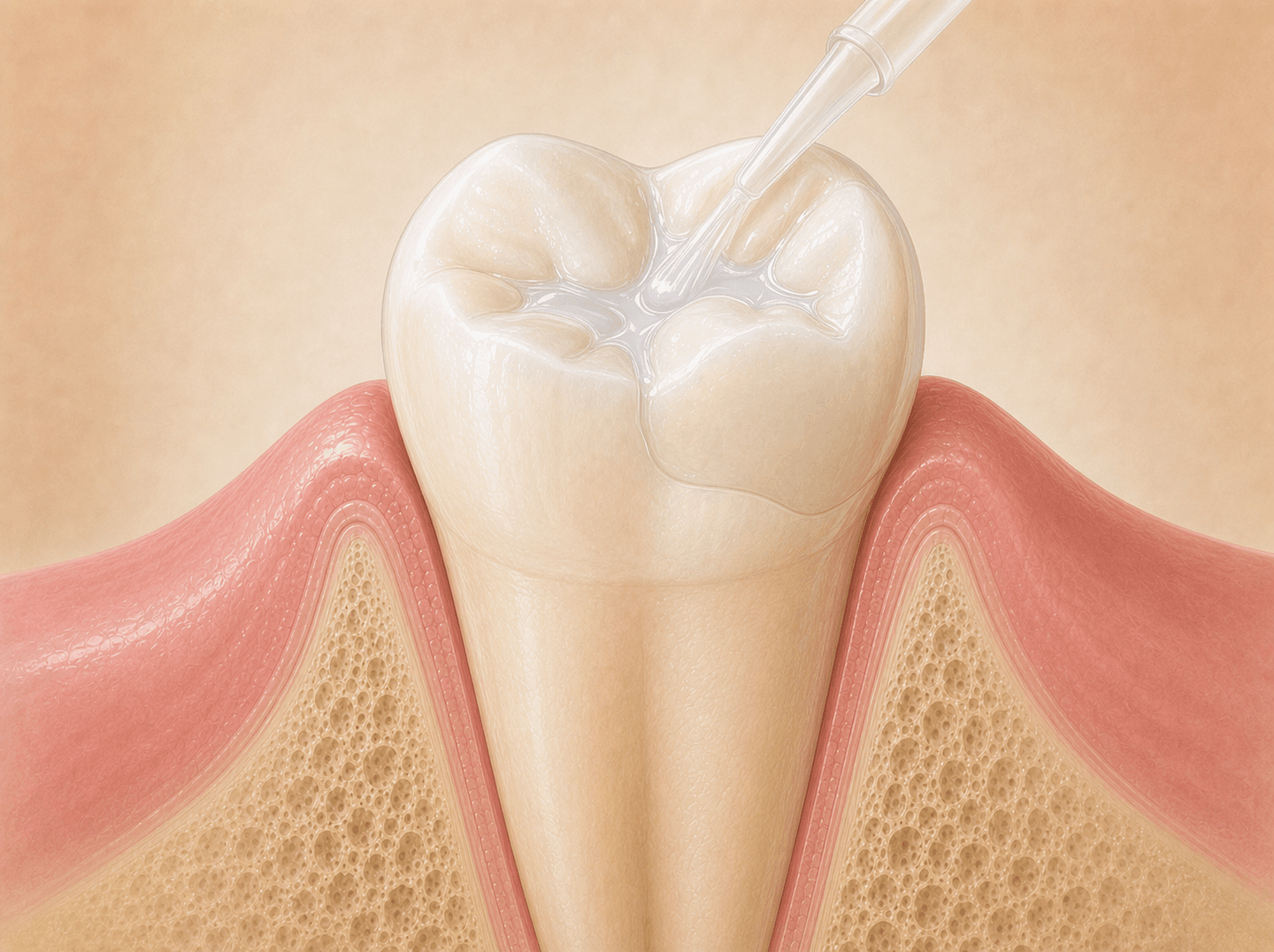
D1351 is the CDT code for a dental sealant on one tooth — the thin protective coating bonded into the pits and grooves of a chewing surface to keep decay from starting.
It is a per-tooth preventive code, so a four-sealant visit is four lines of D1351, not one. The denials trace back to confusing a sealant with a filling or a preventive resin restoration, the age limits and per-tooth frequency caps that carriers apply to sealants, and the 2026 change that deleted D1352.
What D1351 reports
D1351 reports the placement of a sealant on one tooth: a thin resin or glass-ionomer coating bonded into the pits, grooves, and fissures of the chewing surface to keep decay from taking hold where a toothbrush can’t reach. The code covers the clinical work of cleaning and preparing the surface, applying the material, and curing it. It is reported per tooth, so the unit of billing is the tooth, not the visit.
Two facts about the code drive almost everything downstream:
- It’s preventive, not restorative. A sealant protects a sound tooth. It is not a repair. The tooth should be free of decay on the surface being sealed at the time of placement.
- It’s per tooth. Each sealed tooth is its own line of D1351 with its own tooth number. A visit where four molars are sealed is four D1351 lines.
Per tooth, not per visit
This is the most common posting error on D1351, and it costs the practice money rather than triggering a denial. The code is scoped to the tooth, so a multi-tooth sealant appointment generates one line per tooth.
Contrast it with fluoride. D1206, fluoride varnish, is billed once per application no matter how many teeth get varnish, because the procedure is the application, not the tooth. D1351 is the opposite: the procedure is the sealant on a specific tooth, so the count of lines equals the count of teeth sealed.
Where the sealant stops and a restoration starts
The line that gets miscoded is the one between a sealant and a restoration. Both can sit on the occlusal surface of a back tooth. They report different procedures.
- D1351 (sealant) protects a sound tooth. No decay is removed. The material flows into intact grooves to keep decay out.
- D2391 (resin-based composite, one surface, posterior) repairs a tooth. The dentist removes affected tooth structure and fills the resulting preparation. It is a restorative code.
The deciding question is whether the tooth is being protected or repaired. Sealing intact grooves on a caries-free tooth is D1351. Restoring an occlusal lesion, even an early one, is D2391.
When to bill D1351
Bill D1351 when the dentist places a sealant on a tooth to prevent decay. The typical situation is a child or teen with a newly erupted, caries-free posterior tooth whose deep grooves put it at risk.
Do not bill D1351 for:
- A composite filling or any procedure where decay was removed first. That’s restorative (D2391 and the rest of the composite family).
- A topical fluoride treatment. Varnish is D1206; it’s a different preventive procedure billed per application, not per tooth.
- A non-restorative caries-arresting medicament such as silver diamine fluoride placed on an active lesion. That’s D1354, which treats existing decay without drilling, the opposite of sealing a sound tooth.
Coverage rules that decide whether it pays
Sealant coverage is common, but it’s fenced in by conditions, and the conditions vary by plan. The patterns to verify before treatment:
- Age limits. Many plans cover sealants only for children and teens. The cutoff age varies by plan, and some extend further than others. A sealant on an adult often won’t pay even when the clinical case for it is sound.
- Tooth limits. Plans frequently limit coverage to permanent molars, sometimes adding premolars. A sealant on a tooth outside the covered set is a benefit exclusion, not a coding error.
- Caries-free requirement. Plans that cover sealants generally expect the sealed surface to be decay-free at placement, consistent with the preventive intent of the code.
- Per-tooth frequency. Coverage usually carries a frequency window per tooth, so the same tooth can’t be resealed and rebilled inside the set period.
Verify the plan’s age, tooth, and frequency rules before treatment. Whether a clinically appropriate sealant pays comes down to plan design, not how cleanly you code it.
When a sealant fails: repair vs. replace
A sealant can chip, wear, or partly debond. What you bill depends on what you do.
- Repair. If you restore the integrity of an existing sealant without redoing it, use D1353, the sealant-repair code, also scoped per tooth. It exists specifically for fixing a partially failed sealant rather than placing a new one.
- Replace. If you remove and redo the sealant, that’s another D1351. The catch is the plan’s per-tooth frequency window: a replacement that falls inside it can deny for frequency even though the clinical need is real.
Document the date of the original placement and the reason the sealant failed. That record is what lets you answer a frequency denial, support an appeal where one is warranted, or, on plans that allow it, present the replacement to the patient as a non-covered service.
Documentation that supports the claim
Even on a routinely covered procedure, the chart note and the claim need to line up:
- Tooth number on each line. D1351 is per tooth, so every sealed tooth carries its own line and its own tooth number.
- The surface and that it was sound. Note that the sealed surface was caries-free at placement. This is what keeps a sealant from looking like a miscoded restoration on review.
- Date of any prior sealant on the tooth. Frequency edits key on this. Having the prior date in the record turns a frequency question into a quick answer.
- The material, when relevant. Resin versus glass ionomer can matter for some plans’ policies and for your own clinical record.
What to get right in your PMS
The menus differ across Open Dental, Dentrix, Eaglesoft, Curve, and Carestream, but the setup that prevents problems is the same:
- Make D1351 a per-tooth line item, and train the front desk to post one per tooth. The fastest way to underbill is to drop a single sealant line on a multi-tooth visit. Tie the code to a tooth-number prompt so it can’t be posted without one.
- Remove D1352 from the code table. It was deleted for 2026. Leaving it active invites a claim that rejects. Map the early-lesion workflow to D2391 instead.
- Keep D1351 distinct from the restorative composite codes. A fuzzy “filling or sealant” entry is how a sealant gets billed as a restoration or vice versa. Separate, clearly labeled line items let the team pick the one that matches what was done.
- Load the plan’s age, tooth, and frequency rules where your team can see them. Sealant coverage is conditional. Surfacing the limits at verification prevents the patient-billing surprise when a sealant on an adult or an out-of-range tooth doesn’t pay.
FAQs
- What is the dental code for a sealant?
- It's D1351, and it is scoped to a single tooth. That scope matters for how you post the claim. A sealant is a single procedure on a single tooth, so if the dentist seals four molars in one visit, you bill four lines of D1351, each with its own tooth number, not one line that covers the visit. That's different from fluoride, which is billed once per application regardless of how many teeth are treated. Posting one D1351 for a multi-tooth sealant visit underbills the practice; the code is scoped to the tooth, not the appointment.
- What's the difference between D1351 and a filling like D2391?
- D1351 is preventive: a sealant bonded to a sound, decay-free tooth to stop decay from ever starting in the pits and grooves. D2391 (resin-based composite, one surface, posterior) is restorative: it repairs a tooth that already has decay or a defect, after the dentist removes the affected structure. The dividing line is whether the tooth is being protected or repaired. Sealing intact grooves is D1351. Restoring an early occlusal lesion is D2391. Coding a restoration as a sealant, or a sealant as a restoration, is the most common miscode on this code family.
- Why can't I bill D1352 for a preventive resin restoration anymore?
- D1352, the code that used to report a preventive resin restoration on a higher-caries-risk patient, was deleted effective January 1, 2026. The ADA removed it alongside a descriptor change to D2391: the language that limited D2391 to lesions penetrating into dentin was dropped, so D2391 now covers one-surface posterior composites regardless of lesion depth. The practical result is that the early-lesion work formerly reported as D1352 is now reported as D2391. If your code table still lists D1352, remove it, because claims submitted under a deleted code will reject.
- Does insurance cover D1351, and what are the limits?
- Coverage is common but conditional, and the conditions are plan-specific. Most plans that cover sealants restrict them by patient age (frequently to children and teens, with cutoffs that vary by plan), by tooth (often permanent molars only, sometimes premolars), and by a per-tooth frequency window so the same tooth can't be resealed and rebilled inside a set period. Many plans also require the tooth to be caries-free at placement. Verify the specific plan's age, tooth, and frequency rules before treatment rather than assuming a sealant on an adult or on a primary tooth will pay.
- Can I bill D1351 again if a sealant falls off?
- It depends on what you actually did and the plan's frequency rule. If the sealant is partially lost or chipped and you repair it rather than redo it, D1353, the sealant-repair code, also billed per tooth, is the code for that. If you fully replace the sealant, that's another D1351, but the plan's per-tooth frequency window may deny a replacement that falls inside it. Document the reason the original sealant failed and the date of the prior placement so you can answer a frequency denial or, where the plan allows, bill the patient for the replacement.
Related codes
Need help billing this code?
We handle D1351 claims daily.
If your team is spending time on denials, narratives, or carrier follow-up for this code, our dental insurance verification service can take it off your plate. We work inside your PMS and post payments the same week.
CDT codes are maintained by the American Dental Association. This page is an editorial billing guide, not the official ADA code descriptor. Verify current coverage policies with each carrier before submitting claims.