D1553 is the CDT code for cementing or bonding a loose space maintainer on one side of one arch back in place, billed per quadrant.
- When to use: A band and loop, crown and loop, or distal shoe has come loose but is intact, and the same appliance goes back on.
- When not to use: A lost or broken appliance that must be remade is a new D1510 or D1575, and a loose upper or lower bilateral arch is D1551 or D1552.
- Billing note: Many plans cap re-cements per quadrant, some at once per year or a few per lifetime, so check the history before the visit.
What D1553 reports
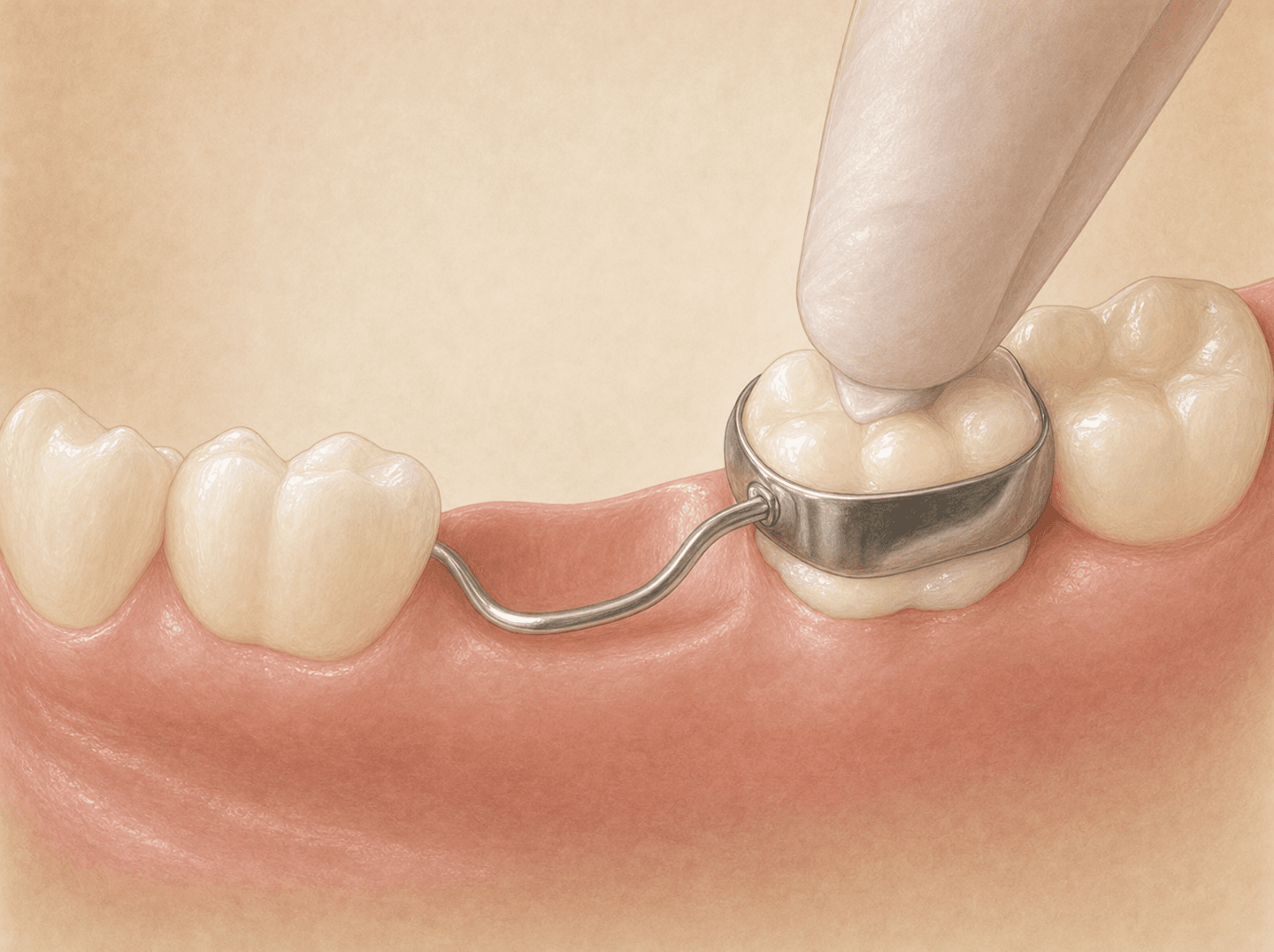
D1553 reports putting a loose one-sided space maintainer back in place with new cement or bonding, scoped per quadrant. It applies to the appliances placed under D1510, the band and loop and crown and loop, and to the distal shoe placed under D1575, which is also fixed and unilateral.
The descriptor says re-cement or re-bond, without the word fixed. The removal codes do say fixed. The difference is cosmetic in practice: only an appliance that was cemented or bonded in the first place can come loose and be re-cemented.
D1550, the old single re-cement code, was deleted at the end of 2019. CDT 2020 added three codes split by side and arch: D1553 for one side per quadrant, D1551 for an upper bilateral appliance, and D1552 for a lower one. Delta Dental of Kansas’s 2020 notice mapped D1550 only to D1551 and D1552, so don’t use an old crosswalk to code a one-sided appliance.
Loose, lost, or broken: re-cement or a new appliance
The code depends on what the patient brings back.
Loose but intact. The band has lifted off the tooth, the appliance still fits, and it goes back on. This is D1553.
Lost. The appliance came off and is gone. Nothing is re-cemented, so D1553 doesn’t apply. The dentist fabricates a new appliance, billed as a new D1510 or D1575.
Broken. A fractured loop or a band that no longer fits usually means a new appliance too. The space maintainer family has no repair code. If the dentist repairs the appliance in a way no code describes, D1999, the by-report catch-all for preventive work, sent with a narrative, is the fallback, and payment for it is plan-dependent.
A replacement appliance is where plans push back hardest. Blue Cross Blue Shield of Arizona Health Choice, an Arizona Medicaid plan, won’t reimburse a lost or damaged space maintainer replacement billed by the same provider or group that placed the original, citing a lifetime warranty under Arizona’s Medicaid program. Many other plans apply a per-quadrant frequency limit to placements, so a replacement inside the window can deny. Either way, chart what happened to the original appliance.
Frequency limits on re-cements
Re-cement limits vary more than placement limits. Examples from current payer documents:
- Illinois Medicaid (children’s benefits table, April 2025): one per six months per patient, and not within six months of placement.
- Nevada Medicaid (coverage table updated March 23, 2026): two units per lifetime.
- Delta Dental, New York City DC 37 schedule (codes effective February 1, 2024): once per 12 months, for children under 14.
- Delta Dental of Kansas (CDT 2020 processing notice): benefit allowed once, later submissions denied.
The Illinois rule is worth noticing. An appliance that loosens within weeks of placement may be treated as part of the placement service, not a separate re-cement. A band that keeps coming loose is also a clinical signal: the appliance may need to be remade, which brings the replacement rules above into play.
Documentation
- The quadrant and the appliance re-cemented.
- That the appliance was intact and reseated, not remade.
- The original placement date, and whether your office placed it.
- Prior re-cements on the same appliance, so the frequency check happens before the claim, not on the EOB.
FAQs
- Is D1553 only for fixed space maintainers?
- In practice, yes. The re-cement descriptors don't say fixed, unlike the removal codes, but only an appliance that was cemented or bonded can be re-cemented. A removable maintainer that no longer fits is adjusted or replaced, not re-cemented.
- The space maintainer was lost. Do I bill D1553?
- No. Re-cementing means the same appliance goes back on. If the patient lost it, the dentist has to make a new one, which is a new placement: D1510 for a band and loop or D1575 for a distal shoe. That new placement can run into the plan's frequency limit or a same-provider replacement rule.
- How often will insurance pay for D1553?
- It varies widely. Illinois Medicaid's April 2025 children's benefit table allows one re-cement per six months and none in the first six months after placement. Nevada Medicaid's March 2026 table allows two per lifetime. A Delta Dental schedule for New York City's DC 37 members, effective February 2024, allows one per 12 months for children under 14. Delta Dental of Kansas's 2020 notice allowed one, with later claims denied.
- Do two loose appliances in two quadrants mean two units?
- Yes. D1553 is per quadrant, so re-cementing a band and loop in the lower left and another in the lower right is two lines, each with its own quadrant. A single appliance spanning both sides of the arch is D1551 (upper) or D1552 (lower), one unit.
- Is there a code for repairing a broken space maintainer?
- The space maintainer codes have no repair code. If the loop is broken, the dentist usually remakes the appliance, which is a new placement. A repair that doesn't fit any code can go out as D1999, the unspecified preventive code, with a narrative, and payment for it varies by plan.
Related codes
Need help billing this code?
We handle D1553 claims daily.
If your team is spending time on denials, narratives, or carrier follow-up for this code, our dental insurance verification service can take it off your plate. We submit the claims, post what comes back, and follow up on anything unpaid.
“Claims, posting, denials, all of it gets handled, and it costs far less than hiring another employee. My front desk got hours of their week back, and honestly I just don't think about billing anymore.”
CDT codes are maintained by the American Dental Association. This page is an editorial billing guide, not the official ADA code descriptor. Verify current coverage policies with each carrier before submitting claims.