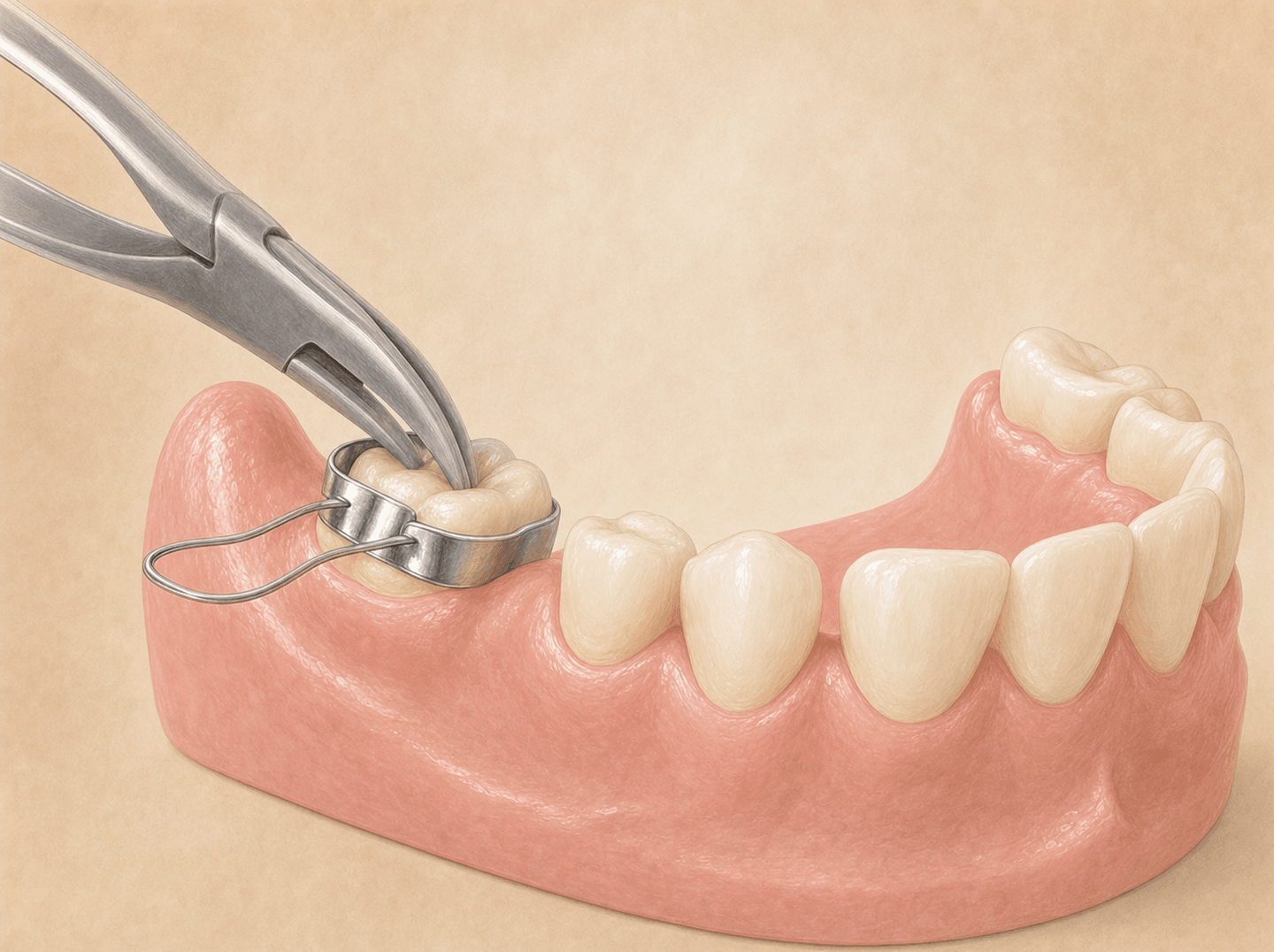
D1556 is the CDT code for removing a fixed space maintainer from one side of one arch, such as a band and loop, per quadrant.
- When to use: A cemented or bonded one-sided appliance comes off for good, because the successor is erupting or a different appliance is replacing it.
- When not to use: Removing an upper bilateral appliance is D1557, a lower one is D1558, and putting a loose one back on is D1553.
- Billing note: Some plans treat removal as part of the placement fee when the same office does both, so check who placed the appliance before billing.
What D1556 reports
D1556 reports taking off a fixed space maintainer that holds space on one side of an arch. It covers the one-sided appliances placed under D1510 (band and loop, crown and loop) and the distal shoe placed under D1575. It is scoped per quadrant, the same unit as the placement codes.
The removal codes say “fixed” in the descriptor, and that matters. A removable appliance has no removal code, because the patient takes it out. D1556 and its bilateral siblings D1557 and D1558 only apply to an appliance cemented or bonded to teeth.
D1556 is also not a re-cement. If the appliance is loose and goes back on, that is D1553. D1556 means the appliance is coming off and not going back.
Who placed it decides whether it pays
This is the question that decides most D1556 claims, and payers answer it differently.
- Bundled for the placing office. A Delta Dental benefit schedule for New York’s DC 37 members (new codes effective February 1, 2024) treats removal of a fixed space maintainer as part of the placement fee, and gives special consideration when a different dentist or office does the removal. Delta Dental of Kansas’s CDT 2020 processing notice went further: the removal codes were not billable by the office that placed the appliance and were denied when a different office did the removal.
- Paid as its own line. Maryland Medicaid’s CDT 2026 fee schedule (revised August 18, 2026) prices D1556 at $26.37. Nevada Medicaid’s March 2026 coverage table covers it for patients under 21, limited to one unit per lifetime.
The logic behind bundling is that the placement fee anticipates the appliance coming off. When another office placed it, for example a pediatric dentist placed a band and loop and the family later moved to your practice, the bundling rationale doesn’t apply. Some plans, like the DC 37 schedule, give that case special consideration, but others deny removal by any office, as Delta Dental of Kansas did in 2020. Note who placed the appliance and when in the chart, because a claims reviewer will ask.
Removal at eruption vs removal to change appliances
Two situations produce a D1556, and they bill differently.
The successor erupted. The permanent tooth is coming in and the space no longer needs holding. The appliance comes off and nothing replaces it. One line of D1556. Delta Dental of Michigan’s space maintenance criteria (282.27, revised February 2026) list a maintainer that obstructs permanent tooth eruption among the conditions that can lead to denial, so a radiograph or note showing the erupting successor supports the timing.
The appliance is being swapped. The space still needs holding, but the current design no longer fits the case. The classic example is the distal shoe.
Example case: distal shoe to band and loop
A child lost the lower right second primary molar (tooth T) before the first permanent molar erupted. The dentist placed a distal shoe to guide that molar in, billed as D1575 for the lower right quadrant. Delta Dental of Michigan’s criteria limit distal shoe coverage to exactly this situation.
Months later, the lower right first permanent molar (tooth 30) has erupted. The distal shoe has done its job, but the space for the second premolar still needs holding. The dentist removes the distal shoe and cements a band and loop on the new molar.
- D1556, lower right quadrant, for removing the distal shoe.
- D1510, lower right quadrant, for the new band and loop.
Two things can go wrong. If the same office placed the distal shoe, the plan may fold D1556 into that earlier fee. And some plans apply one space maintainer frequency limit per quadrant, so the new D1510 can deny against the D1575 placed months earlier. Ask about both before the visit, and send a narrative explaining that the distal shoe was replaced because the molar erupted, not because it failed.
Counting units
D1556 is per quadrant. Two separate one-sided appliances removed at one visit are two lines, each with its quadrant. A single appliance that crosses the arch, such as a lower lingual holding arch, is one unit of D1558, not two units of D1556. The upper equivalent, a Nance or transpalatal arch, is D1557.
Documentation
- The quadrant, and which appliance came off.
- Why it came off: successor erupting, appliance replaced, or appliance no longer indicated.
- Who placed it and the placement date, when known.
- A radiograph or clinical note showing the erupting tooth, if the plan asks.
Common denials
- Included in placement. The plan treats removal by the placing office as part of the original fee.
- Frequency. Nevada Medicaid, for one, allows one D1556 per lifetime.
- Wrong code family. A removable appliance billed with D1556, or a bilateral arch billed as two D1556 lines.
- Not on the schedule. Some plans don’t list removal codes at all. Check before assuming coverage.
FAQs
- Can we bill D1556 if our office placed the space maintainer?
- Sometimes, and it depends on the plan. A Delta Dental schedule for New York's DC 37 members says removal of a fixed space maintainer is included in the placement fee, with special consideration when a different office removes it. Delta Dental of Kansas's CDT 2020 processing notice was stricter: not billable by the placing office, and denied when a different office removed it. Maryland Medicaid prices D1556 on its 2026 schedule, and Nevada Medicaid covers it for children. Check the plan before treating removal as billable.
- What code is used to remove a distal shoe?
- D1556. A distal shoe (D1575) is a fixed, unilateral appliance, and the removal codes split only by fixed unilateral versus fixed bilateral and by arch. There is no separate removal code for a distal shoe, so it comes off under D1556 for that quadrant.
- Is there a code for removing a removable space maintainer?
- No. All three removal codes, D1556, D1557, and D1558, name a fixed appliance. A removable maintainer such as D1520 is taken out by the patient, so there is no removal code to report when it is retired.
- How many units of D1556 do I bill when two appliances come off?
- One per quadrant. If separate band and loop appliances come off in the lower left and lower right, that is two lines of D1556, each with its own quadrant. A single appliance spanning both sides of an arch is not two units of D1556; it is D1557 for the upper arch or D1558 for the lower.
- What code replaced D1555?
- D1555, the single removal code, was deleted for CDT 2020. Three removal codes took its place: D1556 for one side per quadrant, D1557 for an upper bilateral appliance, and D1558 for a lower bilateral appliance. Payer notices from that year disagreed on the crosswalk: Burkhart's CDT 2020 summary mapped D1555 to all three, while Delta Dental of Kansas named only D1557 and D1558. Pick the current code by the appliance, not by a crosswalk.
Related codes
Need help billing this code?
We handle D1556 claims daily.
If your team is spending time on denials, narratives, or carrier follow-up for this code, our dental insurance verification service can take it off your plate. We submit the claims, post what comes back, and follow up on anything unpaid.
“Claims, posting, denials, all of it gets handled, and it costs far less than hiring another employee. My front desk got hours of their week back, and honestly I just don't think about billing anymore.”
CDT codes are maintained by the American Dental Association. This page is an editorial billing guide, not the official ADA code descriptor. Verify current coverage policies with each carrier before submitting claims.