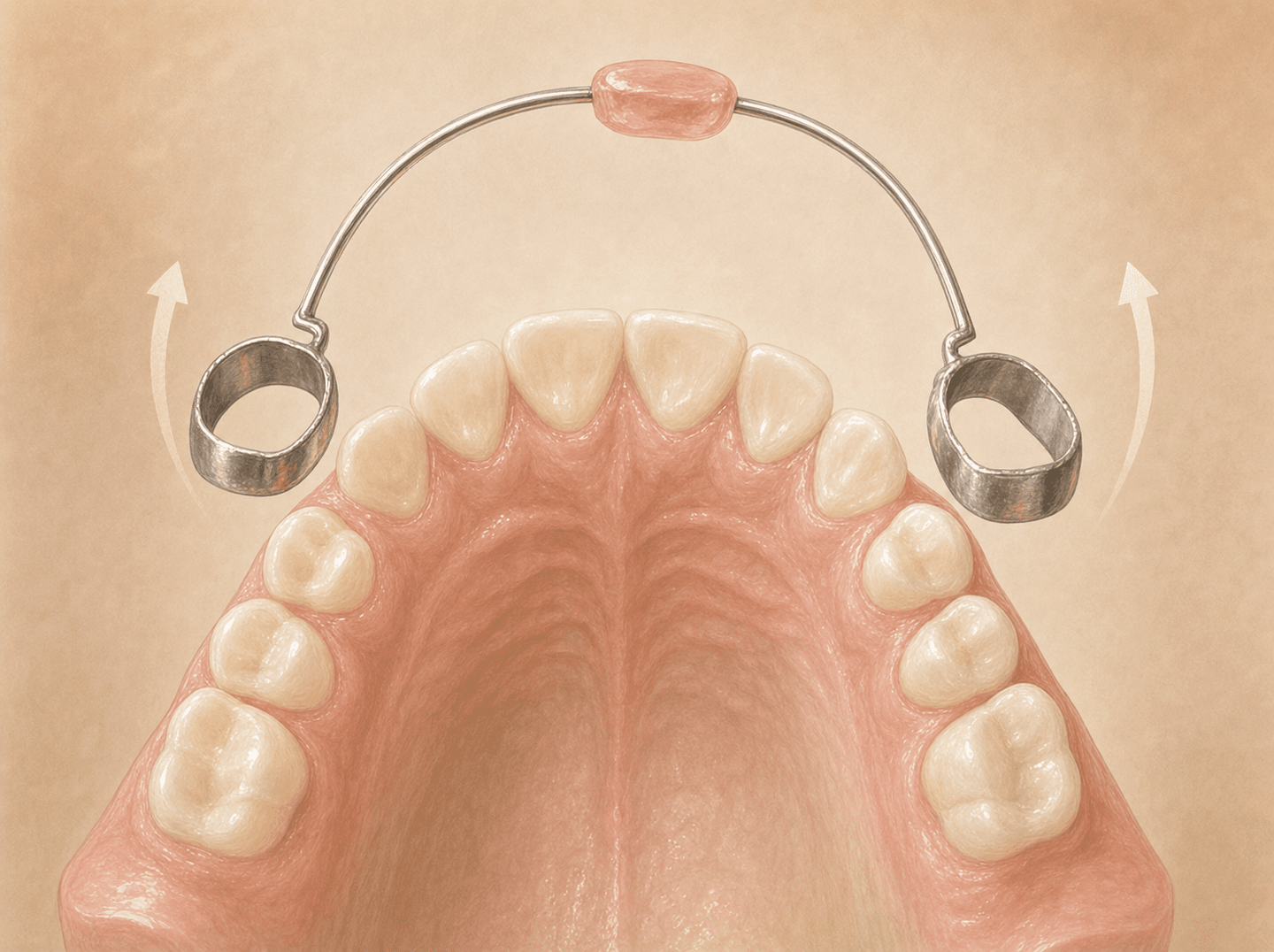
D1557 is the CDT code for removing a fixed space maintainer spanning both sides of the upper arch, such as a Nance or transpalatal arch.
- When to use: A Nance or transpalatal arch comes off for good, because the premolars are erupting or another provider is starting treatment.
- When not to use: A one-sided appliance comes off with D1556 per quadrant, the lower arch is D1558, and reseating a loose upper arch is D1551.
- Billing note: Coverage and same-office rules vary, and some Medicaid schedules don't list D1557, so verify before the visit.
What D1557 reports
D1557 reports taking off a fixed space maintainer that spans both sides of the upper arch. It follows the appliances placed under D1516: the Nance appliance and the transpalatal arch, the two upper designs Delta Dental of Michigan’s space maintenance criteria (282.27, revised February 2026) name. One appliance is one unit, regardless of how many bands come off.
The removal codes name fixed appliances in the descriptor. A removable upper maintainer has no removal code.
Who removes it
Upper bilateral appliances can outlive the relationship with the office that placed them. A child gets a Nance at a pediatric practice, and years later an orthodontist takes it off before placing brackets. That is one way D1557 ends up billed by an office that didn’t place the appliance.
Payers handle the two cases differently:
- The placing office removes it. Some plans fold the removal into the placement fee. Delta Dental of Kansas’s CDT 2020 processing notice said the three removal codes were not billable by the office that placed the appliance.
- A different office removes it. This is not a safe harbor. The same Delta Dental of Kansas notice denied the removal codes when a different office submitted them. A Delta Dental schedule for New York’s DC 37 members (new codes effective February 1, 2024) says benefits for D1557 rest on professional determination, while its bundling note is written for the unilateral removal code, D1556. Plan language like this is the reason to read the schedule code by code rather than assume the bilateral removal follows the unilateral rule.
Removal vs re-cement vs replacement
The upper arch has three follow-up codes after placement, and they don’t overlap. A loose appliance that goes back on is D1551. An appliance that comes off and stays off is D1557. If the arch is removed and a new one is made, the new appliance is another D1516, subject to the plan’s placement frequency, and the removal may or may not be paid alongside it.
If two separate one-sided appliances were placed instead of one bilateral arch, each comes off with D1556 for its quadrant, following the original D1510 placements. Lower-arch removal is D1558.
FAQs
- What code is used to remove a Nance appliance?
- D1557, when the Nance is a fixed bilateral maxillary space maintainer placed under D1516. The same code covers a transpalatal arch used as a space maintainer. It is one unit for the arch.
- Is D1557 included in the placement fee?
- Sometimes. Delta Dental of Kansas's CDT 2020 processing notice said the removal codes weren't billable by the office that placed the appliance, and it denied them for a different office too. Nevada Medicaid and BCBS Arizona Health Choice list D1557 as a covered code for children. Check the plan, and who placed the appliance, before billing.
- Can an orthodontist bill D1557?
- Yes, D1557 is not limited to the office that placed the appliance. If an orthodontist removes a Nance before starting treatment, the orthodontist reports D1557. Whether the plan pays it as a preventive service or treats it differently once ortho has started depends on the plan.
Related codes
Need help billing this code?
We handle D1557 claims daily.
If your team is spending time on denials, narratives, or carrier follow-up for this code, our dental insurance verification service can take it off your plate. We submit the claims, post what comes back, and follow up on anything unpaid.
“Claims, posting, denials, all of it gets handled, and it costs far less than hiring another employee. My front desk got hours of their week back, and honestly I just don't think about billing anymore.”
CDT codes are maintained by the American Dental Association. This page is an editorial billing guide, not the official ADA code descriptor. Verify current coverage policies with each carrier before submitting claims.