D1558 is the CDT code for removing a fixed space maintainer spanning both sides of the lower arch, most often a lower lingual holding arch.
- When to use: A lower lingual holding arch comes off because the space no longer needs holding, or because a broken arch is being replaced.
- When not to use: A one-sided appliance comes off with D1556 per quadrant, the upper arch is D1557, and reseating a loose lower arch is D1552.
- Billing note: When a broken arch is removed and remade, the new D1517 can deny on placement frequency, so check the placement history first.
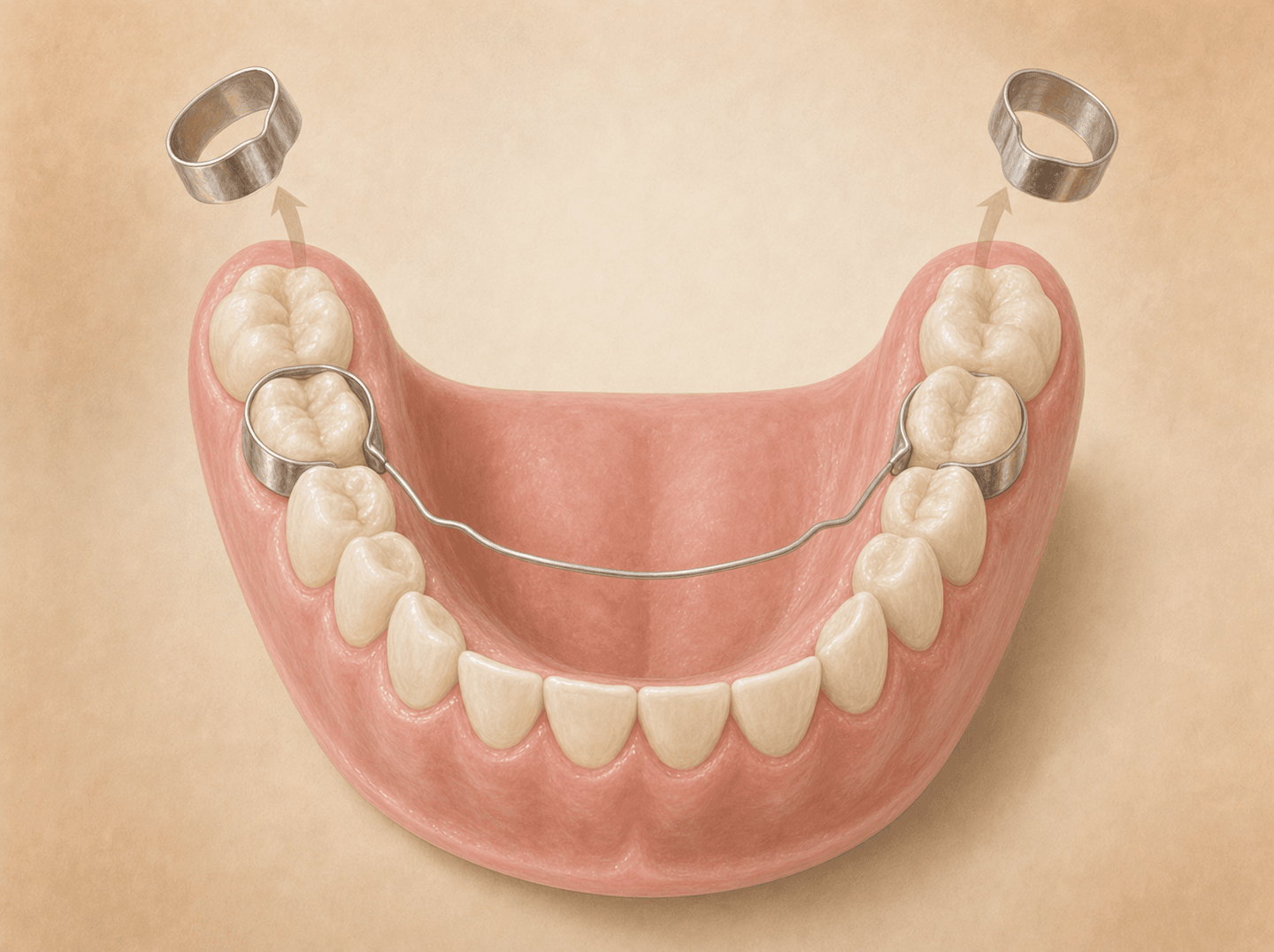
What D1558 reports
D1558 reports taking off a fixed space maintainer that spans both sides of the lower arch. It follows the appliances placed under D1517, which in practice is usually the lower lingual holding arch: two molar bands joined by a wire along the tongue side of the lower teeth. One appliance is one unit.
Like the other removal codes, D1558 names a fixed appliance. If the lower arch instead had two separate one-sided appliances placed under D1510, each comes off with D1556 for its quadrant.
Removal because the job is done
A lingual arch holds space on both sides at once, but the successor teeth don’t always erupt on both sides at the same time. The dentist decides when the arch has done its job, often once the premolars are coming in. The removal visit is one line of D1558.
The chart should say why the arch came off now: the erupting teeth, and a radiograph if the plan wants one. Who placed the arch matters too, because some plans fold removal into the placement fee for the same office. The D1556 page covers that rule and the payers that apply it.
Removal because the arch is being replaced
The other path to D1558 is a lingual arch that is broken, distorted, or no longer fits, and the space still needs holding. The dentist removes it and places a new one. With a lab-made arch, the old one often comes off at the band-fitting and impression visit and the new one is cemented later, so the two lines can carry different dates of service.
- D1558 for removing the old arch, dated when it came off.
- D1517 for the new arch, dated when it is delivered.
Both are real procedures, but the second line carries the risk. The new D1517 counts against the plan’s placement frequency, and replacement rules can be strict. Blue Cross Blue Shield of Arizona Health Choice, an Arizona Medicaid plan, won’t reimburse the office that placed a space maintainer for replacing it when lost or damaged (policy D0019, 2026), citing a lifetime warranty on space maintainers under AHCCCS. The same policy lists D1558 itself as covered for members under 21, so the removal line and the replacement line can adjudicate differently.
Limits worth knowing
Nevada Medicaid’s March 2026 coverage table allows one unit of D1558 per lifetime. A Delta Dental schedule for New York’s DC 37 members (new codes effective February 1, 2024) bases D1558 benefits on professional determination, for children under 14. Delta Dental of Kansas’s CDT 2020 notice denied the removal codes whether or not the placing office submitted them. The upper-arch counterpart, with the same structure, is D1557.
FAQs
- What is the code to remove a lower lingual holding arch?
- D1558, one unit for the arch. A lower lingual holding arch is a fixed bilateral mandibular space maintainer placed under D1517, and its removal is D1558 regardless of how many bands come off.
- Can D1558 and D1517 be billed on the same day?
- Yes, they are two different procedures, removing the old arch and placing a new one. They often fall on different dates, because a lab-made arch is usually delivered at a later visit than the one where the old arch comes off. Whether both pay depends on the plan: the new D1517 can deny against a placement frequency limit, and some plans won't pay a replacement to the office that placed the original.
- Is D1558 covered by Medicaid?
- It depends on the state. Nevada Medicaid covers D1558 for children, one unit per lifetime. Maryland Medicaid's CDT 2026 fee schedule lists the unilateral removal code D1556 but not D1558. Check the state's current schedule.
Related codes
Need help billing this code?
We handle D1558 claims daily.
If your team is spending time on denials, narratives, or carrier follow-up for this code, our dental insurance verification service can take it off your plate. We submit the claims, post what comes back, and follow up on anything unpaid.
“Claims, posting, denials, all of it gets handled, and it costs far less than hiring another employee. My front desk got hours of their week back, and honestly I just don't think about billing anymore.”
CDT codes are maintained by the American Dental Association. This page is an editorial billing guide, not the official ADA code descriptor. Verify current coverage policies with each carrier before submitting claims.