D2332 is the CDT code for a tooth-colored composite filling that restores three surfaces of a front tooth — the three-surface tier of the anterior resin-composite family, with the code set by how many surfaces are restored.
It is the code many incisal-angle restorations actually belong in, and that is where the billing trouble starts. Offices over-code three-surface corner restorations to D2335 on the obsolete incisal-angle rule, or undercode them to D2331.
On this page
- What D2332 covers
- When to bill D2332
- The surface-count rule
- The incisal angle lands here more than anywhere
- Top reasons D2332 gets denied or repriced
- Surface designation on the claim
- Documentation that supports the claim
- D2332 versus the posterior three-surface code
- Example case
- What to get right in your PMS
- FAQs
What D2332 covers
D2332 reports a resin-based composite restoration covering three surfaces of an anterior tooth (incisor or canine). The three surfaces are any combination of the five anterior surfaces: mesial (M), distal (D), facial or labial (F), incisal (I), and lingual (L). Common triples are MIL, DIF, MFL, and MID. The code includes the material, the placement, the shaping, and the finishing.
It does not cover:
- One-surface anterior composites. Use D2330.
- Two-surface anterior composites. Use D2331.
- Four-or-more-surface anterior composites. Use D2335.
- Composites on posterior teeth. Use D2391 (one surface), D2392 (two surfaces), D2393 (three surfaces), or D2394 (four or more).
- Veneers, crowns, or indirect restorations.
The code structure is surface-count based. Material is composite. Tooth type is anterior.
When to bill D2332
Bill D2332 when:
- An anterior tooth has a carious lesion, fracture, or failing restoration involving exactly three surfaces.
- The restoration is placed with resin-based composite.
- The three surfaces are restored in continuity.
Do not bill D2332 for:
- A two-surface restoration. Use D2331.
- A four-or-more-surface restoration. Use D2335.
- A posterior tooth.
The surface-count rule
The surface count determines the code. For anterior teeth the five countable surfaces are mesial, distal, facial or labial, incisal, and lingual. The incisal is the biting edge and counts as a surface, the way the occlusal counts on a back tooth.
A three-surface restoration involves exactly three of them. Common three-surface anterior restorations:
- MIL or DIL: a corner fracture or proximal lesion that wraps from the proximal across the incisal and onto the lingual. This is the classic Class IV pattern.
- MID: a restoration spanning both proximals and the incisal, common on a worn or fractured incisal edge with proximal decay.
- MFL or DFL: a proximal lesion that involves both the facial and lingual.
The dentist or assistant documents the three surfaces on the chart and the claim.
The incisal angle lands here more than anywhere
The incisal-angle confusion costs offices the most money on D2332, because a large share of incisal-angle restorations are exactly three surfaces.
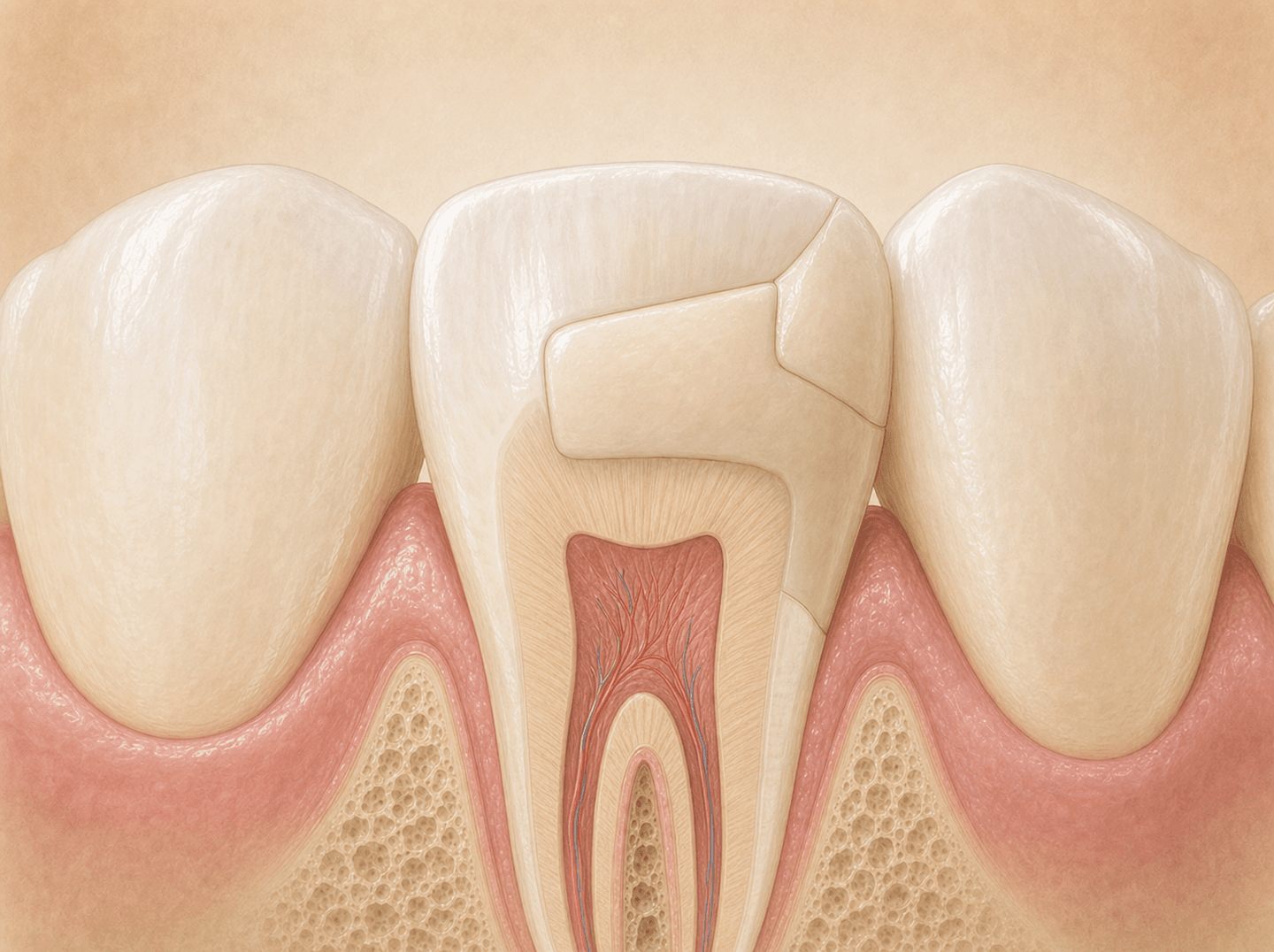
A patient breaks a corner of a central incisor down to involve the proximal, the incisal, and the lingual. That is the incisal angle, and it is also three surfaces, MIL. Under the rule that applied before CDT 2024, “involving the incisal angle” sent this to D2335 automatically. The ADA removed that clause. The incisal angle is the corner where the incisal edge meets a proximal surface, and a corner is not a reportable surface. The claim only carries surfaces: M, D, F, I, L.
So the case codes by its surface count, three, and that is D2332. The ADA’s published coding guide uses this exact example: a restoration involving the incisal angle on the mesial, incisal, and lingual surfaces is D2332, not D2335.
Top reasons D2332 gets denied or repriced
- Incisal-angle over-code. A three-surface corner restoration billed as D2335. The carrier downcodes to the documented three surfaces.
- Surface-count miscoding. D2332 billed on a two-surface restoration gets downcoded to D2331. A four-surface restoration billed as D2332 underbills it.
- Frequency limit on the same surfaces. Most plans pay one restoration per surface per benefit period. A repeat on a recently restored combination pends. Document the clinical failure.
- No documented clinical indication. Carriers occasionally audit restorations on teeth that looked sound at recall. The chart should name the caries, fracture, or failing margin.
- Posterior code on an anterior tooth, or the reverse. A code-type mismatch the carrier catches against the tooth number.
Surface designation on the claim
The surface designation is its own field on the claim. For D2332 it is three letters from M, D, F, I, L:
- D2330 takes one letter.
- D2331 takes two.
- D2332 takes three (MIL, DIF, MID, and so on).
- D2335 takes four or more.
A D2332 claim with two letters or four letters gets flagged for code-surface mismatch. The chart and the claim must match. A restoration recorded as “MIL” and billed “MI” will not pass audit, and it underbills the work.
Documentation that supports the claim
The claim needs:
- Date of service.
- Tooth number (anterior, 6 through 11 or 22 through 27).
- Surface designation matching three surfaces.
For the patient record, document:
- The clinical reason: caries on named surfaces, fracture, or failing restoration.
- The three surfaces restored.
- The material used.
- Whether the incisal angle was involved, naming the actual surfaces. On a three-surface incisal-angle case this note is what holds the code if the carrier challenges it.
D2332 versus the posterior three-surface code
D2332 and D2393 occupy the same spot in their families. The split is tooth position.
- D2332 is a three-surface composite on an anterior tooth.
- D2393 is a three-surface composite on a posterior tooth.
The amalgam-downgrade pattern common on posterior composites is largely absent on anterior composites, because amalgam was never an esthetic choice on front teeth. D2332 usually pays at the composite allowable.
Example case
A 41-year-old patient fractures the distal corner of tooth 9 in a fall. The fracture runs across the distal, the incisal, and onto the lingual. The dentist restores all three surfaces with composite.
Billing steps:
- Verify benefits and confirm anterior composite coverage.
- Place the composite. Three surfaces: D, I, L. Designation DIL.
- Submit D2332 with surface designation DIL on the date of service.
- The carrier processes at the D2332 allowable. Because the incisal angle was involved, keep a chart note naming the three surfaces so the code holds if questioned.
If the office had coded this D2335, the carrier would downcode to the documented three surfaces and the appeal would go nowhere. D2332 is the correct code from the start.
What to get right in your PMS
- Code by surface count. Three surfaces = D2332. Two = D2331. Four or more = D2335.
- Set the surface designation correctly. Three letters for D2332, from M, D, F, I, L.
- Route incisal-angle cases by surface count, not to D2335. Most incisal-angle restorations are D2332. Some are D2331. D2335 only when four or more surfaces are restored.
- Use anterior codes only on anterior teeth. Block D2332 on a posterior tooth number.
- Document the three surfaces and the clinical reason. Naming the surfaces protects the code on an incisal-angle restoration the carrier might otherwise downcode.
FAQs
- What's the difference between D2330, D2331, D2332, and D2335?
- All four are anterior composite codes, distinguished by surface count. D2330 is one surface. D2331 is two surfaces. D2332 is three surfaces. D2335 is four or more surfaces. The anterior surfaces are mesial (M), distal (D), facial or labial (F), incisal (I), and lingual (L). The incisal surface on an anterior tooth plays the same counting role the occlusal surface plays on a posterior tooth.
- My restoration involved the incisal angle and three surfaces. D2332 or D2335?
- D2332. The ADA's own coding guide uses this exact case: a restoration involving the incisal angle on the mesial, incisal, and lingual surfaces is reported as D2332, three surfaces, not D2335. The incisal angle was removed from D2335's definition in CDT 2024 because it is not a tooth surface. You code by the number of surfaces restored.
- Does the carrier care which three surfaces?
- Yes. The three-letter surface designation (MIL, DIF, MFL, and so on) goes on the claim, drawn from M, D, F, I, L. Carriers match it against the patient's restorative history and frequency limits. The combination should match what the chart records.
- Will a plan downgrade D2332 to amalgam?
- Rarely. Alternate-benefit amalgam downgrades are essentially a posterior phenomenon, since amalgam was never used esthetically on front teeth. Most plans pay anterior composite at the composite allowable. Verify the specific plan if you see unusual processing.
Related codes
Need help billing this code?
We handle D2332 claims daily.
If your team is spending time on denials, narratives, or carrier follow-up for this code, our outsourced dental insurance billing service can take it off your plate. We work inside your PMS and post payments the same week.
CDT codes are maintained by the American Dental Association. This page is an editorial billing guide, not the official ADA code descriptor. Verify current coverage policies with each carrier before submitting claims.