D2335 is the CDT code for a tooth-colored composite filling that restores four or more surfaces of a front tooth — the top tier of the anterior resin-composite family, which CDT 2024 redefined by surface count alone after dropping its incisal-angle clause.
It is the top of the anterior composite family, and the code most often misused. For years it was defined as four or more surfaces or involving the incisal angle, and that second clause sent every corner chip here by reflex. CDT 2024 removed the incisal-angle language.
On this page
What D2335 covers
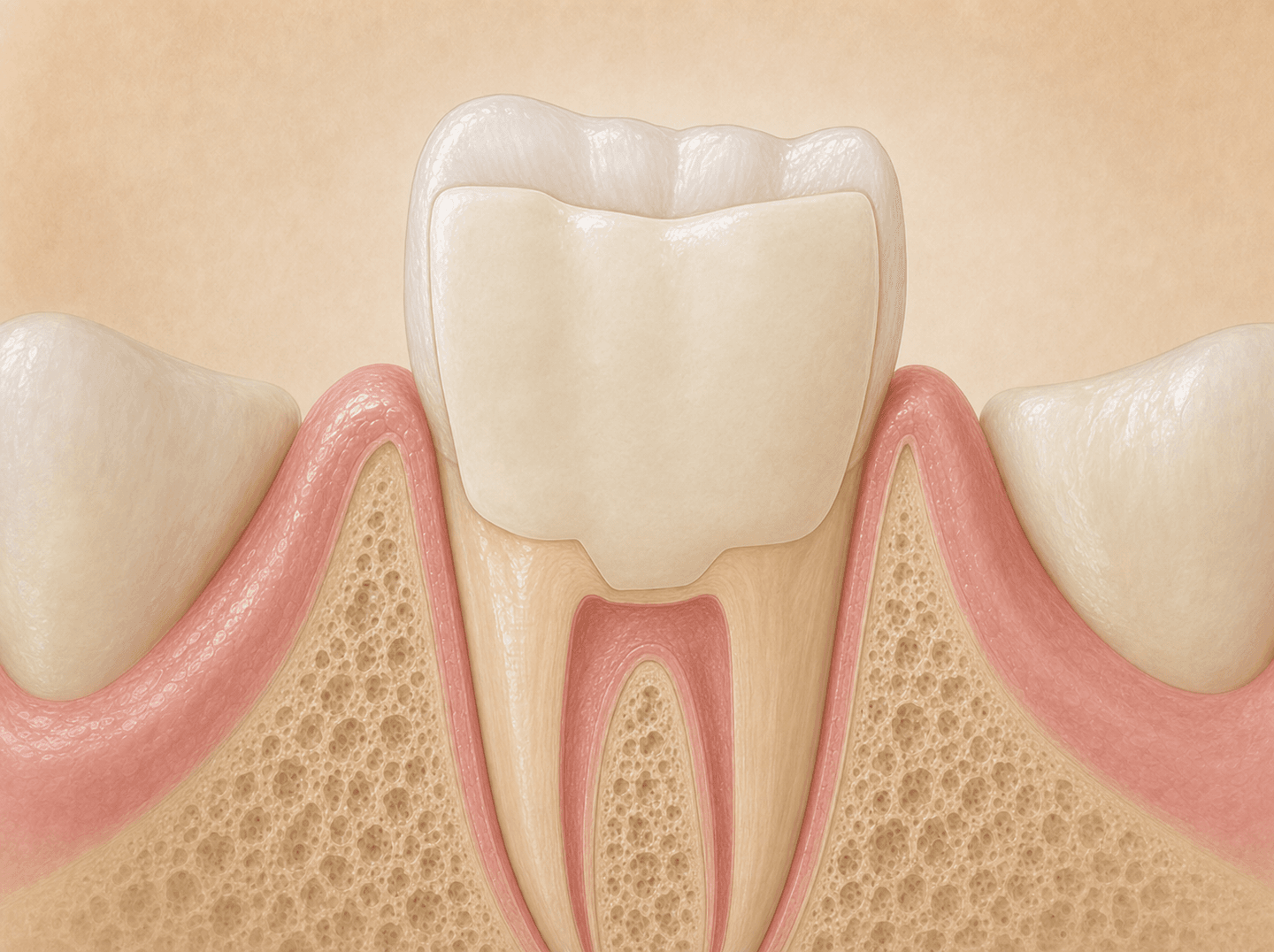
D2335 reports a resin-based composite restoration covering four or more surfaces of an anterior tooth (incisor or canine). The surfaces are drawn from the five anterior surfaces: mesial (M), distal (D), facial or labial (F), incisal (I), and lingual (L). A four-surface case might be MIDF or MIDL; a five-surface case is MIDFL. The code includes the material, the placement, the shaping, and the finishing.
It does not cover:
- One-surface anterior composites. Use D2330.
- Two-surface anterior composites. Use D2331.
- Three-surface anterior composites. Use D2332.
- Composites on posterior teeth. Use D2391 (one surface), D2392 (two surfaces), D2393 (three surfaces), or D2394 (four or more).
- Veneers (D2960 direct, D2961 indirect resin, D2962 porcelain), crowns, or other indirect restorations.
The code structure is surface-count based. Material is composite. Tooth type is anterior. The threshold is four surfaces.
The big change: the incisal angle is out
This is the detail that matters most on D2335, and it is the one most likely to be wrong in older references.
Before CDT 2024, D2335 was defined as four or more surfaces or involving the incisal angle (anterior). That second clause meant any restoration touching the incisal angle, the corner of a front tooth, was reported as D2335 regardless of how many surfaces it actually involved.
The ADA revised the code effective CDT 2024 and removed the incisal-angle clause. The current definition is four or more surfaces, anterior, with no mention of the angle. The reasoning, stated plainly in the ADA’s coding guidance: the incisal angle is not a tooth surface. It is the junction where the incisal edge meets the mesial or distal surface. A claim can only report surfaces, using the letters M, D, F, I, L. There is no field for an angle.
So the involvement of the incisal angle no longer drives the code. You count the surfaces and pick the code that matches.
When to bill D2335
Bill D2335 when:
- An anterior tooth has damage or decay restored across four or more surfaces with resin-based composite.
- The dentist rebuilds a major portion of the crown, such as a large Class IV fracture spanning both proximals plus the facial, incisal, and lingual.
Do not bill D2335 for:
- A two- or three-surface restoration, even one that involves the incisal angle. Use D2331 or D2332.
- A posterior tooth. Use D2394 for four or more surfaces posterior.
- A case better treated as a veneer or crown, where those codes apply.
The surface-count test
The surface count determines the code. For anterior teeth the five countable surfaces are mesial, distal, facial or labial, incisal, and lingual. The incisal is the biting edge and counts as a surface, the way the occlusal counts on a back tooth.
D2335 requires four or more distinct surfaces restored in continuity. Because an anterior tooth has only five surfaces, D2335 covers four-surface and five-surface (full) restorations.
Work the count honestly:
- Restored the mesial, incisal, and lingual? Three surfaces, D2332.
- Restored the mesial, distal, incisal, and lingual? Four surfaces, D2335.
- Rebuilt the whole crown across all five surfaces? D2335.
The incisal angle being involved tells you nothing about the count. A corner can be involved in a two-surface restoration or a five-surface one. Count the surfaces.
Top reasons D2335 gets denied or repriced
- Incisal-angle over-code (the big one). A two- or three-surface corner restoration billed as D2335. The carrier downcodes to the documented surface count. This is the most common D2335 problem since CDT 2024.
- Surface count not documented. D2335 is the highest-paying code in the family, so carriers scrutinize it. If the chart does not name four or more surfaces, the carrier downcodes or pends for records.
- Should have been a crown or veneer. On a tooth this damaged, some carriers question whether a direct composite was the appropriate treatment versus an indirect restoration. A narrative explaining the clinical choice helps.
- Frequency or replacement limits. A large composite replacing a recent restoration on the same tooth can hit replacement limits. Document the clinical failure.
- Posterior code on an anterior tooth, or the reverse. A code-type mismatch the carrier catches against the tooth number.
Surface designation on the claim
The surface designation is its own field on the claim. For D2335 it is four or more letters from M, D, F, I, L:
- D2330 takes one letter.
- D2331 takes two.
- D2332 takes three.
- D2335 takes four or more (MIDL, MIDF, MIDFL).
A D2335 claim with only two or three letters gets flagged for code-surface mismatch and downcoded. The chart and the claim must agree, and the chart has to actually support four surfaces. This is the code where loose documentation costs the most, because the gap between the D2335 allowable and the D2332 allowable is the largest in the family.
Documentation that supports the claim
The claim needs:
- Date of service.
- Tooth number (anterior, 6 through 11 or 22 through 27).
- Surface designation listing four or more surfaces.
For the patient record, document:
- The clinical reason: extent of caries, fracture, or failed restoration.
- The four or more surfaces restored, named individually.
- The material used.
- A note on why a direct composite was the appropriate treatment if the case was large enough that a carrier might expect a crown or veneer.
On D2335 the surface list in the chart is the whole ballgame. A note that says “large composite #9” with no surfaces will not hold the code.
D2335 versus the posterior four-surface code
D2335 and D2394 occupy the same spot in their families. The split is tooth position.
- D2335 is a four-or-more-surface composite on an anterior tooth.
- D2394 is a four-or-more-surface composite on a posterior tooth.
The amalgam-downgrade pattern that affects posterior composites does not apply to D2335, because amalgam was never an esthetic option on front teeth. A large anterior composite pays at the composite allowable, though its size may instead prompt a crown-versus-restoration question from the carrier.
Example case
A 47-year-old patient fractures tooth 8 in a bike fall, breaking off most of the incisal half. The dentist rebuilds the crown with composite across the mesial, distal, facial, incisal, and lingual surfaces.
Billing steps:
- Verify benefits and confirm anterior composite coverage.
- Place the composite. Five surfaces: M, D, F, I, L. Designation MIDFL.
- Submit D2335 with the full surface designation on the date of service, with a pre-op image and a narrative describing the extent of the fracture.
- The carrier processes at the D2335 allowable. The narrative supports both the surface count and the choice of a direct composite over a crown.
If this office instead saw a small corner chip on tooth 9 across the mesial and incisal, that case is D2331, not D2335, even though it involves the incisal angle. The size and surface count are what separate them.
What to get right in your PMS
- Code by surface count. Four or more surfaces = D2335. Three = D2332. Two = D2331. One = D2330.
- Set the surface designation correctly. Four or more letters for D2335, from M, D, F, I, L. The PMS should reject a D2335 with fewer than four surfaces.
- Kill the incisal-angle auto-bump. Since CDT 2024, the incisal angle does not justify D2335. Route by surface count.
- Use anterior codes only on anterior teeth. Block D2335 on a posterior tooth number.
- Document every surface. D2335 carries the largest allowable in the family and the most carrier scrutiny. Name all four-plus surfaces and the clinical reason in the chart.
FAQs
- What's the difference between D2330, D2331, D2332, and D2335?
- All four are anterior composite codes, distinguished by surface count. D2330 is one surface. D2331 is two surfaces. D2332 is three surfaces. D2335 is four or more surfaces. The anterior surfaces are mesial (M), distal (D), facial or labial (F), incisal (I), and lingual (L). The incisal surface on an anterior tooth plays the same counting role the occlusal surface plays on a posterior tooth.
- Doesn't D2335 cover restorations involving the incisal angle?
- Not anymore. The ADA revised D2335 effective CDT 2024 to remove the 'or involving the incisal angle' clause. The incisal angle is the corner where the incisal edge meets a proximal surface, and a corner is not a reportable tooth surface. Today D2335 means four or more surfaces, period. An incisal-angle restoration is coded by its actual surface count, which is often D2331 or D2332.
- When does a Class IV restoration actually reach D2335?
- When four or more distinct surfaces are restored. A large corner fracture rebuilt across the mesial, distal, facial, incisal, and lingual is four or more surfaces and codes as D2335. A small or moderate corner chip that touches only two or three surfaces is D2331 or D2332, even though it involves the incisal angle.
- Will a plan downgrade D2335 to amalgam?
- No. Alternate-benefit amalgam downgrades apply to posterior teeth, where amalgam was a real alternative. Amalgam was never used on front teeth for esthetic reasons, so anterior composite, including a large D2335, pays at the composite allowable. A large anterior restoration may instead prompt the carrier to ask whether a crown or veneer was the more appropriate treatment.
Related codes
Need help billing this code?
We handle D2335 claims daily.
If your team is spending time on denials, narratives, or carrier follow-up for this code, our outsourced dental insurance billing service can take it off your plate. We work inside your PMS and post payments the same week.
CDT codes are maintained by the American Dental Association. This page is an editorial billing guide, not the official ADA code descriptor. Verify current coverage policies with each carrier before submitting claims.