D2790 is the CDT code for a full-cast crown made entirely of high noble metal (at least 60% noble metal with 40% or more gold), the modern code for what most billers and patients call a gold crown.
The trouble is almost always an alternate-benefit downgrade to a base-metal or PFM fee, or an audit on material content when the lab invoice doesn't confirm 60% noble metal with at least 40% of the casting in gold.
What D2790 covers
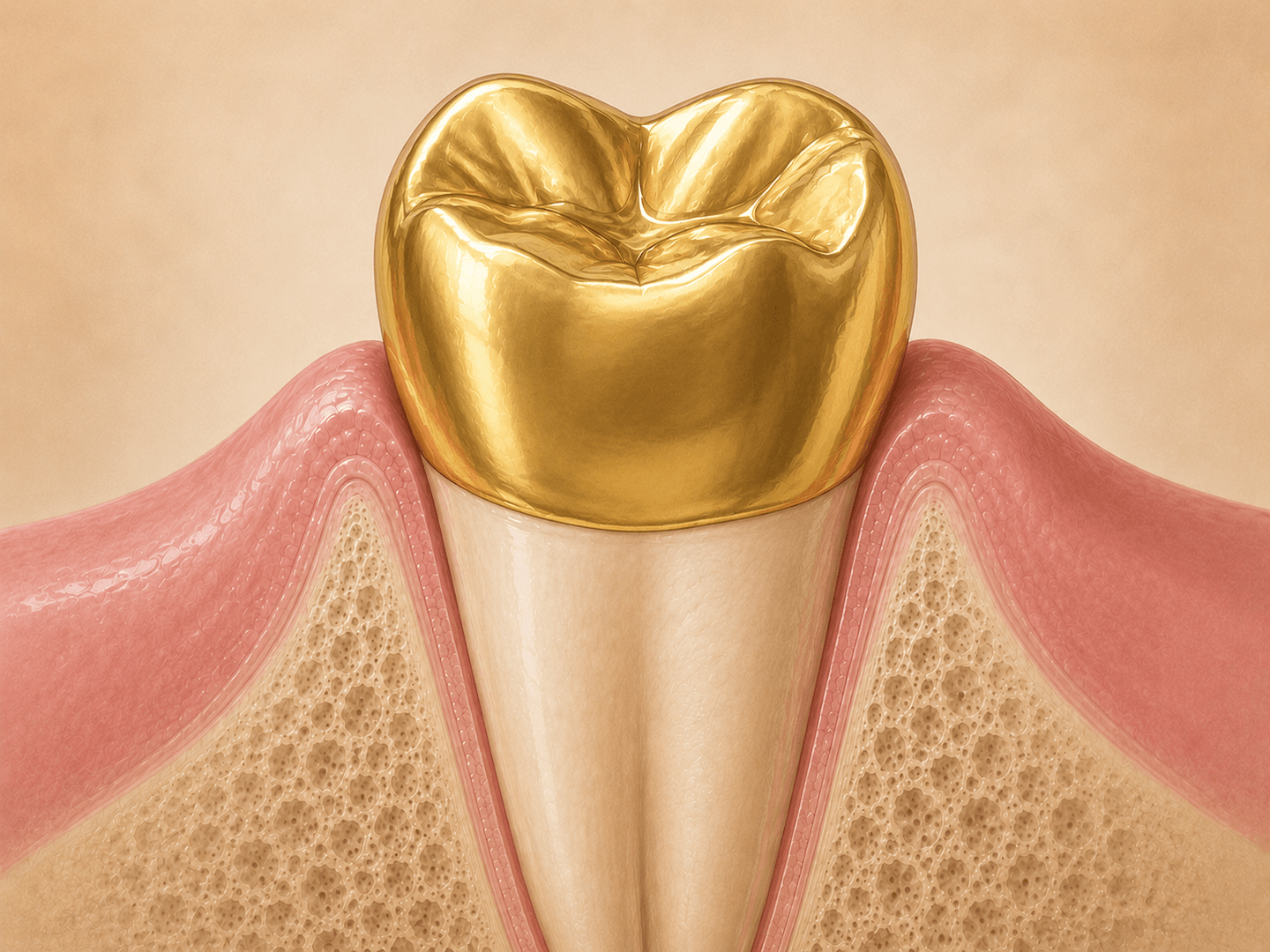
D2790 reports a full-cast crown made entirely of high noble metal alloy, typically yellow gold. The code covers the prep, impression, lab fabrication, try-in, and cementation. It does not include the core buildup, the post, the bite registration as a separate charge, or any indirect pulp procedures.
It does not cover:
- A porcelain-fused-to-metal crown with a high noble substrate. That’s D2750.
- A full-cast crown made of predominantly base-metal alloy. That’s D2791.
- A full-cast crown made of noble (but not high noble) metal. That’s D2792.
- A full-cast crown made of titanium or titanium alloy. That’s D2794.
- An all-ceramic or porcelain crown. That’s D2740.
- An indirect inlay or onlay made of cast metal. Those are D2520, D2530, D2542, D2543, or D2544.
- A core buildup. That’s D2950.
- A post and core. That’s D2952 (cast) or D2954 (prefab).
When to bill D2790
Bill D2790 when:
- The lab fabricates a full-cast crown using a high noble alloy (60% noble metal minimum, 40% gold minimum).
- The crown is seated and cemented at the delivery visit.
- The lab invoice confirms the alloy composition.
Do not bill D2790 for:
- A crown with porcelain on the facial or occlusal surface. That’s the D2750 series.
- A crown made of predominantly base-metal alloy. Use D2791.
- A crown made of noble metal that doesn’t meet the high-noble threshold. Use D2792.
- A provisional or temporary crown. Use D2799.
- A crown recement. Use D2920.
Top reasons D2790 gets denied or downgraded
- Alternate-benefit downgrade to PFM. Some plans pay the D2750 fee against D2790, on the theory that PFM is the standard treatment and full-cast gold is an upgrade. Who absorbs the difference is set by your participating-provider agreement, not by the downgrade.
- Alternate-benefit downgrade to base metal. A smaller number of plans pay the D2791 fee against the D2790 claim, treating any full-cast crown as functionally equivalent regardless of alloy.
- Frequency on the same tooth. A crown billed on a tooth that had a crown paid inside the carrier’s lookback window (typically 5 to 7 years) gets denied as a repeat unless documented as a remake.
- Material content audit. The carrier requests the lab invoice and the alloy doesn’t meet the high-noble threshold. The claim downgrades to D2792 (noble) or D2791 (base metal).
- Coverage exclusion. Some plans exclude full-cast crowns entirely and cover only PFM or all-ceramic. The denial reads “service not a covered benefit,” and the balance falls to the patient unless the participating-provider agreement sets a fee for non-covered services.
The high noble standard
The CDT definition of high noble metal is specific: the alloy must contain at least 60% noble metal by weight, with at least 40% gold. The “60/40” shorthand is what most labs and most billers use.
What counts as noble metal is wider than the three metals most people name. The classification of materials counts gold plus the entire platinum group, meaning platinum, palladium, rhodium, iridium, osmium, and ruthenium. In casting alloys the last four are effectively absent, so the arithmetic on a crown invoice almost always comes down to gold, palladium, and platinum. Knowing the full list still matters on the occasional invoice that itemizes a trace platinum-group metal, because it counts toward the 60%.
Common alloys that meet the threshold:
- Type IV high noble (often 60-75% gold).
- Yellow gold dental alloys at 65% or higher gold content.
Alloys that don’t meet the threshold despite being marketed as “noble”:
- Palladium-silver alloys with less than 40% gold.
- White noble alloys with gold content under 40%.
The lab invoice is the source of truth. Carriers requesting an audit will ask for the invoice that confirms the alloy. A practice that places “gold crowns” without ever reviewing the lab invoice can be surprised by an audit downgrade.
The downgrade pattern, in practice
Plans use one of three approaches on full-cast crown claims:
- Pay D2790 at the full benefit. Less common. Usually older indemnity-style plans.
- Pay the D2750 (PFM, high noble) fee against D2790. Most common. The reasoning: PFM is the modern functional standard, full-cast is an upgrade. What happens to the unpaid difference is a separate question, answered by the contract.
- Pay the D2791 (base metal) fee against D2790. Less common but increasing. The reasoning: any full-cast crown gives the same functional outcome regardless of alloy cost.
The downgrade is plan design, not a denial. The EOB shows the billed code, the allowed amount, the plan’s percentage, and the remaining balance. There is no appeal that overturns a plan-design downgrade, so the work is on the balance rather than on the claim.
Practices that don’t have the downgrade conversation at treatment planning see these balances roll into 90+ AR. Patients who hear “your insurance covers crowns” at scheduling and “you owe $400 because the plan downgraded the material” at delivery feel misled.
Documentation that supports the claim
The claim needs:
- Date of service for the seat (delivery), not the prep visit.
- Tooth number.
- Material confirmation when the carrier requests it (lab invoice).
- A narrative when the crown is a remake inside the frequency window (citing the clinical reason: fractured original, defective margin, recurrent decay).
For the patient record, document:
- Lab invoice with alloy composition.
- Prep date, impression date, and seat date.
- Clinical reason for the crown (fractured cusp, large failing restoration, post-endo).
- Any prior crown on the same tooth and its placement date.
Example case
A 62-year-old established patient has tooth #30 with a large failing amalgam and a fractured distolingual cusp. The dentist plans a full-cast high noble crown for the occlusal strength and biocompatibility. The plan covers crowns at 50% and downgrades full-cast to PFM (D2750).
Billing steps:
- Verify the plan covers crowns and confirm the alternate-benefit rule at treatment planning. The patient hears the financial picture before the prep.
- Place a core buildup if needed and code D2950 on the same claim as D2790.
- Submit at the seat visit, not the prep visit. The fee covers the completed restoration.
- Expect the EOB to allow the D2750 fee against D2790 and pay 50% of that allowed amount.
- Post the carrier’s payment, then check the participating-provider agreement before posting the downgrade difference to the patient. Where the contract permits it and the patient signed the upgrade agreement at treatment planning, bill that difference along with the coinsurance and deductible. Where it requires a write-off, adjust it off.
- Keep the lab invoice in the patient record in case of an audit on the alloy content.
What to get right in your PMS
- Verify the lab invoice confirms 60% noble metal and 40% gold minimum before billing D2790. Alloys below threshold should be coded D2792 (noble) or D2791 (predominantly base metal).
- Bill at the seat visit, not the prep visit. Submitting at the prep is a common error that gets the claim rejected or pended.
- Have the alternate-benefit conversation at treatment planning, not at posting. Patients who hear about the downgrade after delivery assume the practice failed to check the plan.
- Don’t bundle the buildup or post into D2790. Code D2950, D2952, or D2954 separately on the same claim.
- Keep the lab invoice in the patient record for the carrier’s audit window. Most plans audit back 5 to 7 years on crown material claims.
FAQs
- What is the dental code for a gold crown?
- D2790 for a full-cast crown made of high noble metal. The high-noble category requires the alloy to contain at least 60% noble metal by weight with at least 40% gold. Noble metal means gold plus the whole platinum group, so platinum, palladium, rhodium, iridium, osmium, and ruthenium all count toward the 60%, though only gold, palladium, and platinum show up on a crown invoice in any real quantity. D2791 is the code for predominantly base-metal crowns, D2792 is for noble-metal alloys that don't meet the high-noble threshold, and D2794 is for titanium and titanium alloys.
- Why is the carrier paying D2790 at the PFM fee?
- Alternate-benefit downgrade. Some plans pay the lesser of the full-cast crown fee or the PFM crown fee on posterior teeth, on the theory that PFM is the functional standard. The plan pays the D2750 (PFM, high noble) allowed amount against the D2790 claim. Whether the office can then bill the patient the difference is a contract question rather than a feature of the downgrade: some participating-provider agreements allow it on a material upgrade the patient chose and agreed to in writing beforehand, others require the amount written off, and Medicaid prohibits balance-billing the member. Verify the plan's crown alternate-benefit rules and your agreement's terms at treatment planning.
- Does D2790 require a lab invoice showing the metal content?
- Carriers occasionally request the lab invoice to confirm the alloy meets the high-noble threshold (60% noble, 40% gold minimum). On routine claims this isn't requested at submission, but it's standard on audit. Keep the lab invoice in the patient record for at least the carrier's audit window (usually 5 to 7 years).
- Can I bill D2790 for a posterior tooth when the plan covers crowns?
- Yes. D2790 has no anterior/posterior restriction by code definition, though most practices place full-cast gold crowns on posterior teeth where aesthetics aren't the priority and occlusal strength is. The carrier adjudicates based on plan rules, not tooth location, but expect more scrutiny on anterior full-cast crowns.
- What's the difference between D2790, D2791, D2792, and D2794?
- All four are full-cast crowns. The difference is the metal. D2790 is high noble (at least 60% noble metal, 40% gold minimum). D2792 is noble metal (at least 25% noble). D2791 is predominantly base metal (less than 25% noble). D2794 is titanium and titanium alloys. The codes pay at different fees because the materials cost different amounts. The lab invoice determines which code applies.
- Does D2790 include the core buildup or the post?
- No. If a core buildup is needed before the crown prep, bill D2950 separately on the same claim. If a post is placed in a treated root canal, bill D2952 (cast post and core) or D2954 (prefabricated post and core) instead of D2950. Each is a separate benefit decision on most plans.
Related codes
Need help billing this code?
We handle D2790 claims daily.
If your team is spending time on denials, narratives, or carrier follow-up for this code, our outsourced dental insurance billing service can take it off your plate. We work inside your PMS and post payments the same week.
CDT codes are maintained by the American Dental Association. This page is an editorial billing guide, not the official ADA code descriptor. Verify current coverage policies with each carrier before submitting claims.