D5224 is the CDT code for an immediate lower partial denture on a cast metal framework, seated the day the failing lower teeth are extracted.
- When to use: The patient keeps some lower teeth, a cast framework partial is made before surgery, and it is seated on the same date as the extractions.
- When not to use: The same lower framework on a healed ridge is D5214, a resin immediate is D5222, the upper version is D5223, and a planned-temporary lower is D5821.
- Billing note: Many plans pay cast metal at a resin allowable, and an early saddle reline often denies as part of delivery, so quote both before the framework is cast.
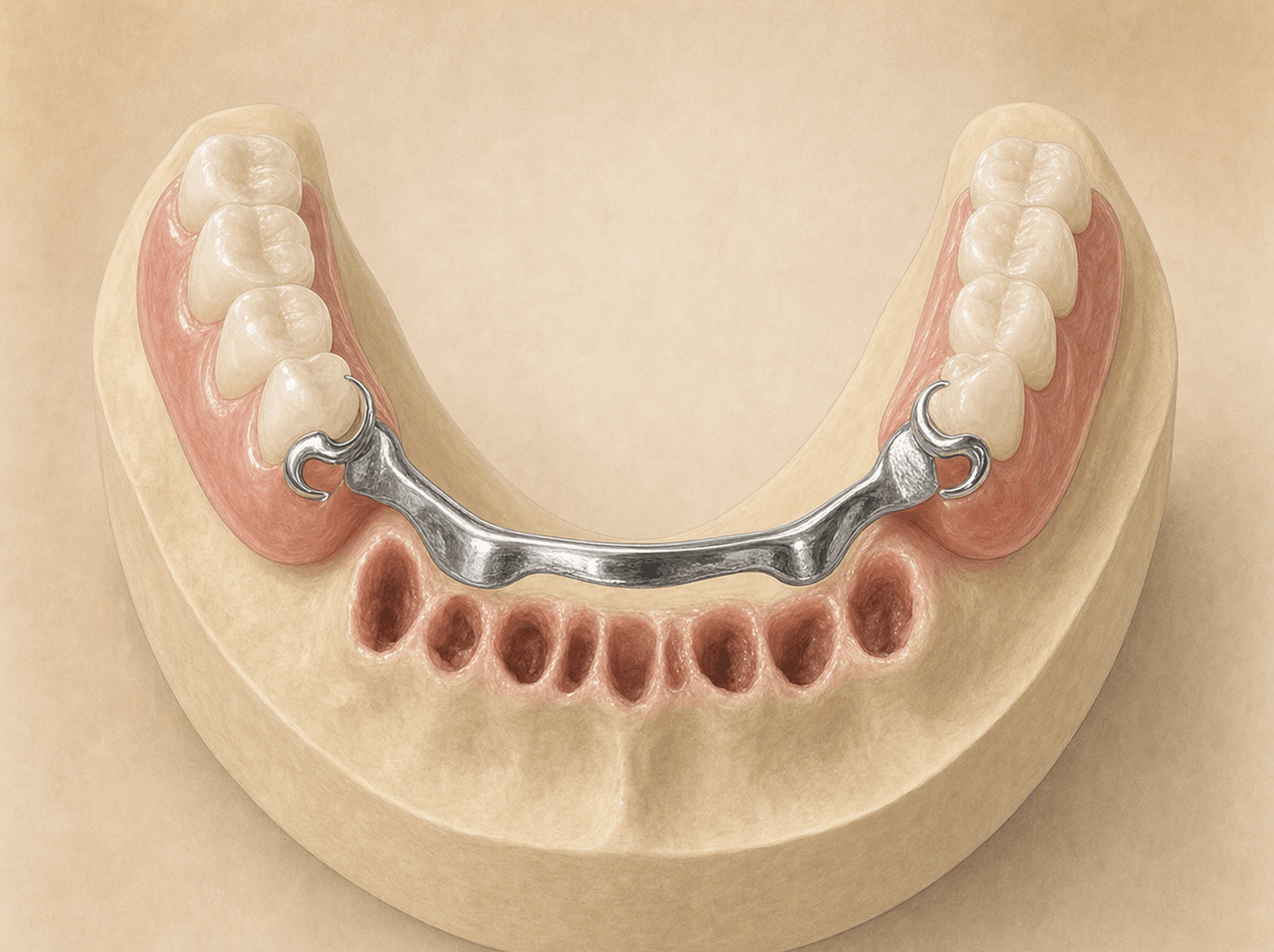
What D5224 covers
D5224 reports a definitive lower partial denture built on a cast metal framework carrying resin saddles, made before surgery and seated at the same appointment where the remaining failing lower teeth are extracted. One fee covers the framework, the bases, the clasps and rests, the replacement teeth, and the limited follow-up care in the code’s scope. Later relines and rebases are excluded.
It does not cover:
- A lower cast metal partial seated on a healed ridge. That is D5214.
- A lower immediate partial on an all-resin base. That is D5222.
- A lower immediate partial on a flexible nylon base. That is D5228.
- The upper-arch version of this prosthesis. That is D5223.
- A lower appliance planned as temporary. That is D5821, whatever day it is seated.
- A fully cleared lower arch. An immediate complete lower denture is D5140.
- The extractions themselves, billed per tooth on D7140 or D7210.
Three axes, one code
Every immediate partial claim answers three questions, and D5224 is the only code with this combination of answers:
- Timing. Seated the day the teeth are removed (immediate) or on a healed ridge (conventional, D5214).
- Base. Cast metal framework with resin saddles, as opposed to all-resin (D5222) or flexible (D5228).
- Arch. Mandibular. The maxillary twin is D5223.
A fourth question sits behind the first: intent. A same-day appliance that the treatment plan treats as transitional is D5821, not an immediate partial. The interim and immediate codes split on purpose, not on delivery timing.
The delivery date does more work than usual
On a conventional partial, the delivery date is just the date of service. On an immediate partial it also sets two clocks the office will meet again later.
Delta Dental of Ohio’s published clinical criteria for removable partials state the rule plainly: an immediate partial is treated as finished on the day the last teeth come out and the prosthesis goes in. The same document treats relining as part of the partial for six months after delivery. Other carriers use different windows, and some set none, but the structure is common.
That first date therefore anchors:
- The replacement frequency clock for the lower arch, typically five years or more on commercial plans and plan-dependent.
- The reline window, inside which a saddle reline denies as included in the original prosthesis.
The lower arch makes the second clock the one that bites. Mandibular extraction sites tend to remodel quickly, and the resin saddles on a cast framework lose contact with the ridge while the metal stays where it was cast.
Example: the five-month reline
A patient has four periodontally hopeless lower incisors (teeth 23 through 26) and keeps sound canines and premolars on both sides. The plan is a cast framework partial with a lingual bar, clasping the remaining teeth, delivered when the incisors come out.
- Delivery visit: D7140 for each of teeth 23, 24, 25, and 26, and D5224 for the mandibular arch, all on one date of service.
- Month five: the saddles have lifted off the healing ridge and the patient reports food packing under the anterior segment. The dentist does a chairside reline, and the office submits D5741.
- The EOB: the reline denies as included in the partial, because the plan applies a six-month post-delivery window.
Nothing about the coding was wrong. The fix was at case acceptance: the office could have quoted the reline as a likely patient-paid stage, or scheduled it past the window if the patient could tolerate the fit. A laboratory reline (D5761) would have hit the same window.
Why carriers look harder at this code
A cast framework is fitted to a model of an arch that surgery is about to change. Claim reviewers know this, and some ask why a definitive cast partial was placed at the immediate stage rather than a resin immediate followed by a cast partial on the healed ridge. Lower anterior cases add a second question, because teeth lost to periodontal disease make the reviewer look at the abutments.
Delta Dental of Ohio’s criteria list what a reviewer may ask for on a partial denture claim:
- Pre-operative radiographs, including bitewings, showing the teeth, the edentulous areas, and the opposing arch.
- Six-point periodontal charting from within the past 12 months, with attachment loss, mobility, bleeding, and furcation findings.
- A narrative explaining why a removable partial is indicated.
On a D5224 case, attach those with the claim and add one sentence on why the framework is going in now. That answers the review question before it is asked.
Top reasons D5224 gets denied or reduced
- Alternate benefit to resin. Many plans pay a cast metal partial at the resin partial’s allowable, and the patient owes the difference. Catch it at verification.
- Reline inside the post-delivery window. Covered above. Plan-dependent, and lower immediates hit it early.
- Dates that don’t match. The partial and the extractions on different dates of service make the claim read as conventional, and the carrier may recode it to D5214 or ask for records.
- Missing-tooth clause. The teeth extracted at delivery are current, but any lower teeth lost before coverage began can be carved out or used to deny the prosthesis, depending on the plan.
- Abutment health not documented. Without current periodontal charting, a lower anterior case built on teeth adjacent to periodontally lost ones can pend for records.
FAQs
- What is the D5224 dental code?
- D5224 is the immediate mandibular partial denture on a cast metal framework with resin bases. The clasps, rests, and replacement teeth are part of the one fee. It is fabricated before surgery and seated at the visit where the remaining hopeless lower teeth are removed. Future relines and rebases are outside its scope and bill separately.
- Can D5224 be billed if the framework is seated a week after the extractions?
- No, not as an immediate partial. The immediate codes describe a prosthesis inserted the same day the teeth come out, and carriers read the dates on the claim. If the lower teeth were extracted first and the cast partial goes in later on a healing or healed ridge, the conventional code D5214 applies. Bill the code that matches what happened on the delivery date.
- Which codes handle the reline on a lower immediate cast partial?
- The mandibular partial reline codes: D5741 chairside or D5761 laboratory, with D5721 if the whole base is replaced. Only the resin saddles are relined; the cast framework stays as it is. Many plans treat relines in the first months after delivery as part of the prosthesis, so check the plan's window before scheduling the refit as a covered claim.
- Is D5224 the right code for a temporary lower partial worn until implants are placed?
- Usually not. A lower partial planned as temporary while implants or a final prosthesis are completed is an interim partial, D5821, even when it is seated on extraction day. D5224 is a definitive prosthesis. A cast metal framework is rarely made as a throwaway, so a D5224 claim on a case whose treatment plan shows implants coming in months later invites a reviewer's question.
Related codes
Need help billing this code?
We handle D5224 claims daily.
If your team is spending time on denials, narratives, or carrier follow-up for this code, our outsourced dental insurance billing service can take it off your plate. We submit the claims, post what comes back, and follow up on anything unpaid. Already sitting on older claims that never paid? Our AR cleanup project works the backlog.
“Claims, posting, denials, all of it gets handled, and it costs far less than hiring another employee. My front desk got hours of their week back, and honestly I just don't think about billing anymore.”
CDT codes are maintained by the American Dental Association. This page is an editorial billing guide, not the official ADA code descriptor. Verify current coverage policies with each carrier before submitting claims.