D6241 is the CDT code for a bridge pontic made of porcelain fused to a predominantly base metal alloy, such as nickel-chromium.
- When to use: The pontic is porcelain over a nickel-chromium or cobalt-chromium frame, the alloy most labs call non-precious, with under 25% noble content.
- When not to use: Porcelain over noble metal is D6242, over high noble is D6240, over titanium is D6243, and the base metal PFM abutment crowns are D6751.
- Billing note: Each pontic is adjudicated on its own line, so a multi-unit bridge can pay one D6241 and exclude the next under a missing-tooth clause.
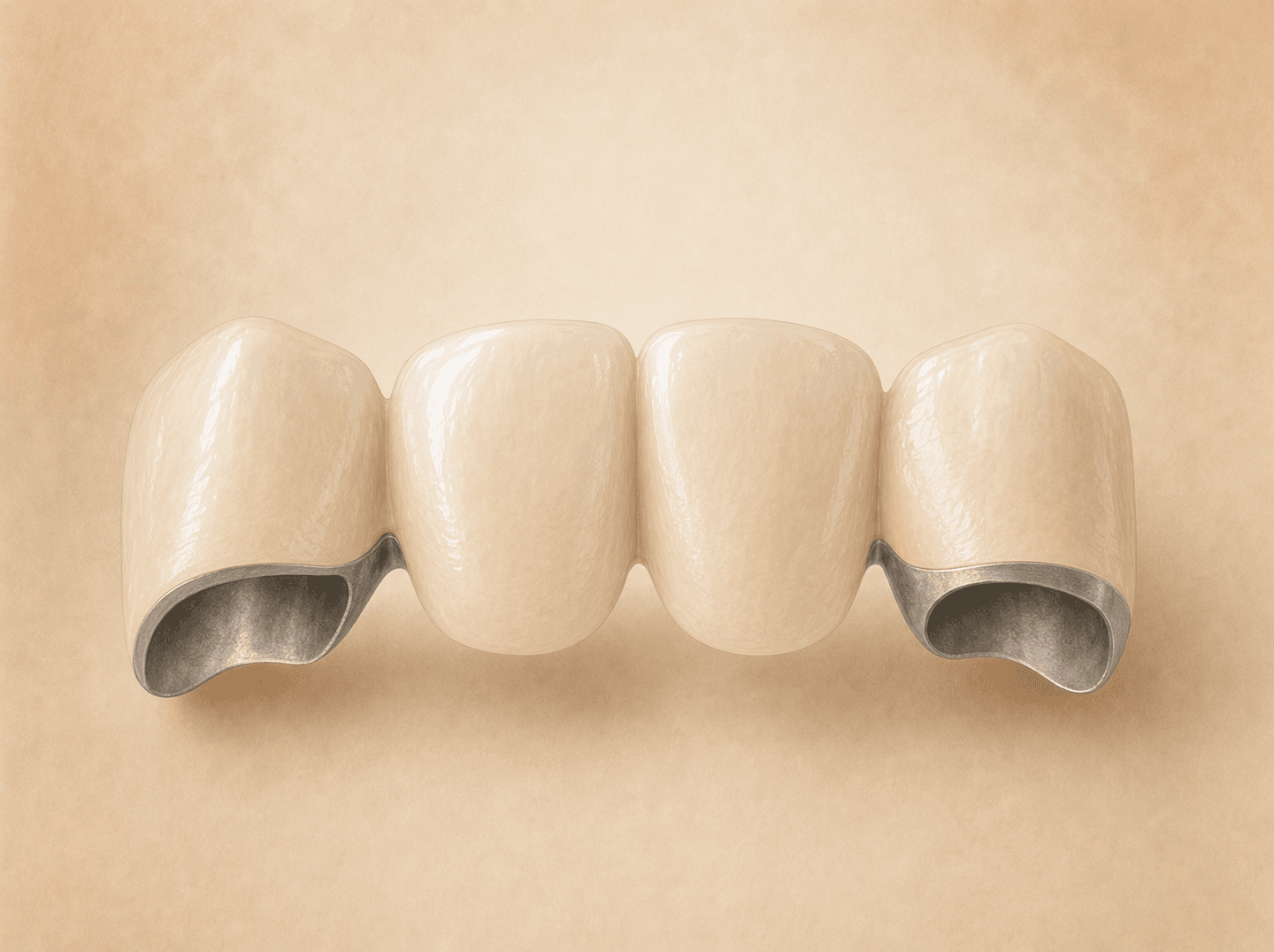
What D6241 reports
D6241 reports one pontic in a fixed bridge when the lab layers porcelain over a frame of predominantly base metal. “Predominantly base” means the alloy has less than 25% noble content, counting gold and the platinum group metals. Nickel-chromium and cobalt-chromium are the usual alloys.
It is usually the lowest-cost of the porcelain-fused-to-metal pontics, which is why it shows up on value-priced bridges. The abutment crowns bill separately, usually as D6751 when they share the same alloy.
Reading the lab slip
Labs rarely write “predominantly base metal.” They write a trade term or an alloy brand, and the biller has to map it:
- “Non-precious” almost always means a base metal alloy. Code D6241.
- “Semi-precious” has no fixed meaning. It often describes a palladium-silver alloy, which is usually noble (D6242), but the percentage decides it.
- “Precious” or “gold” may be noble or high noble (D6240). Never code from the word alone.
When the slip gives only a brand, ask the lab for the composition. The 25% noble line is the only test for D6241. Titanium frames are a separate class entirely and bill as D6243.
Two pontics, two outcomes
A carrier adjudicates every pontic and retainer as its own line. That matters most on bridges with more than one pontic, where the teeth were lost at different times.
A 34-year-old patient lost #8 in a sports injury six years ago, before the current coverage started. #9 cracked and was extracted last spring, while covered. The dentist plans a four-unit bridge from #7 to #10 in porcelain over base metal. The claim lists:
- D6751 on #7.
- D6241 on #8.
- D6241 on #9.
- D6751 on #10.
Under a typical missing-tooth clause, the #8 pontic is excluded and the #9 pontic is eligible. The retainers depend on the plan’s wording: some plans pay them with the eligible pontic, and some exclude a bridge that replaces any pre-coverage tooth. A pre-treatment estimate shows which reading this plan uses. The missing tooth clause guide walks through the common wordings.
Fees and alternate benefits
Base metal sits at the bottom of the PFM fee range, though the gap is often narrower than practices expect. South Dakota Medicaid’s adult fee schedule effective July 1, 2026, for example, lists D6241 at $766.58, D6242 at $792.85, and D6240 at $811.30.
Because D6241 usually sits at the bottom of a plan’s PFM fees, a D6241 claim has little room for a metal downgrade. The exception is posterior porcelain: some plans pay a PFM pontic on a back tooth at a cast metal allowable such as D6211, the all-metal base pontic. Check the plan’s alternate benefit provision before quoting a molar bridge.
FAQs
- What's the difference between D6241 and D2751?
- D6241 is a pontic, the replacement tooth in a bridge, while D2751 is a single crown on a natural tooth. Both are porcelain over predominantly base metal. The bridge counterpart of D2751 is D6751, the retainer crown that anchors the pontic. A three-unit base metal PFM bridge bills as D6751, D6241, D6751.
- Is a porcelain-fused-to-titanium pontic billed as D6241?
- No. It is D6243. Titanium is its own alloy class (at least 85% titanium in the ADA classification), separate from predominantly base metal, and CDT gives it a separate PFM pontic code.
- Does a nickel allergy change how D6241 is billed?
- No. The code follows the alloy actually used. If a nickel-sensitive patient gets a nickel-free alloy instead, code that alloy's class: a cobalt-chromium frame is still D6241, while a palladium-based frame would be D6242 or D6240 depending on its noble and gold content. Record the allergy and the alloy choice in the chart.
Related codes
Need help billing this code?
We handle D6241 claims daily.
If your team is spending time on denials, narratives, or carrier follow-up for this code, our outsourced dental insurance billing service can take it off your plate. We submit the claims, post what comes back, and follow up on anything unpaid. Already sitting on older claims that never paid? Our AR cleanup project works the backlog.
“Claims, posting, denials, all of it gets handled, and it costs far less than hiring another employee. My front desk got hours of their week back, and honestly I just don't think about billing anymore.”
CDT codes are maintained by the American Dental Association. This page is an editorial billing guide, not the official ADA code descriptor. Verify current coverage policies with each carrier before submitting claims.