D6751 is the CDT code for a porcelain-fused-to-metal bridge anchor crown on a natural tooth, built on a predominantly base metal alloy.
- When to use: A PFM crown anchors a tooth-supported bridge and the lab invoice shows an alloy with less than 25% noble metal content.
- When not to use: High noble is D6750, noble is D6752, titanium is D6753, a standalone base metal PFM crown is D2751, and all-ceramic retainers are D6740.
- Billing note: Code the alloy from the lab invoice, not the color or the treatment plan, because carriers that audit compare the two.
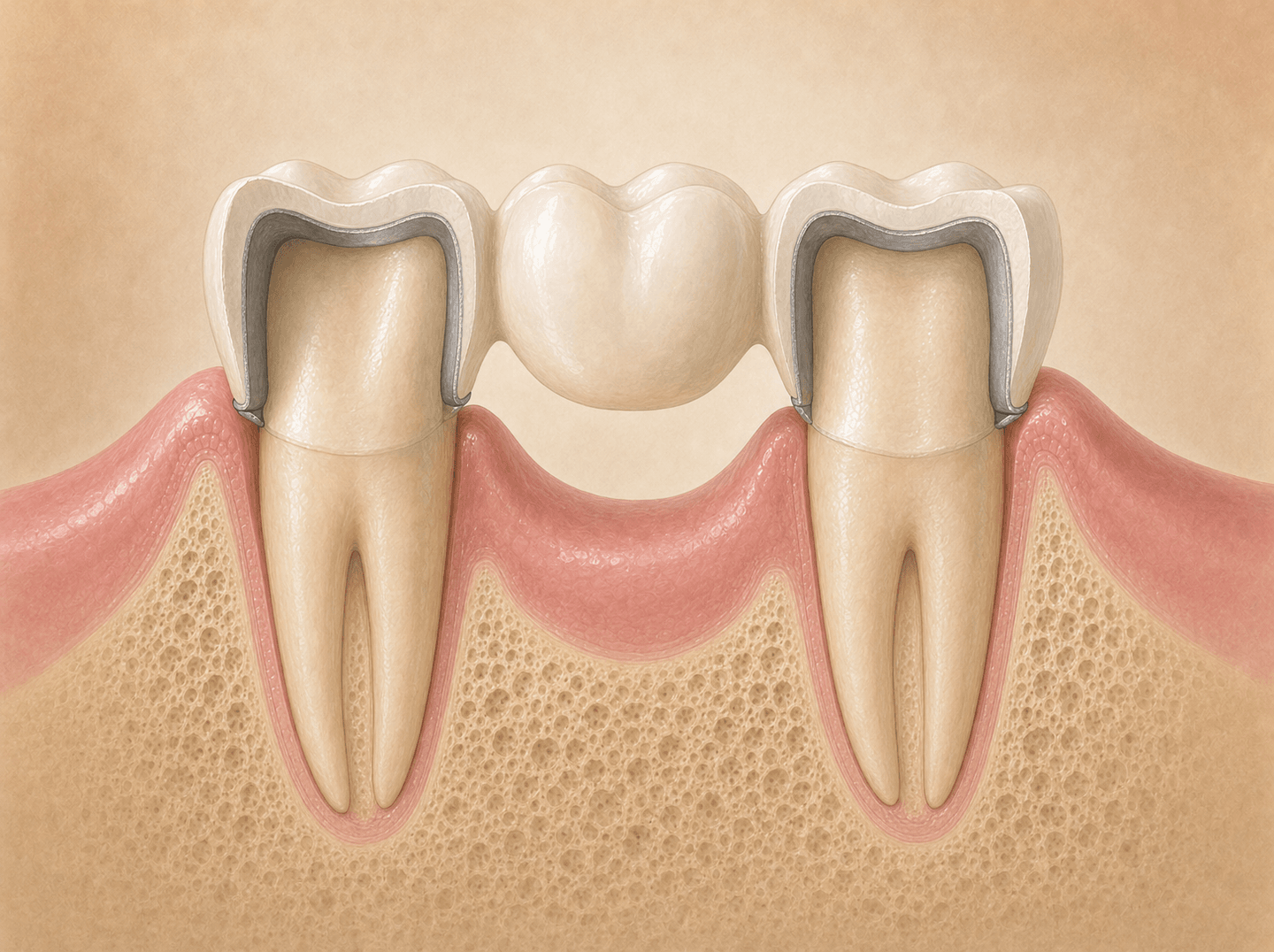
What D6751 reports
D6751 reports one retainer crown in a tooth-supported fixed bridge: a full crown on a prepared natural tooth, with porcelain fired over a metal framework that is predominantly base metal. “Retainer” means the crown is joined to a pontic and carries part of its load. A three-unit bridge with one missing tooth has two retainers and one pontic, so it carries two retainer lines.
The code sits in a grid that varies on two things at once: what the retainer is made of, and whether it is a full-coverage crown at all.
| Retainer crown on a natural tooth | Code |
|---|---|
| PFM, high noble | D6750 |
| PFM, predominantly base metal | D6751 |
| PFM, noble | D6752 |
| PFM, titanium and titanium alloys | D6753 |
| All porcelain or ceramic | D6740 |
| Full cast metal, no porcelain | D6790, D6791, D6792, D6794 |
The full cast row splits the same way as the PFM row: high noble, predominantly base, noble, and titanium. A retainer on an implant or implant abutment is a different family entirely, and a bonded Maryland-style wing is D6545 or one of its material siblings, not a crown code.
Reading the lab invoice
The alloy class decides the code, and the lab invoice is where the alloy class lives. The CDT material classes run on noble metal content by weight:
- High noble (D6750): at least 60% noble metal, with at least 40% gold.
- Noble (D6752): at least 25% noble metal.
- Predominantly base (D6751): less than 25% noble metal.
Noble metal means gold and the platinum group (platinum, palladium, rhodium, iridium, osmium, ruthenium). Silver is not on the list.
That last point causes the miscode billers see most on this code. A white or silver-colored alloy reads as “non-precious” to the front desk, but palladium-silver alloys are white and often carry well over 25% palladium. Those are noble, D6752, even with no gold in them. They cannot be high noble, because the high noble class needs 40% gold.
The opposite slip is titanium. Titanium is classed separately and is not graded by noble content, so the invoice may show a blank or “N/A” in the noble column. A blank is not zero. Porcelain over titanium is D6753.
Worked example: a four-unit bridge with a noble surprise
A patient is missing #13 and #14. The dentist plans a four-unit PFM bridge: retainers on #12 and #15, pontics at #13 and #14. The treatment plan was entered as base metal because the office’s standard bridge is nickel-chromium.
The case comes back from the lab, and the invoice lists a palladium-silver alloy at 54% palladium. That is noble content above 25% with no gold, so the bridge is noble, not base metal. The claim should read:
- D6752 on #12.
- D6242 on #13 (porcelain fused to noble metal pontic).
- D6242 on #14.
- D6752 on #15.
Had the office submitted the planned D6751 and D6241 lines, the codes would have understated the material. That usually costs the practice money rather than triggering a denial. The real exposure is the reverse case. A base metal bridge billed as noble or high noble is an overcode, and it is the one an audit that pulls lab invoices will find.
If the pre-treatment estimate went out with base metal codes, update the estimate. That gives the patient a corrected quote before seating.
Coverage notes specific to base metal retainers
On many plans the base metal PFM retainer is the least expensive PFM option, so it is often the allowable that a high noble or noble bridge gets paid at. When a plan applies that kind of alternate benefit to D6750 or D6752, the EOB usually shows the D6751 allowable. Whether the gap can be billed to the patient depends on the plan and the provider agreement.
Bridges built entirely in base metal less often trigger a material downgrade, but they still meet the usual bridge rules. Those are the missing-tooth clause on the pontic positions, a replacement frequency (commonly five years, sometimes longer), waiting periods on major services, and pre-treatment estimate requirements. Coverage varies by plan, so read the benefit booklet for each of them before the prep visit.
If a D6751 bridge later comes loose and is re-cemented, that visit is D6930, not a new retainer.
Documentation that supports the claim
- The lab invoice or certificate naming the alloy and its noble content. Keep it with the case, since it is the document an auditor asks for.
- A pre-operative radiograph showing the abutment teeth and the edentulous space.
- Tooth numbers for every retainer and every pontic, each on its own line.
- The date the replaced tooth was lost, for the missing-tooth clause.
- For a replacement bridge, the date and condition of the prior prosthesis.
- The seat date as the date of service, not the prep date.
FAQs
- What is the D6751 dental code?
- D6751 is a porcelain-fused-to-metal retainer crown made on a predominantly base metal alloy, placed on a natural tooth to anchor a fixed bridge. Each abutment tooth in the bridge gets its own D6751 line, and the pontic between them is billed with a separate pontic code.
- What counts as predominantly base metal for D6751?
- An alloy with less than 25% noble metal content. Noble metals are gold plus the platinum group, which includes palladium. Nickel-chromium and cobalt-chromium alloys are the usual base metal frameworks. If the alloy reaches 25% noble content it moves to D6752, and at 60% noble or more, with at least 40% gold, it is D6750.
- Is a titanium PFM bridge retainer coded D6751?
- No. A porcelain-fused-to-titanium retainer crown has its own code, D6753. Titanium is not graded on the noble scale, so a titanium lab invoice usually lists no noble percentage. Reading that blank as zero percent noble and billing D6751 is a miscode.
- Which pontic goes with D6751?
- The pontic takes the code for its own material. A pontic made the same way as the retainers, porcelain over predominantly base metal, is D6241. If the lab made the pontic differently, code what the lab made rather than forcing a match to the retainers.
- What's the difference between D6751 and D2751?
- Whether the crown is part of a bridge. D2751 is a single base metal PFM crown that stands alone on a tooth. D6751 is the same kind of crown joined to a pontic as a bridge abutment. A bridge billed with D2751 on the abutments does not match the procedure and tends to deny or pend.
Related codes
Need help billing this code?
We handle D6751 claims daily.
If your team is spending time on denials, narratives, or carrier follow-up for this code, our outsourced dental insurance billing service can take it off your plate. We submit the claims, post what comes back, and follow up on anything unpaid. Already sitting on older claims that never paid? Our AR cleanup project works the backlog.
“Claims, posting, denials, all of it gets handled, and it costs far less than hiring another employee. My front desk got hours of their week back, and honestly I just don't think about billing anymore.”
CDT codes are maintained by the American Dental Association. This page is an editorial billing guide, not the official ADA code descriptor. Verify current coverage policies with each carrier before submitting claims.