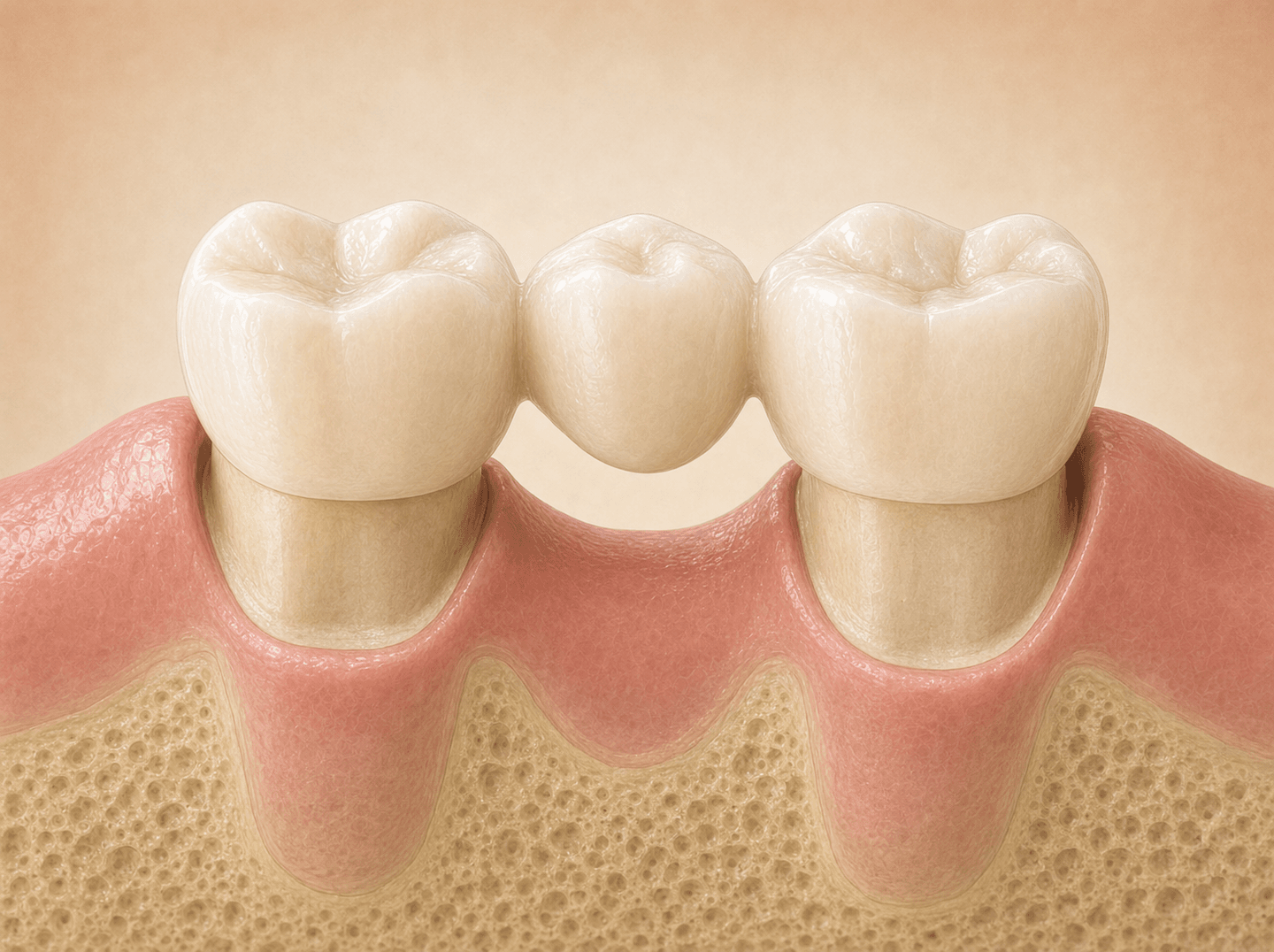
D6740 is the CDT code for an all-ceramic crown on a natural tooth that anchors a fixed bridge and connects to the pontic.
- When to use: The porcelain or ceramic crown is joined to a pontic, even when it looks the same as a standalone crown.
- When not to use: A standalone ceramic crown is D2740, a PFM high noble retainer is D6750, and an all-ceramic retainer on an implant abutment is D6068.
- Billing note: The missing-tooth clause on the pontic position can decide the whole bridge, so run a predetermination before any tooth is prepped.
What D6740 reports
D6740 reports a porcelain or ceramic crown that serves as a retainer in a fixed partial denture: the anchor crown of a bridge. It caps a prepared natural tooth at one end of the span and connects to the pontic, the replacement tooth that fills the gap.
The code depends on the crown’s role, not its appearance. A retainer crown looks like any other porcelain crown. It is D6740 because it is splinted to a pontic and carries a bridge.
Do not bill D6740 for:
- A single porcelain/ceramic crown that stands alone. Use D2740.
- A retainer crown of a different material. Use D6750 for porcelain fused to high noble metal, and the matching code for other materials.
- A crown anchored on an implant. Use the implant codes (D6058, D6065, or D6068), covered below.
- The pontic. That is its own code, D6245 for porcelain/ceramic.
D6740 vs D2740: the distinction that drives the code
D2740 and D6740 describe crowns of the same material, prepared and seated the same way, that can look identical in the mouth. The difference is function:
- D2740 is a single porcelain/ceramic crown on a natural tooth. It connects to nothing.
- D6740 is a porcelain/ceramic crown joined to a pontic, sharing the load of replacing a missing tooth.
The test: is there a pontic in the case? If the crown is splinted to one, bill the retainer code. Keep the standalone crown and the retainer crown as separate, clearly labeled entries in the PMS code table; a single “porcelain crown” entry is how retainers get billed as single crowns.
Billing a bridge: retainers and pontic together
A fixed bridge is never one code. Build it in the treatment plan and on the claim as separate lines, each with its own tooth number:
- Retainer crowns on the anchor (abutment) teeth. For all-ceramic, D6740 on each.
- A pontic for each replaced tooth. For all-ceramic, D6245.
A classic three-unit all-ceramic bridge is two D6740 retainers plus one D6245 pontic: three lines, three tooth numbers.
Match the material across the bridge. Porcelain/ceramic retainers (D6740) go with a porcelain/ceramic pontic (D6245). A porcelain-fused-to-high-noble bridge uses D6750 retainers and a D6240 pontic. The bridge dental codes guide lists every retainer and pontic pairing by material.
D6740 vs the implant retainer codes
D6740 applies only when the retainer caps a prepared natural tooth. When the anchor is an implant, the implant family applies.
A single implant restoration is D6058 (abutment-supported porcelain/ceramic crown) or D6065 (a ceramic crown attached directly to the implant, with no separate abutment). On an implant-anchored bridge, the abutment-supported porcelain/ceramic retainer is D6068, the implant counterpart of D6740.
What the crown sits on decides the code, not what it is made of. A tooth-supported retainer code on an implant case will deny, and so will an implant retainer code on a natural-tooth bridge.
Coverage reality: the missing-tooth clause decides
Payment on D6740 usually depends less on the crown than on the tooth the bridge replaces. These factors are plan-dependent:
- The missing-tooth clause. Many plans exclude replacement of a tooth missing before coverage started. If the pontic position fails the clause, the carrier can deny the pontic, and sometimes the whole bridge, however cleanly the retainers are coded.
- Frequency and replacement limits. Plans that cover bridges typically limit replacement in a given area, often to once every five to seven years, varying by contract.
- Alternate benefit and downgrade. A plan may alternate-benefit a bridge against a different treatment or pay an all-ceramic bridge at a lower-cost material allowance. The patient owes the difference where the contract permits.
- Abutment status. Some plans want documentation that the anchor teeth need crowns, not just that they border the gap.
Because each unit is a separate line, a plan can pay the retainers and deny the pontic, or downgrade the material. Post the EOB line by line against the contract so the patient balance reflects what the plan allowed.
Documentation that supports the claim
The documentation has to explain the whole bridge, not one crown:
- Tooth numbers for every unit. The pontic position is what the missing-tooth clause is keyed to.
- The missing tooth and when it was lost. An extraction date, or a note that the tooth was congenitally absent or lost during coverage, answers the missing-tooth clause. Capture it at treatment planning; it is the most important document on a bridge claim.
- A preoperative radiograph showing the edentulous space and the condition of the abutment teeth. Most carriers want one.
- Why the abutments need crowns, in a short narrative, so the retainers don’t read as elective.
- Material. State that the retainers and pontic are porcelain/ceramic so the claim and the lab slip agree.
FAQs
- What is the difference between D6740 and D2740?
- The crown's role, not the crown itself. D2740 is a single porcelain/ceramic crown standing alone on a natural tooth. D6740 is a porcelain/ceramic crown that serves as a bridge retainer, connected to a pontic. The two can be identical in material and lab work. Coding a bridge retainer as D2740 underreports the procedure and is a common denial trigger.
- When do I use D6740 instead of D2740?
- Use D6740 when the porcelain/ceramic crown is a retainer (abutment) crown in a tooth-supported bridge, connected to a pontic. Use D2740 when it restores a single tooth and is joined to nothing. A three-unit bridge replacing one tooth is billed as two retainers and one pontic, for example two D6740s and one D6245, not as standalone crowns.
- Does insurance cover D6740?
- It depends on the plan, and usually on the missing-tooth clause more than the crown. Bridge benefits turn on when the missing tooth was lost, whether the plan covers its replacement, and the plan's frequency and downgrade rules. Many plans also alternate-benefit a bridge or downgrade the material. Because each unit is a separate line, a plan can pay part of a bridge and deny the rest, so run a predetermination before prep.
- How is a three-unit bridge billed?
- As three lines, each with its own tooth number: a retainer crown on each anchor tooth and a pontic in between. An all-porcelain bridge is typically two D6740 retainers and one D6245 pontic. Match the material across the bridge: porcelain retainers (D6740) with a porcelain pontic (D6245), and high noble PFM retainers (D6750) with the matching PFM pontic (D6240). The missing-tooth clause is keyed to the pontic position.
- Is D6740 the same as an implant crown code?
- No. D6740 caps a prepared natural tooth in a tooth-supported bridge. A single crown on an implant is D6058 (abutment-supported) or D6065 (implant-supported), and the all-ceramic bridge retainer on an implant abutment is D6068. Using a tooth-supported retainer code on an implant case, or the reverse, will deny.
Related codes
Need help billing this code?
We handle D6740 claims daily.
If your team is spending time on denials, narratives, or carrier follow-up for this code, our outsourced dental insurance billing service can take it off your plate. We submit the claims, post what comes back, and follow up on anything unpaid. Already sitting on older claims that never paid? Our AR cleanup project works the backlog.
“Claims, posting, denials, all of it gets handled, and it costs far less than hiring another employee. My front desk got hours of their week back, and honestly I just don't think about billing anymore.”
CDT codes are maintained by the American Dental Association. This page is an editorial billing guide, not the official ADA code descriptor. Verify current coverage policies with each carrier before submitting claims.