D7220 is the CDT code for removing an impacted tooth covered only by gum tissue, reached with a flap and no bone removal.
- When to use: The tooth is impacted with soft tissue over its biting surface, often a third molar, and a flap was raised to reach it.
- When not to use: Bone over part of the crown is D7230, a crown encased in bone is D7240, and an erupted tooth needing a flap is D7210.
- Billing note: Carriers downgrade to D7140 or D7210 when the note does not name the soft tissue coverage and the flap, so document both.
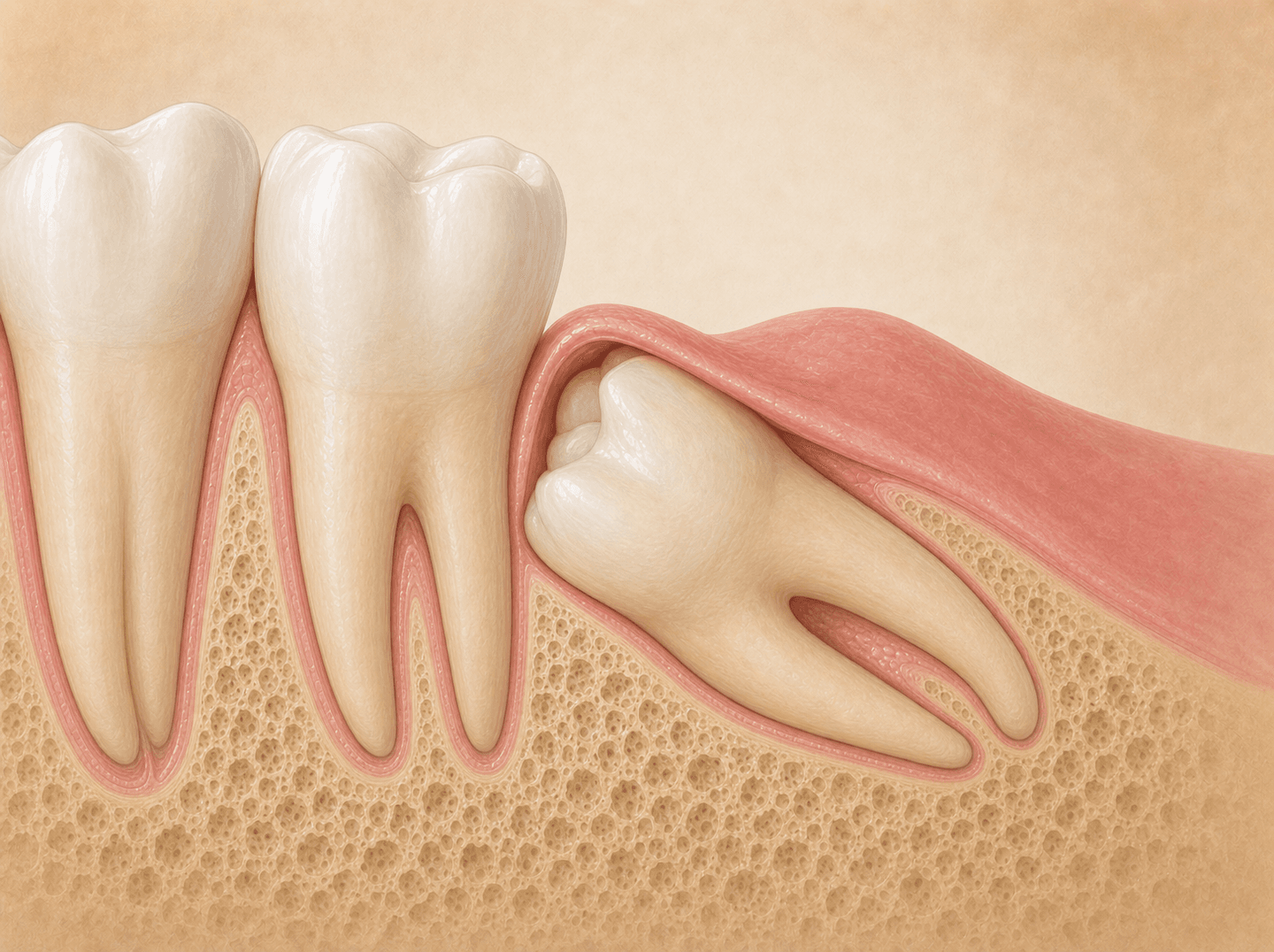
What D7220 covers
D7220 reports the removal of an impacted tooth whose occlusal surface is covered by soft tissue. The tooth has not fully erupted, gum tissue overlies the biting surface, and the dentist elevates a mucoperiosteal flap to reach and deliver it. No bone removal is needed to expose the crown, which makes it the least involved impaction code.
Most D7220 cases are third molars (wisdom teeth), though the code applies to any soft tissue impaction.
Bill D7220 when all three are true:
- The tooth is impacted and its occlusal surface is covered by soft tissue.
- A flap was elevated to access the tooth.
- No bone removal was required to expose the crown.
It does not cover:
- A fully erupted tooth that needs a flap, bone removal, or sectioning. That is D7210, the surgical extraction of an erupted tooth.
- A simple extraction of an erupted tooth or exposed root by elevator or forceps. That is D7140.
- An impaction that required bone removal. That is D7230, D7240, or D7241 (see the next section).
How the impaction codes are distinguished
The impaction codes are not a difficulty ladder. They are separated by what covers the tooth, established at the procedure and recorded in the operative note.
- D7220 soft tissue: the occlusal surface is under gum tissue. Flap, no bone removal.
- D7230 partially bony: part of the crown is under bone. Flap plus bone removal.
- D7240 completely bony: the crown is essentially encased in bone. Flap plus more extensive bone removal.
- D7241 completely bony with unusual surgical complications: atypical anatomy, deep nerve involvement, or other documented difficulty beyond the standard completely bony case.
Because D7220 is the lowest impaction code, it draws scrutiny in both directions. The note has to show enough to support an impaction code without overstating the case into a bony classification the film does not support.
Top reasons D7220 gets denied or downgraded
- Downgraded to a non-impaction code. The note didn’t establish soft tissue coverage or the flap, so the carrier paid at the D7140 or D7210 allowable. The operative report is the defense.
- Documentation missing. No radiograph showing the impaction and no description of the soft tissue coverage, so the carrier cannot confirm the classification.
- Coverage questioned on an asymptomatic case. Some plans limit benefits for asymptomatic impactions or apply the dental benefit only. This is plan language, not a clinical judgment.
- Medical and dental confusion. On cases with a medical indication, the claim may need to go to medical first. Sending it to the wrong payer first creates rework, so check medical eligibility before treating symptomatic cases.
Medical and dental crossover
Medical plans are more likely to pay for an impaction removal when there is a documented medical indication: symptoms, infection, an associated cyst or pathology, or interference with a planned medical procedure such as cardiac surgery, transplant preparation, or radiation therapy.
When medical applies, it is usually billed first as primary, with dental secondary for any remaining benefit. The medical claim uses CPT codes; the dental claim uses the D7220 line. Whether a given soft tissue impaction qualifies for medical, and which payer is primary, is plan-dependent and should be verified before treatment planning.
Documentation that supports the claim
The claim is stronger with:
- A radiograph, often panoramic, showing the impaction and the soft tissue coverage, attached to the claim.
- An operative note stating the occlusal surface was covered by soft tissue and a flap was elevated.
- The clinical indication, especially when seeking medical coverage.
For the patient record, document:
- The tooth number and impaction status.
- That the occlusal surface was covered by soft tissue.
- The flap elevation and that no bone removal was required.
- Any symptoms, pathology, or medical indication.
The supporting sentence names both the coverage and the access: “Tooth 17 impacted with occlusal surface covered by soft tissue; mucoperiosteal flap elevated for access, tooth delivered without bone removal.” That separates D7220 from both a routine extraction and a bony impaction.
Example case
A 19-year-old established patient has tooth 32, a lower wisdom tooth whose biting surface is covered by gum tissue but not by bone. The patient reports recurrent pericoronitis. The dentist elevates a flap, removes the tooth without bone removal, and closes.
Billing steps:
- Take a panoramic radiograph showing the soft tissue impaction.
- Verify whether the symptoms make this a medical-primary case under the patient’s plans.
- Code D7220 with an operative note naming the soft tissue coverage and the flap.
- Attach the film. If a medical indication applies, bill medical first and dental secondary.
- If the carrier downgrades, appeal with the operative report documenting the impaction and access.
FAQs
- What's the difference between D7220, D7230, and D7240?
- What covers the tooth, not how hard the procedure was. D7220 is a soft tissue impaction: gum tissue covers the occlusal surface and the dentist elevates a flap to reach it. D7230 is partially bony: bone covers part of the crown, so bone is also removed. D7240 is completely bony: the crown is essentially encased in bone. The classification comes from the clinical presentation documented at the procedure.
- Why did the carrier downgrade my D7220 to a regular extraction?
- Usually because the operative note didn't establish that the occlusal surface was under soft tissue, or didn't document the flap. When the note reads like a routine extraction, the carrier defaults to D7140 or D7210. A note that names the soft tissue coverage and the flap elevation is the defense. This is plan-dependent.
- Does medical insurance cover a D7220 soft tissue impaction?
- Sometimes. Medical plans more often cover impactions with a documented medical indication, such as symptoms, infection, an associated cyst, or interference with a planned medical procedure. An asymptomatic soft tissue impaction is frequently a dental-only benefit. Whether medical is primary varies by plan and should be verified before treatment.
- Do I need a panoramic X-ray for D7220?
- Most carriers want a radiograph that shows the impaction, and a panoramic film is common for third molars. It supports the impaction classification and the choice of D7220 over a non-impaction code. Attach it with the initial claim. Plan requirements vary.
- Is a partially erupted wisdom tooth always D7220?
- Not automatically; the code depends on what covers the occlusal surface. Soft tissue only with a flap is D7220. Bone over part of the crown with bone removal is D7230. A fully erupted third molar that needs flap or bone work is D7210, not an impaction code.
Related codes
Need help billing this code?
We handle D7220 claims daily.
If your team is spending time on denials, narratives, or carrier follow-up for this code, our outsourced dental insurance billing service can take it off your plate. We submit the claims, post what comes back, and follow up on anything unpaid. Already sitting on older claims that never paid? Our AR cleanup project works the backlog.
“Claims, posting, denials, all of it gets handled, and it costs far less than hiring another employee. My front desk got hours of their week back, and honestly I just don't think about billing anymore.”
CDT codes are maintained by the American Dental Association. This page is an editorial billing guide, not the official ADA code descriptor. Verify current coverage policies with each carrier before submitting claims.