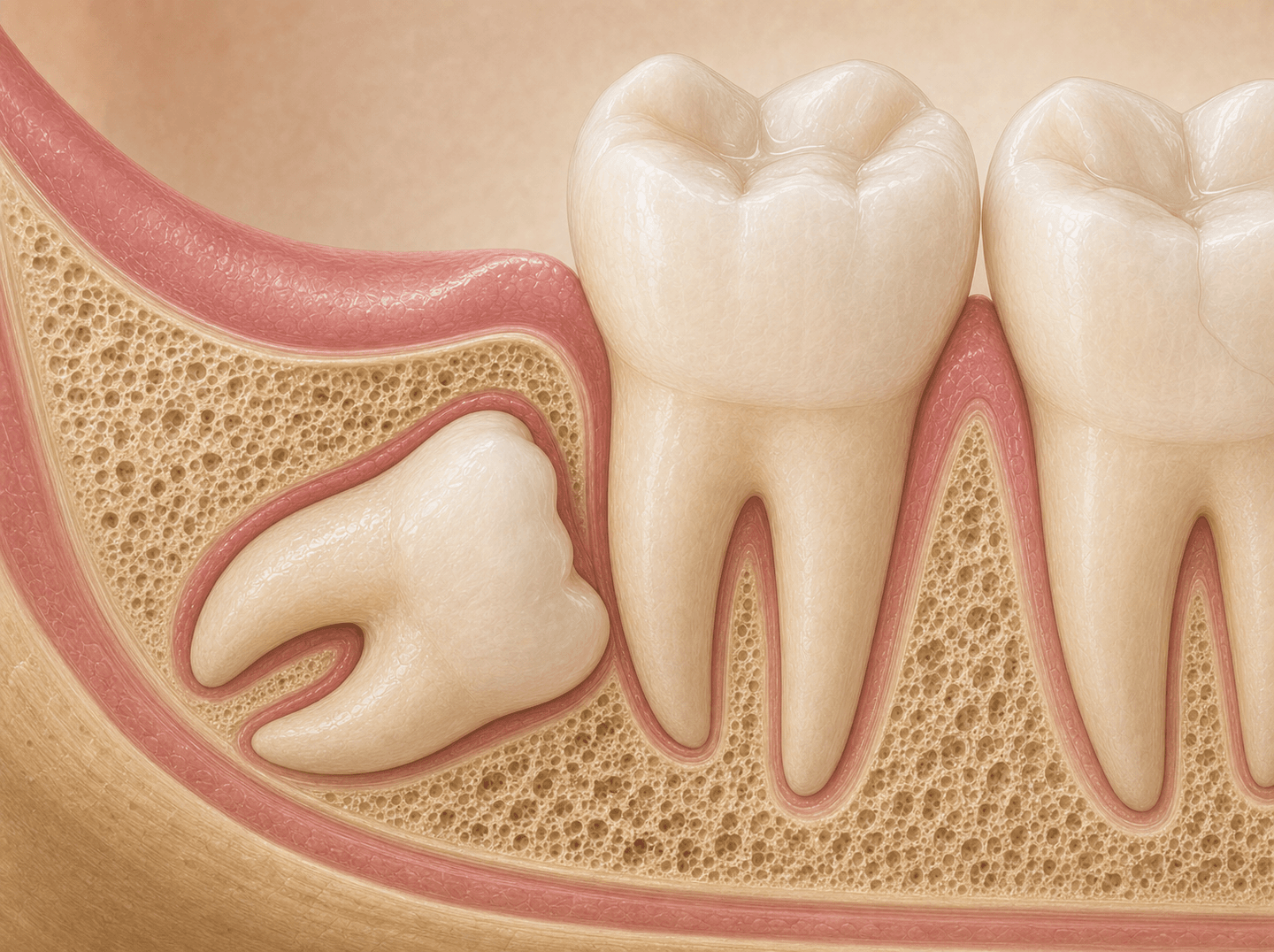
D7240 is the CDT code for removing an impacted tooth fully covered by bone, which requires cutting bone away to reach it.
- When to use: The pre-op radiograph shows the tooth completely covered by bone, and the surgery used standard technique with no unusual complications.
- When not to use: Partial bony coverage is D7230, gum tissue only is D7220, and a completely bony case with documented unusual complications is D7241.
- Billing note: Carriers often downgrade to D7230 when the operative report does not establish full bony coverage, so attach the pano and describe the bone removed.
On this page
- What D7240 covers
- When to bill D7240
- The impaction classification on the operative report
- The medical-dental crossover
- Top reasons D7240 gets denied or downgraded
- The pre-operative panoramic radiograph as the foundation
- Documentation that supports the claim
- Example case
- What to verify before the surgical case ships
- FAQs
What D7240 covers
D7240 reports the surgical removal of a completely bony impacted tooth: a tooth that is entirely covered by bone and requires bone removal for surgical access. The code includes the local anesthesia, the soft tissue flap, the bone removal necessary to expose the tooth, the tooth removal (including routine sectioning when needed), socket management, and the routine wound closure with sutures.
It does not cover:
- Soft tissue impactions covered only by gum tissue. Use D7220.
- Partially bony impactions partly covered by bone. Use D7230.
- Completely bony impactions with unusual surgical complications. Use D7241.
- Simple extraction of an erupted tooth. Use D7140.
- Surgical extraction of an erupted tooth (involving sectioning or bone removal on an erupted tooth). Use D7210.
- IV sedation or general anesthesia. Use the sedation/anesthesia series (D9222–D9243).
- Local anesthesia beyond what’s included in the surgical code (not usually billed separately).
- Post-operative visits, dressing changes, or suture removal.
- Bone grafting at the extraction site. Use D7953.
The code specifically requires bone removal for tooth access. A case removed without bone removal is one of the other codes.
When to bill D7240
Bill D7240 when:
- A tooth (most commonly a third molar) is completely covered by bone on the pre-op radiograph.
- The surgical procedure includes raising a tissue flap, removing bone to expose the tooth, removing the tooth, and closing the wound.
- The procedure was completed using standard surgical technique without unusual complications.
Do not bill D7240 for:
- Cases where the tooth was partially erupted or the impaction was only soft tissue. Use the appropriate D7220 or D7230 code.
- Cases with unusual surgical complications. Use D7241.
- Simple extractions on erupted teeth.
The impaction classification on the operative report
The single most important documentation element on D7240 is the operative report’s description of the impaction. Carriers review the report (along with the pre-op panoramic radiograph) to verify that the impaction was actually completely bony rather than partially bony or soft tissue.
Completely bony (D7240) requires:
- Pre-op panoramic radiograph showing the tooth fully covered by bone, including the occlusal surface and the crown.
- Operative report describing bone removal performed to expose the tooth.
- Documentation that the tooth was not visible in the oral cavity before the bone was removed.
Partially bony (D7230):
- Pre-op panoramic radiograph showing the tooth partially covered by bone (typically the crown is partially exposed or partially covered).
- Operative report describing limited bone removal.
Soft tissue impaction (D7220):
- Pre-op panoramic radiograph showing the tooth fully erupted through bone but covered by gum tissue.
- No bone removal in the operative report.
The classification is made by the surgeon based on the actual anatomy at the time of surgery. The operative report and the radiograph should support the code billed. Carrier downgrades from D7240 to D7230 are common when the documentation doesn’t clearly establish the completely bony status.
The medical-dental crossover
Impacted third molar removal is one of the more common medical-dental crossover scenarios in dentistry. Medical insurance may cover the procedure when it meets medical necessity criteria, in which case medical is billed primary and dental is billed secondary.
Medical-necessity criteria typically include:
- Symptomatic impactions (pain, infection, pericoronitis).
- Pathology associated with the impaction (cyst, abscess, adjacent tooth resorption).
- Interference with planned medical treatment (cardiac surgery preparation, organ transplant, radiation therapy to head/neck).
- Trauma-related cases.
- Tumor or oncologic association.
Less likely to be medically covered:
- Asymptomatic prophylactic extractions (commonly recommended on third molars before complications develop, but often only dental-covered).
- Patient-preference cases without clear medical justification.
The plan-specific rule varies. Medical plans differ widely on what they consider medically necessary for impacted-tooth removal. A pre-operative authorization on medical insurance is the cleanest way to verify coverage.
Top reasons D7240 gets denied or downgraded
Five issues account for most problems on this code:
- Downgrade to D7230. Carrier reviewer judges the impaction was partially bony based on the panoramic radiograph. Appeal with the operative report documenting bone removal extent and the pre-op radiograph annotated to show full bony coverage.
- Medical necessity not established. Some plans require documentation of symptoms, pathology, or medical-procedure preparation. Asymptomatic prophylactic extractions on third molars get denied as medically unnecessary on some plans. A narrative documenting pericoronitis history, partial eruption causing food trapping, or developing pathology often clears the denial.
- Frequency or coverage exclusion on third molars. Some plans cover only symptomatic impactions or limit the lifetime coverage for third molar removals. The exclusion is plan-specific.
- Missing operative report. Carriers reviewing the claim may pend for the operative report. Most offices have this documented; the issue is usually attachment failure rather than missing documentation.
- Wrong code for unusual complications. Cases with a documented unusual complication, such as inferior alveolar nerve involvement, an aberrant tooth position, or a separate sinus closure, should be billed D7241 rather than D7240. Routine sectioning is not one of them. Billing D7240 on a D7241 case underbills the procedure.
The pre-operative panoramic radiograph as the foundation
The pre-op panoramic radiograph is the single most useful piece of documentation on D7240 cases. It establishes the impaction classification visually, supports the operative report, and answers most of the questions carrier reviewers ask.
The pano should clearly show:
- The tooth’s position relative to the bone (fully covered, partially covered, or not covered).
- The proximity to vital structures (inferior alveolar nerve, maxillary sinus).
- Any associated pathology (cyst, resorption of adjacent teeth, periodontal involvement).
- The patient’s overall dental status (relevant for medical-necessity arguments).
A pano taken at the consultation or the same day as the surgery is preferred. An older pano (1+ year old) may not reflect the current status and can weaken the claim.
Documentation that supports the claim
The claim needs:
- Date of service.
- Tooth number(s).
- Pre-operative panoramic radiograph attached.
- Operative report attached or available on request.
- Sedation or anesthesia codes if used (separate claim line).
For the patient record, document:
- Pre-operative diagnosis (impacted third molar with symptoms, pathology, or asymptomatic prophylactic indication).
- Pre-operative panoramic radiograph date and findings.
- Anesthesia type (local, oral sedation, IV sedation, general).
- Surgical approach (flap design, bone removal performed, sectioning if any).
- Tooth removal sequence.
- Wound closure (suture type and count).
- Post-operative instructions (bleeding, swelling, pain management, dry socket signs).
- Follow-up schedule.
For multi-tooth cases (common with third molars), each tooth’s classification is documented separately. A case with all four wisdom teeth removed may include two completely bony impactions (D7240), one partially bony (D7230), and one soft tissue (D7220).
Example case
A 22-year-old patient presents with intermittent pain and swelling around tooth #32 (lower right wisdom tooth). Pre-op panoramic radiograph shows #32 fully covered by bone, mesially angulated, with the crown impacting against the distal root of #31. The surgeon plans D7240 for #32 plus D7230 for the contralateral #17 which is partially bony.
Treatment sequence:
- Pre-operative consultation, panoramic radiograph review, treatment plan.
- Surgical day: local anesthesia plus IV moderate sedation (D9239 first 15 min, D9243 each subsequent 15 min).
- Tissue flap raised on #32. Bone removal to expose the crown. Tooth sectioned for atraumatic removal. Socket inspected. Flap repositioned and sutured.
- Similar procedure on #17, with less bone removal required.
Billing steps:
- Verify benefits on both dental and medical plans. If symptomatic and the medical plan covers oral surgery, submit medical claim first.
- Dental claim submitted on the date of service with:
- D7240 for #32.
- D7230 for #17.
- D9239 plus D9243 for the IV sedation (first 15-minute increment plus each subsequent 15-minute increment).
- Attach the pre-op panoramic radiograph and the operative report.
- If medical paid first, dental is billed secondary for the remaining balance.
If the dental claim is downgraded by the carrier to D7230 on #32, an appeal with the operative report’s bone removal description and the annotated pano usually succeeds when the case is genuinely completely bony.
What to verify before the surgical case ships
The specifics vary across Open Dental, Dentrix, Eaglesoft, Curve, and Carestream. The steps that matter:
- Code by impaction classification, not by procedure complexity. D7240 specifically requires the tooth to be completely covered by bone on the pre-op radiograph. Difficulty alone doesn’t make a case D7240.
- Attach the pre-op panoramic radiograph to every claim. Carriers expect it and the claim often pends without it.
- Document the operative report in detail. Bone removal, sectioning if performed, and the clinical reasoning belong in the report. A short report invites the downgrade.
- Track sedation codes separately. IV moderate sedation (D9239 first increment, D9243 each subsequent increment) has its own coverage rules and is billed separately from D7240. D9230 is nitrous oxide as a sole agent only, not an IV-sedation code, and as of Jan 1, 2026 it can’t be reported alongside the IV sedation codes.
- Consider medical-dental crossover on symptomatic or pathology cases. A medical-primary claim changes the payment math. Set up the workflow in advance if your office does meaningful oral surgery volume.
If your office sees recurring downgrades from D7240 to D7230, the cause is usually that the operative report doesn’t clearly establish the bone removal extent. A standardized operative report template that explicitly documents the bone removal performed prevents most downgrades.
FAQs
- What's the difference between D7220, D7230, D7240, and D7241?
- All four are impacted-tooth removal codes, distinguished by the degree of impaction. D7220 is soft tissue impaction (covered only by gum tissue). D7230 is partially bony impaction (partly covered by bone). D7240 is completely bony impaction (fully covered by bone, requires bone removal). D7241 is completely bony with documented unusual surgical complications (such as inferior alveolar nerve involvement, an aberrant tooth position, or a separate maxillary sinus closure). Routine sectioning of the tooth is part of D7240 and does not upgrade the case. The classification is determined by the surgeon at the operative visit and documented in the operative report.
- When does medical insurance cover wisdom tooth removal?
- Most medical plans cover impacted-tooth removal when the procedure is medically necessary, typically defined as symptomatic impactions, pathology associated with the impaction (cyst, infection, adjacent tooth resorption), or interference with planned medical procedures (cardiac surgery, organ transplant preparation, radiation therapy). Asymptomatic prophylactic extractions are sometimes covered by medical, sometimes only by dental. The plan-specific rule should be verified before treatment planning.
- Do dental and medical bill at the same time?
- On crossover cases, medical is usually billed first as primary, then dental is billed secondary for any uncovered portion. The medical claim uses CPT codes (typically CPT 41899 for unlisted dentoalveolar surgery or specific maxillofacial codes depending on the case). The dental claim uses the appropriate D7000 series code. The two claims process independently and the patient owes the balance after both have processed.
- Why was D7240 reclassified to D7230 by the carrier?
- Some carriers downgrade impaction claims based on the panoramic radiograph evidence. If the carrier's reviewer judges the impaction is partially bony rather than completely bony, they may pay at the D7230 allowable. The downgrade can be appealed with the operative report documenting the bone removal performed and the depth of the impaction on the radiograph.
- What's the difference between D7240 and D7241?
- D7240 is a standard completely bony impaction removed using normal surgical technique. D7241 adds unusual surgical complications documented in the operative report: inferior alveolar nerve involvement, an aberrant tooth position, a separate maxillary sinus closure, or other unusual difficulties. Routine sectioning alone does not qualify, because D7240 already includes it. The higher allowable on D7241 requires the operative report to substantiate the complications.
Related codes
Need help billing this code?
We handle D7240 claims daily.
If your team is spending time on denials, narratives, or carrier follow-up for this code, our outsourced dental insurance billing service can take it off your plate. We submit the claims, post what comes back, and follow up on anything unpaid. Already sitting on older claims that never paid? Our AR cleanup project works the backlog.
“Claims, posting, denials, all of it gets handled, and it costs far less than hiring another employee. My front desk got hours of their week back, and honestly I just don't think about billing anymore.”
CDT codes are maintained by the American Dental Association. This page is an editorial billing guide, not the official ADA code descriptor. Verify current coverage policies with each carrier before submitting claims.