D7250 is the CDT code for surgically removing leftover root fragments from the bone after the crown is already gone.
- When to use: Only roots remain from an earlier extraction or trauma, and getting them out required a flap and bone removal.
- When not to use: Exposed roots lifted out without cutting are D7140, primary tooth remnants are D7111, and a difficult whole-tooth extraction keeps its own extraction code.
- Billing note: Carriers downgrade to D7140 when the note doesn't record the flap and bone removal, so document the cutting and attach an x-ray of the retained roots.
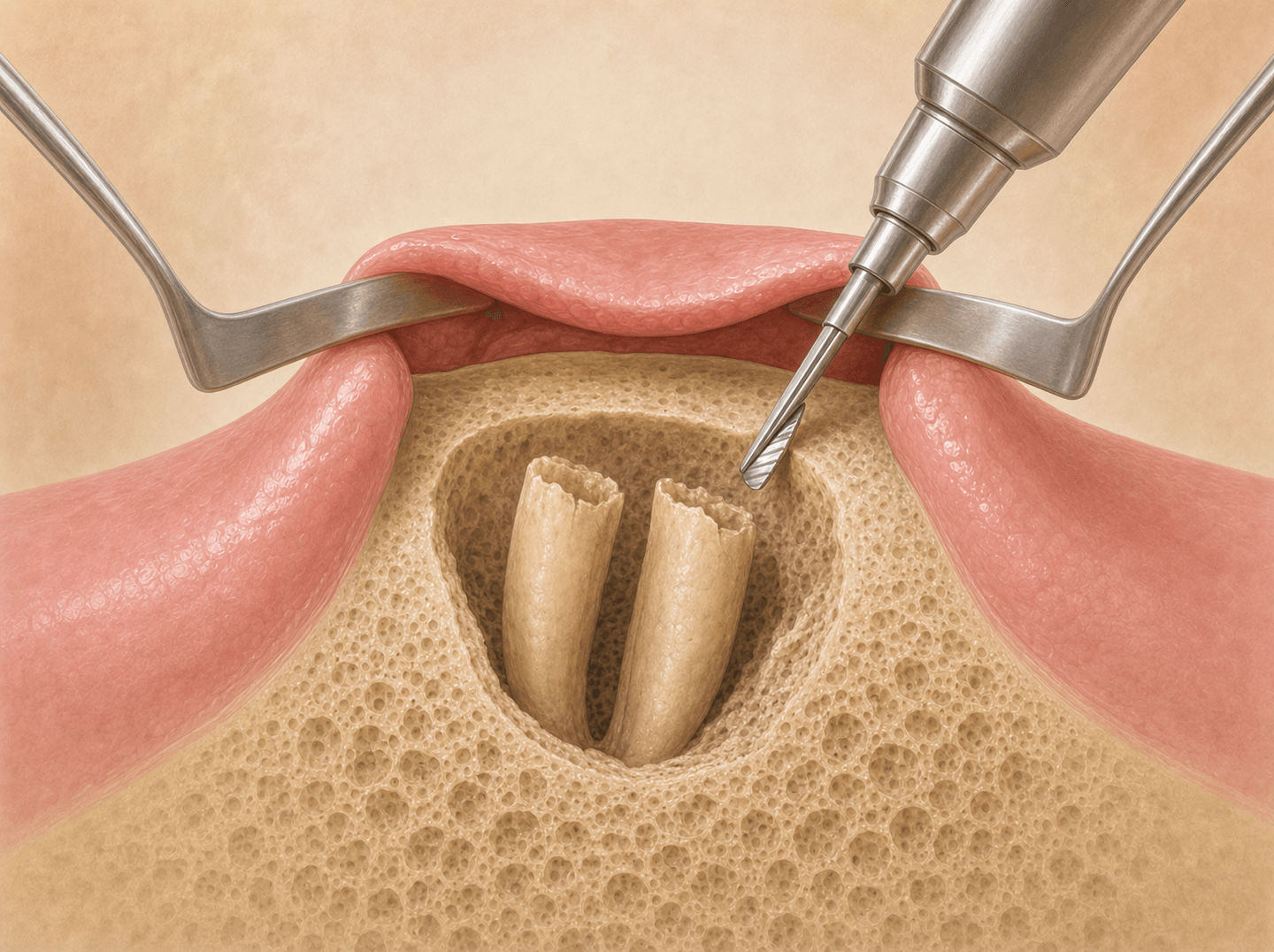
What D7250 covers
D7250 reports cutting leftover roots out of the jaw. Root fragments remain in the bone, usually from a prior extraction or from trauma where the crown is already gone, and reaching them requires cutting soft tissue and bone. The procedure includes the flap, the bone removal, the removal of the root structure, and closure.
Two facts both have to be true for D7250:
- Only root structure remains, with the crown already gone.
- Removing the roots required cutting soft tissue and bone.
It does not cover:
- An erupted tooth or an exposed root removed by elevator or forceps without cutting. That is D7140, even when only a root is being removed.
- A whole tooth still bearing its crown. Those are the standard extraction or impaction codes, regardless of difficulty.
- Coronal remnants of a primary tooth with resorbed roots. That is D7111.
- A difficult extraction of an otherwise standard tooth. D7250 is a different procedure category, not a difficulty modifier.
D7250 versus D7140
Both codes can involve roots. The difference is access:
- D7140 covers an exposed root delivered by elevator and/or forceps, no cutting.
- D7250 covers residual roots that require cutting soft tissue and bone to reach and remove.
ADA guidance is clear that D7250 is not a code for a difficult extraction. If separated roots are exposed and can be elevated out, the code is D7140 even when it took effort. D7250 applies only when a cutting procedure was needed, and the operative note has to record the cutting for the code to hold.
Top reasons D7250 gets denied or downgraded
- Downgraded to D7140. The note didn’t establish that cutting was required, so the carrier paid at the simple-extraction allowable. The operative report recording the flap and bone removal is the defense.
- Documentation missing. No radiograph showing the retained roots and no description of the cutting, so the carrier cannot confirm the procedure.
- Read as a difficult extraction. A note that describes a hard extraction of a whole tooth invites a downgrade because D7250 is not a difficulty code. The note has to establish residual roots and cutting.
- Timing questions. When the residual roots are removed at the same visit as the original extraction, some plans scrutinize whether D7250 is separately reportable. This is plan-dependent.
Documentation that supports the claim
The claim is stronger with:
- A radiograph showing the retained root fragments in the bone, attached to the claim.
- An operative note stating that only roots remained and that cutting soft tissue and bone was required.
- A description of the flap and the bone removal performed.
For the patient record, document:
- The tooth number and that only residual roots were present.
- The reason the roots required removal.
- The cutting procedure: the flap, the bone removed, and any sectioning.
- The origin of the residual roots when known (prior extraction, trauma).
The supporting sentence names the cutting: “Retained mesial and distal root fragments on tooth 30 from a prior extraction; mucoperiosteal flap elevated and buccal bone removed to access and section the roots for delivery.”
Example case
A 47-year-old established patient has retained root fragments on tooth 19 from an extraction attempted elsewhere. The radiograph shows two root tips below the bone with no crown. The dentist elevates a flap, removes overlying bone, sections and delivers the roots, and closes.
Billing steps:
- Take a radiograph showing the retained roots in the bone.
- Code D7250 with an operative note recording the flap, the bone removal, and the cutting.
- Attach the film to the claim.
- If the carrier downgrades to D7140, appeal with the operative report documenting the cutting procedure.
FAQs
- What's the difference between D7250 and D7140?
- Access. D7140 covers an erupted tooth or exposed root removed by elevator or forceps, with no cutting. D7250 covers residual roots that require cutting soft tissue and bone to remove. If a flap and bone removal were needed to reach the roots, it is D7250; if they came out with an elevator or forceps, it is D7140.
- Is D7250 a code for a difficult extraction?
- No. ADA guidance is explicit that D7250 is not meant to report a difficult extraction. It reports root fragments remaining after the crown is already gone that require a cutting procedure to remove. A whole tooth that was simply hard to deliver takes the appropriate extraction code.
- Does D7250 apply to roots left over from a prior extraction?
- Yes. The typical case is root fragments retained in the bone after a previous extraction, or roots left by trauma where the crown is gone. If the roots are still attached to a present crown, a different extraction code applies depending on access and impaction status.
- Why did the carrier downgrade my D7250 to D7140?
- Usually because the note didn't establish that cutting was required. When the documentation reads like the roots were simply elevated out, the carrier pays at the D7140 allowable. A note recording the flap and bone removal, with a radiograph showing the retained roots, is the defense. This is plan-dependent.
- Do I need an X-ray for D7250?
- Most carriers want one. A radiograph showing the retained root fragments in the bone confirms the clinical picture and supports D7250 over a simple extraction. Attach it with the initial claim. Plan requirements vary.
Related codes
Need help billing this code?
We handle D7250 claims daily.
If your team is spending time on denials, narratives, or carrier follow-up for this code, our outsourced dental insurance billing service can take it off your plate. We submit the claims, post what comes back, and follow up on anything unpaid. Already sitting on older claims that never paid? Our AR cleanup project works the backlog.
“Claims, posting, denials, all of it gets handled, and it costs far less than hiring another employee. My front desk got hours of their week back, and honestly I just don't think about billing anymore.”
CDT codes are maintained by the American Dental Association. This page is an editorial billing guide, not the official ADA code descriptor. Verify current coverage policies with each carrier before submitting claims.