D7310 is the CDT code for alveoloplasty with extractions, reshaping the bony ridge across four or more teeth or tooth spaces in one quadrant.
- When to use: The dentist does significant ridge recontouring beyond routine socket smoothing, usually to prepare for a denture or partial.
- When not to use: One to three spaces is D7311, a quadrant with no same-day extractions is D7320 or D7321, and a socket graft is D7953.
- Billing note: Carriers bundle it into the extraction unless the note describes the specific bone recontouring and why it was needed, such as denture preparation.
On this page
- What D7310 covers
- The bundling problem: routine smoothing is already in the extraction
- D7310 vs. D7311 vs. D7320 vs. D7321
- When to bill D7310
- Alveoloplasty is reshaping, not grafting
- Coverage reality: prosthesis-driven and plan-dependent
- Documentation that supports the claim
- What to get right in your PMS
- FAQs
What D7310 covers
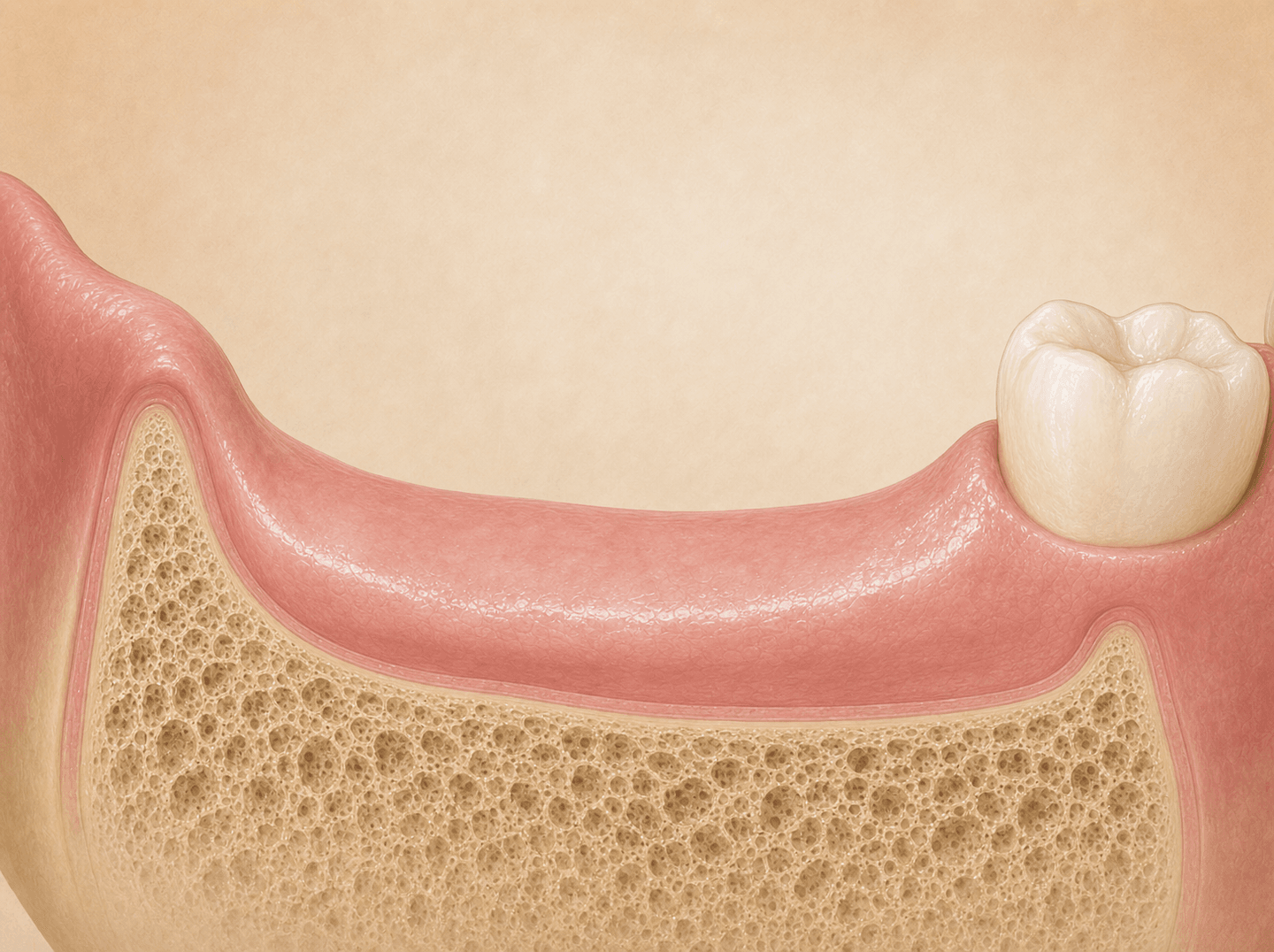
D7310 reports alveoloplasty performed in conjunction with extractions when four or more teeth or tooth spaces in a single quadrant are involved. Alveoloplasty is the surgical reshaping of the alveolar bone, the ridge that held the teeth, to produce a smooth, even contour. After multiple teeth come out, the ridge is often left with sharp edges, undercuts, and uneven height. D7310 is the code for the work of recontouring that bone so the ridge will accept a denture or partial, or otherwise heal to a usable shape.
Two facts in the descriptor do the work, and both have to be true for D7310 to be the right code.
- In conjunction with extractions. The alveoloplasty happens in the same quadrant, on the same date, as the extractions. If no teeth were extracted in that quadrant during the procedure, this is not a D7310 case.
- Four or more teeth or tooth spaces, per quadrant. The count is teeth or tooth spaces in the quadrant, and the code is reported per quadrant. Three or fewer spaces is a different code (D7311).
The bundling problem: routine smoothing is already in the extraction
This is where most D7310 denials come from, so it is worth being precise. Current CDT extraction codes include minor smoothing of socket bone as part of the extraction itself. When you take a tooth out and smooth the rough socket edges, that cleanup is part of the extraction, not a separate alveoloplasty.
D7310 is correct only when the bone work is significant and distinct from that routine smoothing: real recontouring of the ridge, removal of sharp bony projections, reduction of undercuts, leveling for a prosthesis. The line between “smoothed the socket while pulling the teeth” and “performed a separate alveoloplasty” is a clinical judgment, and the chart note is what proves which one happened.
D7310 vs. D7311 vs. D7320 vs. D7321
Four codes describe alveoloplasty, and they are easy to confuse because they differ on only two axes. Read both correctly.
Axis 1: in conjunction with extractions, or not.
- In conjunction with extractions (D7310, D7311): the alveoloplasty is done in the same quadrant and date as extractions.
- Not in conjunction with extractions (D7320, D7321): the ridge is reshaped at a separate visit, or in a quadrant where no extractions were performed, often on a ridge that healed with sharp bone or an undercut after teeth were lost earlier.
Axis 2: how many teeth or tooth spaces in the quadrant.
- Four or more teeth or tooth spaces: D7310 (with extractions) or D7320 (without).
- One to three teeth or tooth spaces: D7311 (with extractions) or D7321 (without).
Put together:
| Code | Extractions same quadrant/date? | Teeth or spaces in quadrant |
|---|---|---|
| D7310 | Yes | Four or more |
| D7311 | Yes | One to three |
| D7320 | No | Four or more |
| D7321 | No | One to three |
All four are reported per quadrant. A case that crosses two quadrants can carry the code twice, with separate documentation for each quadrant. The mistake to avoid is treating the count as whole-mouth or treating “the patient also had extractions today” as automatically making it a D7310 even when those extractions were in a different quadrant from the alveoloplasty.
When to bill D7310
Bill D7310 when, in a single quadrant on the same date as extractions, you perform significant alveolar bone recontouring involving four or more teeth or tooth spaces. Common situations:
- Multiple adjacent teeth are removed in a quadrant and the ridge needs leveling and smoothing to seat an immediate or future denture or partial.
- The ridge is left with sharp bony projections or pronounced undercuts after the extractions, and meaningful recontouring is done to correct them.
- Pre-prosthetic bone preparation is performed at the time of the extractions to produce a ridge shape the prosthesis can fit.
Do not bill D7310 for:
- Routine smoothing of socket bone done as part of the extraction itself. That is included in the extraction code (such as D7140, D7210, or D7240).
- One to three teeth or tooth spaces in the quadrant. Use D7311.
- Alveoloplasty done at a separate visit or in a quadrant with no same-date extractions. Use D7320 or D7321.
- Placing bone graft material to preserve the socket and ridge shape. That is a graft, not reshaping. See D7953 below.
Alveoloplasty is reshaping, not grafting
A frequent mix-up is between alveoloplasty and a ridge preservation graft. They are opposite operations and they are not interchangeable codes.
Alveoloplasty (D7310 and its siblings) removes and reshapes bone. The ridge has too much bone, or bone in the wrong shape, and the surgeon recontours it down to a usable form.
D7953 (bone replacement graft for ridge preservation, per site) adds bone. Graft material is placed into the extraction socket to maintain ridge volume for a future implant or to hold the ridge contour.
One reduces bone, the other builds it. D7953 is reported per site, not per quadrant, which is another reason not to swap them. A patient can have both in the same arch (graft one socket for a future implant, recontour an adjacent area of ridge), but each is documented and coded on its own terms.
Coverage reality: prosthesis-driven and plan-dependent
Alveoloplasty is most often performed to prepare a ridge for a denture or partial, and that clinical purpose drives how plans handle it.
- Some plans cover D7310 as oral surgery when the bone work is clearly separate from the extraction and documented as medically necessary ridge preparation.
- Some plans fold pre-prosthetic bone preparation into the denture benefit, so the alveoloplasty does not pay separately even when correctly performed and documented.
- Some plans exclude alveoloplasty for prosthesis preparation entirely, treating it as part of the cost of getting the denture.
- Third-molar alveoloplasty is commonly bundled by carriers, because a third molar is not replaced with a prosthesis, so the bone contouring around it is treated as part of the extraction rather than a separate benefit.
The practical takeaway is that a D7310 denial can mean two very different things: a documentation problem (the note did not separate the alveoloplasty from the extraction) or a true plan exclusion (the plan does not cover ridge preparation, or covers it only inside the denture benefit). Read the EOB language before you appeal. Appealing a genuine benefit exclusion wastes effort. Supplementing documentation on a bundling denial is often worth it.
Documentation that supports the claim
The chart note is what separates D7310 from a routine extraction in a reviewer’s eyes. It should capture:
- The quadrant and the count. Which quadrant, and how many teeth or tooth spaces were involved (four or more for D7310). This anchors the code choice.
- The extractions performed in that quadrant on that date. This establishes the in-conjunction-with-extractions basis for D7310 rather than D7320.
- The bone work itself, specifically. Not “smoothed bone,” but what was recontoured and how: sharp bony projections removed, undercuts reduced, ridge leveled. This is the line that distinguishes a separate alveoloplasty from the socket smoothing already included in the extraction.
- Why it was needed. The clinical reason, usually preparation for a denture or partial, or correction of an irregular ridge that would interfere with healing or prosthesis fit.
- Imaging when available. Before-and-after intraoral images make the case for a distinct procedure far stronger than the narrative alone.
For the claim, a short narrative restating the quadrant, the count, the same-date extractions, and the specific bone recontouring performed gives the carrier what it needs to process D7310 against the right benefit instead of bundling it on sight.
What to get right in your PMS
The menus differ across Open Dental, Dentrix, Eaglesoft, Curve, and Carestream, but the setup that prevents problems is the same:
- Keep all four alveoloplasty codes distinct in your code table. D7310, D7311, D7320, and D7321 differ on only two axes (extractions or not, four-plus or one-to-three). One fuzzy “alveoloplasty” entry is how the wrong code gets posted. Label each clearly.
- Post per quadrant, with the quadrant indicated. These are per-quadrant codes. A two-quadrant case is reported twice, each with its own documentation.
- Attach the narrative to the claim, not just the patient record. The bundling defense lives in the narrative. Many systems store notes at the patient level by default. The clearinghouse needs the alveoloplasty narrative linked to the D7310 line.
- Flag whether the plan covers ridge preparation separately. Note on the carrier record whether D7310 pays as oral surgery, folds into the denture benefit, or is excluded, so the team quotes the patient correctly before the procedure.
- Do not auto-post D7310 alongside every multi-tooth extraction. It belongs only when significant, separate bone recontouring was actually performed and documented. Posting it reflexively with extractions is what trains a carrier to bundle every claim you send.
FAQs
- What is the dental code for alveoloplasty?
- There are four, and you have to pick the right one. The split is on two questions. First, was the alveoloplasty done in the same quadrant as extractions or on its own? Second, did it involve four or more teeth or tooth spaces, or one to three? D7310 is in conjunction with extractions, four or more teeth or spaces per quadrant. D7311 is in conjunction with extractions, one to three. D7320 is not in conjunction with extractions, four or more. D7321 is not in conjunction with extractions, one to three. The codes are reported per quadrant, so a case spanning two quadrants can carry the code twice with documentation for each.
- Can I bill D7310 on the same day as the extractions?
- Yes. D7310 is specifically the in-conjunction-with-extractions code, so it is meant to be reported on the same date and in the same quadrant as the extractions. The catch is that the alveoloplasty has to be a distinct, significant procedure beyond the routine smoothing of socket bone, which is already included in the extraction code itself. If you only smoothed the socket edges as part of taking the teeth out, that is part of the extraction, not a separate D7310. Report D7310 when meaningful ridge recontouring was performed and your note describes that work.
- Why was D7310 denied or bundled into the extraction?
- The most common reason is documentation that does not distinguish the alveoloplasty from the extraction. Current extraction codes already include minor smoothing of socket bone, so a carrier seeing alveoloplasty on the same date will bundle it unless the note shows significant, separate bone recontouring. The fix is a narrative that describes the actual bone work and why it was needed (sharp bony projections, an irregular ridge, preparation for a denture or partial), ideally with before-and-after images. Carrier policy also varies on whether ridge preparation for a prosthesis is a covered benefit at all, so a denial can be a true exclusion rather than a documentation gap.
- What is the difference between D7310 and D7311?
- Only the count. Both are alveoloplasty in conjunction with extractions, reported per quadrant. D7310 is for four or more teeth or tooth spaces in the quadrant. D7311 is for one to three. The number you report is teeth or tooth spaces in that quadrant, so count the affected spaces, not just teeth physically present. Using D7310 when only one to three spaces were involved is a coding error a carrier can catch and downgrade or deny.
- Does insurance cover D7310?
- It depends on the plan and the reason for the procedure. Alveoloplasty is usually performed to prepare the ridge for a denture or partial, and some plans cover prosthesis-related bone preparation while others exclude it or fold it into the denture benefit. When the bone work is genuinely separate from the extraction and well documented, plans that cover it will often pay it as oral surgery. Verify the specific plan before the procedure and set the patient's out-of-pocket expectation in writing, especially since this often accompanies a denture the patient is already paying toward.
Related codes
Need help billing this code?
We handle D7310 claims daily.
If your team is spending time on denials, narratives, or carrier follow-up for this code, our outsourced dental insurance billing service can take it off your plate. We submit the claims, post what comes back, and follow up on anything unpaid. Already sitting on older claims that never paid? Our AR cleanup project works the backlog.
“Claims, posting, denials, all of it gets handled, and it costs far less than hiring another employee. My front desk got hours of their week back, and honestly I just don't think about billing anymore.”
CDT codes are maintained by the American Dental Association. This page is an editorial billing guide, not the official ADA code descriptor. Verify current coverage policies with each carrier before submitting claims.