D7953 is the CDT code for a bone replacement graft placed to preserve the ridge for a future implant or prosthesis, reported per site.
Most billing problems on it are the same two questions from the carrier: was the graft medically necessary, and was it placed at the extraction visit (a separate code) or at a later visit.
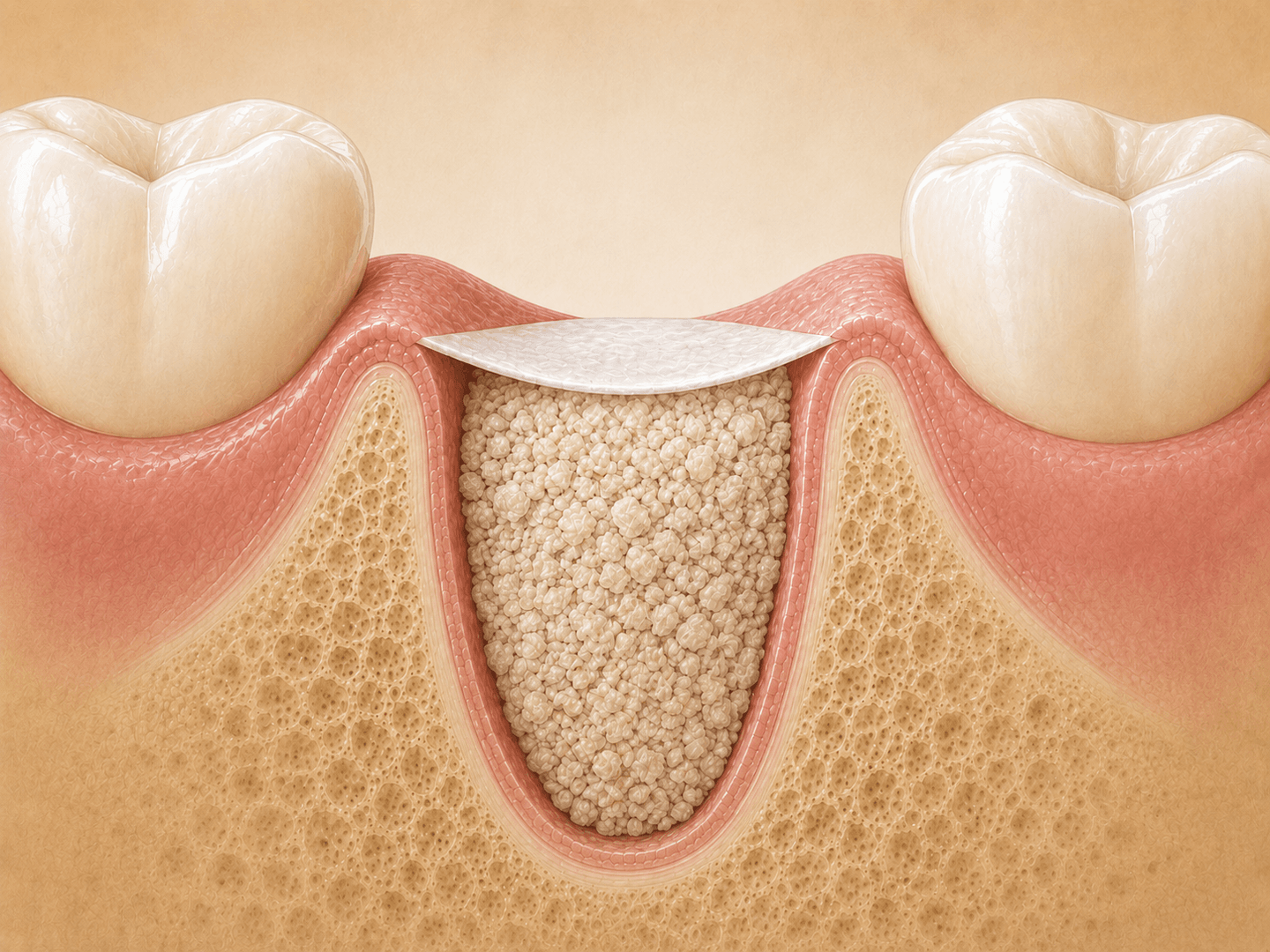
What D7953 covers
D7953 reports a bone replacement graft placed into a surgical site, typically an extraction socket, to preserve the alveolar ridge for a future implant or prosthesis. The fee covers the graft material, placement, and the surgical work to seat it. It is billed per site, not per tooth, per visit, or per arch.
It does not cover:
- A bone graft placed at the same visit as an implant body. That’s D6104, on the same claim as D6010.
- Sinus augmentation by the lateral window approach. That’s D7951.
- Sinus augmentation by the crestal approach. That’s D7952.
- Ridge augmentation outside an extraction socket. That’s D7950.
- The barrier membrane is not part of D7953. Per the D7953 descriptor, a membrane (D4266 or D4267) is reported separately on its own line. Note, however, that many carriers bundle it by their own benefit policy and deny the separate line on the same site, so verify the payer’s policy before submitting.
- The biologic, like PRF or PRP. Those are separate procedures with their own codes if billed at all.
When to bill D7953
Bill D7953 when:
- A graft is placed in an extraction socket to preserve the ridge for a future implant or fixed prosthesis.
- A graft is placed at a prior visit (separate from the implant placement) to build a deficient site.
- Each surgical site that receives a graft, billed as a separate line.
Do not bill D7953 for:
- A graft placed at the same visit as an implant body. Use D6104 on the same claim as D6010.
- A graft placed for sinus augmentation. Use D7951 or D7952.
- A graft placed without a planned future restoration. Some carriers will deny on necessity grounds if the chart doesn’t name a planned implant or bridge.
- A particulate placed only for socket plug or hemostasis with no graft volume. The code assumes graft material that contributes to bone regeneration.
Top reasons D7953 gets denied
- Coded at the wrong visit. D7953 billed on the same date of service as D6010 (implant body placement) gets denied because the correct code at that visit is D6104. The reverse error happens too.
- Not medically necessary. The carrier judges the graft was elective. Often the chart didn’t document a planned implant or prosthesis at the site. A narrative naming the planned restoration usually resolves this on appeal.
- Site count mismatch. Three graft lines billed but only two extraction sites in the chart. Carriers cross-check with the operative note.
- Bundled with the membrane. Some carriers bundle a separate D4266 or D4267 billed on the same site as D7953 and deny it as inclusive. The membrane is a separately reportable procedure under the CDT descriptor, so document the placement (type, material, site), bill it on its own line where the plan allows, and appeal bundling denials. External-appeal precedent exists: NY DFS case 202010-132226 overturned exactly this denial and approved both D7953 and D4266.
- Plan excludes grafts. Some plans cover implants but exclude any preparatory bone grafting. The denial reads “graft not a covered benefit.” There is no appeal that wins this.
Per-site billing in practice
Each surgical site that receives a graft is one D7953. The site count is what the carrier verifies, not the tooth count or the volume of material used.
- Two adjacent extraction sockets grafted at the same visit: two D7953 lines.
- Three nonadjacent sockets: three D7953 lines.
- One socket grafted with a larger volume of material: still one D7953 line, regardless of the material quantity.
- A single graft that spans across two adjacent sites with a continuous bone defect: usually one D7953 line, with a narrative explaining the contiguous site.
Carriers occasionally challenge counts above two per visit. The operative note should make the site count obvious: “Bone graft placed at extraction sites #14, #15, and #19” supports three lines. “Bone graft placed in the upper right quadrant” does not.
D7953 versus D6104
The two codes report bone grafts in different surgical contexts:
- D7953 is a ridge-preservation graft. Placed at extraction, or as a separate prior visit to build a site. Used when no implant is being placed at the same visit.
- D6104 is a bone graft at the time of implant placement. Same visit as D6010, on the same claim. Used when the surgical visit places both the implant and a graft.
Using D7953 at the implant placement visit gets the graft denied for bundling. Using D6104 at the extraction visit (with no implant) gets it denied because the code requires implant placement at the same DOS. The visit timing determines the code.
Documentation that supports the claim
The claim needs:
- Per-site itemization in the narrative, with tooth numbers for each graft line.
- A treatment plan note naming the planned restoration (implant, fixed bridge) that the graft is preserving the site for.
- The graft material used (autograft, allograft, xenograft, alloplast) and the manufacturer if applicable.
- The membrane used, with its own code (D4266 or D4267). Document the placement even when a carrier bundles it by policy. Carriers occasionally request membrane details on appeal.
For the patient record, document:
- The extracted tooth, the extraction date, and the reason for extraction.
- The clinical rationale for the graft (planned implant, fixed bridge, denture base, ridge defect from periodontal loss).
- Material, lot number, and volume.
- Post-op instructions and the planned timeline to the next visit (typically three to six months for implant placement after a ridge-preservation graft).
Example case
A 47-year-old patient presents with a non-restorable tooth #30 fractured at the gum line. The treatment plan is extraction now, ridge preservation graft at the same visit, implant placement in four months, and a porcelain crown three months after the implant. The plan covers implants and grafts.
Billing steps:
- Verify the plan covers ridge-preservation grafts and confirm the implant benefit at the same time. Some plans cover one and exclude the other.
- Code D7210 (surgical extraction) and D7953 on the same claim, with a narrative naming the planned implant restoration.
- Document the graft material (allograft, brand, lot number) and the membrane.
- Expect the EOB to show D7210 paid at the extraction benefit and D7953 paid if the necessity documentation is sufficient.
- Do not bill D6104 or D6010 at this visit. Those happen at the implant placement appointment four months later.
What to get right in your PMS
- Use D7953 when the visit has no implant placement, D6104 when the same visit places the implant. Visit timing determines the code. Mixing them up is the most common denial.
- Bill per site, not per tooth or per visit. Itemize tooth numbers in the narrative so the carrier can verify the count against the operative note.
- Name the planned restoration in the chart at the time of the graft. “Planned implant in four months” prevents most necessity denials.
- Bill the membrane (D4266 or D4267) on its own line, then verify the plan. The membrane is separately reportable under the D7953 descriptor, but many carriers bundle it by policy at the same site. Check the plan’s bundling rule at verification and appeal denials where the placement is documented.
- Confirm the plan covers preparatory bone grafting at verification, not at surgery. Some plans cover implants but exclude the graft that makes the implant possible.
FAQs
- What is the dental code for a bone graft?
- D7953 for a bone replacement graft placed for ridge preservation, billed per site. If the graft is placed at the same visit as an implant placement, the correct code is D6104. If the graft is for sinus augmentation, use D7951 (window approach) or D7952 (crestal). For ridge augmentation outside an extraction socket, that's D7950.
- Is D7953 billed per tooth or per site?
- Per site. Each surgical site that receives a graft is billed as one D7953. Two adjacent extraction sockets grafted in the same visit are two D7953 lines, not one. Three nonadjacent sites are three lines. Carriers verify the count against the surgical narrative and the operative note.
- What's the difference between D7953 and D6104?
- D7953 is a graft placed to preserve the ridge after extraction, billed at the extraction visit or as a separate prior visit to build the site for a future implant. D6104 is a graft placed at the same visit as the implant body placement. They are not interchangeable. Using the wrong code at the wrong visit gets the graft denied for bundling.
- Why did the carrier deny D7953 as not medically necessary?
- Many plans require evidence that the graft was placed to preserve a site for a planned implant or fixed prosthesis, not as a routine adjunct to every extraction. The denial cites missing documentation of the treatment plan that justifies the graft. A narrative naming the planned restoration (implant, fixed bridge abutment) and a treatment plan note in the chart usually resolves this on appeal.
- Can I bill D7953 to medical insurance?
- Sometimes, when the graft is part of trauma reconstruction, tumor resection, or congenital defect repair. The medical CPT codes are 21210 (bone graft to facial bones, autograft) or 21215 (bone graft, mandible). For routine post-extraction ridge preservation, medical generally does not cover. Most dental practices bill dental-only.
- Does D7953 cover the membrane?
- Most carriers consider the membrane part of the graft procedure and do not pay a separate membrane code (D4266 or D4267) on the same site as D7953. Some accept the membrane code on a separate line. Many bundle it. Verify the carrier's policy before submitting the membrane separately.
Related codes
Need help billing this code?
We handle D7953 claims daily.
If your team is spending time on denials, narratives, or carrier follow-up for this code, our outsourced dental insurance billing service can take it off your plate. We work inside your PMS and post payments the same week.
CDT codes are maintained by the American Dental Association. This page is an editorial billing guide, not the official ADA code descriptor. Verify current coverage policies with each carrier before submitting claims.