D7956 is the CDT code for placing a resorbable barrier membrane at an edentulous site to guide bone regeneration, reported per site.
- When to use: A dissolving membrane goes over a site with no tooth or implant, including a fresh socket, a sinus lift, or a ridge augmentation.
- When not to use: A non-resorbable membrane is D7957, a membrane at a natural tooth is D4266, and one around an implant is D6106.
- Billing note: Some plans pay only one of the graft and the membrane on a site, so verify bundling first and name the planned implant or prosthesis in the narrative.
What D7956 covers
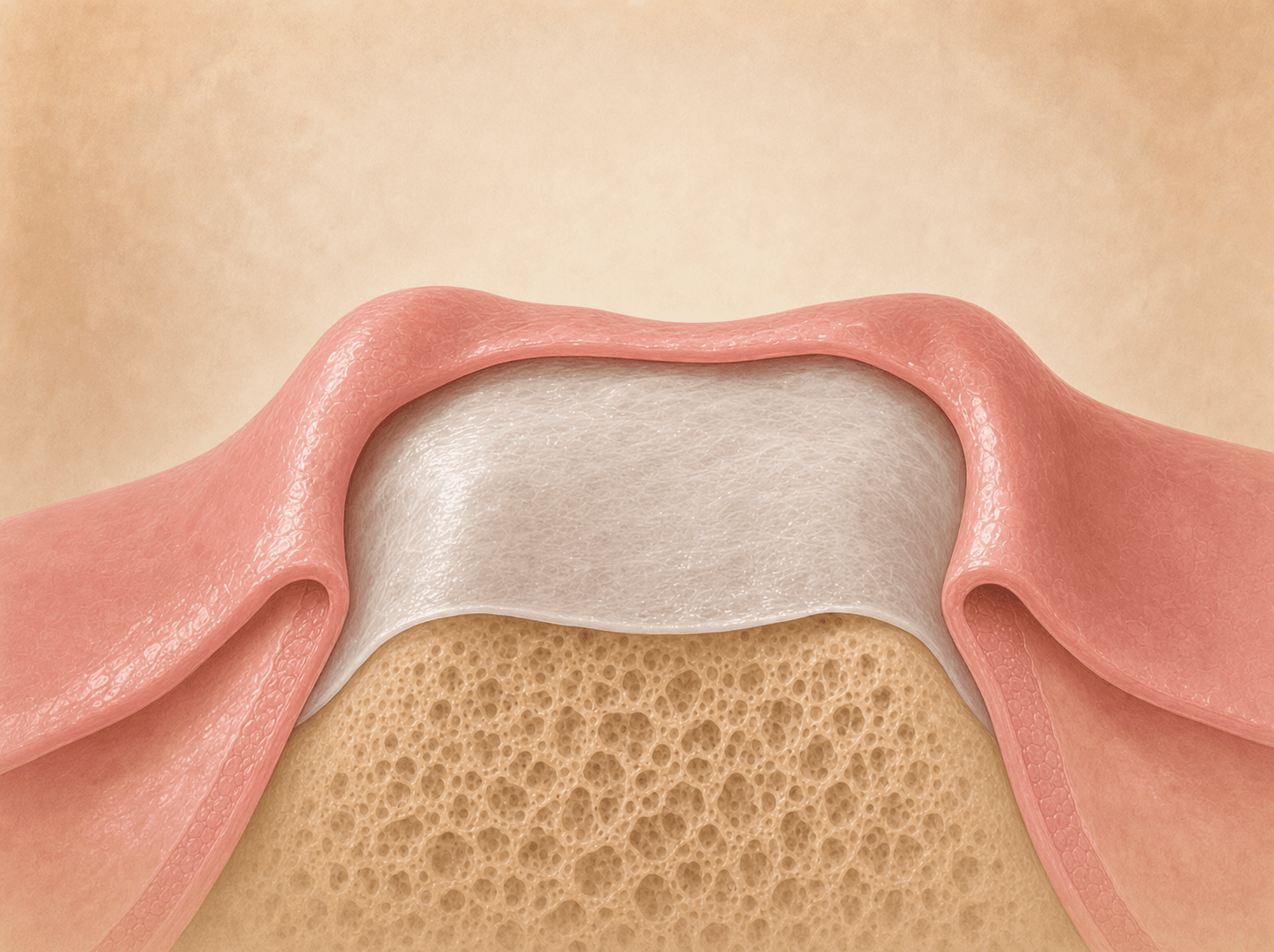
D7956 reports placing a resorbable barrier membrane at an edentulous site to guide the regeneration of tissue and bone. An edentulous site is one with no natural tooth and no implant there, and the family is broader than most billers assume. The published description of the code, reproduced in Cigna’s OS-09 policy, names three settings: ridge augmentation, sinus lift procedures, and the site of a tooth that has just been removed. A socket the surgeon extracted from this morning qualifies as readily as a ridge that healed years ago. The membrane holds space and keeps faster-growing soft tissue out of the area so bone can fill in underneath it. Resorbable means the membrane breaks down and is absorbed by the body on its own, so there is no second surgery to remove it. The code is reported per site.
The code reports the barrier work. It does not, on its own, include:
- The bone graft placed under the membrane, in any of the three settings. Building up an established edentulous ridge is D7950, ridge augmentation. Ridge preservation in a fresh extraction or implant-removal socket is D7953. Sinus augmentation is D7951 through a lateral window or D7952 through the crest. Each is a graft code on its own line, and none of them puts the site outside the edentulous GTR family. The membrane over any of them is still D7956.
- A non-resorbable barrier. That is D7957. Taking that membrane out at a follow-up visit is a separate procedure with its own code, D4286.
- The same membrane procedure at a natural tooth (D4266) or around an implant (D6106).
The distinguishing axis: two questions, site then barrier
The 2023 CDT update rebuilt guided tissue regeneration into a grid. Get D7956 right by answering two questions in order, because each one points to a different part of the grid.
Question one: where did the membrane go? GTR is coded by site type first.
- Natural tooth: D4266 (resorbable) or D4267 (non-resorbable). These two existed before 2023 and were revised that year to name the natural-tooth site explicitly.
- Implant: D6106 (resorbable) or D6107 (non-resorbable). New in 2023, reported per implant.
- Edentulous site: D7956 (resorbable) or D7957 (non-resorbable). New in 2023, reported per site.
Question two: which membrane? Within the edentulous pair, the only thing that separates D7956 from D7957 is the barrier material.
- D7956 is the resorbable barrier. It dissolves on its own, so nothing has to be removed later.
- D7957 is the non-resorbable barrier. It has to be taken out at a follow-up visit, and that removal is reported on its own code, D4286. See the section below, because how the removal is reported and whether it gets paid are two different questions.
So the choice is not about how big the defect is, how much graft material went in, or what the planned restoration is. It is site type, then barrier type. An implant case with a resorbable membrane is D6106, not D7956, even though both are resorbable. An edentulous case with a non-resorbable membrane is D7957, not D7956, even though both are edentulous.
If the case was D7957, the removal is D4286
This one does not affect a D7956 claim directly, because a resorbable membrane never comes out. It matters because offices code the pair together and the rule flipped in 2023.
Before CDT 2023, the non-resorbable GTR descriptor said the removal was included in the procedure. The 2023 rebuild took that language out and added D4286 for removing a non-resorbable barrier, on the reasoning that the removal happens at a different visit and sometimes by a different dentist. The current descriptors for D7957, D4267, and D6107 do not fold the removal in. So the removal gets reported on D4286, not absorbed into the placement code.
Reporting it is not the same as getting paid for it, and that is where the confusion comes from. Carriers commonly treat the removal fee as already covered by the placement fee when the same office did both:
- Delta Dental Insurance Company includes the removal fee in D4267, D6107, and D7957 at the same site when the same dentist or office submits it, and it is not billable to the patient within 36 months. If a different office removed the barrier, Delta’s summary says the fee may become the patient’s responsibility on reconsideration with supporting documentation. Other Delta member companies write this differently, so read the one that holds the contract.
- Northeast Delta Dental denies D4286 when a different dentist or office removes the barrier, and treats it as not billable to the patient when the placing office removes it.
- Cigna’s 2026 DPPO guidelines (policy PERIO-09) treat the removal as part of the primary GTR service and name D4267, D6107, and D7957, with no same-office qualifier attached.
- Hawaii Dental Service, in the 01/01/2024 revision of its periodontics procedure code guidelines, goes the other way on the different-office case: not billable to the patient when the placing office removes it, but a benefit once per 36 months per site when a different office does. Pin that citation to the revision year, because HDS reversed itself here. The 01/01/2023 edition of the same document denied the different-office removal outright.
So the answer to “can we bill the removal” is not a flat no. Report D4286. Then check the specific plan for whether it pays, and check whether your office is the one that placed the membrane, because that fact is what most of these rules turn on.
D7956 and the bone graft are two different lines
At an edentulous site, guided tissue regeneration almost always rides along with a bone replacement graft. The graft is the material that rebuilds the bone. The membrane is the barrier that protects it while it heals. They are separate procedures with separate codes.
The graft code is picked by timing, not by the membrane. That is the distinction that gets lost:
- An established ridge, healed and edentulous for a while, is built up with D7950, ridge augmentation.
- A socket, grafted at the time the tooth or the implant came out, is D7953, ridge preservation. Its own descriptor says the membrane is reported separately, so the D7956 line belongs on that claim rather than folded into the graft.
- The resorbable membrane over either one is D7956, billed per site.
The guardrail is the same fact read the other way: you cannot reach for D7953 on a ridge that healed years ago just because it is edentulous. That graft is D7950. Timing decides it.
A case that places both generates two lines, not one. The mistake to avoid is rolling the membrane into the graft and dropping the D7956 line, or the reverse, billing D7956 for what was really just a graft with no separate barrier placed. The bone graft dental codes guide shows the membrane line on a socket case and on a staged ridge case.
Coverage reality
Guided tissue regeneration at an edentulous site tends to get individual review rather than automatic payment. Carriers commonly look at edentulous-ridge GTR through the lens of the restoration it is building toward: a membrane placed to preserve or build a site for a planned implant or fixed prosthesis reads differently from a membrane with no documented plan behind it. Some plans cover it as part of implant-site preparation, some exclude ridge-building procedures, and some route it to medical review when it is part of larger reconstruction.
Because the coverage stance is so plan-specific, the working approach is the same one that holds for the bone graft underneath it: verify the benefit before surgery, not after. The narrative that supports the claim names the planned restoration the site is being built for and the clinical reason the membrane was needed.
When to bill D7956
Bill D7956 when:
- A resorbable barrier membrane is placed at an edentulous site (no tooth, no implant there) to guide tissue and bone regeneration. That covers a healed ridge being augmented, a sinus lift, and a socket the tooth just came out of.
- Each edentulous site that receives a resorbable membrane, as a separate per-site line.
Do not bill D7956 for:
- A non-resorbable membrane at an edentulous site. That is D7957, with the later removal of that membrane reported on D4286.
- A membrane placed at a natural tooth (D4266) or around an implant (D6106). Code by the site.
- The bone graft itself. On an established ridge that is D7950 (ridge augmentation); at a socket grafted the day the tooth came out it is D7953 (ridge preservation). Either one is its own line.
- A graft with no separate barrier placed. That is D7950 or D7953 on its own, with no D7956 line to add.
Documentation that supports the claim
The claim is strongest when the operative note makes the two coding facts and the necessity obvious:
- The site, with location, identified as edentulous (no tooth, no implant) so the D79xx family is defensible against the D42xx and D61xx families.
- The membrane type, resorbable, so D7956 is correct and not D7957.
- The per-site count, with each edentulous location itemized so the line count matches the note.
- The bone graft, if one was placed, documented as its own procedure with the material used and with the extraction date if the site was grafted at the time of removal, so the separate D7950 or D7953 line stands on the right code.
- The planned restoration, naming the implant or fixed prosthesis the site is being built toward, which is what carriers look for on an edentulous GTR review.
What to get right in your PMS
The menus differ across Open Dental, Dentrix, Eaglesoft, Curve, and Carestream, but the setup that prevents the common errors is the same:
- Keep all six GTR codes distinct and labeled by site and barrier. D4266 and D4267 (natural tooth), D6106 and D6107 (implant), D7956 and D7957 (edentulous) should be separate, clearly labeled line items so the site family is a deliberate pick, not a default.
- Keep D7956, D7950 and D7953 as separate line items. The membrane and the graft are different procedures, and the two graft codes are separated by timing rather than by site. If your fee schedule blurs any of them, a line goes missing or goes out on the wrong code.
- Set D7956 to bill per site. Each edentulous location is its own line. Itemize the sites in the narrative so the count matches the operative note.
- Build a narrative template that names the planned restoration. Edentulous GTR gets reviewed, and “membrane placed to preserve the site for a planned implant at #19” supports the claim in a way a bare procedure line does not.
- Confirm graft-plus-membrane coverage at verification. Whether the plan pays both D7950 and D7956 on the same site is plan-dependent. Check it before surgery, not on the EOB.
FAQs
- Is D7956 a current CDT code for 2026?
- Yes. D7956 is active in CDT 2026. It was added effective January 1, 2023, as part of a six-code rebuild of the guided tissue regeneration codes that split GTR by site type and barrier type. The whole set is still in place: D4266 and D4267 for natural teeth, D6106 and D6107 for implant sites, and D7956 and D7957 for edentulous sites.
- What is the difference between D7956 and D7957?
- The barrier type, and that is the only difference. D7956 is guided tissue regeneration at an edentulous site with a resorbable barrier, the membrane that dissolves on its own. D7957 is the same procedure at an edentulous site with a non-resorbable barrier, which has to be taken out at a later visit. Pick the code by the membrane the surgeon actually placed, documented in the operative note. Taking a non-resorbable barrier out later is not part of D7957. It has its own code, D4286, which was added in CDT 2023 when the GTR set was rebuilt. Report the removal on D4286 and expect the payment to be a separate question: several carriers, including Cigna on its 2026 DPPO guidelines, treat the removal as part of the primary GTR service rather than a separately paid line.
- What's the difference between D7956 and D4266?
- Site type. Both are resorbable-barrier guided tissue regeneration, but D7956 is for an edentulous site (no tooth and no implant there) and D4266 is for a natural tooth. There is a third option, D6106, for a resorbable barrier placed around a dental implant. Same procedure, three different site families. Code the one that matches where the membrane went: tooth (D4266), implant (D6106), or edentulous ridge (D7956).
- Can I bill D7956 and a bone graft on the same site?
- Often yes, because they are two different procedures. D7956 is the barrier membrane; the graft is its own line. Which graft code depends on timing, not on the membrane. An established edentulous ridge, healed for a while and being built back up, is D7950 (ridge augmentation). A socket grafted at the time the tooth or the implant came out is D7953 (ridge preservation), and D7953's own descriptor says the membrane is reported separately, so the D7956 line belongs on that claim too. The guardrail runs the other direction: you cannot bill D7953 on a ridge that healed years ago just because it is edentulous. Whether a given plan pays the graft and the membrane on the same site is plan-dependent, so verify the benefit and bundling rules before submitting and document each procedure separately in the note.
- Does insurance cover D7956?
- It depends on the plan. Guided tissue regeneration at an edentulous site is frequently reviewed case by case rather than approved automatically, and some carriers treat ridge-building GTR as a non-covered or individually-reviewed benefit. A clear narrative naming the planned restoration the site is being built for (an implant or a fixed prosthesis) and the clinical reason for the membrane is what supports the claim. Confirm coverage at verification, not at surgery.
- Is D7956 billed per tooth or per site?
- Per site. Each edentulous surgical site that receives a resorbable barrier is one D7956 line. Two separate edentulous sites grafted and membraned at the same visit are two D7956 lines. The site count is what the carrier checks against the operative note, so itemize the locations in the narrative.
Related codes
Need help billing this code?
We handle D7956 claims daily.
If your team is spending time on denials, narratives, or carrier follow-up for this code, our outsourced dental insurance billing service can take it off your plate. We submit the claims, post what comes back, and follow up on anything unpaid. Already sitting on older claims that never paid? Our AR cleanup project works the backlog.
“Claims, posting, denials, all of it gets handled, and it costs far less than hiring another employee. My front desk got hours of their week back, and honestly I just don't think about billing anymore.”
CDT codes are maintained by the American Dental Association. This page is an editorial billing guide, not the official ADA code descriptor. Verify current coverage policies with each carrier before submitting claims.