D7950 is the CDT code for a jawbone graft that builds up or rebuilds the ridge itself — not a socket fill and not a sinus lift. It's a by-report code, so the claim lives or dies on the narrative.
Most denials trace to a thin operative note or to confusing ridge augmentation with the socket-preservation and sinus codes that look similar on an EOB.
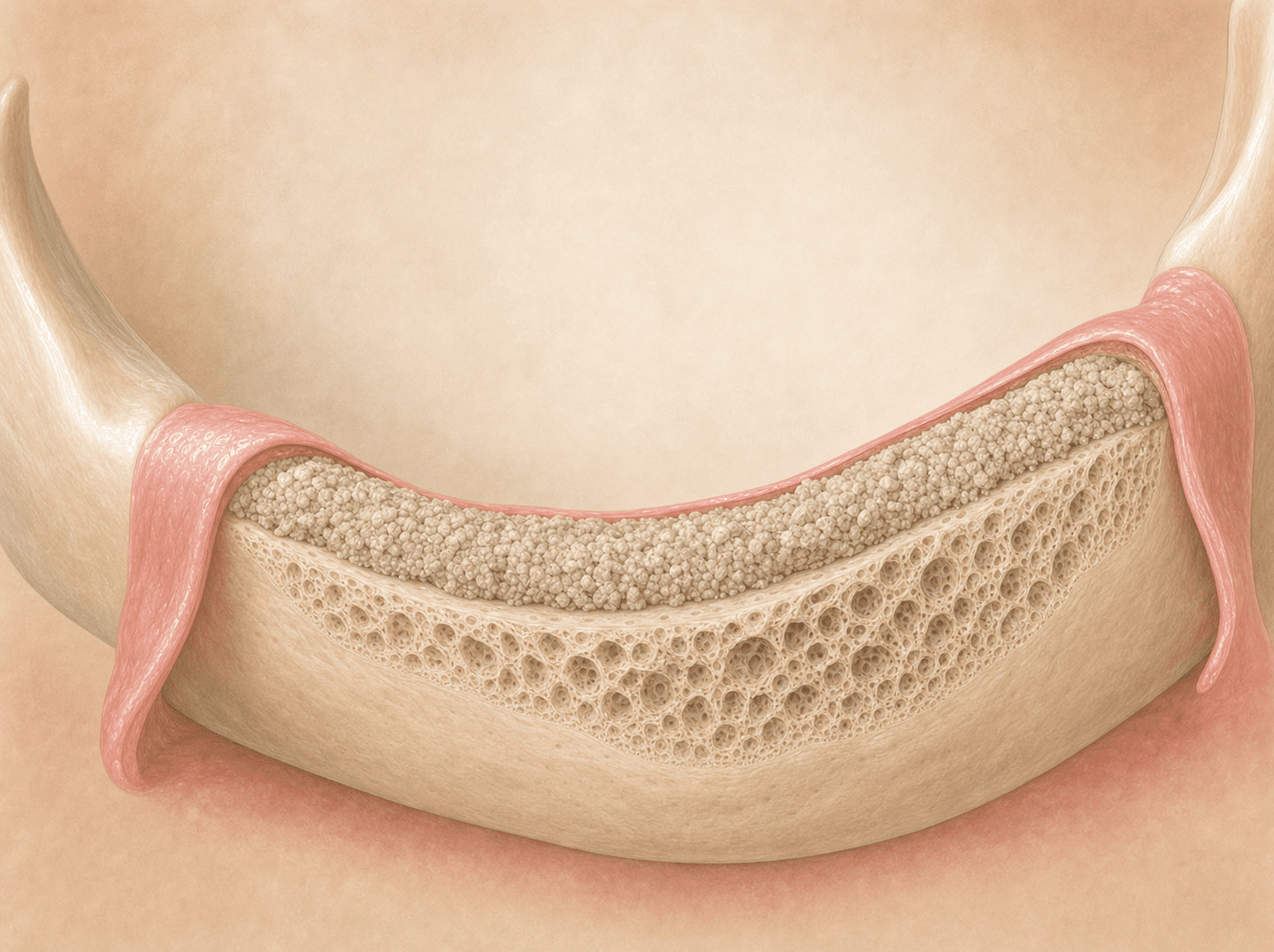
What D7950 covers
D7950 reports a graft that rebuilds the jaw ridge itself. The surgeon adds bone, or in some cases cartilage, to increase the height, width, or volume of a deficient alveolar ridge, usually to make a site that can hold an implant or support a prosthesis. The graft material can be the patient’s own bone, called autogenous, or a substitute from another source. The code covers either.
This is ridge augmentation and reconstruction, not a routine fill. It applies to larger defects: a knife-edge ridge that needs width, a resorbed posterior segment that needs height, a jaw rebuilt after trauma or pathology.
D7950 does not cover:
- A graft packed into a fresh extraction socket to hold the site. That is D7953, billed per site.
- A graft that augments the maxillary sinus floor. That is D7951 (lateral window) or D7952 (vertical crestal).
- A graft placed at the same visit as the implant body. That is D6104.
- The implant body placement itself. That is D6010.
The descriptor ends in “by report,” which is the load-bearing part for billing. The carrier expects a written narrative on every claim.
When to bill D7950
Bill D7950 when:
- The procedure augments or reconstructs the ridge to correct a height, width, or volume deficiency.
- The graft is done as its own procedure, typically staged ahead of an implant rather than at the same visit.
- The defect comes from trauma, tumor or cyst removal, congenital absence, or advanced resorption, and the graft rebuilds the jaw to a usable contour.
Do not bill D7950 for:
- A fresh extraction socket graft. Use D7953, per site.
- A sinus floor augmentation. Use D7951 or D7952.
- A graft at the moment of implant placement. Use D6104.
The by-report narrative
Because D7950 is by report, the narrative is the claim. A carrier cannot adjudicate it from the code alone, so a missing or thin note is the fastest path to a denial. The operative note attached to the claim needs to state:
- The defect: where the ridge was deficient and why (trauma, resorption, pathology removal, congenital).
- The graft material: autogenous bone, allograft, xenograft, or an alloplastic substitute.
- The donor site, if the graft was autogenous and harvested from the patient.
- The technique: block graft, particulate with membrane, ridge split, or another method.
- The planned end use: the implant or prosthesis the ridge is being built to support.
Attach a pre-op radiograph or CBCT image showing the deficiency. A claim that names the defect, the material, and the technique gives the carrier something concrete to approve. A claim that says only “bone graft placed” does not.
Top reasons D7950 gets denied or bundled
- No narrative, or a thin one. This is the defining failure for a by-report code. The carrier pends or denies because the claim does not describe what was done.
- Wrong code for the procedure. A socket graft billed as D7950 instead of D7953, or a sinus lift billed as D7950 instead of D7951/D7952. The carrier cross-checks the narrative against the code and denies the mismatch.
- Billed at implant placement. A graft done the same day as the implant should be D6104. D7950 at that visit reads as a duplicate or unbundling attempt.
- Plan excludes implant-related grafting. Many dental plans treat ridge augmentation done to enable an elective implant as a non-covered, implant-related service. This is plan language, not a clinical judgment.
- Missing medical coordination. When the defect is from trauma or pathology, the case often belongs to medical first. Submitting dental-only on a clearly medical case can stall the claim.
D7950 versus the grafts it gets confused with
Four codes sit close to D7950 on an EOB. The distinguishing axis is the defect being treated and the timing.
- D7950, ridge augmentation. Builds up or reconstructs the ridge itself. Its own procedure, usually staged before the implant.
- D7953, ridge preservation. Fills a fresh extraction socket to hold the site for a later implant. Billed per site. The defect is an open socket, not a deficient ridge.
- D7951, lateral sinus augmentation. Augments the maxillary sinus floor through a window cut in the lateral wall of the maxilla. The open window approach, used for larger lifts.
- D7952, vertical sinus augmentation. Augments the sinus floor through the crest of the ridge, entering up through the implant osteotomy. The crestal approach, used for smaller lifts when several millimeters of bone remain.
- D6104, graft at implant placement. A graft placed at the same visit the implant body goes in. The timing is what sets it apart from D7950.
The two errors that recur: calling a socket graft D7950 (it is D7953), and calling a sinus lift D7950 (it is D7951 or D7952). Both get caught when the carrier reads the narrative.
Medical crossover
Ridge grafts split between dental and medical depending on why the jaw needs rebuilding.
When the defect comes from trauma, removal of a tumor or cyst, or a congenital condition, the reconstruction is often a medical procedure. The medical claim typically uses CPT 21210 (graft to facial bones, autograft) or 21215 (graft to the mandible). Medical carriers want the diagnosis and the surgical narrative tied to the underlying condition.
When the ridge is being augmented purely to place an elective implant, the case usually stays dental, and many dental plans exclude it as implant-related anyway. There is no universal rule here. Verify both the medical and dental benefits before treatment, and confirm which carrier is primary for the specific diagnosis.
Example case
A patient lost the upper left posterior teeth to a cyst that was enucleated last year. The ridge healed deficient in both height and width, not enough bone to place implants. The oral surgeon harvests a block graft from the ramus, fixates it to the deficient ridge, and packs particulate allograft around it under a membrane. Implants are planned for six months out, after the graft consolidates.
Billing steps:
- Confirm whether the cyst history makes this a medical-primary case. If so, coordinate the medical claim first.
- Write the operative narrative naming the defect (post-enucleation ridge deficiency), the materials (ramus autograft plus particulate allograft), the technique (block graft with membrane), and the planned implants.
- Code D7950 with the narrative and a pre-op CBCT showing the deficiency attached to the claim.
- Do not bill the future implants or any D6104 graft now. Those are separate procedures at a later visit.
- Watch the EOB. If the plan excludes implant-related grafting, the patient likely owes the fee unless medical covered it.
What to get right in your PMS
- Treat the narrative as required, not optional. D7950 is by report. A claim without a real operative note will pend or deny every time.
- Match the code to the defect. Socket goes to D7953, sinus goes to D7951 or D7952, same-day implant graft goes to D6104. Reserve D7950 for ridge augmentation done as its own procedure.
- Check medical first on trauma and pathology cases. When the defect is not elective, the medical claim usually leads, and submitting dental-only can stall it.
- Attach the pre-op image to the claim. A radiograph or CBCT showing the deficiency does more than the code to justify a by-report graft.
- Verify both benefits before treatment. Ridge augmentation tied to an implant is excluded by many dental plans. Know that before the patient is in the chair, not after the denial.
FAQs
- What is the difference between D7950 and D7953?
- D7950 augments or reconstructs the ridge itself, adding bone height, width, or volume to a deficient jaw. D7953 is a graft packed into a fresh extraction socket to preserve that site for a later implant. The axis is the defect: D7950 builds up a ridge, D7953 fills a socket. A graft placed at the extraction visit to hold the socket is D7953, not D7950.
- Why does D7950 always need a narrative?
- D7950 is a by-report code. The descriptor itself tells the carrier to expect a written report, so a claim with no narrative gets denied or pended on arrival. The note has to name the graft material, whether it was autogenous or a substitute, the defect being corrected, and the surgical technique. Without that, the carrier has nothing to adjudicate against.
- Is D7950 the same as a sinus lift?
- No. A sinus lift augments the floor of the maxillary sinus to gain vertical bone for an upper implant, and it has its own codes: D7951 for the lateral open window approach and D7952 for the vertical crestal approach. D7950 augments the alveolar ridge outside the sinus. Coding a sinus augmentation as D7950 is a common error that draws a denial.
- Can D7950 be billed to medical insurance?
- Sometimes. When the graft is part of trauma repair, tumor or cyst resection reconstruction, or a congenital defect, the case often crosses to medical, frequently under CPT 21210 or 21215. Ridge augmentation done purely to support an elective implant usually stays dental, and many dental plans exclude it as implant-related. Verify both benefits before treatment.
- Can I bill D7950 on the same day as the implant?
- Generally no. A graft placed at the same visit as the implant body is reported with D6104, not D7950. D7950 describes ridge work done as its own procedure, typically months before the implant goes in. Billing D7950 at implant placement invites a bundling denial because the carrier expects D6104 for that timing.
Related codes
Need help billing this code?
We handle D7950 claims daily.
If your team is spending time on denials, narratives, or carrier follow-up for this code, our outsourced dental insurance billing service can take it off your plate. We work inside your PMS and post payments the same week.
CDT codes are maintained by the American Dental Association. This page is an editorial billing guide, not the official ADA code descriptor. Verify current coverage policies with each carrier before submitting claims.