D7952 is the CDT code for a sinus lift done through the crest of the ridge, raising the sinus floor from below at the implant site, rather than through a window cut in the side wall of the upper jaw.
Because the crestal route comes up through the implant osteotomy, D7952 usually happens the same day as the implant, and billers collapse the sinus lift into the peri-implant graft code D6104 when it should keep its own code. Coverage is the second question, since sinus augmentation crosses to medical more readily than most dental surgery.
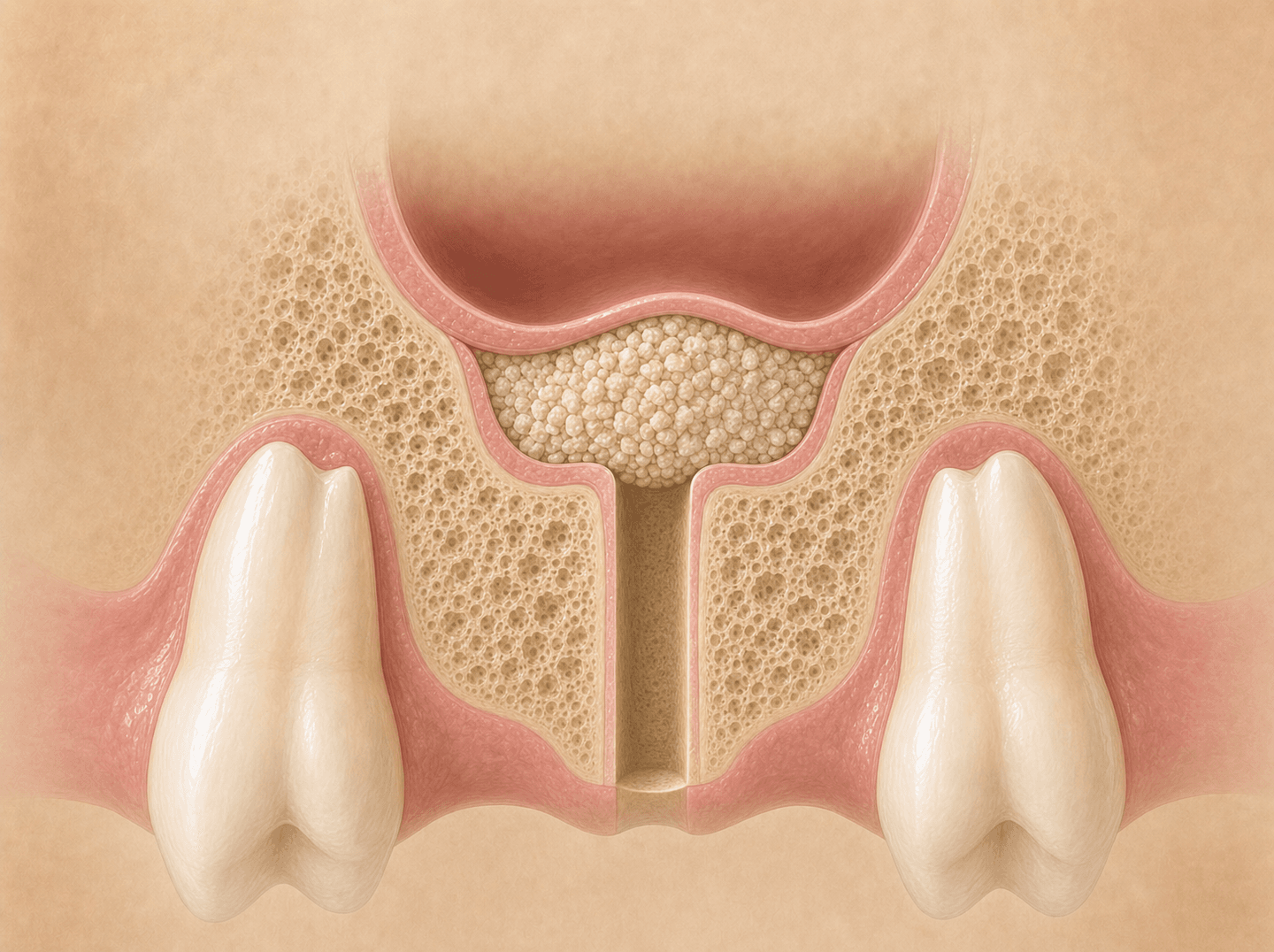
What D7952 covers
D7952 reports a sinus lift performed through the vertical, or crestal, approach. The surgeon works up through the crest of the ridge, usually through or near the implant osteotomy, gently raises the Schneiderian membrane that lines the sinus floor from below, and grafts as needed to gain vertical bone height in the posterior maxilla. This is the less invasive of the two sinus augmentation methods, sometimes called an osteotome lift or a crestal sinus floor elevation.
The crestal approach is the appropriate choice when several millimeters of native ridge already remain beneath the sinus, enough to start the lift from below and often enough to place the implant at the same visit. When very little bone remains and a large vertical gain is needed, the lateral window approach (D7951) is used instead.
D7952 does not cover:
- A sinus lift done through a window cut in the side wall of the maxilla. That is D7951, the lateral open approach.
- A graft that builds up the alveolar ridge itself, outside the sinus. That is D7950.
- A graft packed into a fresh extraction socket. That is D7953, billed per site.
- The implant body placement. That is D6010.
- A graft placed around the implant at the time it is seated. That is D6104.
When to bill D7952
Bill D7952 when:
- The procedure augments the maxillary sinus floor to gain vertical bone for an upper posterior implant.
- The surgeon used the vertical crestal approach, entering up through the ridge rather than through a lateral window.
- Enough native ridge height remained to raise the sinus floor from below, which is the clinical setting the crestal approach is built for.
Do not bill D7952 for:
- A lateral window sinus lift. Use D7951.
- Ridge augmentation outside the sinus. Use D7950.
- A socket preservation graft. Use D7953.
- A graft placed only around the implant body at seating. Use D6104.
D7952 versus D7951: the approach is the axis
Both codes have the same goal, more bone under the sinus, reached by two different routes. The distinguishing axis is the surgical approach, not the graft volume, the implant brand, or which carrier pays.
- D7952, vertical crestal approach. Access comes up through the crest of the ridge, through or near the implant osteotomy. The sinus floor is lifted from below and grafted. This is the smaller procedure, used when several millimeters of bone already remain to work from.
- D7951, lateral open approach. A window is cut in the side wall of the maxilla, the membrane is lifted from the side, and graft is packed into the opened space. This is the more invasive procedure, used for larger vertical gains when little native ridge is left.
Coding the wrong approach is the most common D7952 error, in both directions. Billing a true lateral window as D7952 understates the work and the fee. Billing a crestal bump as D7951 overstates it, and on the lateral code carriers tend to want documentation, usually minimal residual ridge height, that justifies the open approach. The narrative has to match the code, because the carrier reads the route from the operative note.
Same-day implant timing and D6104
The crestal approach is often done at the same visit as the implant, since the surgeon is already working through the osteotomy.
When the lift and the implant are simultaneous:
- D7952 reports the sinus augmentation itself, the lift of the membrane and the graft beneath it.
- D6010 reports the implant body placement.
- D6104 is added only if a separate graft is packed around the implant body, which is a different graft from the sinus lift.
A same-day implant does not fold the sinus lift into D6104. D6104 is a peri-implant graft, and the sinus floor augmentation stays D7952 no matter what day the implant goes in. Dropping D7952 and billing only D6104 undercodes the case and leaves the sinus work unpaid.
When the implant is staged for later, to let the graft mature or because primary stability was uncertain, D7952 is billed at the sinus surgery and the implant codes come at the later visit. The carrier reads staged versus simultaneous from the dates of service and the narrative, so keep them straight in the ledger.
Medical crossover
Sinus augmentation is one of the dental procedures most likely to cross to medical, so the coverage decision starts with coordination rather than picking a single plan.
Many practices submit the medical claim first and bill dental for any remaining benefit. Whether medical pays depends on the diagnosis and the plan: some medical carriers cover sinus augmentation when it is tied to a recognized condition, others treat it as elective. On the dental side, a number of plans exclude sinus augmentation as implant-related, the same way they exclude ridge augmentation done to enable an implant. Many plans also require pre-authorization before the surgery.
There is no universal answer. Verify both benefits before treatment, confirm which carrier is primary, secure any required pre-auth, and have the patient’s financial responsibility clear before the surgery date.
Top reasons D7952 gets denied or downgraded
- No pre-authorization. Many plans require pre-auth for sinus augmentation. A claim submitted without an approval on file pends or denies, and the patient balance question lands after the surgery instead of before it.
- Wrong approach code. A crestal lift billed as D7951, or a lateral window billed as D7952. The carrier cross-checks the operative note against the code and reprocesses or denies the mismatch.
- Plan excludes implant-related augmentation. Some dental plans treat any bone work done to enable an elective implant as a non-covered, implant-related service. This is plan language, not a clinical judgment, and there is no appeal that overturns it.
- Missing medical coordination. On a case a medical plan would have covered, submitting dental-only can stall the claim or leave benefit on the table when the dental plan excludes it.
- Thin operative note. A narrative that does not name the crestal approach, the residual ridge height, the graft material, and the planned implant gives the carrier little to adjudicate against, especially where pre-auth review is involved.
Documentation that supports the claim
The claim needs:
- A pre-op image showing the sinus floor and the residual ridge height, ideally a CBCT. The residual height is what supports choosing the crestal approach over a lateral window.
- A narrative naming the vertical crestal approach, the graft material, and the planned implant, with the tooth or site number.
- The dates of service that make the timing clear: same-day implant or a staged sequence.
- Any pre-authorization number the plan issued.
For the patient record, document:
- The residual ridge height measured pre-op and the reason the crestal approach was appropriate.
- The graft material used, autogenous or a substitute, with manufacturer and lot where applicable.
- Whether the implant was placed the same day or staged, and the planned timeline to restoration.
Example case
A patient needs a single implant in the upper right posterior. A CBCT shows about five millimeters of bone beneath the sinus floor, enough to start a lift from below and to seat the implant with primary stability. The surgeon plans a crestal sinus augmentation with the implant placed at the same visit.
Billing steps:
- Verify medical and dental benefits for sinus augmentation, confirm which is primary, and secure any required pre-authorization before scheduling.
- Write the narrative naming the vertical crestal approach, the roughly five millimeters of residual ridge height, the graft material, and the same-day implant.
- Submit to the primary carrier first. Code D7952 for the sinus augmentation and D6010 for the implant body on the appropriate claim, with the CBCT attached.
- Add D6104 only if a separate graft was placed around the implant body. Do not replace D7952 with D6104; the sinus lift is its own procedure.
- Reconcile the medical and dental EOBs and bill the patient any balance the plans did not cover, knowing many plans treat sinus augmentation as implant-related.
What to get right in your PMS
- Match the code to the approach. Crestal is D7952, lateral window is D7951. The narrative has to describe the route the carrier is paying for.
- Keep D7952 separate from D6104 on same-day cases. The sinus lift is D7952; D6104 is only a graft around the implant body. Do not let the same-day timing collapse the sinus code into the peri-implant code.
- Secure pre-auth first. Many plans require it for sinus augmentation. Get the approval before surgery, not after the denial.
- Coordinate medical and dental from the start. Sinus lifts cross to medical often. Decide which carrier is primary before submitting.
- Attach the CBCT and record residual ridge height. The measured height supports the crestal approach and the necessity of the lift, and it is the detail carriers look for on review.
FAQs
- What is the difference between D7952 and D7951?
- The axis is the surgical approach, not the amount of graft. D7952 is the vertical crestal approach: the surgeon works up through the ridge at the implant osteotomy and raises the sinus floor from below, sometimes called an osteotome or crestal lift. D7951 is the lateral open approach, cutting a window in the side wall of the maxilla to lift the membrane and pack graft underneath. D7952 is the smaller procedure, used when several millimeters of native bone already remain; D7951 is chosen when little residual ridge is left and a large vertical gain is needed.
- Can D7952 and the implant be billed the same day?
- Yes, and it often is, because the crestal lift is done through the implant osteotomy. When the lift and the implant happen together, D7952 reports the sinus augmentation and D6010 reports the implant body. D6104 is only added if a separate graft is placed around the implant itself. Do not collapse the sinus lift into D6104 because it was same-day; the crestal sinus augmentation is D7952 regardless of timing. Some surgeons stage the implant for later when primary stability is a concern, in which case D7952 is billed at the sinus surgery and the implant codes follow.
- Should I bill D7952 to medical or dental insurance?
- Often both, in coordination. Sinus augmentation crosses to medical more readily than most dental surgery, especially when tied to a diagnosis the medical plan recognizes. Many practices submit medical first, then dental for any remaining benefit. Coverage is plan-dependent: some dental plans exclude sinus augmentation as implant-related, and some medical plans treat it as elective. Verify both benefits and confirm which carrier is primary before the surgery date.
- Is D7952 the same as a socket graft or a ridge graft?
- No. D7952 lifts and grafts the floor of the maxillary sinus. A graft that builds up the alveolar ridge itself is D7950. A graft packed into a fresh extraction socket to preserve the site is D7953. The sinus codes are specific to raising the sinus membrane and grafting beneath it. Using a ridge or socket code for sinus work, or the reverse, is a mismatch the carrier catches when it reads the narrative.
- Why did the carrier deny or downgrade D7952?
- The common reasons are a missing pre-authorization, a plan that excludes implant-related augmentation, or a narrative that does not support the crestal approach. Some carriers also want to see that a crestal lift was appropriate rather than a lateral window, so residual ridge height matters in the note. On many plans sinus augmentation needs pre-auth, and coverage is plan-dependent, so verify benefits and get the approval before surgery.
Related codes
Need help billing this code?
We handle D7952 claims daily.
If your team is spending time on denials, narratives, or carrier follow-up for this code, our outsourced dental insurance billing service can take it off your plate. We work inside your PMS and post payments the same week.
CDT codes are maintained by the American Dental Association. This page is an editorial billing guide, not the official ADA code descriptor. Verify current coverage policies with each carrier before submitting claims.