D0180 is the CDT code for the full-mouth periodontal workup, six-point probing and complete charting on every tooth, billed when a patient shows signs, symptoms, or risk factors for periodontal disease, whether that patient is new to the practice or not.
It is not a new-patient version of the comprehensive exam, and it is not a periodic recall code. What separates D0180 from D0150 and D0120 is the work, not the patient. You bill it when the patient shows signs, symptoms, or risk factors for periodontal disease and you record the full periodontal picture (pocket depths, bleeding, recession, attachment levels, furcations, mobility) to support a diagnosis. Two patterns drive most of the denials: using it as a generic comprehensive exam without the charting to back it up, and shared frequency limits that make it compete with D0150 on the same plan.
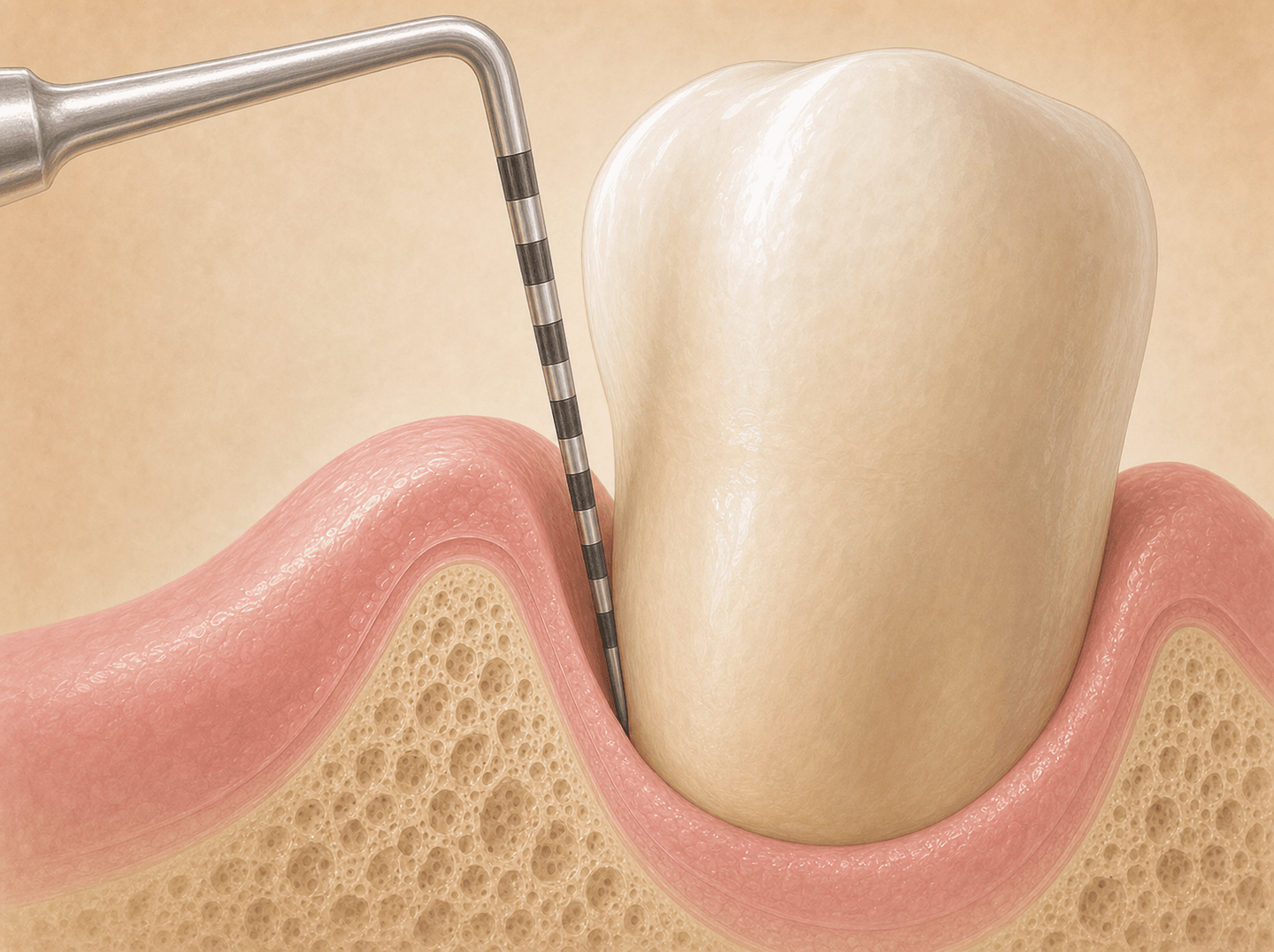
What D0180 covers
D0180 reports a comprehensive periodontal evaluation. It captures the patient’s full periodontal status: full-mouth probing with six measurements per tooth, complete periodontal charting, bleeding on probing, gingival recession, clinical attachment levels, furcation involvement, and tooth mobility. Alongside the periodontal workup, it includes the broader elements you would expect in a comprehensive exam: medical history review, a general health and wellness assessment, an oral cancer screening, and an assessment of the patient’s current dental conditions.
The code is indicated for patients who show signs or symptoms of periodontal disease, or who carry risk factors such as smoking, diabetes, or a relevant systemic medical condition. It applies to both new and established patients. That last point matters. The “new or established patient” language in the descriptor is what leads people to treat D0180 as a new-patient exam. It isn’t. The patient’s history is not the trigger. The periodontal picture is.
What separates D0180 from D0150 and D0120
This is where the code gets miscoded, so it’s worth being exact. All three are evaluations, and the lines between them are not about how new the patient is.
D0180 (comprehensive periodontal evaluation) is the exam built around the periodontium. The full-mouth six-point probing and complete periodontal charting are the defining work. You reach for it when the clinical picture points at periodontal disease (signs, symptoms, or risk factors) and you need the full periodontal data set to diagnose and plan.
D0150 (comprehensive oral evaluation) is the general comprehensive exam: a new patient, an established patient with a significant change in health, or one who has been out of active treatment for three or more years. It is a thorough overall evaluation, but it is not built around full-mouth periodontal charting the way D0180 is.
D0120 (periodic oral evaluation) is the recall exam for an established patient whose baseline is already on file. It checks what has changed since the last comprehensive or periodic evaluation. It is the lightest of the three.
The documentation that supports D0180
Because the periodontal workup is the code, the chart has to show it. The note should capture:
- The clinical indication. Why a periodontal evaluation was warranted: reported symptoms, visible inflammation or recession, a risk factor like smoking or diabetes, or a history that points at periodontal disease.
- Full-mouth six-point probing. Six measurements per tooth, recorded. This is the single most important element. A partial or spot-check probing does not support D0180.
- Complete periodontal charting. Bleeding on probing, recession, clinical attachment levels, furcation involvement, and mobility, mapped across the mouth, not summarized in a sentence.
- The broader exam elements. Medical history, oral cancer screening, and the overall dental assessment that round out the comprehensive evaluation.
A reviewer who sees D0180 with no periodontal charting has a reason to question the claim. The same is true in reverse: a comprehensive exam with no periodontal focus billed as D0180 looks like an upcode. Keep the code and the chart telling the same story.
Frequency and the shared-limit trap
Coverage and frequency on D0180 are plan-dependent, and one pattern causes more denials than any other: many carriers count D0180 and D0150 against a single combined frequency allowance for comprehensive evaluations rather than giving each its own window.
A common limit is one comprehensive evaluation every 12 to 36 months. On a plan with a shared window, a D0150 done last year can use up the allowance, so a D0180 this year denies for frequency even though it is a different code reporting different work. Some plans do track the two separately. The only way to know is to check the specific plan.
D0180 and the periodontal treatment codes
D0180 is the diagnostic front end. What follows depends on what the evaluation finds, and those treatment codes turn on different clinical thresholds. Getting the evaluation right sets up the correct treatment code, so it helps to know where the lines fall.
- D4346 (scaling with generalized moderate or severe gingival inflammation) is for a patient with generalized inflammation but no bone loss, gingivitis rather than periodontitis. The dividing line from scaling and root planing is attachment and bone loss: D4346 is the no-bone-loss code.
- D4341 and D4342 (scaling and root planing) are therapeutic procedures for periodontitis, indicated when there is attachment loss and bone loss. D4341 reports a quadrant with four or more affected teeth; D4342 reports a limited quadrant of one to three teeth. The split between them is the number of teeth treated per quadrant, not the depth of the pockets.
- D4910 (periodontal maintenance) is the ongoing therapeutic maintenance interval that follows active periodontal therapy. It is not a prophylaxis, and it is not the diagnostic exam.
The evaluation and the treatment are separate procedures. D0180 documents the periodontal status; the D4xxx code reports whatever treatment that status calls for.
When D0180 is not the right code
- A comprehensive exam without the periodontal workup. If you did a thorough new-patient evaluation but not full-mouth six-point probing and charting, that is D0150, not D0180.
- A recall exam on an established, stable patient. A periodic check against an existing baseline is D0120.
- A problem-focused deep dive after a prior exam. When a previous comprehensive or periodontal evaluation has flagged a condition that needs a much more extensive, problem-focused workup with additional diagnostic modalities, that is D0160, the in-depth problem-focused workup, not a second D0180.
- The periodontal treatment itself. Scaling, root planing, and maintenance have their own codes (D4346, D4341, D4342, D4910). D0180 reports only the evaluation.
What to get right in your PMS
The exact menus differ across Open Dental, Dentrix, Eaglesoft, Curve, and Carestream, but the setup that prevents problems is the same:
- Keep D0180, D0150, and D0120 as distinct, labeled exam codes. A single fuzzy “exam” entry is how the front desk picks the wrong one. Label each by what it actually is so the code matches the visit.
- Tie D0180 to the periodontal charting in the workflow. If your system can prompt or require a perio chart when D0180 is selected, use it. The charting is what defends the code.
- Flag the shared frequency limit. Note on the carrier record which plans count D0180 and D0150 against a combined comprehensive-evaluation window so your team can spot a frequency denial before it happens, not after.
- Verify the clinical indication is in the note. A documented periodontal sign, symptom, or risk factor is what separates a legitimate D0180 from an upcoded comprehensive exam under audit.
FAQs
- What is the difference between D0180 and D0150?
- Both are comprehensive evaluations, but they document different things. D0150 is a comprehensive oral evaluation for a new patient, an established patient with a significant health change, or one who has been away from active treatment for three or more years. D0180 is a comprehensive periodontal evaluation: it adds full-mouth six-point probing and complete periodontal charting and is meant for patients showing signs, symptoms, or risk factors for periodontal disease. The split is the work and the clinical indication, not whether the patient is new. D0180 covers new and established patients both. The common mistake is billing D0180 as a higher-paying comprehensive exam without the perio charting to support it.
- Can D0180 and D0150 be billed on the same day?
- No. They are mutually exclusive comprehensive evaluations for the same visit, so you report one or the other, not both. Pick the code that matches what you actually performed and documented. If you did the full-mouth periodontal workup with six-point probing and charting because of perio signs or risk factors, that is D0180. If you did a comprehensive oral evaluation without that periodontal focus, that is D0150. Many carriers also apply a shared frequency limit across the two, so even on separate dates one can use up the allowance for the other.
- How often will insurance pay D0180?
- It is plan-dependent, but a common frequency limit is once every 12 to 36 months, and many carriers count D0180 and D0150 against a combined comprehensive-evaluation allowance rather than giving each its own. That shared limit is what trips up offices that alternate between a comprehensive perio exam and a comprehensive oral exam. Verify the specific plan's frequency rule and whether the two codes share a window before you assume a D0180 will pay on top of a recent D0150.
- Does D0180 require periodontal charting to be billed correctly?
- Yes. The defining feature of D0180 is the full-mouth periodontal assessment: six measurements per tooth, bleeding on probing, recession, clinical attachment levels, furcation involvement, and mobility, recorded as complete periodontal charting. If the chart does not show that workup, the code is not supported, even if the patient has periodontal disease. Carriers that audit will look for the charting. Code what you documented, and document the full perio exam when you bill D0180.
- Does the patient need a periodontal diagnosis for D0180?
- The code is indicated for patients who show signs or symptoms of periodontal disease, or who carry risk factors such as smoking or diabetes, so the chart should reflect that clinical reason. You do not need a confirmed diagnosis before the exam, since the exam is part of how you reach one, but you do need a documented clinical indication. Billing D0180 on a healthy patient with no perio findings and no risk factors is a coding error a reviewer can catch.
- Can a general dentist bill D0180 or is it only for periodontists?
- A general dentist can bill D0180. The code is not restricted to periodontists. If the patient meets the clinical indication and you perform and document the full-mouth periodontal evaluation, a general practice can report it. The code follows the procedure performed, not the provider's specialty.
Related codes
Need help billing this code?
We handle D0180 claims daily.
If your team is spending time on denials, narratives, or carrier follow-up for this code, our dental insurance verification service can take it off your plate. We work inside your PMS and post payments the same week.
CDT codes are maintained by the American Dental Association. This page is an editorial billing guide, not the official ADA code descriptor. Verify current coverage policies with each carrier before submitting claims.