D0230 is the CDT code for each additional intraoral periapical radiograph taken on the same date of service after the first one — billed once per image, always following a D0220 for the first film.
It never stands alone. The first periapical that day is D0220, and every periapical after it on that date is D0230, billed once per image. Take four periapicals at one visit and the claim reads D0220 once, D0230 three times. What goes wrong is usually one of two things: forgetting that D0230 is a per-image add-on that has to follow a D0220, or stacking so many periapicals that a carrier reprices the whole group as a full-mouth series (D0210).
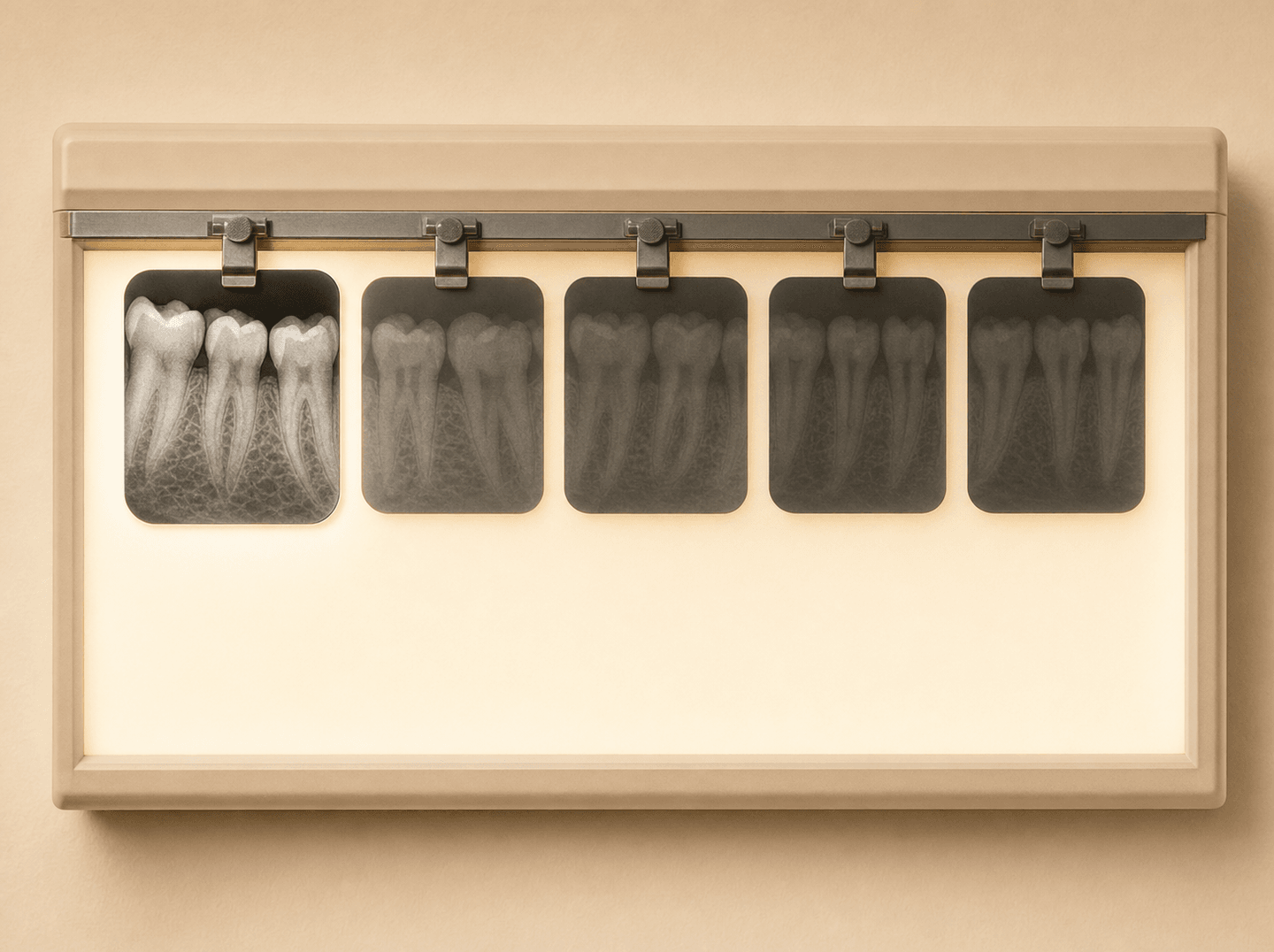
What D0230 reports
D0230 reports each additional intraoral periapical image taken on the same date of service, after the first one. A periapical captures a tooth from crown to root tip along with the surrounding bone, which is what makes it the workhorse film for decay at the root, periapical pathology, bone loss, and endodontic anatomy.
What defines D0230 is its position in the sequence, not the image itself. The first periapical you take on a given date is D0220. Every periapical after that, on the same date, is D0230, reported once per image. The two codes describe the same kind of picture. What separates them is whether the image is the first of the day or an additional one.
D0230 always follows D0220
D0230 is an add-on. It cannot be the only radiograph code on a date of service, because “additional” presupposes a first image that the additional ones are added to. That first image is D0220.
The pairing in practice:
- One periapical at a visit: D0220 only.
- Two periapicals: D0220 once, D0230 once.
- Four periapicals: D0220 once, D0230 three times.
The distinction that drives the code
The mix-up on this code is almost never about what a periapical is. It is the boundary between stacking individual periapicals and reporting a full-mouth series.
Individual periapicals (D0220 plus D0230) are right when you image one tooth or a handful of teeth for a focused reason: a patient points to pain on a specific tooth, you check an apex before or after a root canal, you confirm a suspected fracture or a failing restoration. You took targeted films, so you bill targeted films.
A comprehensive series (D0210) is right when you take a radiographic survey of the whole mouth meant to show the crowns, roots, periapical areas, interproximal areas, and alveolar bone of all the teeth. In CDT 2026 the D0210 descriptor no longer ties the series to a specific number of films, so the question is whether the intent and coverage were a whole-mouth survey, not whether you hit a count.
The error is reporting a true whole-mouth survey as a long stack of D0220 and D0230 to chase a higher total fee, or the reverse, splitting a few diagnostic periapicals into a series. Code what you actually did.
When to bill D0230
Bill D0230 when, on a single date of service, you take more than one periapical image and have already reported D0220 for the first. Common situations:
- A focused workup on one quadrant where two or three teeth need apex-level detail.
- Pre- and post-operative periapicals on an endodontic case taken at the same visit.
- A patient presents with localized pain and you image the symptomatic tooth plus its neighbors to compare.
- A specific restorative or surgical plan needs root and bone detail on several adjacent teeth.
Do not bill D0230 for:
- The first periapical of the date. That is always D0220.
- Bitewing images. A single bitewing is D0270 and a set of four is D0274. Bitewings are a different view and a different code family, even when taken at the same visit.
- An occlusal film. An intraoral occlusal image is D0240.
- A panoramic image. A panoramic film is extraoral and is D0330, not a periapical.
- A whole-mouth survey billed as a stack. If the intent was a comprehensive series, use D0210.
Periapicals versus the rest of the radiograph family
These codes get confused because they often appear on the same visit, but each reports a distinct image.
D0220 / D0230 (periapical, first / each additional) report tooth-and-root-apex images of specific teeth. D0220 is the first of the date, D0230 each additional.
D0210 (comprehensive series) reports a whole-mouth survey intended to display all teeth, their roots and periapical areas, the interproximal areas, and the alveolar bone. It is the series, not the individual films that might make it up.
D0270 (single bitewing) and D0274 (four bitewings) report interproximal views that show the crowns of upper and lower teeth in one image, used mainly to find decay between teeth and check bone levels. A bitewing is not a periapical and never rolls up into D0230.
D0240 (intraoral occlusal) reports a larger film positioned on the biting surface, used to capture a wider arch segment than a periapical covers.
D0330 (panoramic) reports a single extraoral image of both arches and surrounding structures. Because it is taken outside the mouth, it is never part of an intraoral periapical count or an intraoral comprehensive series.
The billing mistake to avoid is letting the front desk pick a fuzzy “X-ray” code. The image type and, for periapicals, the first-versus-additional position decide the code.
Documentation that supports the claim
Periapicals are routine, which is exactly why thin documentation is the quiet cause of trouble on review. The chart and the claim should make the count and the reason obvious.
- The teeth or areas imaged. Note which teeth each periapical covered. This is what supports the number of D0230 units and separates a focused workup from a whole-mouth survey.
- The clinical reason. Why the images were taken: localized pain, an endodontic step, a suspected fracture, a restorative or surgical plan. A periapical with no charted reason looks like a routine add-on.
- The image count and date. The number of films and the date of service, so the D0220-once-then-D0230 math on the claim matches the record.
If a carrier requests images, attach the periapicals tied to the specific line items so the count on the claim and the films in the record tell the same story.
What to get right in your PMS
The exact menus differ across Open Dental, Dentrix, Eaglesoft, Curve, and Carestream, but the setup that prevents miscoding is the same.
- Keep D0220 and D0230 as distinct, clearly labeled entries. One should read as the first periapical and the other as each additional. A single fuzzy “PA” code is how staff bill D0230 alone or report D0220 multiple times on one date.
- Bill D0220 once per date, then D0230 per additional image. Confirm the system isn’t set to repeat D0220 for each film. Repeated D0220 on one date is a common reject.
- Watch the count against the patient’s plan. If the periapical total on a date is high, check whether the plan reprices to a full-mouth series (D0210) and whether a recent D0210 is already on file within the plan’s window.
- Attach images to the correct line items. When a carrier asks for radiographs, link each periapical to its claim line so the count is defensible.
- Don’t mix image families under one code. Bitewings (D0270, D0274), occlusal (D0240), and panoramic (D0330) each have their own codes and never fold into the periapical count.
FAQs
- What is the difference between D0220 and D0230?
- They report the same type of image, an intraoral periapical, but in a different position within the same date of service. D0220 is the first periapical taken that day. D0230 is each additional periapical after the first. You report D0220 once and then D0230 for every extra periapical on the same date. Three periapicals at one visit is D0220 plus two units of D0230. The distinction is purely first-versus-additional, not image quality, tooth, or area of the mouth.
- Can D0230 be billed by itself?
- No. D0230 is an add-on code for additional images and only makes sense after a first periapical, which is D0220. A claim showing D0230 with no D0220 on the same date of service will usually reject or pend, because there is no first image for the additional ones to follow. If you took a single periapical, the correct code is D0220, not D0230.
- How many times can I bill D0230 on one date?
- Once per additional periapical image, with no fixed CDT limit. If you take six periapicals at a visit, that is D0220 once and D0230 five times. The practical ceiling is set by the carrier, not the code. Many plans cap the number of individual periapicals they will pay per date, and once you take enough images, a carrier may reprice the whole group as a full-mouth series (D0210) at the lower series allowable. Where that line sits is plan-specific.
- When should periapicals be billed as a full-mouth series (D0210) instead of D0220 and D0230?
- Bill D0210 when you actually take a comprehensive survey of the whole mouth intended to show the crowns, roots, periapical areas, interproximal areas, and alveolar bone of all teeth. Bill individual periapicals (D0220 plus D0230) when you image a specific tooth or a few teeth for a focused diagnostic reason. Code what you did. The complication is that some carriers will reprice a large stack of individual periapicals as D0210 even when you billed them separately, paying the series allowable. That is a plan repricing rule, not a coding choice on your end.
- Does insurance limit how often D0230 is covered?
- Frequency limits on individual periapicals are less common than on full-mouth series or bitewings, but they exist and they vary by plan. Some plans cap the number of periapicals per date of service or per benefit period. Many also bar a full-mouth series (D0210) within a window, often three to five years, and will fold a large group of periapicals into that limit. Verify the specific plan's periapical and series rules rather than assuming periapicals are always open.
- Is D0230 a current CDT 2026 code?
- Yes. D0230 is active in CDT 2026 and reports every periapical film taken after the first one on a date of service. The intraoral radiograph family did see attention in recent CDT cycles, mainly the comprehensive series code D0210, whose descriptor was simplified to drop the old fixed image count. The first-versus-additional structure of D0220 and D0230 carries into 2026 unchanged in meaning.
Related codes
Need help billing this code?
We handle D0230 claims daily.
If your team is spending time on denials, narratives, or carrier follow-up for this code, our dental insurance verification service can take it off your plate. We work inside your PMS and post payments the same week.
CDT codes are maintained by the American Dental Association. This page is an editorial billing guide, not the official ADA code descriptor. Verify current coverage policies with each carrier before submitting claims.