D0461 is a new CDT 2026 code used to report diagnostic testing done specifically to determine whether a tooth is cracked — the clinical time, instruments, and interpretation of findings, but not the treatment that follows.
It's a new code, so the ground is still shifting. Before 2026, there was no standalone code for crack diagnosis. Practices absorbed the time and instruments into the exam or reported under general diagnostic codes. D0461 gives that work its own line item. The reality in 2026: most carriers haven't loaded this code yet, and early claims are hitting denials for bundling or non-recognition.
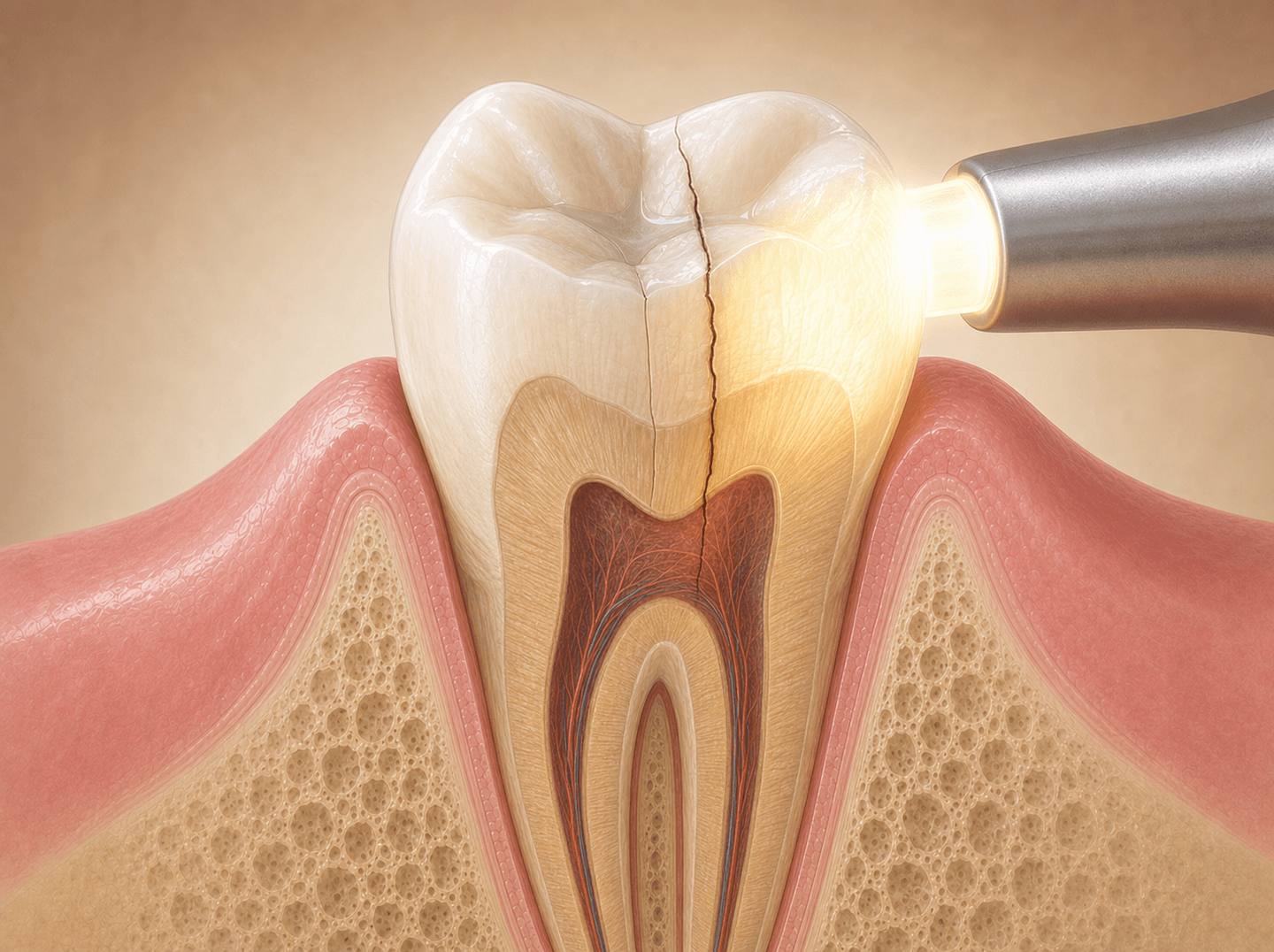
What D0461 covers and doesn’t cover
D0461 reports diagnostic testing performed specifically to determine whether a tooth is cracked. This includes the clinical time, the instruments, and the interpretation of findings. The code covers the testing itself, not the treatment that follows.
Testing methods that fall under D0461:
- Bite stick or Tooth Slooth testing (directed biting pressure on individual cusps).
- Transillumination (fiber-optic light passed through the tooth to reveal fracture lines).
- Dye staining (methylene blue or similar applied to highlight crack paths).
- Selective removal of restorations to visualize the crack directly.
- Periapical radiographs taken as part of the crack workup (though cracks rarely show on standard 2D films).
- CBCT imaging when ordered specifically for crack diagnosis. The imaging itself may have a separate code. D0461 reports the clinical testing and interpretation.
D0461 does not cover:
- Pulp vitality testing. That’s D0460. Vitality testing determines if the pulp is alive. Crack testing determines if the tooth is cracked. Different question, different code.
- Treatment of the cracked tooth (crown, extraction, root canal). Those have their own codes.
- The exam visit itself. The periodic or comprehensive eval is a separate procedure.
When to bill D0461
Bill D0461 when the dentist performs dedicated testing to determine if a tooth is cracked. Common clinical triggers:
- Patient reports sharp pain on biting, especially on release.
- Patient reports sensitivity to cold that lingers after the stimulus is removed.
- A visible fracture line is suspected during the exam but needs confirmation.
- An existing restoration on the tooth is failing and crack involvement needs to be ruled in or out before treatment planning.
- The dentist uses specific instruments (Tooth Slooth, transillumination light, dye) to isolate and confirm a crack.
Do not bill D0461 for:
- A visual observation during the exam that a tooth appears cracked, without dedicated testing. If you noted a fracture line during a D0150 but didn’t perform additional diagnostic tests, D0461 is not supported.
- Radiographs taken for general diagnostic purposes that happen to show a fracture. D0461 is the clinical testing workup, not incidental findings.
- Testing that was actually a pulp vitality assessment. Use D0460.
Testing methods for cracked teeth
The choice of method depends on the clinical situation and what the dentist needs to confirm.
Bite stick / Tooth Slooth. The most common initial test. The patient bites down on a stick or Tooth Slooth device positioned on individual cusps. Pain on release of biting pressure (rebound pain) is the classic positive finding. This isolates which cusp or area of the tooth is involved.
Transillumination. A fiber-optic light is directed through the tooth. Cracks interrupt light transmission, appearing as a dark line or shadow. Works best on anterior teeth and premolars. Posterior molars are harder to transilluminate because of their bulk and multiple cusps.
Dye staining. Methylene blue or a similar dye is applied to the tooth surface (sometimes after etching). The dye seeps into the crack and highlights it visually. Useful when the fracture line is suspected but not visible under normal lighting.
Selective restoration removal. When a crack is suspected under an existing restoration, the dentist removes the restoration to visualize the tooth structure directly. This is the most definitive method but also the most invasive. It commits the tooth to a new restoration regardless of findings.
Radiographic evaluation. Standard periapical radiographs are part of most crack workups, but cracks are notoriously difficult to see on 2D films unless the X-ray beam passes exactly through the plane of the fracture. CBCT (3D imaging) is better at catching vertical root fractures but still misses some incomplete cracks.
In practice, most cracked-tooth workups involve two or more of these methods in sequence: a bite test to confirm the symptom pattern, transillumination to locate the line, and sometimes dye or restoration removal for definitive confirmation.
New code, carrier lag
D0461 is effective January 1, 2026. Like all new CDT codes, carrier adoption follows its own timeline. Some carriers update their tables before the effective date. Others take six to twelve months. A few require manual intervention from the practice to trigger recognition.
What this means in 2026:
- Some carriers will return D0461 as an unrecognized code. The claim won’t process at all.
- Some carriers will recognize D0461 but bundle it into the definitive cracked-tooth treatment per their stated policy, so it won’t reimburse separately.
- Some carriers will process and pay it without issue.
Two carrier responses look similar but call for opposite handling.
For carriers that genuinely haven’t loaded D0461 (true non-recognition), your options are limited. You can submit the test under D0140 (limited oral evaluation, problem-focused) if no other exam was billed on that date, or, on plans with no prohibition on it, collect the fee from the patient as a non-covered diagnostic and note it on the ledger. Neither option is ideal, but both are defensible during the transition period.
For carriers that recognize D0461 but bundle it, patient-pay is not on the table. Major carriers treat the testing as included in the definitive treatment. Delta Dental’s CDT 2026 provider policy states the fee “is not separately billable to the patient.” On those plans, charging the patient is a balance-billing / participating-provider compliance violation, not a coverage workaround. Verify each carrier’s bundling and patient-billable rules before you quote or charge anyone.
D0461 versus D0460 and exam codes
These codes overlap in when they’re performed but not in what they report.
D0461 (the cracked-tooth workup) answers: is this tooth cracked, and where? The instruments are bite sticks, transillumination devices, dye, and direct visualization. The output is a crack diagnosis (or a ruled-out crack).
D0460 (pulp vitality test) answers: is the pulp in this tooth alive? The instruments are cold spray, electric pulp tester, or heat application. The output is a vitality finding (vital, non-vital, or inconclusive).
D0120/D0150 (periodic or comprehensive evaluation) answers: what is the overall condition of the patient’s oral health? The output is a treatment plan and updated chart.
All three can occur on the same visit for the same tooth. A patient comes in for a periodic exam (D0120). The dentist notices a suspicious line on tooth #19 and the patient reports biting sensitivity. The dentist performs a Tooth Slooth test, transillumination, and a cold test to check both the crack and the pulp. That visit supports D0120 + D0461 + D0460, each documented separately with its own findings.
The billing mistake to avoid: billing D0461 when you only did a pulp vitality test, or billing D0460 when you only did crack testing. The codes are specific. Use the one that matches the test you actually performed.
Top reasons D0461 gets denied
Five issues will account for most problems on this code in 2026:
- Code not recognized. The carrier hasn’t loaded D0461 into their system. The claim comes back as an invalid code. This is the most common issue in the first year of a new code.
- Bundled into the definitive treatment. Under documented carrier policy (Delta Dental and others), crack testing is included in the definitive cracked-tooth treatment, such as the crown, and the fee is not separately billable. The denial reads “inclusive procedure” or “included in the definitive treatment.” This is the carrier’s stated policy, not an error to appeal. Treat D0461 here as a documentation and communication code rather than a separately reimbursable line item.
- No documentation of clinical necessity. The carrier sees D0461 with no supporting note explaining why crack testing was performed. Without documented symptoms or clinical findings that triggered the workup, the claim looks like a routine add-on.
- Duplicate or excessive billing. D0461 billed multiple times on the same tooth within a short window. Unless there’s a documented new episode with new symptoms, repeated billing on the same tooth will deny.
- Plan exclusion. The plan simply doesn’t cover this category of diagnostic testing. This is different from non-recognition. The carrier knows what D0461 is but the patient’s plan excludes it.
Documentation that supports the claim
The chart note for D0461 should include:
- Which tooth. Tooth number, documented at the procedure level.
- Why you tested. The clinical indication: patient-reported symptoms (pain on biting, cold sensitivity, spontaneous pain), visual finding during exam (visible fracture line, staining pattern), or history (large restoration, prior trauma).
- What tests you performed. Name each method: “Tooth Slooth test on buccal and lingual cusps,” “transillumination with fiber-optic light,” “methylene blue dye application.”
- What you found. Positive or negative findings per test. “Rebound pain on release from the distolingual cusp.” “Transillumination revealed a mesial-distal crack line extending from the marginal ridge toward the pulp floor.” “Dye pooled along a fracture line on the distal surface.”
- Clinical conclusion. “Cracked tooth confirmed, tooth #19, mesial-distal fracture through the distal marginal ridge.” Or: “Crack suspected but not confirmed. Recommend monitoring and retest if symptoms persist.”
For the claim itself:
- D0461 on the correct tooth number.
- Narrative if the carrier accepts one (many clearinghouses support a brief narrative field). One sentence is enough: “Dedicated crack testing performed on #19 using Tooth Slooth and transillumination due to patient-reported rebound pain on biting.”
- Attach any supporting images if available (transillumination photo, periapical radiograph).
Example case
A 52-year-old patient presents to the office reporting sharp pain on biting in the lower right quadrant for the past two weeks. The pain is intermittent and worse when chewing on hard food. During a limited evaluation (D0140), the dentist notes a large existing MOD amalgam on tooth #30. No obvious caries on the radiograph.
The dentist suspects a cracked tooth and performs dedicated testing:
- Tooth Slooth test on each cusp of #30. Patient reports sharp pain on release from the distolingual cusp.
- Transillumination with a fiber-optic light. A shadow line is visible running mesial-distal across the distal marginal ridge.
- Cold test (D0460) on #30. The tooth responds normally to cold with no lingering pain. Pulp is vital.
Findings: cracked tooth confirmed on #30, mesial-distal fracture through the distal marginal ridge. Pulp vitality intact. Treatment plan: full-coverage crown (D2740) to stabilize the tooth.
Billing for the visit:
- D0140 (limited oral evaluation, problem-focused) on the date of service.
- D0461 (the cracked-tooth workup) on tooth #30.
- D0460 (pulp vitality test) on tooth #30.
- D0220 (periapical radiograph) on tooth #30 if taken during the visit.
- D2740 billed on a subsequent visit when the crown is seated.
If the carrier returns D0461 as unrecognized, that’s a transition issue: resubmit or handle the fee per the plan’s rules. If the carrier denies it as bundled into the definitive treatment, that’s its stated policy: the line won’t pay separately and it isn’t appealable as an error. Keep the chart note documenting the separate instruments, findings, and crack-specific testing time regardless, so the workup is on record even when the line doesn’t reimburse.
What to get right in your PMS
The exact menus and field names vary across Open Dental, Dentrix, Eaglesoft, Curve, and Carestream. The steps that matter are the same:
- Add D0461 to your procedure code table. New 2026 codes don’t always auto-populate from CDT updates. Confirm the code exists in your system with the correct fee and category.
- Post D0461 against the tooth of concern. The code reports a focused cracked-tooth workup that may include comparison testing of adjacent and contralateral teeth in the same report. It is not a routine whole-mouth screening, but it is also not strictly one tooth per code. The reported tooth still anchors the claim and is what most carriers key their frequency edits to.
- Attach the chart note to the claim, not just the patient record. If your PMS separates clinical notes from claim attachments, make sure the crack-testing documentation is linked to the D0461 line item.
- Track carrier recognition. Flag carriers in your PMS that have accepted or denied D0461. This saves your billing team from submitting claims they know will bounce and lets you quote the patient accurately on out-of-pocket cost.
- Don’t batch D0461 with unrelated diagnostics on the same claim unless they were performed on the same visit. Grouping it with procedures from a different date looks like it was added after the fact.
FAQs
- Can D0461 be billed with the exam on the same visit?
- You can report both, but reporting is not the same as separate reimbursement. D0461 is a distinct diagnostic procedure, not part of the periodic or comprehensive exam, so if a patient presents with symptoms during a routine exam and you perform dedicated crack testing, both the exam code (D0120, D0140, D0150) and D0461 belong on the claim, each documented separately. What you cannot assume is that both will pay. Major carriers bundle D0461 into the definitive cracked-tooth treatment under documented policy, so on many plans D0461 will not reimburse separately even when correctly reported. Bill it for the record, but set fee expectations against the specific carrier's bundling rules.
- Can D0461 and D0460 be billed together?
- Yes, if both tests were actually performed. D0460 (pulp vitality test) determines whether the pulp is alive. D0461 determines whether the tooth is cracked. They answer different clinical questions. If you ran a Tooth Slooth test and a cold test or electric pulp test on the same tooth at the same visit, both codes apply. Document each test, its method, and its findings separately.
- What if the carrier returns D0461 as an unrecognized code?
- This is common in 2026 because many carriers haven't loaded the new CDT codes yet. If D0461 comes back as unrecognized, resubmit under D0140 (limited oral evaluation, problem-focused) if you haven't already billed an exam, or under a narrative-supported general diagnostic code. Track which carriers recognize D0461 and update your workflow as adoption spreads.
- Is D0461 a one-time code or can it be billed repeatedly on the same tooth?
- D0461 reports a single cracked-tooth diagnostic workup, not a per-tooth line item. It is scoped as one report per episode, so the adjacent and contralateral teeth you test within the same investigation are already covered by one D0461. Don't bill a separate D0461 for each tooth examined. Report it once per episode against the tooth of concern. If the patient returns months later with new symptoms and you perform a new, separately documented round of crack testing, a second D0461 is defensible. Billing it repeatedly at the same visit or across closely spaced visits without new clinical indication will flag as overutilization.
- Will carriers cover D0461 or is it mostly patient-pay?
- It depends on the plan, and patient-pay is not a safe default. Some carriers haven't loaded D0461 yet (true non-recognition), which is a transition issue. But major carriers that have loaded it bundle it: Delta Dental's CDT 2026 provider policy states the testing is included in the definitive treatment and the fee is not separately billable to the patient. For patients on those plans, charging the patient is a balance-billing / participating-provider compliance problem, not a coverage gap. Before charging any patient, verify that carrier's specific bundling and patient-billable rules. Patient-pay is only defensible for plans with no such prohibition or for genuinely non-participating / out-of-network situations.
Related codes
Need help billing this code?
We handle D0461 claims daily.
If your team is spending time on denials, narratives, or carrier follow-up for this code, our dental insurance verification service can take it off your plate. We work inside your PMS and post payments the same week.
CDT codes are maintained by the American Dental Association. This page is an editorial billing guide, not the official ADA code descriptor. Verify current coverage policies with each carrier before submitting claims.