D1120 is the CDT code for a child prophylaxis — a cleaning for a patient in the primary or transitional (mixed) dentition, the pediatric counterpart to the adult prophy D1110.
The clinical procedure is similar to D1110 (adult prophylaxis), which covers the permanent and transitional dentition, but the fee is lower. The code split is driven by the dentition present, not the patient's age; carriers then layer a coverage age cutoff on top (most commonly 14, sometimes 12, 18, or 19). Most billing problems on D1120 come from age-cutoff timing: a patient who turns 14 between recalls gets the next cleaning billed as D1110, but plans don't always update the age category cleanly.
What D1120 covers
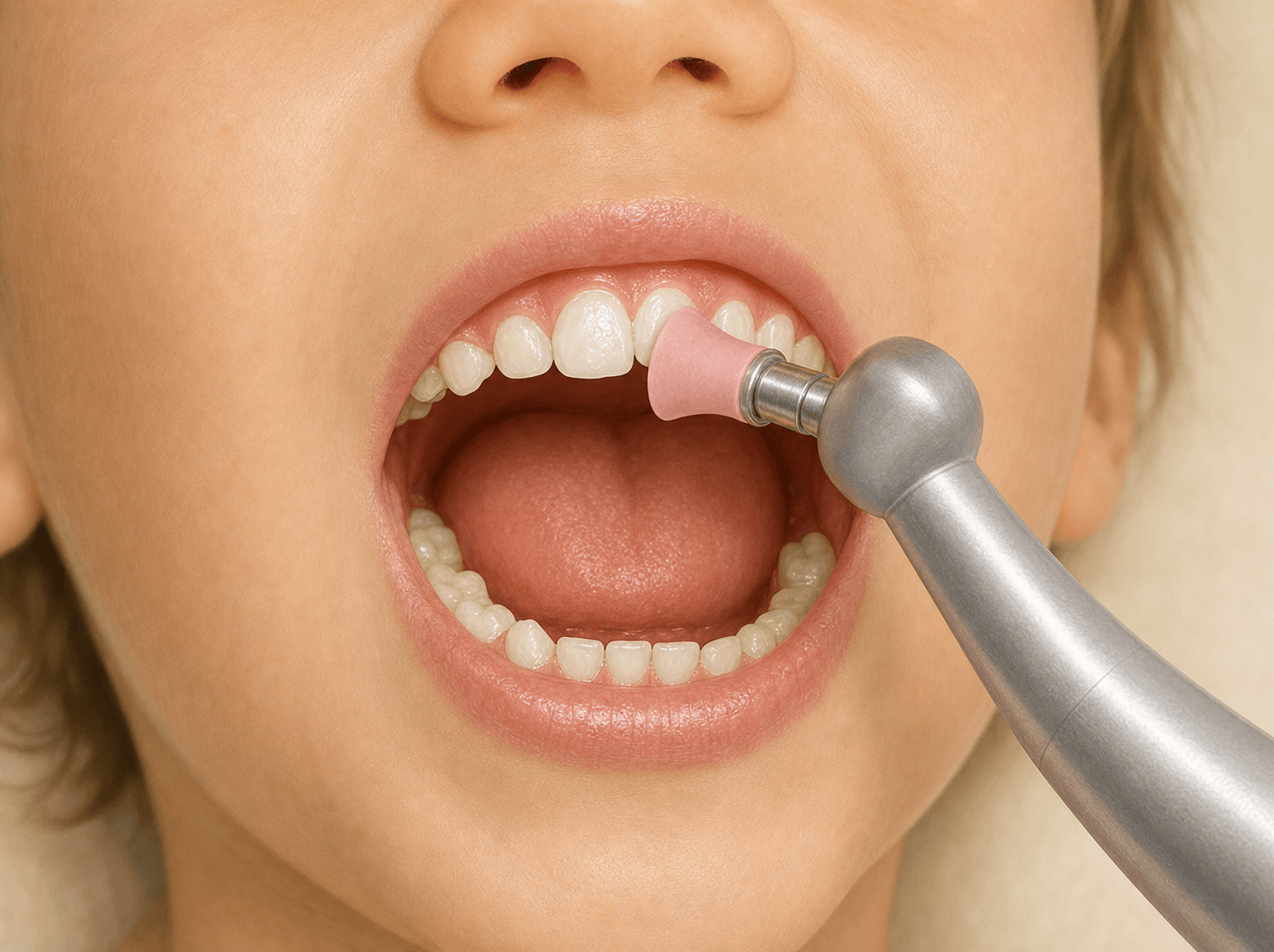
D1120 reports a prophylaxis (cleaning) on a child patient. The procedure includes scaling of supragingival deposits, polishing of all tooth surfaces, oral hygiene instruction appropriate to the patient’s age, and the cleaning of any orthodontic appliances or fixed retainers present. Per the ADA descriptors, D1120 covers prophylaxis in the primary and transitional (mixed) dentition; once the patient is in full permanent dentition, the cleaning is reported as D1110. The split is driven by the dentition present, not by chronological age. An 11-year-old already in full permanent dentition is correctly D1110. Plans layer an age cutoff on top of this for reimbursement, but that cutoff is a coverage rule, not the code’s clinical definition.
It does not cover:
- Adult prophylaxis. Use D1110 once the patient ages out of the plan’s pediatric category.
- Periodontal maintenance. Use D4910 for patients with a periodontal diagnosis requiring maintenance.
- Periodontal scaling and root planing. Use D4341 or D4342 for active periodontal therapy.
- The clinical exam at the same visit. Use D0120 (periodic) or D0150 (comprehensive) as appropriate.
- Fluoride application. Use D1206 (fluoride varnish) or D1208 (topical fluoride excluding varnish).
- Sealants. Use D1351 (per tooth).
- Silver diamine fluoride application. Use D1354.
- Oral hygiene instruction billed as a separate code. Most plans consider OHI included in D1120 and don’t pay D1330 separately.
The procedure is the cleaning. Everything else on the pediatric recall visit is a separate code.
When to bill D1120
Bill D1120 when:
- The patient is in the primary or transitional (mixed) dentition. Once the patient is in full permanent dentition, the cleaning is D1110, regardless of age. Carriers separately apply a coverage age cutoff (most commonly under age 14, with plan-specific variations).
- A cleaning has been performed: scaling, polishing, and oral hygiene instruction.
- The cleaning was on a recall visit, not as part of active periodontal therapy.
Do not bill D1120 for:
- Patients who have aged out of the plan’s pediatric category. Use D1110.
- Patients with a periodontal diagnosis requiring maintenance. Use D4910.
- The exam, fluoride, sealants, or radiographs done at the same visit. Each has its own code.
The age cutoff and how plans actually apply it
The single most common D1120 billing question is “should this patient’s cleaning be D1120 or D1110?” The answer is plan-specific.
Common pediatric prophylaxis age cutoffs:
- Age 14: The most common cutoff on commercial plans. Patients age 13 and younger bill D1120; age 14 and older bill D1110.
- Age 12: Some plans cap pediatric prophylaxis lower, transitioning to adult cleaning at 12.
- Age 18: Some pediatric-focused plans (and some state Medicaid programs) extend the pediatric category to 18.
- Age 19: A few plans, including some specifically structured for student populations, extend to 19.
The cutoff is documented in the plan’s benefit booklet. The pediatric office or general practice with pediatric volume should track the cutoff on each contracted plan to avoid mis-billing.
A patient’s transition from D1120 to D1110 happens at the recall visit after the patient’s birthday passes the plan’s cutoff. The age on the date of service drives the code.
The bundled pediatric recall visit
A typical pediatric recall visit includes more codes than an adult recall. The standard bundle:
- D0120 (periodic oral evaluation) for the dentist’s exam.
- D1120 (child prophylaxis) for the cleaning.
- D1206 (fluoride varnish) for the fluoride application, typically twice per year on pediatric patients.
- D0274 (bitewings, four films) at the standard pediatric radiograph frequency (commonly every 12 to 24 months).
Optional add-ons based on clinical findings:
- D1351 (sealants, one line per tooth) on erupting permanent molars.
- D1354 (silver diamine fluoride, per tooth) for arresting incipient caries in patients where SDF is appropriate.
- D0145 (oral evaluation under age 3) for infant or toddler visits, replacing D0120 when applicable.
Each code is billed and processed independently. Carriers may have specific frequency rules per code (twice per year on fluoride is common; sealants are usually a lifetime benefit per tooth; bitewings have their own frequency).
Top reasons D1120 gets denied or downgraded
Five issues account for most problems on this code:
- Age cutoff hit. Patient is older than the plan’s pediatric category. Recode as D1110.
- Frequency limit. Most plans cover two cleanings per benefit year. A third cleaning request typically requires medical necessity documentation. Less common on pediatric patients than adults, since most pediatric patients are on the standard twice-per-year recall.
- Periodontal diagnosis present. Some plans require D4910 (periodontal maintenance) once a patient has a periodontal diagnosis, even if the patient is in the pediatric age range. This is more common on teenage patients with diagnosed periodontal conditions.
- Missing exam. Some plans require a periodic or comprehensive oral evaluation on the same date as the prophylaxis to pay both. A claim with D1120 alone (no D0120 or D0150) may pend for the exam.
- Plan doesn’t recognize the pediatric prophy code. Rare but happens on a handful of plans that pay only D1110 regardless of age. Recode and resubmit.
The teenager with calculus question
A common clinical situation: a 12- or 13-year-old patient who hasn’t been seen in a while presents with significant calculus accumulation. The cleaning takes longer than a typical pediatric cleaning. Should it still bill as D1120?
Yes, if the patient is still in primary or transitional (mixed) dentition. The code is driven by the dentition present, not by chair time or complexity. A long, difficult cleaning on a patient in primary or transitional dentition still bills as D1120. If the patient is already in full permanent dentition, the cleaning is D1110, regardless of chronological age or the plan’s stated age cutoff.
The exception is if the patient has progressed to periodontal disease requiring active therapy. In that case, the appropriate code is D4341 or D4342 (scaling and root planing) for the active treatment, followed by D4910 (periodontal maintenance) for ongoing care. The diagnosis drives this shift, not the chair time.
Documentation that supports the claim
The claim needs:
- Date of service.
- Patient age clearly documented (the date of birth on the claim is sufficient; the carrier’s system calculates).
For the patient record, document:
- Pre-cleaning periodontal screening (often a basic periodontal screening or full periodontal probing if age-appropriate).
- Calculus and biofilm present at the cleaning.
- Scaling and polishing completed.
- Oral hygiene instruction provided (age-appropriate guidance, parent or guardian present for younger patients).
- Recall interval recommended.
The chart should also document any findings that warrant follow-up (incipient caries, white spot lesions, orthodontic needs, gingival inflammation).
Example case
A 9-year-old patient presents for her semi-annual recall. The dentist examines her, the hygienist cleans her teeth, fluoride varnish is applied, and bitewings are taken per the standard 12-month pediatric radiograph schedule. No clinical concerns at this visit.
Visit codes:
- D0120 (periodic oral evaluation).
- D1120 (child prophylaxis).
- D1206 (fluoride varnish).
- D0274 (bitewings, four films) per the pediatric radiograph schedule.
Billing steps:
- Verify benefits and confirm coverage for each code. Pull the pediatric prophylaxis age cutoff and confirm the patient is within it.
- Submit all four codes on the date of service.
- Standard carrier processing pays each code per the plan’s allowable and frequency rules.
If the patient is 13 with the next visit scheduled after her 14th birthday and the plan’s cutoff is 14, the front desk should note that the next recall will be billed as D1110 (and the cleaning fee will reflect the adult rate on the patient’s portion).
What to get right in your PMS
The specifics vary across Open Dental, Dentrix, Eaglesoft, Curve, and Carestream. The steps that matter:
- Maintain an age cutoff reference for each contracted plan. D1120-to-D1110 transition happens at the plan’s specified age, not at a uniform age across plans.
- Bill all visit codes separately. D0120, D1120, D1206, D0274 each get their own line. The PMS should make this routine for pediatric recalls.
- Set the recall interval per visit type. Six-month pediatric recall is the standard; some patients on caries-control or high-risk protocols are on three-month or four-month intervals with different code combinations.
- Flag patients approaching the age cutoff at booking. A patient turning 14 between recalls is a candidate for D1110 on the next visit; the appointment scheduler should know which code will apply.
- Track which plans have non-standard pediatric coverage. Some plans extend pediatric coverage to 18 or 19; some restrict it to 12. The non-standard cases are the ones that cause mis-billing.
If your office sees recurring D1120 versus D1110 confusion, the cause is usually a patient who aged out without the PMS updating the default code. A quarterly audit of pediatric patients approaching age cutoffs prevents the issue.
FAQs
- What's the age cutoff for D1120?
- Most commonly age 14, but plans vary. Some plans cap pediatric prophylaxis at age 12, some at 18, a few at 19. The cutoff is plan-specific, not ADA-specified. The code descriptor doesn't carry an explicit age; the plan's coverage table does. Verify the cutoff on each patient's plan before assuming D1120 versus D1110 applies.
- When does a child transition from D1120 to D1110?
- On the recall visit after the patient ages out of the plan's pediatric category. A patient who turns 14 in March, on a plan with a 14-and-older D1110 rule, gets the September recall billed as D1110. The April recall (before age 14) is still D1120. The transition is at the visit, not at the birthday.
- Why does D1120 pay less than D1110?
- The carrier's fee schedule typically lists D1120 at a lower allowable than D1110. The reasoning is shorter chair time and less calculus typically present in pediatric patients. The actual chair time on a teenager with calculus may be similar to an adult cleaning, but the code's allowable reflects the plan's blanket pediatric fee level.
- What's billed alongside D1120 on a typical pediatric recall?
- Usually D0120 (periodic oral evaluation), often D1206 (fluoride varnish), sometimes D0274 (bitewings) at the standard radiograph frequency. Sealants (D1351) and SDF (D1354) are added when clinically indicated. The combination of codes on a pediatric recall typically runs 2 to 4 codes; each is billed and processed independently.
- Does D1120 apply to primary teeth, permanent teeth, or both?
- Per the ADA descriptors, D1120 covers prophylaxis in the primary and transitional (mixed) dentition. A patient in full permanent dentition is D1110, even at a young age (the classic 11-year-old in full permanent dentition is D1110). For transitional or mixed dentition, either code is permissible. The distinguishing factor is the dentition present, not chronological age and not the plan's age cutoff. Per the ADA's 'Age of Child' policy, child versus adult status should be based on the clinical development of the patient's dentition. Many carriers do impose an age cutoff for reimbursement, but that is a plan coverage rule layered on top, not the coding rule.
Related codes
Need help billing this code?
We handle D1120 claims daily.
If your team is spending time on denials, narratives, or carrier follow-up for this code, our dental insurance verification service can take it off your plate. We work inside your PMS and post payments the same week.
CDT codes are maintained by the American Dental Association. This page is an editorial billing guide, not the official ADA code descriptor. Verify current coverage policies with each carrier before submitting claims.