D1527 is the CDT code for a removable space maintainer in the lower arch that holds space on both the left and right sides.
- When to use: One removable lower appliance holds space on both sides of the arch after early loss of primary teeth, when a lingual holding arch wasn't a good option.
- When not to use: A lower lingual holding arch is D1517, a removable one-sided lower appliance is D1520, and the upper bilateral removable is D1526.
- Billing note: Bill one unit for the mandibular arch and document why the fixed lingual arch wasn't used, because reviewers ask.
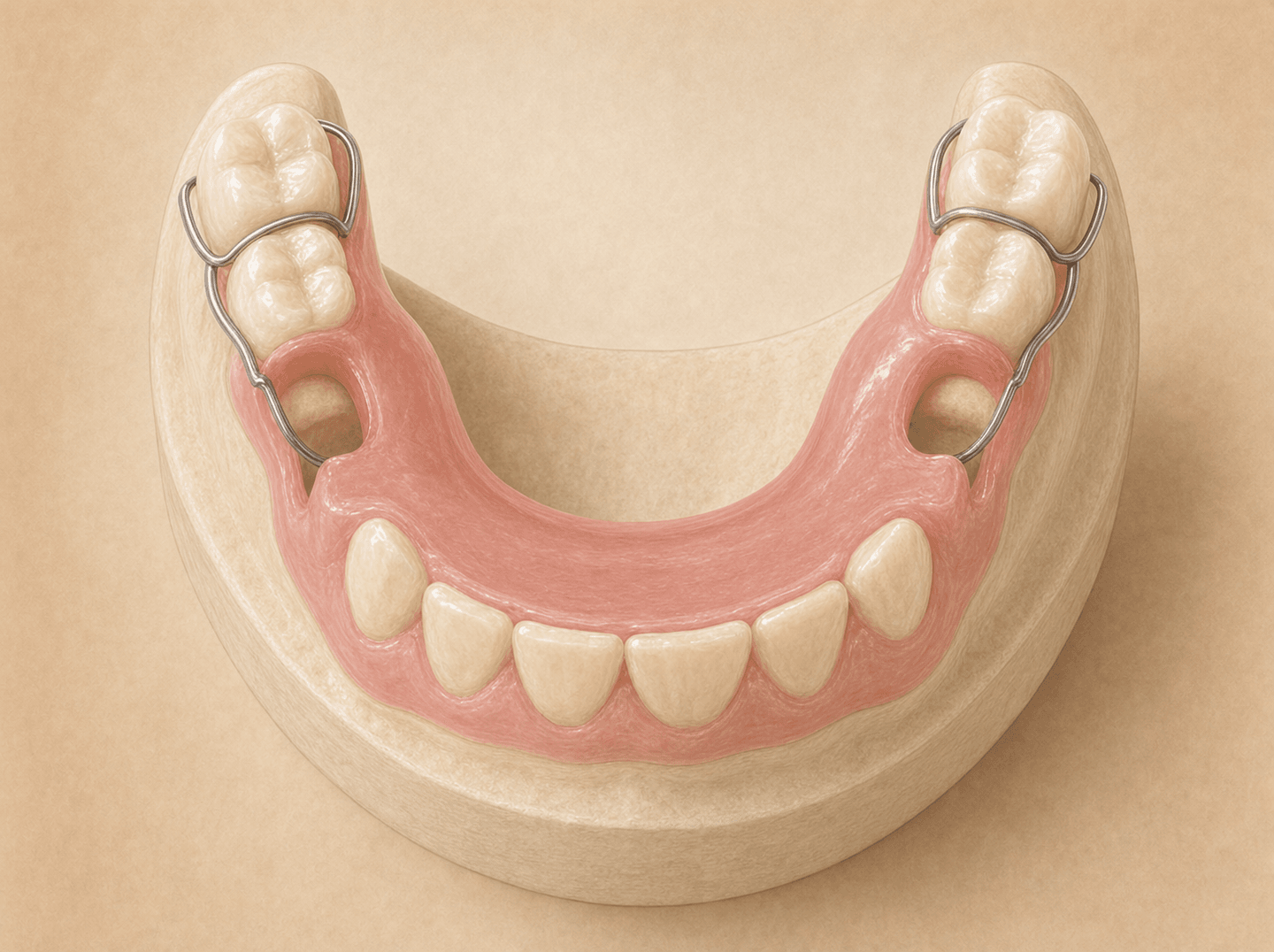
What D1527 reports
D1527 reports a single removable appliance that holds space on both sides of the mandibular arch. It is typically an acrylic body inside the lower arch, behind the teeth, with wire clasps on the remaining back teeth. It holds the gaps from primary teeth lost early on the left and right until the permanent successors erupt. It is passive and billed once for the arch.
It is the removable counterpart of D1517. The full space-maintainer grid is on the D1510 page.
D1527 or the lower lingual holding arch
On the lower arch, the fixed bilateral option is the lower lingual holding arch, billed as D1517. Delta Dental of Michigan’s 2026 criteria name it as the fixed bilateral lower appliance, and Aetna’s space maintenance policy notes it may be used after early loss of the primary lower canines. It doesn’t depend on the child wearing it, so expect a reviewer to ask why it wasn’t used.
Delta Dental of Michigan places removable maintainers in the gap where several primary teeth are lost and no fixed design is a good fit, and flags cooperation as the challenge. A D1527 claim reads best when the chart answers the obvious question: why not D1517? Missing or unsound teeth to band on one side, or a span the lingual arch couldn’t hold, are the kinds of reasons that belong in the note.
Lower front teeth
Lost lower primary incisors rarely justify a maintainer on their own. Aetna says early loss of a front tooth usually holds its own space, and Delta Dental of Michigan treats lost primary incisors as a not-necessary trigger unless the loss came before the primary canines erupted or the front of the arch is crowded. CDT names no code for a child’s tooth-replacing appliance, so this is coding judgment: if a lower appliance mainly replaces missing teeth rather than holding space, a partial denture code such as the interim lower partial, D5821, describes it better. Ask the plan which code it expects; coverage for a child is plan-dependent.
Limits, fees, and follow-up
Nevada Medicaid’s March 2026 coverage table allows D1527 for patients under 21 at two units from any provider and one unit per 12 months. South Dakota Medicaid’s children’s fee schedule effective July 1, 2026 lists it at $239.05, below the $318.85 it pays for D1517. Commercial plans set their own terms.
The lower bilateral follow-up codes don’t apply. D1552 re-cements a bilateral lower maintainer and D1558 removes a fixed one; a removable appliance is never cemented or fixed in place. A lost appliance is remade as a new D1527 against the plan’s frequency limit, and a repair has no family code, only the by-report D1999, which some payers discourage. The D1520 page covers lost and broken appliances in more detail.
FAQs
- What is the difference between D1527 and D1517?
- Retention. Both hold space on both sides of the lower arch. D1517 is fixed, most often a lower lingual holding arch banded to back teeth on each side. D1527 is an appliance the patient takes out, an acrylic piece with clasps that sits inside the lower arch.
- Is a removable lower space maintainer billed per quadrant?
- No. D1527 is one unit for the mandibular arch. Two separate removable lower appliances, one on each side, would be two units of D1520 with their quadrants. One appliance holding both sides is a single D1527.
- Why would a plan question D1527?
- Usually because the chart doesn't explain why a removable appliance was chosen over the fixed lingual holding arch, or because cooperation is in doubt. Delta Dental of Michigan describes removable maintainers as the option when several primary teeth are lost and no fixed design works well, and it can find a maintainer inadvisable when hygiene or cooperation is poor. Document the reason for removable and the lost teeth, with a radiograph.
- Do D1552 or D1558 apply to a removable lower space maintainer?
- No. D1552 re-cements or re-bonds a bilateral lower maintainer, and D1558 removes a fixed bilateral lower maintainer. Neither fits an appliance the patient takes out.
Related codes
Need help billing this code?
We handle D1527 claims daily.
If your team is spending time on denials, narratives, or carrier follow-up for this code, our dental insurance verification service can take it off your plate. We submit the claims, post what comes back, and follow up on anything unpaid.
“Claims, posting, denials, all of it gets handled, and it costs far less than hiring another employee. My front desk got hours of their week back, and honestly I just don't think about billing anymore.”
CDT codes are maintained by the American Dental Association. This page is an editorial billing guide, not the official ADA code descriptor. Verify current coverage policies with each carrier before submitting claims.