D1520 is the CDT code for a removable space maintainer that holds space on one side of one arch, reported once per quadrant treated.
- When to use: The child can take the appliance out, and it holds space in a single quadrant after early loss of primary teeth.
- When not to use: A cemented one-sided appliance is D1510, and one removable appliance holding both sides is D1526 upper or D1527 lower.
- Billing note: A lost or broken removable maintainer has no replacement or repair code, so confirm the plan's replacement frequency before remaking it.
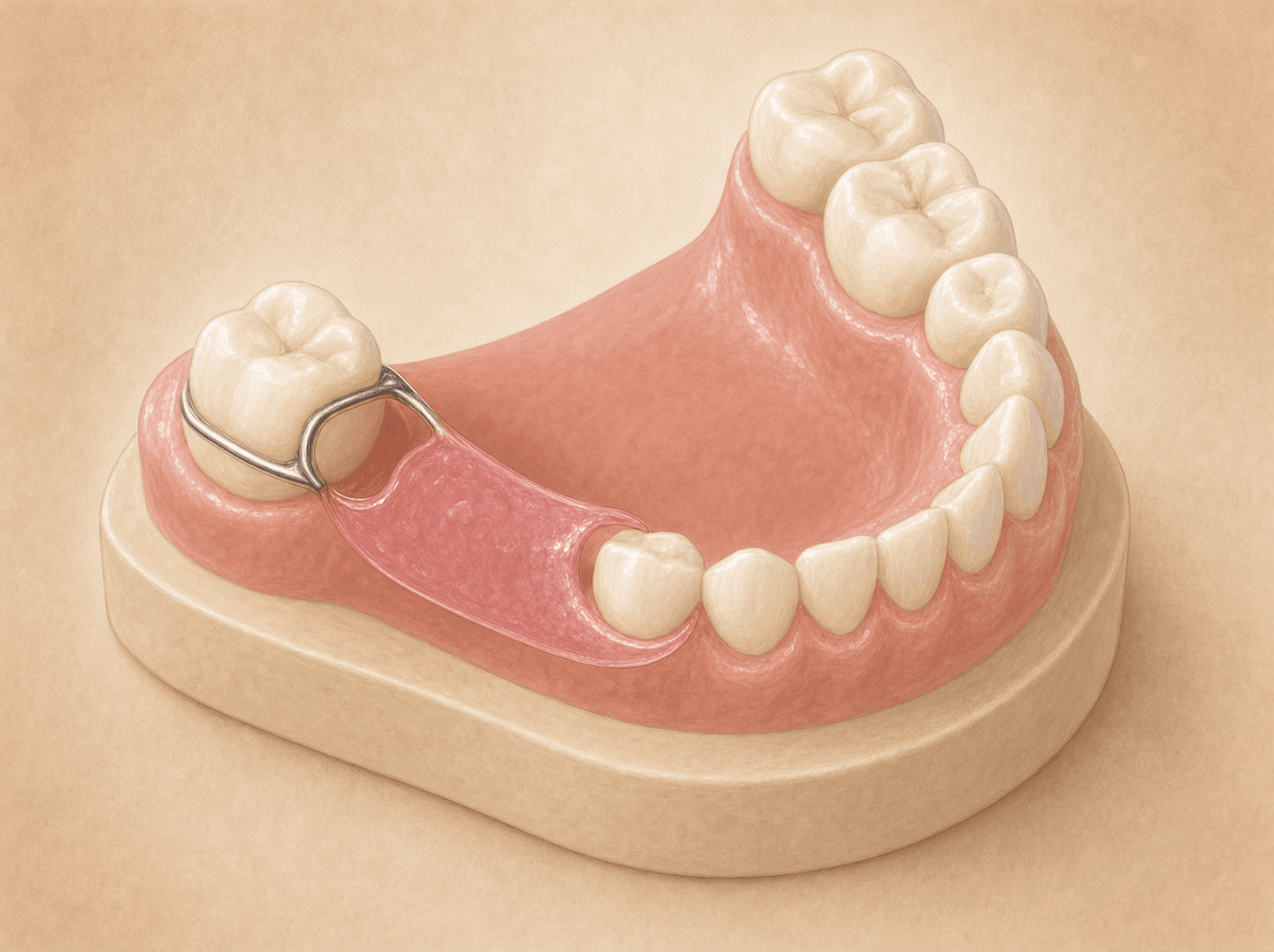
What D1520 reports
D1520 reports a removable space maintainer on one side of one arch. It is usually an acrylic plate with wire clasps on the teeth next to the gap, sometimes with a wire or acrylic stop that sits in the space. The child takes it out to clean it and puts it back in. Like every space maintainer, it is passive: it holds the gap left by an early-lost primary tooth so the permanent successor has room to erupt, and it does not move teeth.
The code sits in the removable branch of the space-maintainer family. The fixed, one-sided version is D1510, and the D1510 page lays out the full family grid. The axis between the two is retention, cemented versus removable, not the patient’s age or the tooth that was lost.
Why a removable maintainer gets chosen
Fixed designs are the usual choice. Delta Dental of Michigan’s 2026 clinical criteria describe the removable types as the option when several primary teeth are lost and there is no good fixed design. A band-and-loop needs a sound abutment tooth next to the gap. When the abutment is missing or has a poor prognosis, or the space spans more than one tooth, a removable appliance can still hold it.
The same criteria name the tradeoff: the appliance only works when the child wears it. Delta Dental of Michigan lists poor hygiene, oral habits, and inability to cooperate as reasons a maintainer may be judged inadvisable. UnitedHealthcare’s 2026 space maintenance policy lists non-compliance as a contraindication. On a reviewed claim, the chart should say why the dentist chose removable and that the parent was told the appliance has to be worn.
Counting units: per quadrant
D1520 is scoped per quadrant, the same as D1510. Report one unit for each quadrant where a removable appliance holds space, with the quadrant on each line.
- One appliance, one quadrant: one unit of D1520.
- Two separate appliances in two quadrants: two units, each with its own quadrant designation. Two lines without distinct quadrants read as a duplicate.
- One appliance holding space on both sides of an arch: not two units of D1520. That is D1526 for the upper arch or D1527 for the lower.
A removable plate covers the palate or sits along the lingual of the lower arch, so its acrylic often crosses the midline even when it holds space on one side only. The descriptors don’t say whether “unilateral” describes where the appliance sits or where it holds space, and payers can read it by design: Blue Cross Blue Shield of Arizona Health Choice’s space maintainer criteria (D0019) cover a fixed bilateral appliance for the loss of both primary molars in a single quadrant. When a one-sided plate could be read as bilateral, ask the plan which code it expects and name the quadrant held in the narrative.
Payers apply limits to the unit count. Nevada Medicaid’s March 2026 coverage table, for example, allows D1520 for patients under 21 at four units from any provider and two units per 12 months. Some plans also collapse two quadrants in one arch into a single bilateral benefit: Envolve’s space maintainer policy (CP.DP.38) makes the bilateral code the approved benefit when teeth are missing in both quadrants of the same arch. Commercial plans set their own age and frequency rules.
When the appliance is lost, broken, or done
This is where removable maintainers differ most from fixed ones on the billing side. The family’s follow-up codes all assume something cemented in the mouth.
- No removal code. D1556, D1557, and D1558 are written for fixed maintainers only. When the permanent tooth erupts and the child stops wearing a removable appliance, there is nothing to report.
- No re-cement code. D1553 re-cements or re-bonds a unilateral maintainer, which a removable plate never is.
- Lost appliance. A remake is a new D1520, because CDT has no replacement code for a space maintainer. The remake is subject to the plan’s D1520 frequency, and a second unit inside the window can deny. Check the limit before sending the new case to the lab, and get the parent’s agreement to pay if it falls outside. Some payers won’t pay the placing office for a replacement at all: Blue Cross Blue Shield of Arizona Health Choice denies a lost or damaged space maintainer remade by the same provider, citing the AHCCCS lifetime warranty.
- Broken clasp or cracked acrylic. The space-maintainer family has no repair code. An office that reports a repair is left with D1999, the unspecified preventive procedure, by report with a narrative; whether a plan pays it or treats the repair as part of the original fee varies. UnitedHealthcare lists D1999 in its space maintenance policy (DCP035.11), but Aetna’s policy says unspecified codes should be avoided. Ask the plan before billing it.
- Adjustments. None of the space-maintainer codes describes an adjustment. Delta Dental of Michigan expects maintainers to be monitored over time (abutment teeth, how well the appliance works, and the permanent teeth developing beneath), so the recheck visit belongs in the chart even when no procedure code goes on the claim.
Removable appliances that are not D1520
A removable maintainer can look like other children’s appliances. The code follows what the appliance is for.
- A Hawley-style plate holding space. Aetna’s space maintenance policy lists a Hawley-type appliance as one removable option after early loss of primary molars. Used that way, it is D1520 (or D1526 or D1527 when it holds both sides).
- A retainer after braces. Retention at the end of orthodontic treatment is D8680, and Delta Dental of Michigan treats it as part of comprehensive orthodontics, not as space maintenance.
- A habit appliance. A removable appliance to stop thumb sucking or tongue thrusting is D8210, in the orthodontic category, often under the plan’s ortho benefit.
Fee context
Removable maintainers usually carry a lower allowable than fixed ones. South Dakota Medicaid’s children’s fee schedule effective July 1, 2026 lists D1520 at $189.70 against $260.07 for the fixed D1510. Commercial schedules differ, but a D1520 paid at the D1510 rate, or the reverse, is worth checking against what was actually delivered.
FAQs
- How many units of D1520 do I bill?
- One per quadrant the appliance holds space in. A removable maintainer for one quadrant is one unit with that quadrant on the line. Two separate removable appliances in two quadrants are two units, each with its own quadrant. One removable appliance that holds space on both sides of an arch is not two units of D1520; it is D1526 for the upper arch or D1527 for the lower.
- What is the difference between D1520 and D1510?
- Retention. D1510 is cemented or bonded in place, and D1520 is an appliance the patient can take out. Both are one-sided and per quadrant. The patient's age and which tooth was lost don't decide between them.
- Can I bill D1556 when a removable space maintainer comes out for good?
- No. D1556, D1557, and D1558 are removal codes for fixed maintainers only. A removable appliance is simply taken out, so there is no removal procedure to report.
- The patient lost the removable space maintainer. How do I bill the new one?
- A new appliance is reported as a new D1520. CDT has no separate replacement code for a space maintainer, so the remake runs into the plan's frequency limit for D1520. Nevada Medicaid, for example, allows two units per 12 months. Check the limit before the lab case goes out, and if the remake falls outside it, collect the patient's agreement to pay first.
- Is a removable space maintainer the same as a Hawley retainer?
- It can look like one, and Aetna's space maintenance policy lists a Hawley-type appliance as a removable option after early loss of primary molars. The code follows the purpose. Holding space for an unerupted permanent tooth is D1520. A retainer at the end of orthodontic treatment is ortho retention, D8680, and a habit appliance is D8210.
Related codes
Need help billing this code?
We handle D1520 claims daily.
If your team is spending time on denials, narratives, or carrier follow-up for this code, our dental insurance verification service can take it off your plate. We submit the claims, post what comes back, and follow up on anything unpaid.
“Claims, posting, denials, all of it gets handled, and it costs far less than hiring another employee. My front desk got hours of their week back, and honestly I just don't think about billing anymore.”
CDT codes are maintained by the American Dental Association. This page is an editorial billing guide, not the official ADA code descriptor. Verify current coverage policies with each carrier before submitting claims.