D1517 is the CDT code for a fixed space maintainer spanning both sides of the lower arch, most often a lower lingual holding arch.
- When to use: A lower lingual holding arch or other single fixed appliance holds space on both sides of the lower arch, reported once with no quadrant.
- When not to use: The upper arch is D1516, separate one-sided appliances are D1510 per quadrant, and a removable lower appliance spanning both sides is D1527.
- Billing note: Some plans require the lower permanent incisors erupted before they pay D1517, so chart incisor status and the wire's position.
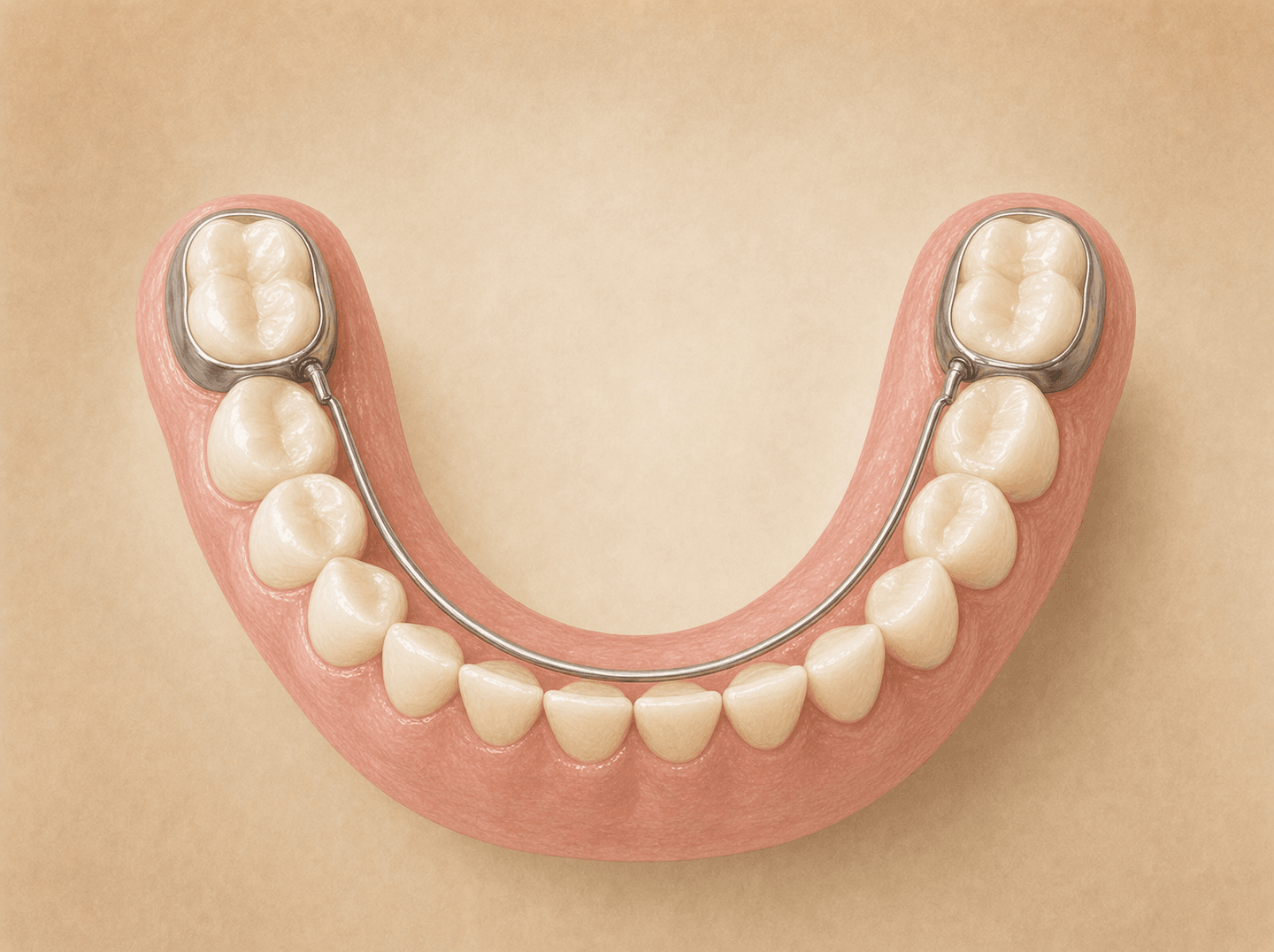
The lower lingual holding arch is D1517
A lower lingual holding arch (often LLHA, or just lingual arch) is billed as D1517. It is the fixed bilateral space maintainer for the mandibular arch: bands on the two lower permanent first molars, joined by a wire that runs along the tongue side of the lower front teeth. Aetna’s dental policy bulletin 033 (reviewed July 2025) lists it among the fixed options as a passive lingual arch. Delta Dental of Michigan’s 2026 criteria list it as the lower member of the fixed bilateral group, alongside the upper Nance appliance and transpalatal arch (D1516).
D1517 is reported once per appliance. The code names the arch, so there is no quadrant on the claim line.
When a lingual holding arch is the right claim
Two patterns lead to a lower lingual holding arch:
- Primary molars lost on both sides of the lower arch, with the permanent first molars in to carry the bands.
- Early loss of the lower primary canines. Aetna’s bulletin notes that this often follows large permanent incisors or ectopic eruption, can let the incisors shift sideways and throw off the midline, and that a fixed lingual holding arch may help keep the arch intact and stop the incisors tipping toward the tongue.
The appliance does not have to answer tooth loss on both sides. Blue Cross Blue Shield of Arizona Health Choice (policy D0019, reviewed October 2026) also covers D1517 when both primary molars are lost on one side, once the eruption conditions below are met. A lower lingual arch is reported as D1517 because one appliance spans the arch, even if the missing teeth are all on the left.
The incisor eruption trap
The wire sits just behind the lower front teeth. If the permanent incisors haven’t erupted, it can sit in their path. Arizona’s criteria apply that incisor check to D1517 only, not to the upper appliance.
Blue Cross Blue Shield of Arizona Health Choice covers D1517 only when both lower permanent first molars and all four lower permanent incisors have erupted. It makes an exception when documentation shows the design allows the incisors to erupt, such as a wire placed lingual to them. Delta Dental of Michigan lists an appliance that obstructs permanent tooth eruption as a reason placement may be found not clinically appropriate.
The same Arizona policy routes the earliest lower case away from D1517 altogether. When the first primary molars are lost on both sides before the lower permanent incisors erupt, its criteria point to D1510 in each quadrant, provided the second primary molar and primary canine are still in place on each side.
One D1517 or two D1510 units
When primary molars are missing on both sides of the lower arch, the dentist can place one lingual arch or two separate band-and-loop appliances (D1510, one per quadrant). Code the appliance that was cemented.
Plans split on which design they pay; the D1516 page compares the Michigan and Arizona rules. On the lower arch the incisors also shape the choice, as in the Arizona routing above. Maryland Medicaid’s 2026 schedule (revised August 18, 2026) shows why the plan cares about the design: $151.91 for D1517 against $88.62 for each D1510, or $177.24 for two.
Ask at verification which design the plan pays, before the appliance is ordered.
Later visits on the same appliance
- Loose lingual arch. Re-cementing or re-bonding it is D1552, the lower bilateral re-cement code.
- Removing it. Taking out a fixed lower bilateral maintainer is D1558. The unilateral removal code, D1556, is for a band-and-loop or other one-sided appliance, not a lingual arch.
- Removable instead of fixed. A removable lower appliance spanning both sides is D1527.
Whether re-cement or removal pays on its own is plan-dependent. DC 37’s Delta Dental code list (effective February 2024) caps D1552 at once in 12 months and pays D1558 only on professional determination, both for children under 14. Maryland Medicaid’s 2026 schedule doesn’t list D1552 or D1558 at all, though it carries the unilateral D1553 and D1556.
Documentation and common denials
Delta Dental of Michigan asks for diagnostic radiographs of the areas of tooth loss that show the developing permanent teeth and the abutment molars, plus a diagnostic rationale from the record. For D1517, add the incisor eruption status and the teeth lost on each side.
Denials that come up on this code:
- Lower incisors not erupted, with nothing in the record about wire position.
- Lower permanent first molars not erupted, so there is nothing to band.
- Successor eruption imminent on the radiograph, or the space already lost and needing active regaining rather than maintenance.
- Bilateral default or alternate design. The plan pays a different design than the one billed.
- Age or frequency limits, which vary by plan.
FAQs
- What is the dental code for a lower lingual holding arch?
- D1517, the fixed bilateral space maintainer for the mandibular arch. The same code covers any single fixed appliance that holds space on both sides of the lower arch, whether the office calls it an LLHA, a lingual arch, or a passive lingual arch.
- Is D1517 billed per quadrant?
- No. D1517 is reported once per appliance, and the lower arch is part of the code. There is no quadrant on the line. Per-quadrant reporting belongs to the unilateral codes such as D1510.
- Can D1517 be billed when teeth are missing on only one side?
- Yes, if a bilateral appliance was placed. Blue Cross Blue Shield of Arizona Health Choice, for example, covers D1517 when both primary molars are lost on one side once both lower permanent first molars and the lower permanent incisors are in. The code follows the appliance, not the number of sides with missing teeth.
- Why was D1517 denied when the lower incisors had not erupted?
- A lingual wire can sit in the path of erupting incisors, and some plans won't pay until they are in. Blue Cross Blue Shield of Arizona Health Choice makes an exception when the record shows the wire positioned lingual to the erupting incisors. Delta Dental of Michigan lists an appliance that blocks eruption as a reason it may find placement not clinically appropriate.
- What are the re-cement and removal codes for a lower lingual arch?
- Re-cementing or re-bonding it is D1552, and removing it is D1558. Both are lower-arch bilateral codes. Separate payment for either depends on the plan, and some plans review removal case by case.
- Should we bill D1517 or two D1510 units?
- Bill what was cemented. One wire joining both lower molars is one D1517; two separate band-and-loop appliances are two D1510 units, each with its quadrant. Some plans accept either design and some default to the bilateral appliance, so verify the plan's rule before treatment.
Related codes
Need help billing this code?
We handle D1517 claims daily.
If your team is spending time on denials, narratives, or carrier follow-up for this code, our dental insurance verification service can take it off your plate. We submit the claims, post what comes back, and follow up on anything unpaid.
“Claims, posting, denials, all of it gets handled, and it costs far less than hiring another employee. My front desk got hours of their week back, and honestly I just don't think about billing anymore.”
CDT codes are maintained by the American Dental Association. This page is an editorial billing guide, not the official ADA code descriptor. Verify current coverage policies with each carrier before submitting claims.