D4210 is the CDT code for surgically removing or reshaping gum tissue on four or more adjacent teeth or tooth gaps in one quadrant, without removing bone.
- When to use: Soft-tissue gum surgery for periodontal reasons, such as suprabony pockets or overgrowth, on four or more contiguous sites in a quadrant.
- When not to use: One to three teeth is D4211, access for one tooth's restoration is D4212, and bone reshaping is D4260 or D4261, or D4249 for crown lengthening.
- Billing note: Attach the perio chart with pocket depths and a diagnosis, and do not bill it on the same quadrant and date as D4341 or D4342.
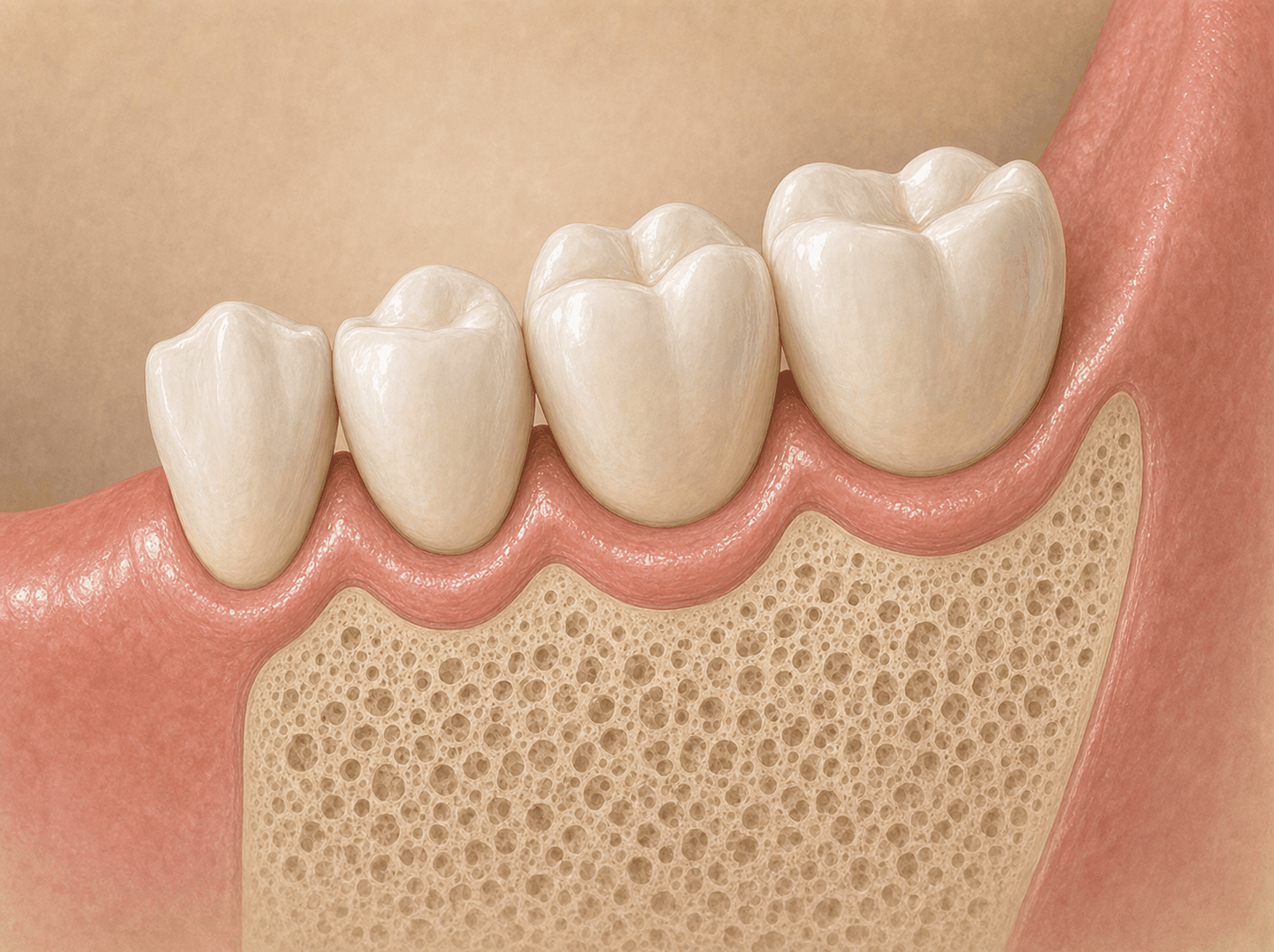
What D4210 covers
D4210 reports a gingivectomy or gingivoplasty on four or more contiguous teeth, or tooth-bounded spaces, within a single quadrant. The dentist removes excess or diseased gum tissue (gingivectomy) or reshapes the gingival contour (gingivoplasty) to eliminate suprabony pockets, reduce overgrown tissue, or restore healthier gum architecture. The code covers the tissue removal or recontouring in that quadrant and the immediate site management.
Two facts separate it from its neighbors:
- It is scoped by count and quadrant. Four or more contiguous teeth or tooth-bounded spaces in one quadrant. Fewer than that is D4211.
- It is soft tissue only. Once the procedure reshapes bone, it is osseous surgery, not gingivectomy.
A tooth-bounded space, an edentulous gap with a natural tooth on each side, counts toward the total the same way a tooth does. A quadrant with three teeth and one bounded space treated reaches the four-site threshold for D4210.
The count axis: D4210 vs D4211
D4210 and D4211 are the same procedure. The count of contiguous teeth or tooth-bounded spaces treated in the quadrant is the only difference, and the most common miscode.
- D4210: four or more contiguous teeth or tooth-bounded spaces per quadrant.
- D4211: one to three contiguous teeth or tooth-bounded spaces per quadrant.
Each quadrant is coded on its own. A patient treated at four sites in one quadrant and two in another generates a D4210 for the first quadrant and a D4211 for the second, each reported with its quadrant.
What D4210 is not
Three neighbors get confused with D4210. Separate them by what tissue was involved and why.
- Osseous surgery (D4260 / D4261). Osseous surgery elevates a full-thickness flap and reshapes the underlying bone. If the bone was recontoured, the procedure is D4260 (four or more teeth) or D4261 (one to three teeth). The two families sit near each other on a fee schedule and pay at different rates.
- Clinical crown lengthening, hard tissue (D4249). D4249 reshapes bone to expose more sound tooth structure for a restoration, usually with a healing period before the crown is prepped. D4210 is soft tissue done for periodontal reasons, not to set up a specific restoration.
- Gingivectomy for restorative access, per tooth (D4212). D4212 is also soft-tissue gingivectomy, but it is reported per tooth and only when the purpose is to reach a single tooth for a restoration, such as exposing a crown margin. It is frequently not separately payable when the same dentist preps the restoration. Periodontal treatment across a quadrant is D4210 or D4211.
When to bill D4210
Bill D4210 for a soft-tissue gingivectomy or gingivoplasty on four or more contiguous teeth or tooth-bounded spaces in one quadrant. Common clinical situations:
- Suprabony periodontal pockets across a quadrant that did not resolve with non-surgical therapy, where removing the pocket wall improves the patient’s access to clean.
- Gingival enlargement or hyperplasia (for example, drug-influenced overgrowth) that needs to be reduced across several adjacent teeth.
- Irregular gingival architecture across a quadrant that needs recontouring to a maintainable form.
Sequencing: non-surgical therapy comes first
Most plans and most clinical guidelines expect non-surgical periodontal therapy before surgery. Scaling and root planing, D4341 (four or more teeth per quadrant) and D4342 (one to three teeth per quadrant), is that non-surgical phase. It is therapeutic, not a routine prophylaxis, and is typically completed and re-evaluated before D4210 is appropriate.
What this means for billing:
- D4341 or D4342 and D4210 on the same quadrant on the same date will usually bundle or deny.
- The expected sequence is SRP, then a re-evaluation (a re-eval visit, or periodontal maintenance D4910 once the patient is in maintenance), then gingivectomy on the sites that didn’t respond.
- A D4210 claim is stronger when the chart shows SRP was done, the tissue was re-evaluated, and surgery was indicated for residual pockets or persistent overgrowth.
The documentation that gets D4210 paid
Carriers that cover gingivectomy treat it as a medical-necessity procedure, not an automatic benefit. The claim is stronger when it carries these:
- A current periodontal chart. Pocket depths per tooth, ideally before and after the non-surgical phase, showing the residual pockets that justify surgery. The chart establishes the diagnosis and, by listing the treated teeth, supports the count. A D4210 claim without one is the most common reason these pend or deny for “documentation required.” Attach it to the claim, not just the patient record.
- A diagnosis. Periodontal disease, gingival enlargement or hyperplasia, or another periodontal indication. Cosmetic framing gets the claim excluded on most plans.
- Current radiographs. Many plans want recent films to confirm the periodontal picture. The absence of bone defects requiring surgery also supports that this was a soft-tissue procedure.
- The count and quadrant, stated clearly. Which quadrant, and the four or more contiguous teeth or tooth-bounded spaces treated.
- A short narrative. One or two sentences naming the indication, the non-surgical therapy that preceded it, and that the procedure was soft-tissue gingivectomy or gingivoplasty without bone removal.
Coverage reality: plan-dependent
Whether D4210 pays varies by plan. Patterns to expect, none of them universal:
- Medical-necessity plans. Coverage requires a documented periodontal diagnosis, perio charting, and radiographs. Without them the claim denies for missing necessity.
- Frequency limits per quadrant. Many plans limit periodontal surgery on a quadrant to once within a defined window. A repeat D4210 inside that window denies for frequency.
- Cosmetic exclusions. Gum reshaping for esthetics, with no periodontal indication, is excluded on most plans however it is coded.
- Bundling with restorative access. When the gingivectomy is done only to access a tooth for a restoration by the same dentist, plans often treat it as inclusive (the per-tooth D4212 situation) and won’t pay it separately.
When the patient asks about cost, verify the specific plan before surgery and set the out-of-pocket estimate against that plan’s rules.
Example case
A 58-year-old patient completed scaling and root planing in the lower left quadrant (D4341) three months ago. At the periodontal re-evaluation, the chart shows residual suprabony pockets of 5 to 6 mm on teeth #18, #19, #20, and #21, with tissue overgrowth the patient can’t clean around. Radiographs show no bone defects requiring osseous surgery. The periodontist performs a soft-tissue gingivectomy across those four contiguous teeth to eliminate the pocket walls and recontour the gingiva. No bone is removed.
Billing for the visit:
- D4210 (gingivectomy/gingivoplasty, four or more contiguous teeth per quadrant), reported on the lower left quadrant for teeth #18 through #21.
- Attach the periodontal chart showing the residual pocket depths, the diagnosis, and recent radiographs.
- A one-line narrative: “Soft-tissue gingivectomy, lower left quadrant, teeth #18 to #21, for residual suprabony pockets after completed SRP and re-evaluation. No osseous involvement.”
Four contiguous teeth in one quadrant makes this D4210, not D4211. No bone was reshaped, so it is not D4260. And because the procedure was periodontal treatment across the quadrant rather than access for a single restoration, it is not D4212.
FAQs
- What is the dental code for a gingivectomy?
- It depends on how many teeth in the quadrant are treated. D4210 is the gingivectomy or gingivoplasty code for four or more contiguous teeth or tooth-bounded spaces in a single quadrant, and D4211 is the same procedure for one to three. D4212 is a per-tooth gingivectomy performed only to allow access for a restorative procedure. Confirm the count and the quadrant from the perio chart before you post.
- What's the difference between D4210 and D4211?
- The number of teeth treated in the quadrant. D4210 is for four or more contiguous teeth or tooth-bounded spaces in one quadrant, and D4211 is for one to three. The procedure is otherwise the same. A tooth-bounded space (an edentulous gap with a tooth on each side) counts toward the total the same way a tooth does. Billing D4210 when only three teeth were treated, or splitting a four-tooth quadrant into D4211 claims, invites denials.
- Is D4210 the same as osseous surgery?
- No. D4210 is soft tissue only: the dentist removes or recontours gum tissue to eliminate suprabony pockets or excess tissue, with no bone removal. Osseous surgery, D4260 (four or more teeth) and D4261 (one to three teeth), elevates a flap and reshapes the underlying bone. If bone was recontoured, it isn't D4210. A gingivectomy claim with an osseous-surgery narrative, or the reverse, gives a reviewer a reason to deny.
- Does insurance cover D4210?
- It depends on the plan and the documentation. Plans that cover gingivectomy generally want evidence of medical necessity: a periodontal chart showing pocket depths, a diagnosis such as periodontal disease or gingival enlargement, and often current radiographs. Purely cosmetic gum reshaping is usually excluded. Many plans also apply a frequency limit per quadrant, and won't pay D4210 separately when it's performed only to access a tooth for a crown or filling, which is the per-tooth D4212 situation. Verify the specific plan and submit the perio chart with the claim.
- Can I bill D4210 in the same quadrant as scaling and root planing?
- Not usually on the same date, and often not within a plan's defined window. Scaling and root planing (D4341 for four or more teeth, D4342 for one to three) is non-surgical periodontal therapy that most plans expect to be completed and re-evaluated before gingivectomy. D4341 and D4210 on the same quadrant the same day commonly bundle or deny. The typical sequence is SRP, a re-evaluation (a re-eval visit, or periodontal maintenance D4910 once the patient is in maintenance), then surgery on the sites that didn't resolve.
- How is D4210 different from crown lengthening?
- Crown lengthening reshapes tissue to expose more sound tooth structure for a restoration, and the surgical version, D4249, removes bone. D4210 is soft-tissue gingivectomy for periodontal reasons such as suprabony pockets or tissue overgrowth, with no bone removal. D4212 is a per-tooth soft-tissue gingivectomy done specifically to access a tooth for a restoration. D4249 usually requires a healing period before the crown prep, while D4212 is often not separately payable when the same dentist preps the crown.
Related codes
Need help billing this code?
We handle D4210 claims daily.
If your team is spending time on denials, narratives, or carrier follow-up for this code, our outsourced dental insurance billing service can take it off your plate. We submit the claims, post what comes back, and follow up on anything unpaid. Already sitting on older claims that never paid? Our AR cleanup project works the backlog.
“Claims, posting, denials, all of it gets handled, and it costs far less than hiring another employee. My front desk got hours of their week back, and honestly I just don't think about billing anymore.”
CDT codes are maintained by the American Dental Association. This page is an editorial billing guide, not the official ADA code descriptor. Verify current coverage policies with each carrier before submitting claims.