D4261 is the CDT code for reshaping the bone around one to three adjacent teeth or tooth gaps in a single quadrant, work on periodontally damaged supporting bone with the flap entry and the closure built into the fee.
D4261 and D4260 cover the same osseous surgery, so the number of teeth treated in a single quadrant is what decides which code the claim carries. Three teeth treated in one quadrant and three in the next are two separate D4261 lines, not one D4260, and an edentulous tooth-bounded space counts toward the tally the same as a natural tooth.
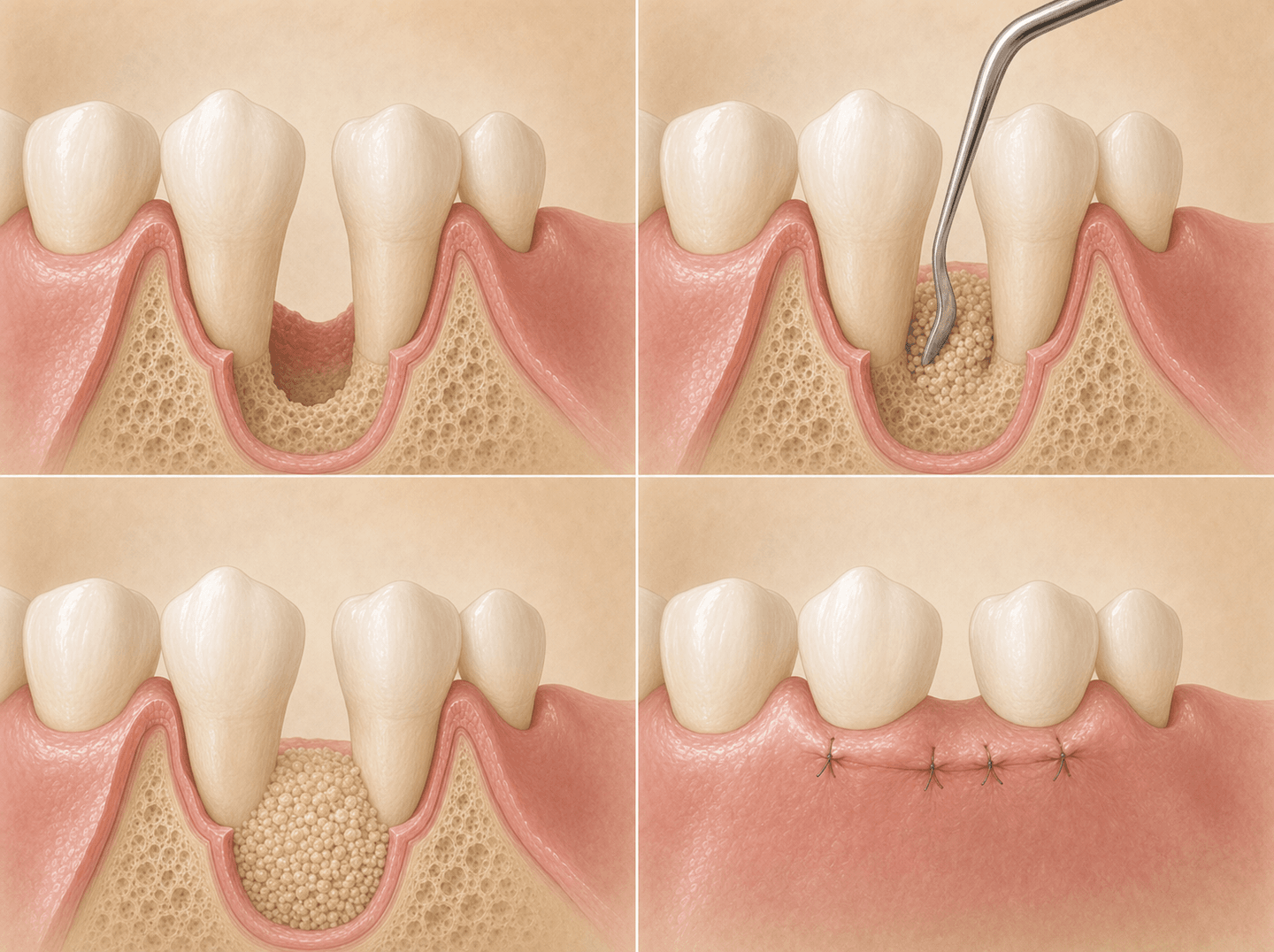
What D4261 covers
D4261 reports osseous surgery on one to three contiguous teeth or tooth-bounded spaces within a single quadrant. Osseous surgery treats the bone around teeth damaged by periodontal disease. The surgeon raises a full-thickness flap to reach the bone, reshapes or removes the diseased and irregular bone so the tissue can heal against a cleaner form, then closes the flap. The fee includes the flap entry and the closure, so neither is billed separately.
The one-to-three part is the extent. Count the contiguous teeth or tooth-bounded spaces treated in the quadrant. One, two, or three is D4261. Four or more in the same quadrant is D4260.
D4261 does not cover:
- The same surgery on four or more teeth in a quadrant. That is D4260.
- A flap raised for access and root cleaning without recontouring bone. That is the gingival flap procedure, D4241 (one to three teeth) or D4240 (four or more teeth).
- Nonsurgical scaling and root planing. That is D4342 (one to three teeth) or D4341 (four or more teeth).
- A gingivectomy or gingivoplasty, which removes or reshapes soft tissue and does not touch bone. That is D4211 (one to three teeth) or D4210 (four or more teeth).
When to bill D4261
Bill D4261 when:
- Osseous surgery is performed on one to three contiguous teeth or tooth-bounded spaces in one quadrant.
- Bone is reshaped or removed as part of the procedure, not just accessed.
- The periodontal charting and diagnosis support surgical treatment on those localized sites.
Do not bill D4261 for:
- Four or more teeth in the quadrant. Use D4260.
- A flap procedure that does not recontour bone. Use D4241 or D4240.
- Scaling and root planing with no surgery. Use D4342 or D4341.
- A soft-tissue gingivectomy. Use D4211 or D4210.
The count axis: one to three per quadrant
D4261 and D4260 describe the identical procedure. The only thing that separates them is how many teeth or tooth-bounded spaces are treated in the quadrant:
- D4261 is one to three contiguous teeth or tooth-bounded spaces per quadrant.
- D4260 is four or more contiguous teeth or tooth-bounded spaces per quadrant.
A tooth-bounded space is an edentulous gap with a natural tooth on each side. It counts in the tally the same as a tooth, because the surgery still addresses the bone across that span. So a quadrant with two teeth and one bounded space treated is three sites, which is D4261.
Osseous surgery versus the flap and scaling codes
Three periodontal procedures sit near D4261 in the treatment sequence, and the line between them is what the procedure actually does to the tissue and bone:
- Scaling and root planing (D4342, D4341) is nonsurgical. No flap is raised. The root surfaces are cleaned below the gumline to treat active disease. This is usually the first line of treatment.
- Gingival flap with root planing (D4241, D4240) raises a flap to clean the roots under direct vision, then closes. It does not reshape bone.
- Osseous surgery (D4261, D4260) raises the same flap and then reshapes or removes bone to correct the defects periodontal disease left behind, then closes.
The distinguishing line between the flap code and the osseous code is bone recontouring. Same flap entry, same closure; osseous surgery adds the bone work. If the operative note describes osteoplasty or ostectomy, it is D4261 (or D4260 at four or more teeth). If the note stops at flap access and root debridement, it is the gingival flap code. Carriers read the operative note to confirm the code matches what was done, so the note has to name the bone work explicitly.
Top reasons D4261 gets denied or downgraded
- The tally crossed quadrants. A claim built by counting four teeth across two quadrants to reach D4260, or the reverse, does not match the charting. Reviewers pull records and reprocess against the per-quadrant count.
- No documented nonsurgical phase. Many plans require scaling and root planing (D4342 or D4341), completed and re-evaluated, before osseous surgery is eligible. A D4261 claim with no prior therapy in the record pends or denies.
- Pocket depths do not justify surgery. Carriers commonly look for pocket depths of 5 mm or greater on the treated teeth. Charting that shows shallower pockets gets the surgery denied as not medically necessary.
- Frequency limit on the quadrant or site. Plans limit how often periodontal surgery is covered on a given quadrant within a defined window. A repeat D4261 on the same quadrant inside that window denies for frequency.
- Quadrant not identified. These codes are reported per quadrant. A line with no quadrant is a predictable pend for information, especially when more than one surgical quadrant is on the claim.
Documentation that supports the claim
The claim needs:
- Recent periodontal charting, usually dated within six months, showing the pocket depths that justify surgery on the treated teeth. Many carriers look for 5 mm or greater.
- A diagnosis of periodontitis.
- The specific teeth treated and the quadrant identified.
- Radiographs showing the bone loss at the localized sites.
- Evidence that nonsurgical therapy, typically scaling and root planing, was completed and re-evaluated, and that it did not resolve the disease at those sites.
For the operative record, document the flap, the bone recontouring specifically, and the closure. The bone work is what separates D4261 from the gingival flap code, so the note has to show it. Because D4261 is the localized code, the note should also make clear which one, two, or three teeth were treated, so the count on the claim and the count in the chart agree.
Example case
A 54-year-old patient completed scaling and root planing in the upper right quadrant (D4342) four months ago. At the periodontal re-evaluation, the chart shows residual pockets of 6 mm on teeth #3 and #4 with an infrabony defect on the mesial of #3 that did not resolve. Radiographs confirm the localized bone loss. The rest of the quadrant charts within normal limits.
The periodontist raises a full-thickness flap over teeth #3 and #4, performs osteoplasty and ostectomy to recontour the defect, and closes. Two contiguous teeth in one quadrant were treated with bone recontouring.
Billing for the visit:
- Report D4261 (osseous surgery, one to three contiguous teeth per quadrant) on the upper right quadrant for teeth #3 and #4. Two teeth is one to three, so it is D4261, not D4260.
- Attach the periodontal charting showing the residual 6 mm pockets, the periodontitis diagnosis, and the radiographs of the defect.
- Add a one-line narrative: “Osseous surgery, upper right quadrant, teeth #3 and #4, for a residual infrabony defect after completed SRP and re-evaluation. Flap elevation, osteoplasty and ostectomy, and closure performed.”
- Watch the EOB for the plan’s periodontal-surgery rules. If the plan required a waiting period after SRP or caps frequency on the quadrant, confirm those were met before posting patient responsibility.
What to get right in your PMS
- Count teeth and tooth-bounded spaces per quadrant. One to three is D4261; four or more is D4260. Never tally across quadrants to reach four.
- Keep D4261 and D4260 as distinct, labeled line items. A single fuzzy “osseous surgery” entry is how the count gets miscoded. The count from the perio chart should drive which one the front desk picks.
- Make the operative note show the bone work. Bone recontouring is what separates osseous surgery from a gingival flap procedure (D4241 or D4240).
- Confirm nonsurgical therapy was done and re-evaluated first. Many plans require scaling and root planing and a waiting period before osseous surgery is eligible.
- Identify the quadrant on every surgical line. These codes are per quadrant, and multi-quadrant coverage in one visit is plan-specific.
FAQs
- What is the difference between D4261 and D4260?
- The number of teeth treated in the quadrant. D4261 covers osseous surgery on one to three contiguous teeth or tooth-bounded spaces in a quadrant. D4260 covers the same surgery on four or more. Both include flap elevation and closure in the fee, and the procedure is otherwise identical. Count the treated teeth or spaces per quadrant, then pick the code.
- Can I bill D4261 on more than one quadrant in the same visit?
- Yes, when surgery is performed in more than one quadrant. Report a separate line per quadrant with the quadrant identified, and keep the count within each quadrant at one to three. Three treated sites in one quadrant and two in another are two D4261 claims, not a single D4260. How many surgical quadrants a plan pays in one visit is plan-dependent, so verify before scheduling.
- Does D4261 include the flap and the closure, or do I bill those separately?
- They are included. The D4261 fee covers raising the full-thickness flap to reach the bone and closing it afterward, along with the bone recontouring itself. Do not bill a separate flap or suture code on top of D4261. If a bone graft or tissue regeneration material is placed in the defect, that may be a separate code depending on the procedure and the plan.
- Is D4261 the same as a gingival flap procedure?
- No. The gingival flap procedure with root planing, D4241 for one to three teeth, raises a flap to clean the root surfaces under direct vision but does not reshape bone. D4261 raises the same flap and then recontours or removes bone. If the operative note describes osteoplasty or ostectomy, it is osseous surgery. If it stops at flap access and root debridement, it is the gingival flap code.
- Does D4261 require scaling and root planing first?
- On many plans, yes. Carriers commonly expect documented nonsurgical therapy, usually scaling and root planing (D4342 for one to three teeth, D4341 for four or more), completed and re-evaluated before they will consider surgical periodontal treatment. This sequencing is plan-dependent, but a D4261 claim with no prior nonsurgical phase in the record is a frequent denial.
- What documentation do carriers want for D4261?
- Recent periodontal charting, usually within six months, showing the pocket depths that justify surgery, often 5 mm or greater on the treated teeth. Carriers also expect a periodontitis diagnosis, the specific teeth and quadrant treated, radiographs showing the bone loss, and evidence that nonsurgical therapy was tried first. Frequency limits and waiting periods vary by plan, so verify the periodontal benefit before scheduling.
Related codes
Need help billing this code?
We handle D4261 claims daily.
If your team is spending time on denials, narratives, or carrier follow-up for this code, our outsourced dental insurance billing service can take it off your plate. We work inside your PMS and post payments the same week.
CDT codes are maintained by the American Dental Association. This page is an editorial billing guide, not the official ADA code descriptor. Verify current coverage policies with each carrier before submitting claims.