D4211 is the CDT code for surgically removing or reshaping gum tissue across one to three adjacent teeth or tooth gaps in a single quadrant, a soft-tissue procedure that leaves the underlying bone untouched.
A one-to-three-tooth gingivectomy is the version carriers most often stop to check for a cosmetic exclusion, because a small gum reshaping looks identical on a claim whether it removed a diseased pocket or evened out a gum line for looks. What keeps it paid is the perio chart: it carries the count that holds the case at D4211 instead of D4210 (four or more), and the periodontal diagnosis that separates real treatment from cosmetic contouring most plans won't cover.
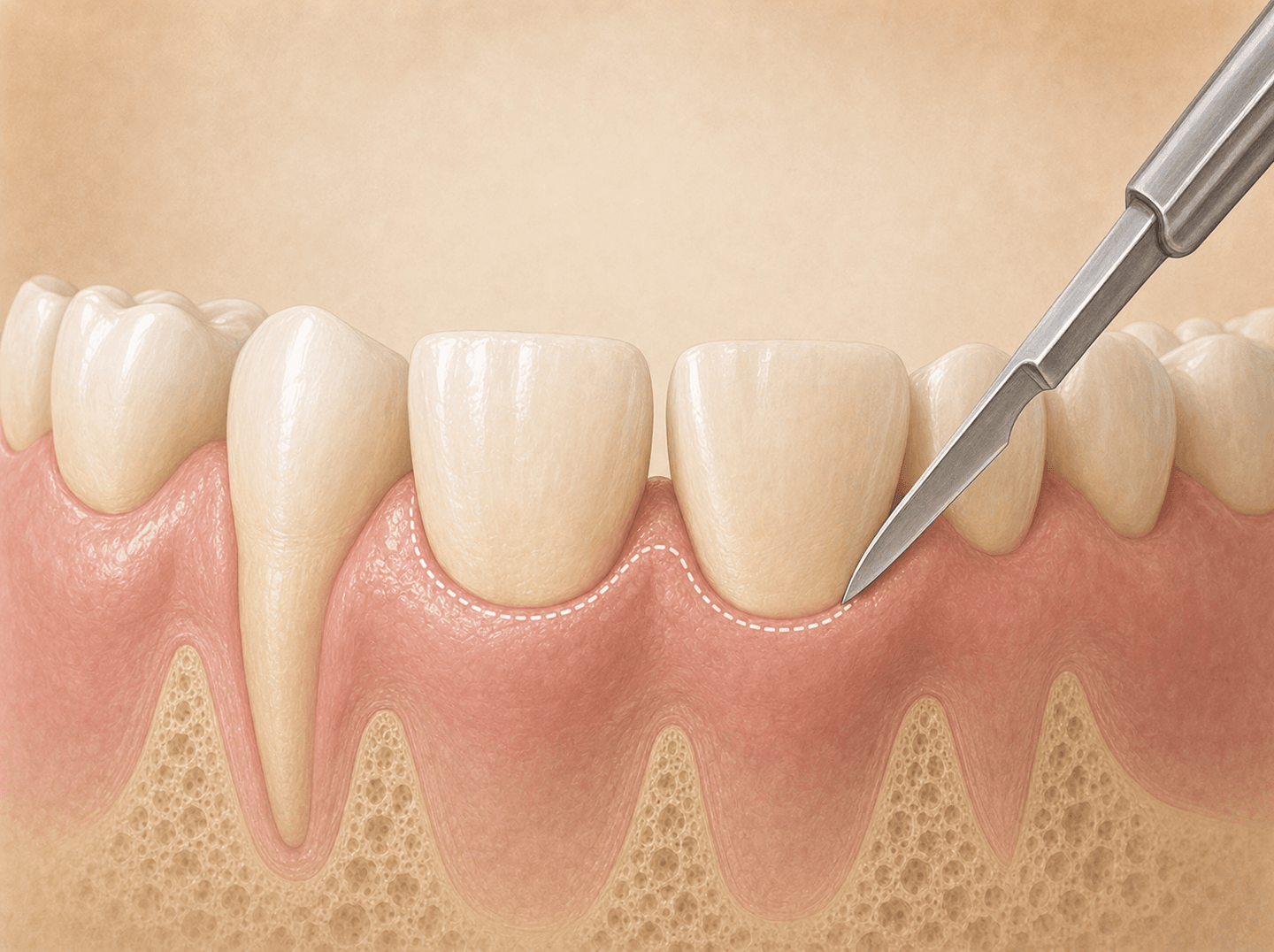
What D4211 covers
D4211 reports a gingivectomy or gingivoplasty on one to three contiguous teeth, or tooth-bounded spaces, within a single quadrant. It is periodontal soft-tissue surgery. The dentist removes excess or diseased gum tissue (gingivectomy) or reshapes the gingival contour (gingivoplasty) to eliminate suprabony pockets, reduce overgrown tissue, or restore a maintainable gum form. The code covers the surgical work at those one to three sites: the tissue removal or recontouring and the immediate site management.
Two things pin down the code and separate it from its neighbors:
- It is scoped by count and quadrant. One to three contiguous teeth or tooth-bounded spaces in one quadrant. Four or more in the same quadrant is D4210.
- It is soft tissue only. No bone is removed. The moment the procedure reshapes bone, it is osseous surgery, not gingivectomy.
A tooth-bounded space, an edentulous gap with a natural tooth on each side, counts toward the total the same way a tooth does. Two treated teeth plus one bounded space between teeth is three sites, still inside the D4211 range.
It does not cover:
- A gingivectomy or gingivoplasty on four or more contiguous teeth in the quadrant. That’s D4210.
- Any procedure that reshaped bone. That’s osseous surgery, D4261 (one to three teeth) or D4260 (four or more).
- Removing tissue to access a single tooth for a restoration. That’s D4212, reported per tooth.
- Clinical crown lengthening that removes bone to expose sound tooth structure. That’s D4249.
- Scaling and root planing, the non-surgical phase. That’s D4342 (one to three teeth) or D4341 (four or more).
The count axis: D4211 vs D4210
D4211 and D4210 report the same procedure. The only thing separating them is how many contiguous teeth or tooth-bounded spaces in the quadrant were treated, and that count is where this code most often gets miscoded.
- D4211: one to three contiguous teeth or tooth-bounded spaces per quadrant.
- D4210: four or more contiguous teeth or tooth-bounded spaces per quadrant.
If sites are treated in more than one quadrant, each quadrant is coded on its own. A patient treated at three sites in one quadrant and two in another generates a D4211 for the first quadrant and a separate D4211 for the second, each reported with its quadrant, not one D4210 built by tallying five sites across the mouth.
When to bill D4211
Bill D4211 when the dentist performs a soft-tissue gingivectomy or gingivoplasty on one to three contiguous teeth or tooth-bounded spaces in a single quadrant. Common clinical situations:
- Suprabony periodontal pockets on one to three adjacent teeth that did not resolve with non-surgical therapy, where removing the pocket wall improves the patient’s access to clean.
- Localized gingival enlargement or hyperplasia, such as drug-influenced overgrowth or a hyperplastic response around a few teeth, that needs to be reduced.
- Recontouring irregular gingival architecture on a short span to restore a form the patient can maintain.
Do not bill D4211 for:
- Four or more teeth in the quadrant. Use D4210.
- Any procedure that reshaped bone. Use D4261 (one to three) or D4260 (four or more).
- Removing tissue to access a single tooth for a restoration. Use D4212 (per tooth).
- Crown lengthening that involved bone removal. Use D4249.
- Purely cosmetic gum reshaping with no periodontal indication, which most plans exclude regardless of how it’s coded.
Cosmetic versus medical necessity
On a small span, the carrier can’t see from the claim alone whether the reshaping eliminated a diseased pocket or evened out a gum line for appearance, so the periodontal reason has to come from the documentation rather than the code number. That is why the localized case draws cosmetic review that a full-quadrant one usually doesn’t.
On most plans, gingivectomy performed purely to improve the look of the gums, with no periodontal disease behind it, is excluded. That is a benefit exclusion, not a coding problem, and no code choice changes it. What supports payment is evidence of a periodontal reason:
- A periodontal chart showing the pocket depths or the tissue overgrowth that justify surgery.
- A diagnosis such as periodontal disease or gingival enlargement, not “esthetic recontouring.”
- A short narrative naming the indication and confirming the procedure was soft-tissue only.
When the case genuinely is cosmetic, the honest workflow is to tell the patient it’s likely a non-covered service and set the fee as an out-of-pocket estimate, rather than submitting it and waiting for the exclusion to come back on the EOB.
Top reasons D4211 gets denied or downgraded
- No periodontal chart attached. The chart is what establishes the diagnosis and the pockets that justify surgery. A D4211 claim without it is the most common “documentation required” pend or denial.
- Read as cosmetic. A localized reshaping with no periodontal diagnosis on the claim gets excluded on most plans. The fix is medical-necessity documentation, not a different code.
- Bundled with restorative access. If the tissue was removed to reach a single tooth for a filling or crown, the carrier treats it as the per-tooth D4212 situation and often won’t pay it separately when the same dentist preps the restoration.
- Billed same day as scaling and root planing. D4342 or D4341 and D4211 on the same quadrant the same date commonly bundle or deny. Surgery is expected to follow the non-surgical phase, not run concurrently with it.
- Frequency limit on the quadrant. Many plans limit periodontal surgery on a given quadrant to once in a defined window. A repeat D4211 on the same quadrant inside that window denies for frequency. Frequency rules are plan-dependent, so verify before scheduling.
Sequencing: non-surgical therapy comes first
Most plans, and most clinical guidelines, expect non-surgical periodontal therapy before surgical treatment. Scaling and root planing, D4342 (one to three teeth per quadrant) and D4341 (four or more teeth per quadrant), is the non-surgical phase. It is therapeutic, not the same as a routine prophylaxis, and it is typically completed and re-evaluated before a surgical code like D4211 is appropriate.
The practical consequence for billing:
- D4342 or D4341 and D4211 on the same quadrant on the same date will usually bundle or deny. Surgery is not billed concurrently with the non-surgical therapy it’s supposed to follow.
- The expected sequence is scaling and root planing, then a re-evaluation (a re-eval visit, or periodontal maintenance D4910 once the patient is in maintenance), then gingivectomy on the sites that didn’t respond.
- Document the non-surgical phase. A D4211 claim is stronger when the chart shows the therapy was done, the tissue was re-evaluated, and surgery was indicated for the residual pockets or persistent overgrowth.
The documentation that gets D4211 paid
Carriers that cover gingivectomy treat it as a medical-necessity procedure, not an automatic benefit. The claim is stronger when it carries these.
- A current periodontal chart. Pocket depths per tooth, ideally before and after the non-surgical phase, showing the residual pockets that justify surgery on those specific teeth. This is the single most important attachment.
- A diagnosis. Periodontal disease, gingival enlargement or hyperplasia, or another periodontal indication. Cosmetic framing gets the claim excluded on most plans.
- The count and quadrant, stated clearly. Which quadrant, and the one to three contiguous teeth or tooth-bounded spaces treated. This is what supports D4211 over D4210, and what keeps the claim from looking like a split of a larger case.
- Current radiographs. Many plans want recent films to confirm the periodontal picture and, by the absence of bone defects requiring surgery, support that this was a soft-tissue procedure.
- A short narrative. One or two sentences naming the indication, the non-surgical therapy that preceded it, and that the procedure was soft-tissue gingivectomy or gingivoplasty without bone removal.
Example case
A 46-year-old patient completed scaling and root planing in the upper right quadrant (D4342) three months ago. At the periodontal re-evaluation, the chart shows residual suprabony pockets of 5 mm on teeth #3 and #4, with fibrotic tissue overgrowth the patient can’t clean around. Radiographs show no bone defects requiring osseous surgery.
The dentist performs a soft-tissue gingivectomy on those two contiguous teeth in the upper right quadrant to eliminate the pocket walls and recontour the gingiva. No bone is removed.
Billing for the visit:
- D4211 (gingivectomy or gingivoplasty, one to three contiguous teeth per quadrant), reported on the upper right quadrant for teeth #3 and #4.
- Attach the periodontal chart showing the residual pocket depths, the diagnosis, and recent radiographs.
- A one-line narrative: “Soft-tissue gingivectomy, upper right quadrant, teeth #3 and #4, for residual suprabony pockets and fibrotic overgrowth after completed scaling and root planing and re-evaluation. No osseous involvement.”
Because two contiguous teeth were treated in one quadrant, this is D4211, not D4210. Because no bone was reshaped, it is not D4261. And because the procedure was periodontal treatment rather than access for a single restoration, it is not D4212.
What to get right in your PMS
The exact menus differ across Open Dental, Dentrix, Eaglesoft, Curve, and Carestream, but the setup that prevents problems is the same:
- Keep the gingivectomy codes separated by count. D4211 (one to three) and D4210 (four or more) should be distinct, clearly labeled line items so the count drives the selection. A single fuzzy “gingivectomy” entry is how the count gets miscoded.
- Code by quadrant, and post the quadrant. D4211 is a per-quadrant code. Record the quadrant and the treated teeth so the claim and the chart agree on the count.
- Keep D4211 distinct from D4212, D4249, and the osseous codes. D4212 is per-tooth restorative access, D4249 is hard-tissue crown lengthening, and D4261 and D4260 are osseous surgery. Separate, labeled entries keep the front desk from reaching for the wrong one.
- Attach the perio chart to the claim. If your system stores clinical notes separately from claim attachments, link the periodontal charting and radiographs to the D4211 line so they travel with it, and so a localized case isn’t read as cosmetic.
- Check the non-surgical sequence before posting. Confirm scaling and root planing was completed and re-evaluated, and don’t submit D4211 on the same quadrant and date as D4342 or D4341. The bundling denial is avoidable.
FAQs
- What is the dental code for a gingivectomy on one to three teeth?
- D4211. It reports a gingivectomy or gingivoplasty on one to three contiguous teeth or tooth-bounded spaces in a single quadrant. The four-or-more version in the same quadrant is D4210. The procedure is the same soft-tissue reshaping in both; the treated-site count is what picks the code. Count the contiguous teeth and tooth-bounded spaces treated in that quadrant off the perio chart before you post.
- What's the difference between D4211 and D4210?
- The number of teeth treated in the quadrant. D4211 is one to three contiguous teeth or tooth-bounded spaces. D4210 is four or more. Nothing else changes: both are soft-tissue gingivectomy or gingivoplasty with no bone removed. A tooth-bounded space (an edentulous gap with a natural tooth on each side) counts toward the total the same way a tooth does, so a treated site with two teeth and one bounded space is still three sites and stays D4211.
- Why did the carrier deny D4211 as cosmetic?
- Because the claim didn't establish a periodontal reason, and a small gingivectomy is the kind of case plans scrutinize for cosmetic gum reshaping. On most plans, gum contouring done purely for appearance is excluded no matter how it's coded. To support medical necessity, attach the periodontal chart showing the pockets or tissue overgrowth, a periodontal or gingival-enlargement diagnosis, and a short narrative. Coverage is plan-dependent, so verify the specific plan before surgery when the patient asks about cost.
- Is D4211 the same as osseous surgery?
- No. D4211 is soft tissue only, removing or reshaping gum tissue with no bone touched. Osseous surgery reshapes the supporting bone and raises a flap. Its one-to-three-teeth code is D4261 and its four-or-more code is D4260. If the operative note describes bone recontouring, it isn't a gingivectomy. Code the tissue that was actually worked, because a D4211 claim backed by an osseous-surgery narrative gives a reviewer a reason to deny.
- Can I bill D4211 to remove tissue for a filling or crown on one tooth?
- Not usually. When the gingivectomy is done to access a single tooth for a restoration, the per-tooth code is D4212, and it's frequently not separately payable when the same dentist preps the restoration. D4211 is periodontal treatment across one to three teeth in a quadrant, not restorative access to one tooth. Pick D4211 when the reason is periodontal (suprabony pockets, tissue overgrowth), and D4212 when the reason is exposing a margin for a filling or crown.
Related codes
Need help billing this code?
We handle D4211 claims daily.
If your team is spending time on denials, narratives, or carrier follow-up for this code, our outsourced dental insurance billing service can take it off your plate. We work inside your PMS and post payments the same week.
CDT codes are maintained by the American Dental Association. This page is an editorial billing guide, not the official ADA code descriptor. Verify current coverage policies with each carrier before submitting claims.