D4381 is the CDT code for placing a controlled-release antimicrobial such as Arestin into a diseased periodontal pocket, billed once per tooth.
- When to use: A pocket of about 5 mm or deeper stays inflamed at a re-evaluation weeks after scaling and root planing.
- When not to use: The scaling itself is D4341 or D4342, generalized gingivitis is D4346, and maintenance is D4910, though D4381 bills separately at that visit.
- Billing note: Placing it on the SRP date is the most common denial, so schedule it at a later re-evaluation and verify the plan covers it at all.
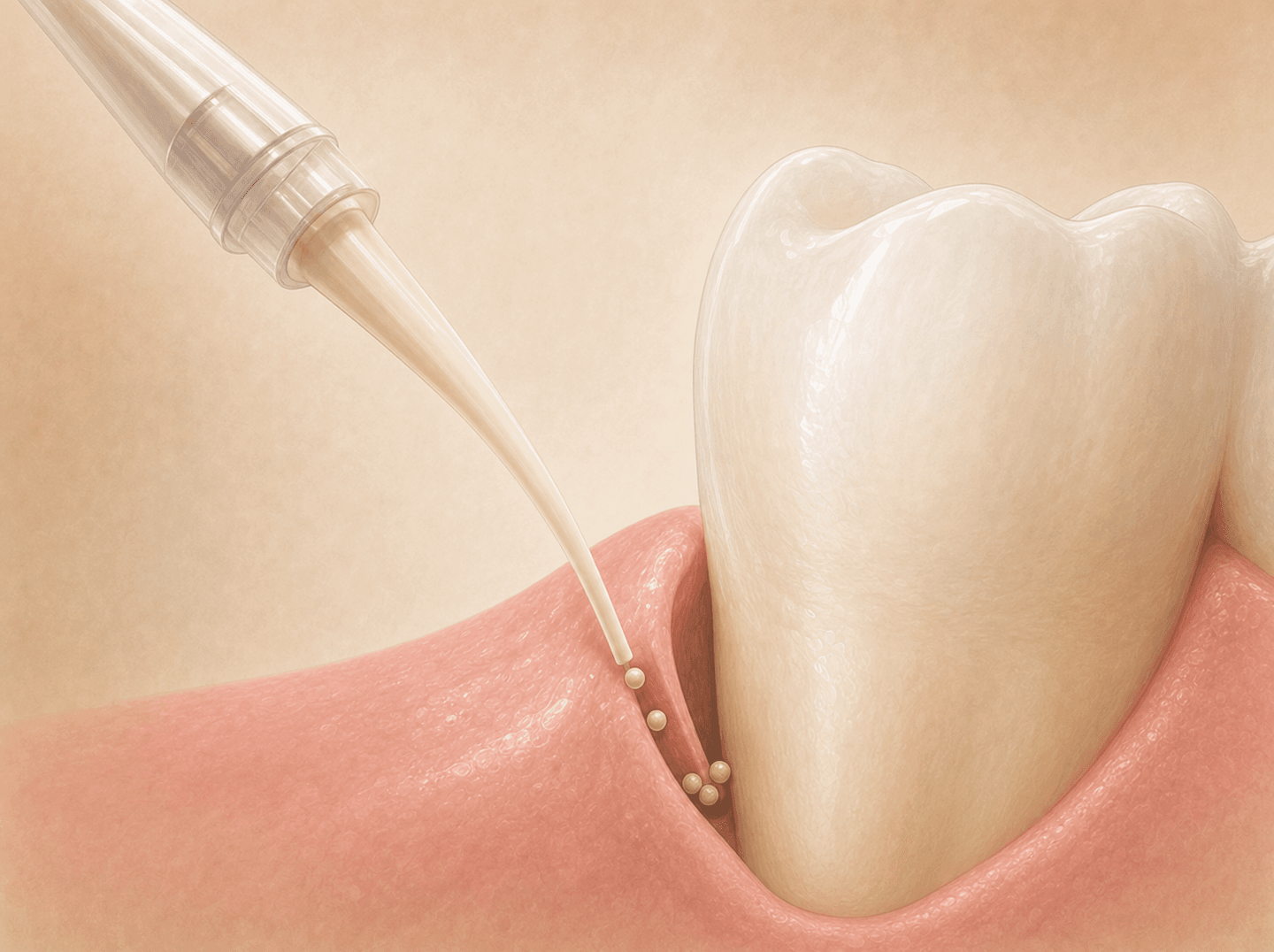
What D4381 covers
D4381 reports placing a controlled-release antimicrobial agent into a diseased periodontal pocket on a single tooth. The agent is an FDA-approved product that sits in the pocket and releases medication over time to suppress the bacteria driving the disease. In practice this is Arestin (minocycline microspheres), PerioChip (a chlorhexidine chip), or Atridox (a doxycycline gel), though the code describes the procedure, not a brand.
The code covers both the placement and the material in one line. There is no separate code for the drug, so the D4381 fee has to include the cost of the agent. A fee set as if it were placement only loses money on every unit.
Billed per tooth, never per site or quadrant
D4381 is counted per tooth. If one tooth gets antimicrobial at three separate pockets, that is still one unit of D4381, and the fee is expected to cover all the sites on it. This is the reverse of scaling and root planing (D4341 and D4342), which are reported by quadrant.
Put the tooth number on every line and never attach a quadrant. A claim showing D4381 three times for one tooth, or a quadrant where a tooth number belongs, gives a reviewer a clean reason to cut it back. The per-tooth rule is the part of this code most often gotten wrong.
Why same-day SRP is the most common denial
Carriers treat the antimicrobial as care for a pocket that stayed diseased after the tissue had a real chance to respond to scaling. If you scale and place Arestin in the same visit, you don’t yet know which pockets would have closed once the inflammation settled. Plans that cover D4381 commonly want a gap of six weeks to several months between SRP and placement, with a periodontal re-evaluation in between showing the pocket is still deep and inflamed.
That re-evaluation is often reported as D0180 (comprehensive periodontal evaluation) or a periodic perio evaluation, depending on the patient and the plan. It documents the “this pocket didn’t respond” finding the antimicrobial is meant to address.
Coverage reality: many plans don’t cover it at all
Coverage for D4381 varies more than for almost any code in the periodontal section. A number of carriers exclude localized antimicrobial delivery outright or classify it as investigational. Aetna, for example, lists it as not a covered service on most of its dental plans, with narrow exceptions for older plans that still carry the benefit.
Plans that do cover D4381 tend to require:
- An isolated residual pocket, typically 5mm or greater, that stayed diseased after scaling and root planing. Shallower pockets, or generalized placement across many sites, are where carriers most often call the treatment investigational.
- A healing interval after SRP, commonly six weeks to several months, with documentation that the pocket persisted.
- Active disease at the site: continued bleeding on probing, suppuration, or attachment loss, not just a number on a chart.
- A frequency limit. Some plans cap how often a tooth can be retreated, and clinically a site may be retreated years apart rather than at every recall.
Verify D4381 specifically when you check benefits: whether it is covered at all, the pocket-depth requirement, the timing rule, and any frequency cap. Where the patient is paying, give them the out-of-pocket number before the appointment, not on the statement.
When to bill D4381
Bill D4381 when an FDA-approved agent (Arestin, PerioChip, Atridox) is placed at a tooth with a residual or recurrent pocket, usually 5mm or deeper, that stayed inflamed after scaling and root planing and was still diseased at re-evaluation after a healing interval. It is an adjunct to the periodontal therapy the patient is already getting, not a replacement for mechanical therapy and not treatment for generalized disease or a fresh perio diagnosis. Report one unit per treated tooth.
Do not bill D4381 for:
- The scaling and root planing itself. That is D4341 (four or more teeth per quadrant) or D4342 (one to three teeth per quadrant).
- A full-mouth therapeutic scaling for generalized gingival inflammation with no bone loss. That is D4346.
- A full-mouth debridement to enable a later evaluation. That is D4355.
- Periodontal maintenance recall after active therapy. That is D4910, and an antimicrobial placed during a maintenance visit is its own D4381 line per tooth, not part of the maintenance fee.
Documentation that supports the claim
Carriers that cover D4381 want to see a residual pocket, not a routine add-on. The record, and the claim where the carrier accepts attachments, should capture:
- The tooth number for each unit billed.
- The pocket depth at the treated tooth, typically 5mm or greater, from current periodontal charting.
- The periodontal diagnosis and signs of active disease at the site: bleeding on probing, suppuration, or attachment loss.
- The prior SRP and its date, so the timeline shows the antimicrobial followed scaling rather than landing on the same day.
- A short narrative naming the tooth, pocket depth, prior SRP date, and product placed, written at the point of care rather than reconstructed after a denial.
Radiographs supporting the periodontal diagnosis help on plans that review these claims closely. A note that reads only “antibiotic placed” gives the carrier nothing to approve.
FAQs
- Is D4381 a current CDT code for 2026?
- Yes. D4381 is active in CDT 2026 and was not added, revised, or deleted in the 2026 update, so its meaning is unchanged: localized delivery of an antimicrobial agent through a controlled-release vehicle into a diseased periodontal pocket, reported per tooth. The 2026 periodontal changes touched the scaling and debridement codes, not D4381.
- What is the D4381 dental code used for?
- Placing an FDA-approved, controlled-release antimicrobial into a diseased periodontal pocket on a single tooth. The common products are Arestin (minocycline microspheres), PerioChip (chlorhexidine), and Atridox (doxycycline). It is an adjunct used at a residual or recurrent pocket, usually 5mm or greater, that didn't fully respond to scaling and root planing. The code covers the placement and the material together; there is no separate code for the drug.
- Is D4381 billed per tooth, per site, or per quadrant?
- Per tooth. A tooth with antimicrobial placed at more than one site is still one unit of D4381, and the fee covers every site on it. Unlike the scaling and root planing codes, it is never reported per quadrant. Each treated tooth is its own line with its own tooth number.
- Can I bill D4381 on the same day as scaling and root planing?
- You can place it, but most carriers that cover D4381 won't pay it on the SRP date. They want a gap, often six weeks to several months, and a re-evaluation showing the pocket stayed diseased after the tissue healed. Same-day placement is one of the most common reasons the claim denies, so confirm the plan's timing rule before treatment.
- Does insurance cover D4381?
- Often not. Many carriers exclude localized antimicrobial delivery outright or treat it as investigational; Aetna, for example, lists it as not covered on most of its dental plans. Plans that cover it usually require an isolated residual pocket of 5mm or greater with continued inflammation after SRP, plus charting and sometimes radiographs. Verify D4381 specifically before treatment and tell the patient the out-of-pocket cost if the plan doesn't pay.
- What documentation does a D4381 claim need?
- At minimum the tooth number, the periodontal diagnosis, and the pocket depth at the treated tooth, typically 5mm or greater. Recent charting and radiographs help, and many carriers want evidence that SRP was done and the pocket persisted after healing. A short narrative naming the agent, the pocket depth, and the prior SRP date is the most useful attachment; a note that only says antibiotic was placed won't carry the claim.
Related codes
Need help billing this code?
We handle D4381 claims daily.
If your team is spending time on denials, narratives, or carrier follow-up for this code, our outsourced dental insurance billing service can take it off your plate. We submit the claims, post what comes back, and follow up on anything unpaid. Already sitting on older claims that never paid? Our AR cleanup project works the backlog.
“Claims, posting, denials, all of it gets handled, and it costs far less than hiring another employee. My front desk got hours of their week back, and honestly I just don't think about billing anymore.”
CDT codes are maintained by the American Dental Association. This page is an editorial billing guide, not the official ADA code descriptor. Verify current coverage policies with each carrier before submitting claims.