D4346 is the CDT code for a full-mouth therapeutic scaling, used when generalized moderate-to-severe gum inflammation is present but there's no bone loss and no attachment loss.
It fills the gap between a routine cleaning and scaling and root planing: the gums are inflamed and bleeding across most of the mouth, but the periodontium is intact, so SRP isn't supported and a standard prophy isn't enough. The miscode goes both directions. Bill it like a prophy and you've undersold therapeutic work. Bill it like SRP and you've claimed bone loss that the chart doesn't show.
On this page
- What D4346 reports
- The clinical threshold that defines the code
- Why it’s a single full-mouth code
- The oral evaluation has to come first
- What you cannot bill alongside D4346
- Documentation that supports the claim
- Coverage reality: verify, don’t assume
- After D4346: what recare looks like
- What to get right in your PMS
- FAQs
What D4346 reports
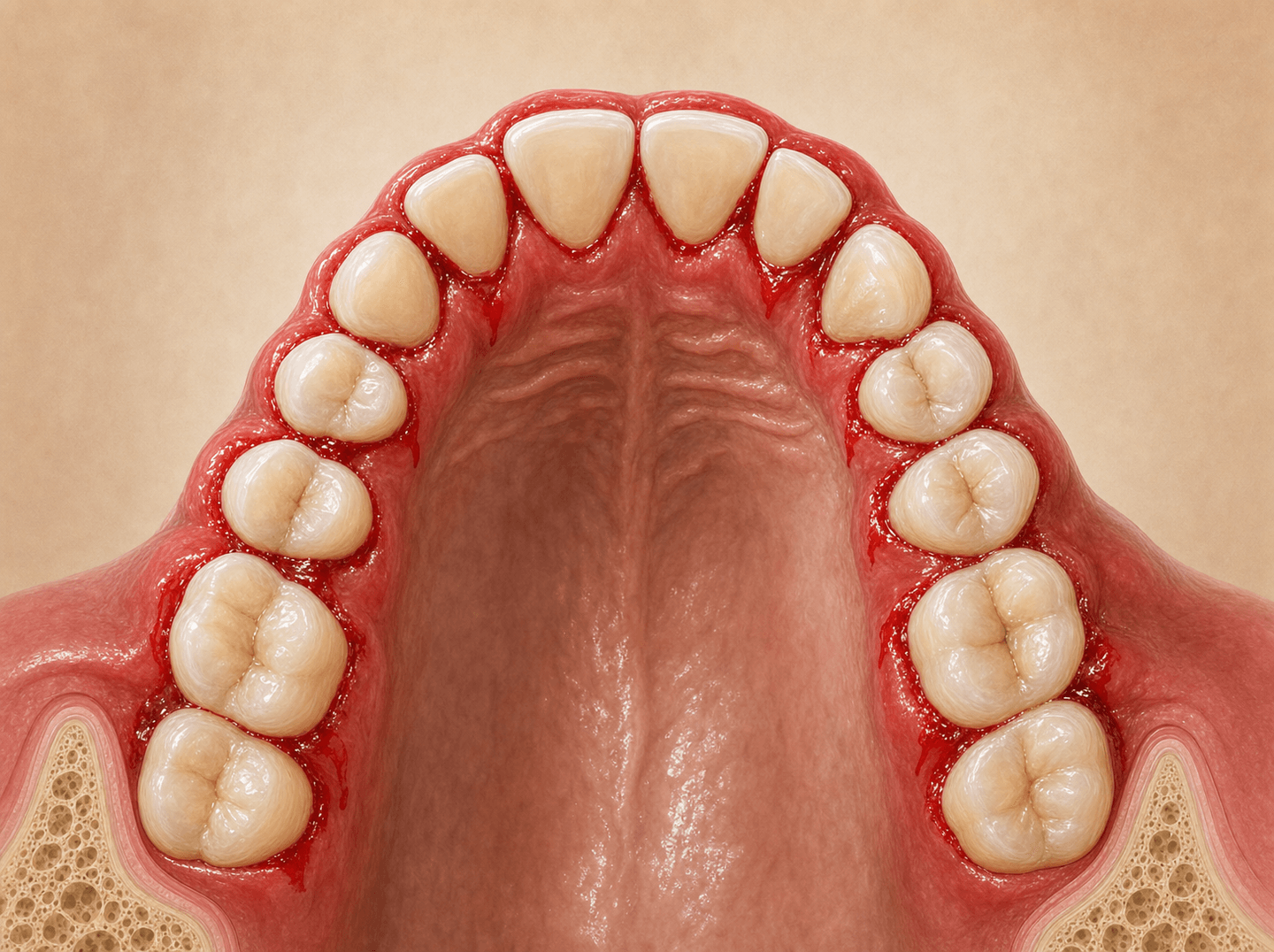
D4346 reports a full-mouth therapeutic scaling for a patient with generalized moderate to severe gingival inflammation, but whose bone and attachment are intact. The work is the removal of plaque, calculus, and stain from the tooth surfaces above and below the gumline, done to treat active inflammation rather than to maintain a healthy mouth.
Two conditions have to be true together. The inflammation is generalized (widespread across the mouth, not one or two isolated spots) and moderate to severe (swollen, bleeding tissue, not a little marginal redness). And there is no bone loss and no attachment loss, which is what keeps the case out of periodontitis and out of the SRP codes.
That combination is the whole point of the code. It exists for the patient who is too inflamed for a routine cleaning to handle but doesn’t have the bone destruction that defines periodontal disease.
The clinical threshold that defines the code
D4346 sits between two more familiar codes, and the line on each side is specific.
On the lighter side is the routine prophylaxis (D1110 for adults, D1120 for children). A prophy is preventive maintenance for a patient with healthy gums or mild, localized gingivitis. D4346 is therapeutic. The inflammation is generalized, and most educators and carriers anchor “generalized” to bleeding on probing across roughly 30% or more of the teeth. Below that threshold, with only scattered or mild inflammation, you’re back in prophy territory.
On the heavier side is scaling and root planing (D4341 and D4342). SRP treats periodontitis: bone loss visible on radiographs and clinical attachment loss, with deliberate instrumentation of the exposed root surfaces. D4346 is the no-bone-loss code. The pockets are inflammatory, not the result of attachment destruction, and the bone support is intact.
Why it’s a single full-mouth code
D4346 is reported once for the entire mouth. It is not billed per quadrant, and it is not billed per tooth.
This is the opposite of the SRP codes, which are quadrant-based: D4341 for a quadrant with four or more affected teeth, D4342 for a quadrant with one to three. With SRP you can report up to four quadrants. With D4346 there is one line item for the whole-mouth treatment, regardless of how many teeth were scaled.
A claim that reports D4346 four times, or D4346 with a quadrant designation, signals a misunderstanding of the code and will draw scrutiny. One patient, one episode of generalized gingival scaling, one D4346.
The oral evaluation has to come first
The CDT descriptor builds the exam into the code itself, and that sequencing is not decorative. D4346 is reported after a dentist has examined the patient, assessed the periodontium, and determined that the generalized inflammation warrants therapeutic scaling rather than a prophy.
In practice that means an evaluation (D0120 periodic or D0150 comprehensive) with periodontal charting and current radiographs supports the D4346 claim. The evaluation establishes two facts the code depends on: that the inflammation is generalized and moderate-to-severe, and that there is no bone loss. Reporting D4346 with no documented evaluation behind it leaves the central clinical judgment unrecorded.
The evaluation and D4346 are separate procedures and can be reported for the same date when both were performed. That is different from reporting D4346 alongside a prophy, which is duplicative (see below).
What you cannot bill alongside D4346
A few combinations are duplicative or contradictory, and carriers catch them.
- A prophylaxis on the same day. D4346 already scales the full mouth above and below the gumline. Reporting D1110 or D1120 on the same date for the same patient covers the same surfaces twice. It denies and can read as unbundling. The routine prophy is a later recare visit.
- SRP on the same teeth. D4346 and D4341/D4342 describe mutually exclusive conditions: no bone loss versus bone loss. The same dentition can’t be both in the same episode. A claim carrying D4346 and SRP together on the same arch invites a denial and a records request.
- Periodontal maintenance afterward. D4910 is for patients who completed active periodontal therapy after attachment loss. D4346 patients had no attachment loss, so the follow-up is a prophy, not perio maintenance.
Documentation that supports the claim
D4346 is a documentation-driven code. Carriers that cover it want to see the generalized inflammation and the absence of bone loss spelled out, because those are the two facts that distinguish it from a prophy on one side and SRP on the other.
The chart and, where the carrier accepts attachments, the claim should capture:
- Periodontal charting. Probing depths and the distribution of inflammation across the mouth. This is what shows the condition is generalized rather than localized.
- Bleeding on probing. A measure of how widespread the bleeding is. Many carriers anchor coverage to roughly 30% or more of the teeth, so a recorded BOP percentage is the single most useful data point.
- No bone loss / no attachment loss. Current radiographs and a note confirming intact bone support. This is what rules out periodontitis and keeps the case in D4346 rather than SRP.
- The oral evaluation. That a dentist examined the patient and determined therapeutic scaling was indicated.
- A short narrative. One or two sentences tying it together: generalized moderate-to-severe gingival inflammation, BOP percentage, no radiographic bone loss, full-mouth therapeutic scaling performed.
A generic “patient’s gums are inflamed, scaling done” note does not carry this code. The specificity is what separates a paid D4346 from one that’s downgraded to a prophy.
Coverage reality: verify, don’t assume
Coverage for D4346 varies more than for a routine prophy, and it splits into a few patterns.
Some plans cover it as a benefit with documentation, paying when the perio charting and BOP findings are attached. Some don’t recognize the code at all, or fold it into the prophy benefit, in which case the patient may owe the difference or the full fee depending on plan language and network status. Frequency rules differ too: a plan might allow it once in a benefit period, or count it against the same frequency bucket as a prophy.
Because of that spread, run a benefit check before treatment and ask specifically about D4346 coverage, documentation requirements, and frequency, rather than assuming it behaves like a cleaning. Where the plan doesn’t cover it and the situation allows patient billing, get the out-of-pocket number in front of the patient before the appointment, not on the statement afterward.
After D4346: what recare looks like
Because a D4346 patient had no attachment loss, the follow-up is not periodontal maintenance. Once the active inflammation resolves, the patient typically returns to a routine prophylaxis (D1110 or D1120), often on a tightened recall interval at first (three or four months) while the tissue stabilizes, then back to a standard schedule.
This is the practical line between D4346 and D4910. Perio maintenance is the recare path after SRP for a patient who lost attachment. The prophy is the recare path after D4346 for a patient who didn’t. Putting a D4346 patient on a D4910 recall claims a periodontal-maintenance history the chart doesn’t show, and a carrier reviewing the sequence will see the mismatch.
What to get right in your PMS
The exact menus differ across Open Dental, Dentrix, Eaglesoft, Curve, and Carestream, but the setup that prevents problems is the same:
- Keep D4346 distinct from the prophy and SRP codes. Don’t let it collapse into one fuzzy “cleaning” entry. D4346 (full-mouth gingival scaling), D1110/D1120 (prophy), and D4341/D4342 (SRP) are separate line items that map to different clinical conditions. A clearly labeled code table is what keeps the front desk from defaulting to a prophy.
- Tie the perio charting to the claim. D4346 lives or dies on documentation. If your PMS separates clinical notes from claim attachments, make sure the periodontal charting, BOP findings, and the no-bone-loss note travel with the D4346 line.
- Block the same-day prophy. Set the expectation that D4346 and a prophy don’t go out together. The full-mouth scaling is the procedure for that visit.
- Verify coverage and the documentation threshold before treatment. Note the plan’s D4346 coverage, its BOP standard, and its frequency rule on the carrier record so the team quotes the patient accurately and submits to the carrier’s actual requirement.
- Set the recare path to prophy, not perio maintenance. Schedule the follow-up as a prophylaxis on a tightened interval, not a D4910 maintenance visit.
FAQs
- What is the D4346 dental code?
- D4346 is a full-mouth therapeutic scaling for a patient with generalized moderate to severe gingival inflammation when there is no bone loss and no attachment loss. It removes plaque, calculus, and stain above and below the gumline to treat active inflammation that a routine prophylaxis can't resolve. The defining condition is gingivitis that's generalized and significant, without the bone loss that would make it periodontitis. It's reported once for the whole mouth, not per quadrant, and it follows an oral evaluation that documents the inflammation.
- What's the difference between D4346 and a regular cleaning (D1110)?
- D1110 is a preventive prophylaxis for a patient with healthy gums or mild, localized gingivitis. D4346 is a therapeutic procedure for generalized moderate to severe gingival inflammation, where bleeding on probing typically appears on roughly 30% or more of the teeth. The two are not interchangeable. The chart has to show the generalized inflammation that takes the visit out of routine-prophy territory. If the documentation reads like a healthy-mouth cleaning, the carrier reclassifies it as D1110 and pays accordingly.
- What's the difference between D4346 and SRP (D4341/D4342)?
- The axis is bone loss and attachment loss. D4341 and D4342 (scaling and root planing) require periodontitis: documented bone loss on radiographs and clinical attachment loss, with treatment of the exposed root surfaces. D4346 is for inflammation with the periodontium still intact, no bone loss, no attachment loss. If the radiographs and charting show bone loss, this is SRP territory, not D4346. If they show inflamed tissue over healthy bone, it's D4346. Coding D4346 as SRP, or SRP as D4346, is the most common error on this code.
- Can D4346 and a prophylaxis be billed on the same day?
- No. D4346 is a full-mouth scaling that covers the same tooth surfaces a prophylaxis would. Reporting both D4346 and D1110 on the same date for the same patient is duplicative and will deny, and it can read as unbundling. D4346 is the procedure for that visit. The routine prophy is a separate, later recare appointment once the inflammation is under control.
- Does insurance cover D4346 and how often?
- It depends entirely on the plan. Some carriers cover D4346 with documentation. Some don't recognize it at all and the patient pays. Carriers that cover it generally want evidence of the generalized inflammation: periodontal charting, a bleeding-on-probing measure (many want roughly 30% or more), and radiographs or notes confirming no bone loss. Frequency limits vary by plan, and some apply it against the same benefit as a prophy. Verify the specific plan's coverage, documentation, and frequency rules before treatment rather than assuming.
- What does the patient get after D4346, a prophy or perio maintenance?
- Usually a prophylaxis (D1110), not periodontal maintenance (D4910). D4910 follows active periodontal therapy on a patient who had attachment loss. D4346 patients, by definition, had no attachment loss, so once the inflammation resolves they typically return to routine prophy recare, often on a shortened interval at first. Reporting D4910 after D4346 claims a periodontal-maintenance status the chart doesn't support.
Related codes
Need help billing this code?
We handle D4346 claims daily.
If your team is spending time on denials, narratives, or carrier follow-up for this code, our outsourced dental insurance billing service can take it off your plate. We work inside your PMS and post payments the same week.
CDT codes are maintained by the American Dental Association. This page is an editorial billing guide, not the official ADA code descriptor. Verify current coverage policies with each carrier before submitting claims.