D6104 is the CDT code for a bone graft placed at the same surgical visit as the implant, reported per implant — the graft that fills bony defects or augments the site while the fixture goes in, not one done at a separate surgery.
Most billing problems on D6104 trace back to confusing it with the extraction-site and ridge-augmentation graft codes (D7953 and D7950), or to missing the fact that the membrane and biologic materials bill separately.
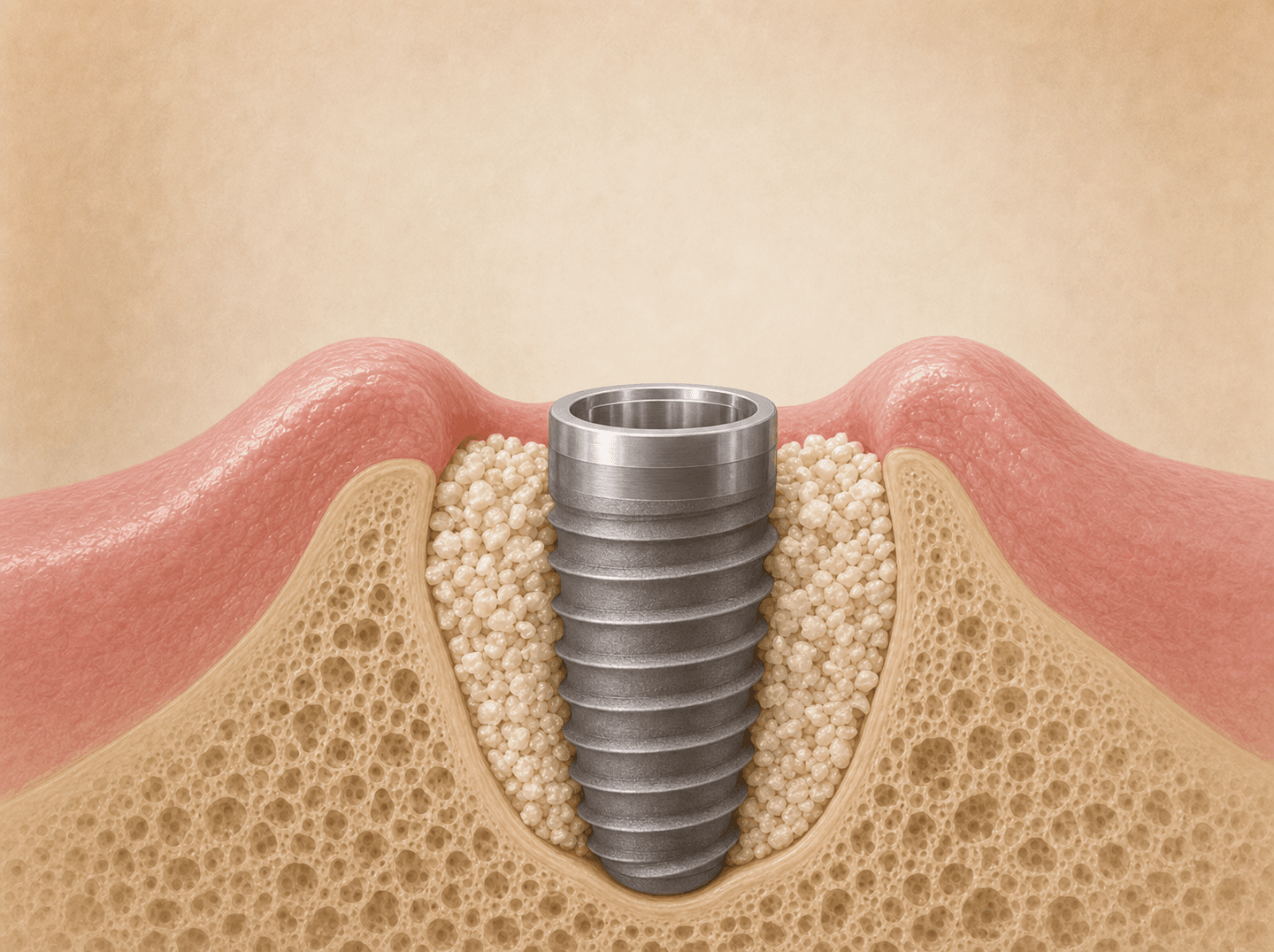
What D6104 covers
D6104 reports a bone graft placed at the same surgical visit as the implant, billed per implant. The graft fills a bony defect around the fixture, augments a thin site, or fills the gap between the implant and the socket wall while the implant is placed. The defining feature is the timing: the graft and the implant happen at the same surgery.
It does not cover:
- A graft placed in a fresh extraction or implant-removal socket to preserve the ridge for a later implant. Use D7953.
- Ridge augmentation done as its own staged procedure when no implant is placed that day. Use D7950.
- The surgical placement of the implant body. Use D6010, billed separately on the same date.
- The barrier membrane used to contain the graft. It bills separately under its own code.
- Biologic materials used to aid osseous regeneration. They bill separately.
- A sinus augmentation, which has its own codes.
The graft material itself is what D6104 reports. Everything layered onto it (membrane, biologics) and the implant placement are separate codes.
When to bill D6104
Bill D6104 when:
- An implant is placed and a bone graft is placed at the same surgical visit.
- The graft addresses a bony defect at the implant site (dehiscence, fenestration, gap between the implant and the socket wall, or augmentation of a thin ridge during placement).
- The graft is documented per implant.
Do not bill D6104 for:
- A graft at extraction with the implant deferred to a later date. Use D7953.
- Ridge augmentation done as a standalone surgery before any implant. Use D7950.
- The implant placement itself. Use D6010.
- The membrane or biologic materials. Use their own codes.
What separates D6104 from D7953 and D7950
These three graft codes are the ones most often confused, because all three place bone in the jaw. Timing and site separate them, not the graft material.
D6104 (bone graft at implant placement):
- The graft and the implant happen at the same surgical visit.
- The graft addresses a defect around the implant being placed.
- Billed per implant, alongside D6010.
D7953 (ridge preservation graft at extraction):
- The graft goes into a fresh extraction or implant-removal socket.
- No implant is placed that day. The site heals, and the implant goes in later.
- The purpose is to preserve ridge height and width for the deferred implant.
D7950 (ridge augmentation, staged):
- A standalone augmentation of an edentulous ridge that needs width or height.
- Not at an extraction socket and not at the same visit as an implant.
- Rebuilds a deficient ridge as its own procedure before later restoration.
The decision tree is simple. Same visit as the implant? D6104. Fresh extraction socket with the implant deferred? D7953. Standalone ridge build with no extraction and no same-day implant? D7950. Getting the timing-and-site axis right is what keeps the claim consistent with the surgical record.
What bills alongside D6104
A grafted implant placement is rarely a single code. The pieces that bill on their own:
- D6010 for the implant body placement, same date.
- The barrier membrane under its own code. Many grafted sites use one.
- Biologic materials (growth factors, biologics) under their own codes when used.
D6104 is the graft. Reporting only D6104 on a case that also placed an implant and a membrane underreports the surgery. Each component is billed and adjudicated on its own, and plans can cover one while excluding another.
Top reasons D6104 gets denied or downgraded
Five issues account for most problems on this code:
- Plan exclusion on implant services. Many plans exclude implant-related procedures, and the exclusion reaches the graft. The claim denies as non-covered. The patient owes the fee. Verify before surgery.
- Wrong graft code for the timing. D6104 billed when the graft was actually at extraction with the implant deferred (should be D7953), or for a standalone ridge build (should be D7950). The carrier pays the code the surgical record supports.
- Missing defect documentation. No radiograph, no operative narrative describing the bony defect. The carrier can’t judge the medical necessity of the graft and denies for insufficient information.
- Membrane or biologic bundled into D6104. The components were lumped into the graft code instead of billed separately, so the surgery is underreported, or the membrane was billed as part of D6104 and denied as not separately payable on that plan.
- Per-implant billing not supported. D6104 reported more than once without documentation tying each graft to a separate implant. The carrier requests the per-implant breakdown.
Documentation that supports the claim
The claim needs:
- Date of service (the surgical date, same as the implant placement).
- Tooth number or implant site for each graft.
- A narrative describing the bony defect and the graft.
- A pre-op or intra-op radiograph showing the defect, when available.
For the patient record, document:
- The bony defect addressed (dehiscence, fenestration, gap, thin ridge) at each implant.
- The graft material used (autograft, allograft, xenograft, alloplast).
- The volume or extent of the graft per implant.
- Whether a membrane was placed, and its type.
- Whether biologic materials were used.
- That the graft was placed at the same visit as the implant.
The narrative that names the defect does the most work: “Buccal dehiscence exposing three threads on the #30 implant, grafted with particulate allograft and covered with a resorbable membrane.” That sentence ties the graft to a real defect at a specific implant and supports both the D6104 and the separate membrane code.
Example case
A 56-year-old patient is having an implant placed on tooth #19 (lower left first molar). During placement, the surgeon finds a buccal dehiscence exposing several threads of the fixture. Particulate allograft is packed against the exposed threads and a resorbable membrane is placed over it.
Treatment sequence:
- Implant body placed at #19.
- Buccal dehiscence identified at placement.
- Particulate allograft placed against the defect at the same visit.
- Resorbable membrane placed over the graft.
Billing steps:
- Verify benefits and confirm coverage for implant placement, the graft, and the membrane separately. Each can be covered or excluded independently.
- Submit D6010 for the implant placement on the surgical date.
- Submit D6104 for the graft on the same date, with a narrative naming the buccal dehiscence at #19.
- Submit the membrane under its own code, separately.
- Attach the radiograph or intra-op documentation of the defect if the carrier requires it.
If the plan covers implant services, D6104 pays per the plan’s graft allowable. If the plan excludes implant-related procedures, the graft denies with the rest of the implant case and the patient owes the fee, which the pre-treatment estimate should have flagged.
Implant graft billing checks
The specifics vary across Open Dental, Dentrix, Eaglesoft, Curve, and Carestream. The steps that matter:
- Confirm the timing-and-site axis before coding. Same visit as the implant is D6104. Extraction socket with the implant deferred is D7953. Standalone ridge build is D7950.
- Bill the membrane and biologics separately. They are not part of D6104. Lumping them in underreports the surgery.
- Report D6104 per implant. Document each graft against a specific implant when more than one is grafted.
- Verify implant-service coverage before surgery. A plan-wide implant exclusion is the most common reason the graft denies.
- Keep the defect narrative in the operative note. It supports the medical necessity of the graft and ties it to the implant.
If your office sees recurring D6104 denials, the cause is usually a plan-side implant exclusion or a coding mismatch with the graft timing. Confirming the plan’s implant rules and the correct graft code before the surgical date prevents most of them.
FAQs
- What's the difference between D6104, D7953, and D7950?
- Timing and site separate them. D6104 is a bone graft placed at the same visit as the implant. D7953 is a graft placed in a fresh extraction or implant-removal socket to preserve the ridge for a later implant. D7950 is ridge augmentation done as its own staged procedure when no implant is going in that day. If the graft and the implant happen at the same surgery, it's D6104. If the graft is at extraction with the implant deferred, it's D7953.
- Does D6104 include the membrane and biologic materials?
- No. D6104 covers the bone graft itself. A barrier membrane and any biologic materials used to aid regeneration are reported separately under their own codes. Bundling them into D6104 underreports the procedure. Check the plan, because some carriers cover the graft but not the membrane, or apply frequency and site limits to each independently.
- Is the implant placement billed separately from D6104?
- Yes. D6104 is the graft only. The surgical placement of the implant body is reported separately under D6010. The two codes bill on the same date of service for the same site but represent distinct procedures. Carriers expect both on a case where bone was grafted at the time of placement.
- Is D6104 billed per implant or per site?
- Per implant. When two implants are placed and each requires a graft, D6104 is reported for each. Document the bony defect and the graft at each implant separately so the per-implant billing is supported. A single graft spanning a site with one implant is one D6104.
- Why was D6104 denied as not covered?
- Coverage is plan-dependent. Some plans cover bone grafts tied to implants, some exclude all implant-related procedures including the graft, and some cover the graft only with documentation of the bony defect (radiograph, narrative, sometimes a photo). A denial often reflects a plan exclusion on implant services rather than a problem with the claim. Verify implant and graft coverage before surgery.
Related codes
Need help billing this code?
We handle D6104 claims daily.
If your team is spending time on denials, narratives, or carrier follow-up for this code, our outsourced dental insurance billing service can take it off your plate. We work inside your PMS and post payments the same week.
CDT codes are maintained by the American Dental Association. This page is an editorial billing guide, not the official ADA code descriptor. Verify current coverage policies with each carrier before submitting claims.